
An agate grinding bowl for a planetary mill is a replaceable working chamber in which the sample and grinding media are placed before grinding. It does not grind the material on its own: the movement is set by a planetary mill, and the glass holds the load, transfers energy to it and protects the working area from losses and external contamination. Such a glass is chosen when not only size and productivity are important, but also moderate introduction of metal impurities, predictable cleaning and careful handling of the sample.
What is an agate grinding bowl and where does it work?
In a planetary mill, the glasses are mounted on a carrier and rotate in two movements at once: around their own axis and around a common axis. The resulting centrifugal forces cause the grinding bodies to repeatedly collide with the walls and roll over them. The sample material ends up between the balls and the inner surface of the glass, so this surface is in contact with the sample the longest.
The grinding bowl is not just a container. Its geometry, mass, cap rigidity and seal condition affect the movement pattern of the balls, material loss and repeatability of the result. The same mill mode can give a different picture if the volume, material or quality of the lid fit changes in the headset.
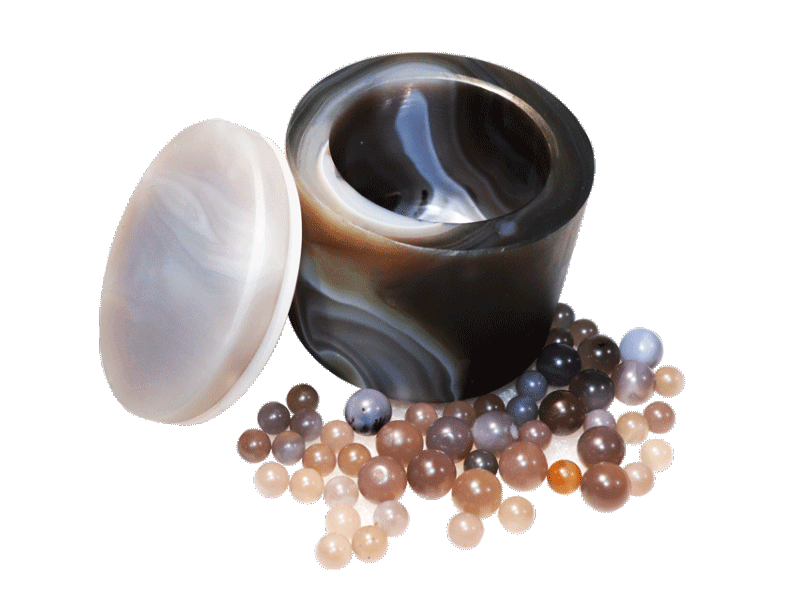
Grinding set functions
The glass has several practical purposes. It forms a closed volume for the sample and balls, absorbs shock and abrasion loads, limits the dusting of dry material and must allow disassembly and cleaning. In wet grinding, this is added to the requirement for tightness: liquid should not enter the fastening area or be lost through leaks.
The cover and seal are the same part of the headset as the body. If the lid does not fit tightly, some of the powder remains in the gaps, and with a wet process, drips and changes in concentration are possible. Therefore, when choosing, they look not only at the material of the glass, but also at the completeness, condition of the seal and ease of fixation.
How does a glass differ from other grinding equipment?
The planetary beaker should not be confused with the roller mill drum, bead mill or roller crusher. The drum usually operates in a different type of drive and has different fit requirements; the bead mill uses fine grinding media and is often designed for suspensions; The crusher destroys material mainly due to compression and shear in the area of the working parts. The general word "grinding" does not make these units interchangeable.
The agate glass refers specifically to the planetary set. It cannot be considered as a stand-alone device or as a universal attachment to any grinding equipment. Compatibility is determined by the mill design, mounting dimensions and documentation for a specific design.
Material and design: what agate gives
In laboratory practice, agate is considered a non-metallic material based on silicon dioxide. For a grinding set, this means a different profile of interaction with the sample than for steel: when worn, not typical metal particles, but the material of the glass itself, can get into the sample. This is important for tasks where elemental composition is controlled, but does not replace contamination control.
Agate is valued for its combination of a relatively smooth working surface, chemical resistance in moderate conditions and the ability to be finely cleaned. However, it is not a “completely inert” material. Chemical resistance depends on the environment, temperature and contact time, and mechanical strength depends on the quality of the product and operating conditions. Highly aggressive environments, gas-emitting mixtures, and unusual temperatures require separate evaluation rather than transferring the general properties of agate to any application.
Why is the material of the glass important?
When grinding, the surface of the headset wears out. The harder and more abrasive the sample, the larger the starting particles, and the longer the process, the more noticeable the contribution of the beaker material to the sample may be. Agate is suitable for many brittle and moderately hard materials, but is not a universal solution for large, particularly hard or highly abrasive specimens. In such cases, it is important to evaluate not only the final size, but also the service life of the headset, as well as the admissibility of silicon impurities.
You shouldn’t choose a glass just based on the word “agate” in the name. Natural material may have inclusions and discontinuities; For laboratory work, stability of geometry, absence of cracks and quality of surface treatment are important. Decorative agate and material not intended for grinding equipment are not equivalent.
Body, cover and seal
The specific equipment depends on the version. The product description should clarify whether the cap, O-ring and fasteners are included, what form of seal is used, and whether the design allows for wet grinding. These details are not always visible in the overall picture, but they are the ones that determine the convenience of work and the risk of losses.
The surface of the glass should not have chips or deep scratches. Even a small defect in the edge can become a point of accumulation of powder and the beginning of further destruction. If cracks or chips appear on the headset, it cannot be considered suitable just because it still holds its shape.
Characteristics and their correct reading
The product card must separate the nominal volume, actual workload, internal and external dimensions. These are different quantities. The nominal volume of the glass is not equal to the mass of the sample that can be loaded: part of the space is occupied by grinding bodies, and for their movement there must be free movement.
| Parameter | What to clarify | Why is this important |
|---|---|---|
| Nominal volume | Full glass volume or recommended load | The volume of the chamber cannot be equated with the mass of the sample. |
| Internal dimensions | Diameter and height of the working cavity | Determine the useful volume and movement of the balls |
| External dimensions | Planting elements, height with cover | Installation in the mill depends on them |
| Headset weight | Weight of the glass assembly | Affects drive balancing and load |
| Equipment | Cover, seal, fasteners | Without the necessary parts, work is impossible |
| terms of Use | Acceptable mode and cleaning | Prevents overheating, wear and sample loss |
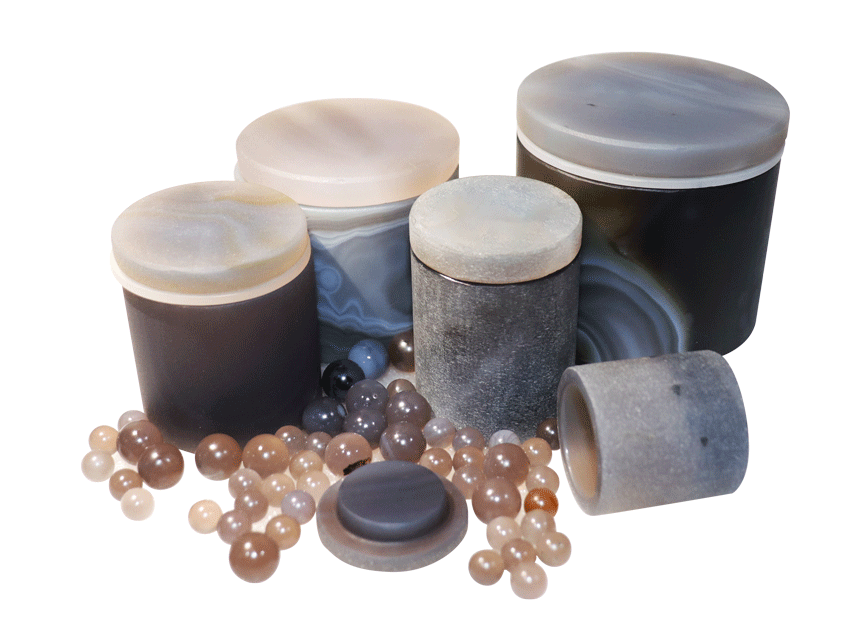
Volume, loading and free movement
When preparing the grind, it is important not to fill the glass to the brim. The grinding bodies must move, collide and roll, and the lid must close without squeezing out the material. If the load is too large, grinding efficiency decreases, heat increases and the risk of ball jamming increases. If too low, the impact energy is not distributed effectively and the layer of material may not be sufficient to make stable contact.
The specific loading is determined according to the manual for the mill and taking into account the properties of the sample. There is no one fraction of the beaker volume that is suitable for any sample, any ball material and any mode. Coarse and heavy material requires a different approach than soft powder, which is prone to agglomeration.
Weight and Balancing
The planetary mill is sensitive to imbalance. If two or more glasses are used, their mass and geometry must be consistent. You cannot place headsets of different weights or with different loads in opposite positions if the instructions do not allow this. Even a working glass with asymmetrical loading creates increased vibration and accelerates wear of mill components.
The mass of the balls also matters. Agate grinding media may be appropriate for an agate beaker, but the specific size, quantity and ratio to sample should be determined for the given model and application. You cannot transfer the parameters of one headset to the entire line.
Wear, soiling and cleaning
The wear of the agate glass develops gradually. First, the surface loses its original uniformity, then matte areas, ring marks and small scratches appear. Under shock loads, the edges may chip, and the seal may lose elasticity and tightness. Accelerated wear is usually caused by too coarse feedstock, highly abrasive material, prolonged grinding, overloading with balls and improper cleaning.
Agate does not provide "zero pollution". Particles of the glass material, remnants of the previous sample, substances from the seal, and dust from the environment may enter the sample. For trace analysis, it is not promises that are important, but the control procedure: blank testing, cleaning, surface testing and understanding which element is considered critical. If silicon is being analyzed, the agate set requires special attention because the material itself contains silicon dioxide.
Proper cleaning and its limitations
After work, the beaker is emptied of balls and sample, then the residue is removed with a soft brush or suitable laboratory instrument. For washing, mild detergents and rinsing are usually used, but the specific composition must be compatible with the agate and seal. Abrasive powders and harsh metal scrapers can damage the polished surface and increase the area for contaminants to accumulate.
Sudden temperature changes and shock impacts during cleaning are undesirable. You should not dry the headset in a way that is not provided for in the documentation, or use aggressive chemicals without checking the durability. For particularly clean tasks, normal visual cleaning may not be sufficient; then a validated washing protocol and background control are needed.
Dry and wet grinding
Dry grinding is convenient for powders, but is accompanied by dust, heating and sticking of the material to the walls. Wet grinding can improve particle distribution and reduce dust, but requires a sealed assembly and subsequent liquid separation. The possibility of a wet process is determined by the design of the glass and lid, and not just by the word “agate” in the name.
The final particle size depends on the initial particle size, material, grinding media, time, speed and measurement method. The typical minimum stated for a mill or attachment does not guarantee the same result for any sample. In addition, reduction in particle size and deagglomeration are not the same thing: in the first case, primary particles are destroyed, in the second, their aggregates are broken up.
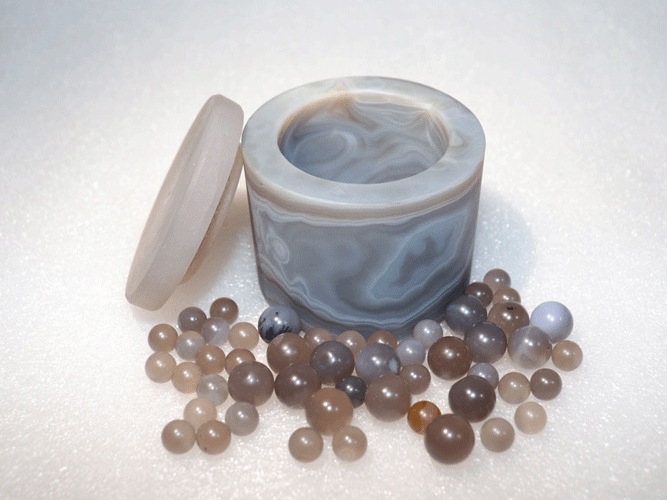
What to check before each download
- No cracks, chips or deep scratches on the working surface.
- Condition of the cover, seal and fasteners.
- Cleanliness of the glass and grinding media after the previous test.
- Compliance of weight and load with balancing requirements.
- Compatibility of the sample material with the agate and the selected mode.
Compatibility with planetary mill and choice according to the task
Compatibility is not determined by mill type alone. It is necessary to check the mounting dimensions, the height of the glass with lid, the method of fixation, the permissible weight, the range of modes and the balancing requirements. If the glass does not fit into the holder or the lid rests on the mill element, operation is impossible even if the series name matches. If the dimensions are the same, but the weight is outside the permissible limits, the load on the drive increases and the risk of vibration increases.
IN agate grinding glass card TENCAN You should specify exactly those parameters that are needed for a particular mill, and not choose based on appearance. General directions of equipment TENCAN и полное название компании — Changsha Tianchuang Powder Technology Co., Ltd. — приведены на manufacturer's website. There you can also check which groups the headset belongs to, but final compatibility is confirmed by the documentation for a specific product.
Selection criteria
First, the task is formulated: is fine grinding, mixing, disagglomeration, or preparation for subsequent analysis necessary? Then the sample is assessed: initial size, hardness, abrasiveness, tendency to stick, sensitivity to heat and chemical environment. After this, the headset material is selected. Agate is appropriate where non-metallic contact and controlled addition of impurities are important, but it is not a replacement for wear assessment and is not suitable for all loads.
For wet grinding, check the tightness and compatibility of the seal with the liquid. For dry – easy cleaning and no dust loss. For oxygen- or moisture-sensitive samples, a regular beaker does not automatically become a sealed, atmosphere-controlled chamber. Each such condition requires separate confirmation.
The manual tablet press from another section of the catalog refers to sample molding rather than grinding. The presence of a glass and a press in the range of one manufacturer does not in itself mean that they form a single technological chain. These are different operations, and their compatibility does not follow from the catalog.
Questions and answers
Can I use an agate beaker for a very hard sample?
The decision depends on the hardness, coarseness and abrasiveness of the material, as well as the permissible wear of the headset. Agate is not a universal material for any load; For particularly hard or large samples, an alternative fitting should be evaluated and the manufacturer should be consulted.
How is an agate glass different from a grinding drum?
The glass is designed for a planetary mill and is installed in its holder. The drum belongs to a different type of equipment, for example, a roller mill, and has different seating dimensions and the principle of loading movement. There is no interchangeability based on the name “grinding container”.
Does agate guarantee freedom from contamination?
No. Bowl material, grinding media, compaction and previous sample residues can all contribute to contamination. Agate reduces the risk of some metallic impurities, but requires silicon control and proper cleaning procedures.
Is it possible to wash a glass with aggressive reagents?
This depends on the specific reagent, temperature, contact time and seal material. There is no universal recommendation; chemical resistance and cleaning method should be confirmed by documentation, and not tested on a working headset without a risk assessment.
How to check compatibility with the mill?
Compare the mounting dimensions, height, weight, fixation method and permissible modes. If at least one parameter is not confirmed, the glass cannot be considered compatible. Reliable source - instructions for the mill and a card for a specific product TENCAN.