
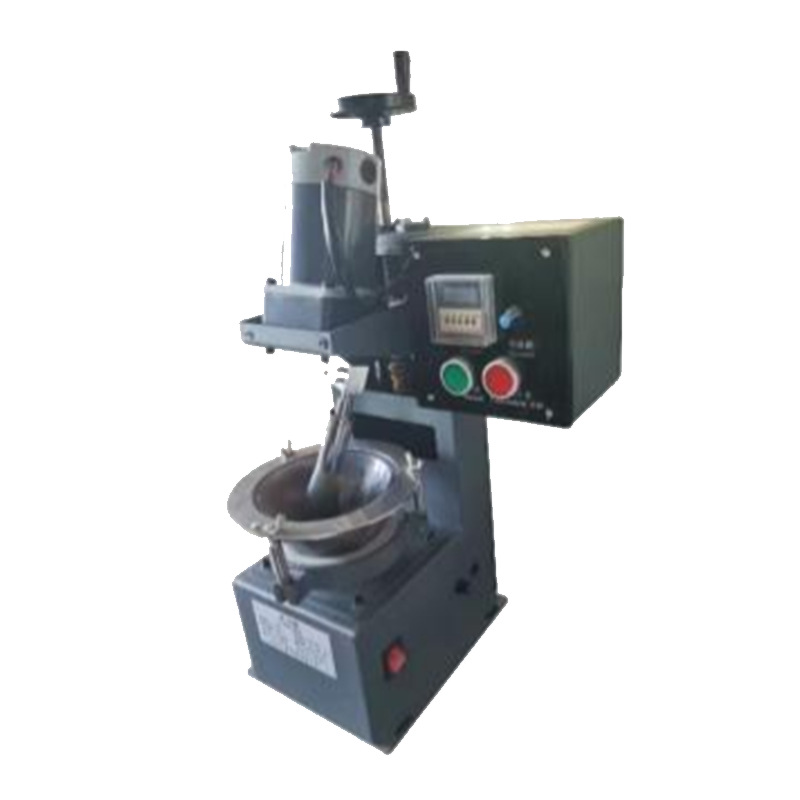
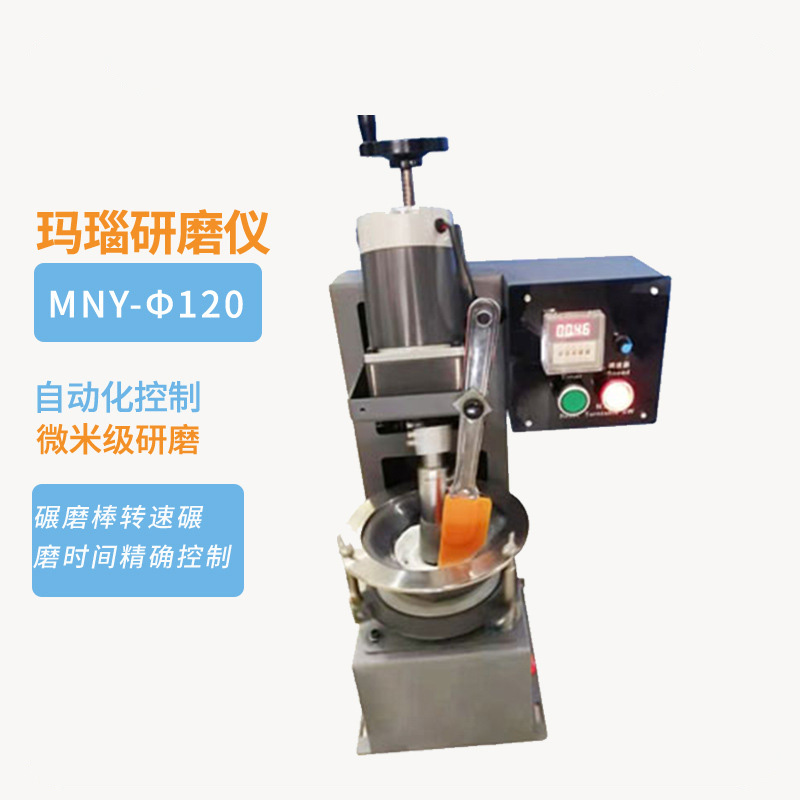
Laboratory agate mill TENCAN — This is equipment for fine grinding, homogenization and small sample preparation, in which the material is in contact primarily with agate working surfaces. In the sample preparation chain, it occupies a place between preliminary crushing, sample reduction and analysis: the goal is to obtain a representative powder with a more uniform particle distribution and limit the transfer of metal impurities. This is not a general-purpose coarse crusher or a high-capacity production mill; actual capabilities are determined by specific design, documentation and operating conditions.
The role of the agate mill in sample preparation
In laboratory practice, an agate mill is most often considered as a tool for final sample preparation before chemical, mineralogical or physical analysis. At this stage, it is important not only to reduce the coarseness, but also to maintain representativeness: too much heating, uneven grinding or contamination by wear products can distort the result more than the original heterogeneity of the material. Therefore, choosing a mill does not start with the rotation speed, but with the question of what exactly will be measured in the powder.
Sampling and sample reduction affect the result as much as the mill itself. If material is introduced into the laboratory chamber that does not reflect the composition of the entire batch, subsequent fine grinding will only evenly distribute this error. For this reason, sample preparation is considered as a sequence of operations where each stage must maintain representativeness. The mill does not correct selection deficiencies and does not compensate for the loss of fine or large fractions at previous stages.
The agate mill does not replace the stage of crushing large pieces. If the starting material is in massive fragments, a coarser size reduction is usually required first, followed by fine grinding in a laboratory chamber. Mixing is also not the main function of the mill: it can occur along the way, but does not guarantee the homogeneity of the mixture of different components. Separate equipment is used for mixing powders, and one should not be replaced with another without checking.
Agate is valued in laboratory practice for its combination of sufficient hardness and a relatively low contribution of metallic impurities. It is a silica-based mineral material; it is fragile and sensitive to shock loads, large inclusions and abrasive wear. Practical limitations follow from this: the agate mill is not suitable for all materials, but primarily for tasks where accuracy is important and the risk of introducing silicon-containing particles is acceptable. No working chamber material is completely free of contamination.
Design and principle of operation
The principle of grinding in a laboratory mill is based on the relative movement of working surfaces and material. Depending on the execution, this may be abrasion, crushing, impact, or a combination of these; in the agate version, contact with the sample is ensured by parts made of agate. Under the influence of load, cracks appear in the particles, the material is crushed and gradually turns into powder. At the same time, not only a decrease in size occurs, but also partial disagglomeration—the destruction of loose aggregates, although the mill may not have a special deagglomeration function.
Grinding is a statistical process. Even under the same conditions, different particles are destroyed differently: large and defective grains are crushed faster, while strong small particles can remain longer. Therefore, the result is assessed by the particle size distribution, and not by one random grain. For reproducibility, not only the mill parameters are important, but also the sample weight, loading method, processing time and the condition of the working surfaces.
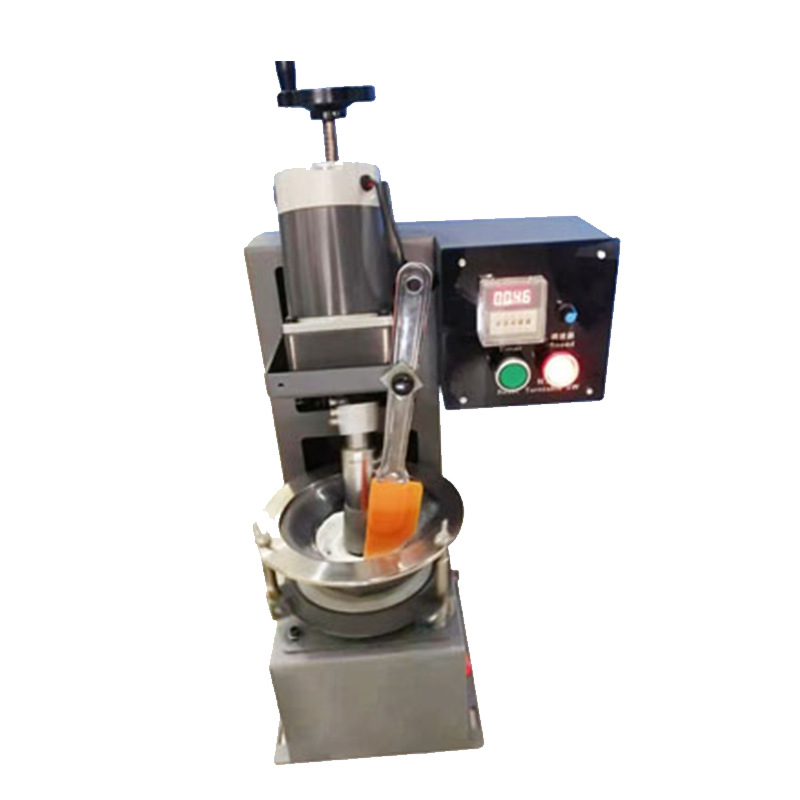
When choosing, it is important to separate the nodes that determine the work with the sample and the auxiliary systems. The first includes the working chamber, working body or grinding elements, their attachment point and the method of loading and unloading. The second includes the drive, housing, controls and dust protection. If the material of the chamber is indicated on the product card, this does not mean that all other parts in contact with the sample are made of the same material; such details should be clarified separately.
What happens to the material
During grinding, energy is spent not only on the destruction of particles, but also on friction, heating and wear of the working surfaces. The longer the processing, the higher the likelihood of overgrinding, agglomeration and accumulation of impurities. For heat-sensitive substances, this limitation may be more important than the achievable fineness. Therefore, the regime is selected based on trial, and not on the principle of “the longer, the better”: after a certain time, the increase in subtlety slows down, and undesirable effects increase.
What the mill doesn't do
The laboratory mill does not classify the powder into fractions, does not dry the material, and does not guarantee the specified size for any batch. It also does not transform the mixture into a perfectly homogeneous system and does not eliminate the initial heterogeneity of the sample. If a narrow fraction is required for analysis, sieving or other separation operation may be required; if humidity is important, it is controlled separately. It is useful to discuss these boundaries before choosing equipment, so as not to impose tasks unusual on the mill.
How to read specifications
In a description of a laboratory mill, different numbers may look similar but mean different things. Below are the parameters that should be checked using the current product card, without transferring values from another model.
| Parameter | What does it mean | What to clarify |
|---|---|---|
| Working chamber volume | Geometric chamber capacity, not sample mass | Is the volume of one chamber indicated or total; what is the payload |
| Sample loading | Amount of material that can be worked with | Recommended range, not just maximum; depends on bulk density |
| Initial size | Allowable inlet particle size | Maximum size and shape of pieces; conditions vary for brittle and hard materials |
| Final size | Particle size guide after grinding | Measurement method, grinding time, material properties; typical minimum not guaranteed |
| Operating mode | Dry or wet grinding, batch or other mode | Is the mode confirmed for a specific camera model and material? |
| Grinding time | Duration of processing until results are obtained | Depends on the sample; is not a permanent characteristic of the equipment |
Chamber volume, workload and time productivity are especially often confused. Volume speaks about the geometry, loading speaks about the permissible amount of material, and productivity speaks about the number of prepared samples per period. These values are not automatically proportional: much depends on the bulk density, initial coarseness, target fineness and permissible heating. If the card does not contain the required parameter, it is more correct to request clarification than to calculate it by analogy.
Dry and wet grinding: where is the border?
Dry grinding is convenient when the material is not prone to sticking and when, after grinding, you need powder without a liquid medium. It is simpler in subsequent operations, but may be accompanied by dust formation and heating. Wet grinding often distributes particles better and reduces dust, but introduces slurry preparation, liquid separation, and drying steps. In addition, the liquid must be compatible with the chamber material and not interfere with subsequent analysis.
It should not be assumed that any agate mill is equally suitable for dry and wet mode. If such a mode is not confirmed in the model description, it cannot be added by analogy with another mill. For wet grinding, check separately for tightness, cleaning, possible swelling or sticking of the sample, as well as the method of removing liquid. For dry - dust collection and loss of material during unloading.
Also distinguish between grinding and disagglomeration. In the first case, the size of the primary particles decreases, in the second, aggregates are destroyed, but the particles themselves may remain the same. Visually, the result may look similar, but the particle size distribution and surface area will be different. It is important for the report to indicate the method of preparation and measurement, otherwise comparison with literature data becomes meaningless.
Materials and limitations of agate work surfaces
An agate mill is appropriate where metal transfer must be limited and relatively small samples must be processed. This does not mean omnivorous: agate is fragile, so large solid inclusions, impact conditions and abrasive materials increase wear and the risk of chipping. Practical choice is based on a compromise between sample purity, wear tolerance, size and quantity of material. The more aggressive the mode, the more attentive you need to be to the condition of the working surfaces.
The introduction of impurities is not an abstract concept, but a consequence of wear and tear. Even durable ceramics or mineral materials will leave abrasion products in the sample over time. For agate, these are primarily silicon-containing particles; their contribution depends on the hardness of the sample, grinding time and surface condition. Therefore, the promise of “zero pollution” for the agate mill is incorrect. If the assay is sensitive to silicon, the blank and the mill contribution should be evaluated separately.
Cleaning between samples affects reliability as much as grinding conditions. Residues from a previous sample may end up in the next sample, and overly abrasive cleaning can accelerate wear on the agate. For a specific product, you need to clarify the acceptable cleaning agents and drying method. Do not use aggressive chemicals or harsh tools without confirming compatibility with agate: this may deteriorate the surface and increase the transfer of impurities.
When agate is justified
Agate work surfaces are considered for medium-hard samples, brittle materials, and applications where metal contamination is undesirable. Typical applications include the preparation of geological, ceramic, glass and pigment samples where sample weight is low and purity requirements are high. Specific suitability is still determined by testing on the actual material: what works for one ceramic may not work for another due to bonding, porosity or inclusions.
When a different material is needed
For large, very hard, viscous or abrasive materials, agate may not be the best choice: it wears out faster and is less resistant to impact. In such cases, other chamber materials and other grinding principles are considered, but the decision is made based on the documentation of a particular product, and not on the name of the material. It is impossible to transfer the properties of agate to the entire line of equipment TENCAN: Different mills have different chambers, drives and purposes.
Selection criteria and compatibility
It is convenient to start selecting a laboratory agate mill from the sample passport, and not from the catalogue. First, the material, initial size, required mass, target size, acceptable contamination and method of analysis are recorded. Then they check which designs and working chambers are available, how loading and cleaning are organized, and what consumables are supplied. Only after this does it make sense to compare models in terms of volume, modes and ease of use.
- Sample material: hardness, brittleness, tendency to stick and sensitivity to heat.
- Initial and target coarseness: whether only fine grinding is required or also pre-crushing.
- Sample mass and volume: payload, not just the geometric volume of the chamber.
- Analysis sensitivity: acceptable contribution of silicon, metals and other wear products.
- Mode: dry or wet grinding, frequency of operation, cleaning requirements between samples.
- Compatibility: Confirms operating items and accessories for a specific model.
Compatibility of accessories requires separate verification. The catalog may present different grinding elements and materials, but the mere presence of an item does not prove that it is suitable for the selected mill. It is necessary to check the design of the unit, the permissible size and material of the working fluids, as well as the effect of denser or harder material on chamber wear. Unless the manufacturer confirms the combination, it should not be considered standard.
Test grinding on a real sample is more useful than comparing only by model name. A small batch allows evaluation of material behavior, heating, discharge losses and achievable homogeneity. After the test, check the condition of the working surfaces and, if necessary, adjust the load weight or time. This approach does not guarantee results for any batch, but it reduces the risk of errors when selecting equipment.
Latest Information on Laboratory Agate Mill TENCAN are given in the product card, and general directions of equipment are shown on website TENCAN. If there is a discrepancy in data from different sources, the documentation for a specific execution takes priority. If the units or mode are unclear, it is better to omit the questionable value and clarify the condition rather than making a guess.
Frequently asked questions
How does an agate mill differ from a planetary ball mill?
These are different types of laboratory equipment. In the catalog TENCAN The agate mill is classified as a different grinding equipment than planetary ball mills. They may have different working chambers, movement of working bodies and a set of parameters, so the characteristics of one model cannot be transferred to another. The only common purpose is to reduce the sample size.
Is it possible to grind very hard materials?
Without verification - no. Agate is fragile, and the permissible hardness and size depend on the specific design. For hard and abrasive samples, wear and the risk of chipping increase; sometimes a different chamber or preliminary reduction of pieces is required. The decision is made based on the product passport and the results of trial grinding.
How to choose the camera volume?
They focus on sample weight, bulk density and recommended loading, and not just volume. A portion that is too small can produce an uneven result, while a portion that is too large can overload the drive and impair grinding. If the volume is indicated on the card, you need to understand whether it refers to one chamber or the total capacity.
Is wet grinding acceptable?
Only if it is confirmed for a specific model and is compatible with the camera material. Wet mode requires sealing, suitable fluid, cleaning and subsequent separation of the fluid. It cannot be assumed that since a mill is designed for grinding, any mode is suitable for it.
Bottom Line
The laboratory agate mill is a narrow but useful tool for fine sample preparation where accuracy and limiting metal contamination is important. It does not replace a crusher, mixer or classifier, and its actual capabilities are determined by its design, material of working surfaces and permissible load. Before choosing, you should formulate the sample properties and analysis requirements, then check the volume, loading, mode and compatibility according to the current documentation TENCAN. This procedure reduces the risk of buying equipment that is technically sound, but does not solve the specific problem of sample preparation.