
Agate grinding balls are grinding media made from natural agate that are loaded into the working drum or grinding bowl of a ball mill to grind and homogenize samples. They are in the contact zone with the material and transfer impact and abrasion energy to it, therefore their material, shape, size and condition directly affect the grind size, sample purity and reproducibility of the result. Below we discuss how such grinding media are designed, what are the limitations of agate, what to look for when choosing, and how to organize cleaning and wear control. Current positions and parameters of specific batches are given in the card agate grinding balls on the website TENCAN.
Place of grinding media in the grinding process
A ball mill grinds material due to the movement of grinding media inside the working chamber. Depending on the type of drive - planetary, drum, vibration or stirring - the ratio of impact and abrasion changes. Agate balls in this system are not an independent device, but a working element that transfers mechanical energy from the walls or rotor to the sample particles. If the grinding media are poorly selected, not only productivity suffers, but also sample purity: ball wear turns into an additional source of substance in the sample.
During dry grinding, the movement of the balls is accompanied by dust formation and heating, while during wet grinding, part of the energy is spent on mixing the suspension. In both cases, the particle size distribution depends on the diameter of the balls, their density, quantity, chamber filling and rotation mode. Therefore, the same set of balls in different mills gives different results. Data obtained from one installation cannot be transferred to another without verification.
When selecting grinding media, it is useful to determine in advance which grinding mechanism predominates in a particular installation. If the main work is done by abrasion, the requirements for the impact resistance of the balls are lower than in a mill, where the particles are destroyed mainly by impacts. This affects the permissible material and size of grinding media.
Agate material: properties and limitations
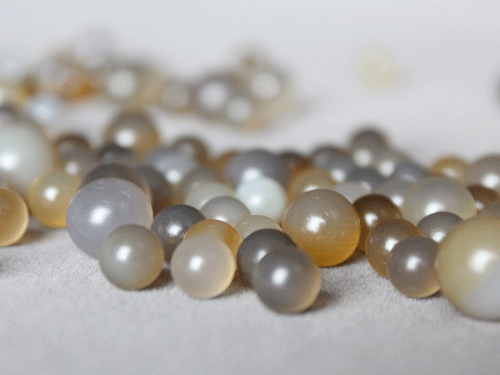
Agate is a natural mineral based on silicon dioxide. In laboratory practice, it is valued for its combination of sufficient hardness, chemical stability and a relatively low contribution to sample contamination compared to metal grinding media. However, this does not mean “zero contamination”: when abraded and chipped, particles of the agate itself get into the sample. The longer the grinding and the higher the impact energy, the more noticeable this contribution.
Agate is fragile. It works well in gentle and medium modes, but does not withstand strong shocks, sudden temperature changes and drops on a hard surface. Large agate balls should not be considered as a replacement for steel or tungsten carbide bodies where high impact energy is required. For hard and abrasive materials, agate balls can wear out faster, and their fragments can contaminate the sample. This limitation is important to consider when choosing between agate, zirconia, corundum and tungsten carbide.
Agate's chemical resistance is not universal. It is resistant to many media, but when working with acids, alkalis and strong solvents, compatibility must be separately checked according to the manufacturer's documentation. This is especially true for wet grinding, where the liquid is constantly in contact with the surface of the balls and glass.
It is important to distinguish between natural agate and synthetic materials, which are sometimes called agate. Even within natural raw materials, different batches may differ in porosity, color and presence of inclusions. These differences affect wear and how the material behaves over long periods of grinding. Therefore, stability of delivery and incoming control are no less important than the declared type.
Designs and sizes of agate grinding media
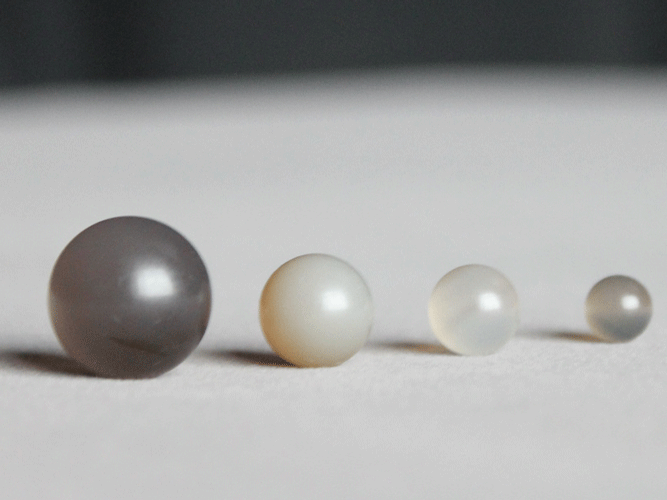
Agate grinding media are supplied in the form of balls. The catalog may contain different diameters, and each size has its own weight and contact area. The exact assortment, tolerances for diameter, sphericity and weight are indicated in the current product card. It should not be assumed that the parameters of one ball automatically apply to the entire line: batches may differ, and tolerance requirements depend on the task.
The choice of diameter is related to the balance between impact and abrasion. Small balls provide more contact and produce finer abrasion, but are less effective at breaking up large particles. Large balls provide higher impact energy, but increase the risk of chipping and local overheating. In practice, a mixture of balls of several diameters is used to cover a wide range of particles. The specific ratio is selected experimentally for the material, initial size and target dispersion.
How to read the characteristics of agate balls
When selecting agate grinding media, it is helpful to understand what each parameter means. Below are the main characteristics that should be specified in the card or accompanying documentation.
- Diameter and tolerance. The mass of the ball, the number of contacts and the loading of the chamber are determined. Tolerance is important for reproducibility: too much variation changes the grinding dynamics.
- Sphericality and surface quality. Irregularities, chips and cracks increase wear and can become a source of contamination. Visual inspection before loading is required.
- Density and mass. They affect the impact energy and the distribution of forces in the drum. When replacing the grinding media material, the density may differ, so the grinding mode must be adjusted.
- Hardness. Compares with the hardness of the sample. If the sample is harder or comparable in abrasiveness, the wear of the agate will be accelerated.
- Purity of the material. For trace analysis, it is important what impurities the agate can introduce. This issue is resolved by comparing blank grinding and background analysis.
- Wear resistance. Not an absolute value: it depends on the sample material, mode, presence of liquid and grinding time.
None of these options work alone. For example, high hardness does not compensate for fragility under impact loads, and a small diameter does not guarantee fine grinding if the number of balls or rotation speed is incorrectly selected.
If the documentation indicates a range rather than a single value, this is normal: natural material and mechanical processing give a scatter. It is important that the tolerance is sufficient for the selected process. For critical analyses, it is useful to record the batch and store samples of the balls so that if the result changes, you can check whether the material has changed.
Compatibility with sample material and equipment
The main criterion of compatibility is the sample material. Agate balls are typically considered for soft, medium and brittle materials where significant metal contamination cannot be tolerated. For very hard, viscous or abrasive samples they may not be suitable: wear will be accelerated and the risk of chipping will increase. It is also important to consider the sensitivity of the analysis to silicon: if silicon or its compounds are determined, the contribution of agate may distort the result.
The second level of compatibility is the grinding bowl or drum. The material of the grinding media and the lining material must be consistent. If agate balls are used in a glass made of a different material, wear may occur on both sides, and particles of different compositions will get into the sample. The most predictable option is to use grinding media and a bowl from the same class of materials, if this is provided for by the mill design. However, any equipment cannot be automatically considered compatible: you need to check the internal dimensions, camera shape, load capacity and speed. For example, among the equipment TENCAN presented laboratory conical ball mill, but the compatibility of specific agate balls with it is determined by the mill’s passport and process conditions, and not just by the name.
The third level is mode. Dry grinding places greater demands on dust removal and temperature. Wet grinding reduces dusting, but adds the factor of chemical interaction of the liquid with the agate and the glass, and also requires more thorough cleaning. For cryogenic applications with liquid nitrogen, conventional agate balls should not be considered suitable without confirmation: rapid cooling may increase brittleness.
Wear, cleaning and storage
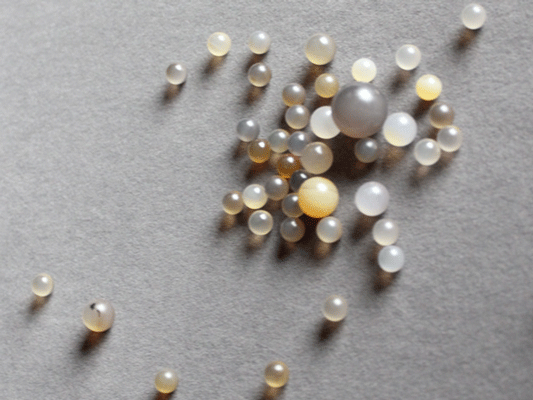
Agate balls wear through two main mechanisms: abrasion and brittle chipping. The first manifests itself as a gradual change in diameter and the appearance of a matte surface, the second - as chips and cracks. Both processes increase the contribution of ball material to the sample. Regular inspection helps to notice degradation in time: balls with cracks, chips and noticeable loss of sphericity are better taken out of service.
Cleaning between samples should remove sample debris but not damage the agate surface. Typically, rinsing with water or a suitable solvent, soft brushes and an ultrasonic bath, if approved for the particular material, are used. Metal scrapers and aggressive media must not be used without checking compatibility. After cleaning, the balls are dried and stored in a closed container to avoid dust, moisture and accidental impacts.
Separately, it is worth monitoring the glass or drum. If the lining wears out faster than the balls, it may be the source of contamination. Maintaining a grinding log indicating the material, mode, time and condition of the grinding media helps to separate the contribution of equipment from the properties of the sample.
The frequency of monitoring depends on the intensity of work. During daily operation, it makes sense to carry out inspection more often than during rare starts. If, after grinding, uncharacteristic particles appear in the sample, the first thing to do is check the condition of the grinding media and lining.
Criteria for selecting agate grinding media
The choice begins with the task, not with the size of the ball. First, they formulate what is required: destruction of agglomerates, fine grinding, homogenization, or preparation for analysis. Then the properties of the material are assessed - hardness, brittleness, initial size, sensitivity to contamination, behavior in dry and wet environments. After this, the type of mill and grinding bowl material are selected.
At the next stage, the diameter and number of balls are determined. For fine abrasion, smaller diameters and a larger number of contacts are usually used; to destroy large particles - large balls or a mixture of them. Filling the chamber should not be excessive: the balls need space to move. The mass ratio of balls to sample affects efficiency and heating. The grinding speed and time are selected so as not to overheat the sample and cause excessive wear. The final particle size will always depend on a combination of these factors, so the typical catalog minimum is not guaranteed for any material without verification.
If the task involves a small sample volume, it is more convenient to use a planetary mill with grinding bowls. If more material needs to be processed, drum or vibration mills are considered. Agate balls in each case remain grinding bodies, and not an independent size classifier. Their contribution to the result is determined by the mode and design of the installation.
Frequently asked questions about agate grinding balls
Are agate balls suitable for wet grinding?
Yes, wet grinding with agate balls is possible if the liquid is compatible with the agate and the glass material. The liquid reduces dust and helps remove heat, but requires more thorough cleaning and consideration of chemical interactions. The specific liquid is selected based on the documentation and properties of the sample.
Can agate balls be used in a glass made of another material?
Technically this is possible, but compatibility needs to be checked. Different materials wear at different rates, and particles from both may be introduced into the sample. If the analysis is sensitive to contamination, it is better to match the ball and lining material.
How can you tell if agate balls are worn out?
Signs: change in diameter, loss of sphericity, matte surface, chips and cracks. They are identified by inspection and periodic measurement. Balls with defects should not be used for critical samples.
Do agate balls replace mixing?
No. Grinding and mixing are different operations. The balls crush and homogenize the material due to impact and abrasion, but are not a mixer in the sense in which devices for simply mixing powders are used. For mixing without grinding, other equipment is used.
Do I need to wash the balls after each test?
Yes, if the next sample is transfer sensitive. Remnants of previous material may distort the result. The cleaning method is chosen taking into account the sample material and the durability of the agate; aggressive methods are used only with confirmed compatibility.
What to check before ordering
Before choosing agate grinding media, it is worth checking several points: the type of mill and the permissible diameter of the balls, the volume of the grinding bowl, the lining material, the required fineness, the permissible level of contamination, dry or wet process, and the cleaning method. Parameters of specific items - diameter, weight, tolerances, packaging - are given in the product card. If the data in different sources differs or the units look unclear, it is better to clarify the condition with the supplier than to substitute the value by guess.
Agate grinding balls are a consumable item on which the purity and reproducibility of laboratory grinding depends. They do not make the process “perfect” and do not completely eliminate wear, but when selected correctly they can reduce metal contamination and handle delicate samples accurately. The basic rule is to consider the balls together with the mill, glass and mode, and not separately.