
The Class A corundum grinding bowl is the working container of a planetary ball mill, made of sintered aluminum oxide (corundum) and designed to accommodate the sample and grinding media directly during the grinding process. The glass is installed in the socket of the planetary mill carrier, closed with a lid with a seal and, together with the grinding media, forms a grinding set - a unit that is in contact with the material and largely determines both the result of grinding and the purity of the resulting powder. Its task is to withstand the centrifugal loads of planetary motion, not to be destroyed by impacts of grinding bodies, and, if possible, not to introduce unwanted impurities into the sample. Below we explain how such a glass is constructed, what its material means, how to read the characteristics and what criteria are used to select it for a specific task. Description of the design is given in the product card corundum grinding bowl class A.
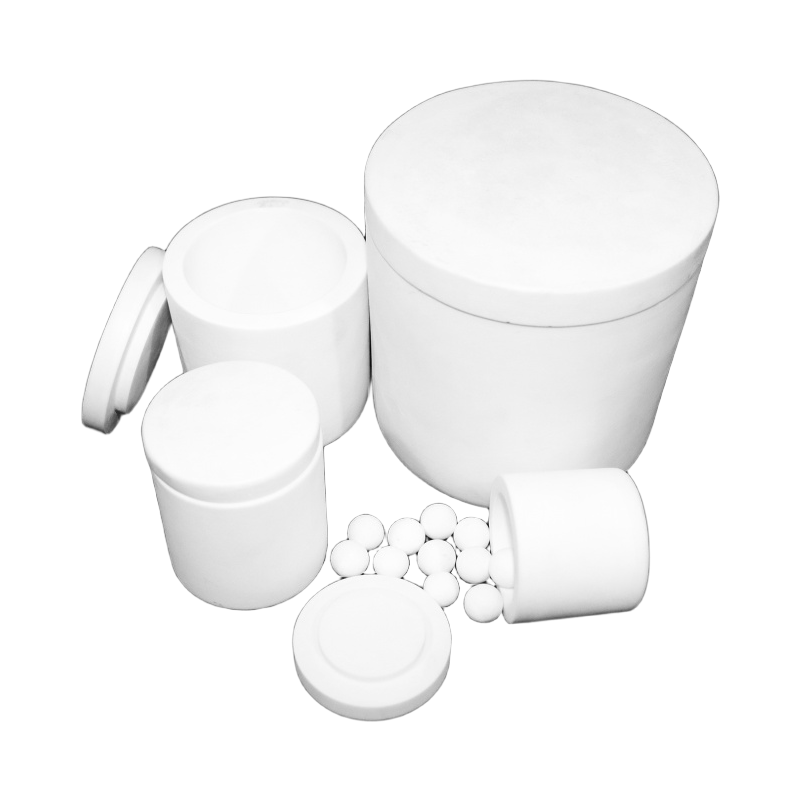
What is grade A corundum grinding bowl and where does it work?
The grinding bowl is a replaceable working container of the mill. In a planetary ball mill, the glasses are fixed on a carrier: the carrier rotates in one direction, and the glasses around their own axis - in the opposite direction. Due to the addition of rotations, a centrifugal field arises, under the influence of which the grinding bodies are pressed against the wall, rise along it and then break away, striking the material and each other. Grinding occurs in combination - due to impact and due to abrasion. The glass in this scheme performs several functions at once: it holds the sample and grinding media, transfers energy to them from the drive, limits the working space and protects the sample from contact with metal parts of the installation.
Grade A corundum glass is made from sintered aluminum oxide α-Al₂O₃. It is a ceramic product, not metal: it has high hardness, chemical resistance to most environments and is not magnetic. This is why corundum is often considered for samples where contamination with iron and other metals is unacceptable or undesirable. The designation “class A” in the name refers to the design of the product in the nomenclature TENCAN; exact tolerances, purity of the material and equipment of a specific standard size are indicated in its card, and they cannot be transferred to the entire line.
What elements does a glass consist of?
Structurally, the grinding bowl consists of a body with a working cavity, a lid and a seal between them. The housing absorbs the main load: impacts of grinding media, abrasive wear, clamping pressure. The lid secures the headset and limits the release of material; With wet grinding, it is the seal that determines whether the liquid will remain inside. A number of designs include liners and linings that change the contact pair “glass - grinding media”. For each option, it is important to understand which surface is in contact with the sample, since this is the source of possible impurities.
Material: what corundum provides and what it does not guarantee
Corundum is one of the hardest oxide materials used in grinding equipment. High hardness means that the ceramic itself resists abrasion longer than, for example, soft polymers. The chemical inertness of aluminum oxide allows you to work with acidic and neutral media, and the absence of ferromagnetic components allows grinding to be carried out without the characteristic “iron” contamination. Additionally, corundum is a dielectric, which is important if further measurements are sensitive to metallic inclusions.
However, the expression “zero pollution” does not apply to corundum. Any headset wears out: with prolonged grinding, high energy and an abrasive test, particles of the glass itself get into the material. In the case of corundum, it is aluminum oxide, that is, aluminum and oxygen. For samples where aluminum is the target or interfering element, this transfer must be taken into account in the same way as iron from a steel fitting. The higher the hardness and abrasiveness of the sample, the longer the grinding and the greater the energy, the more noticeable the contribution of wear. It is impossible to name it numerically in advance - it depends on the combination of sample material, grinding media, mode and time.
Wear and transfer of impurities: what it looks like in practice
Wear products are distributed throughout the sample and do not remain on the wall. Therefore, when assessing contamination, they look not only at the glass itself, but also at the entire contact pair: grinding bodies made of the same material give less “foreign” contribution than a combination of different materials. A second source of contamination is improper cleaning between samples, where residues from a previous sample are carried over into the next. The third is integrity violations: chips and cracks increase the contact surface and accelerate further destruction.
Corundum among other materials
Different materials are used in grinding equipment: stainless steel, zirconium dioxide, agate, tungsten carbide, polymers. Metal glasses are mechanically strong, but introduce iron; zirconium ceramics are denser and heavier; agate is less hard and therefore limited in abrasive tests; Tungsten carbide gives high wear resistance, but introduces tungsten. Corundum occupies an intermediate position: it is harder than polymers and agate, chemically resistant and does not contain metals, but remains a fragile ceramic. There is no universal “best” material - the choice is determined by what element is acceptable in the sample and how abrasive the sample is.
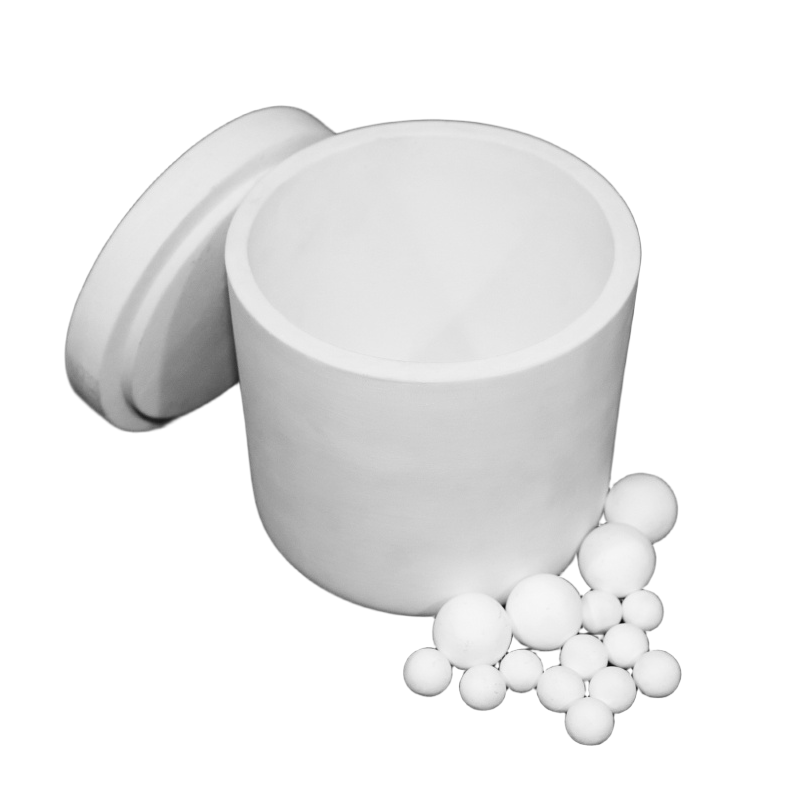
Characteristics and their correct reading
In the product card and in the mill passport there are values that are close in meaning, but different in meaning. They should not be mixed.
- Volume of one glass — internal working volume of one container. For a planetary mill, it is important how many glasses are installed at the same time: the total volume of the set can be several times greater than the volume of one glass.
- Workload — that part of the volume that is permissible to be occupied by sample and grinding media. It is always less than the full volume; the specific allowed value depends on the execution and mode.
- Sample weight — a value derived from the volume, density of the sample and the selected load, and not an independent characteristic of the glass.
- Material and its purity — ceramic brand, presence of impurities, manufacturing method. It is this data, and not just the word “corundum,” that determines how suitable the headset is for sensitive analysis.
- Geometry and fit dimensions — outer and inner diameter, height, method of fixation. They must match the socket of the specific mill model.
- Seal and cover — design designed for dry or wet grinding, for working with solvents and for excess pressure inside the cavity.
Separately, it is worth dwelling on the grinding results. The final particle size is not a property of the beaker: it depends on the sample material, its initial size, type and size of grinding media, mass ratio, rotation speed, time, and whether it is dry or wet grinding. The values given for one standard size or for one model task cannot be automatically transferred to others. Where a description states a minimum achievable particle size, this is a guideline for specific conditions and is not a guarantee for any sample.
Finally, do not confuse grinding and mixing, grinding and disagglomeration. The glass can also be used for mechanical mixing of powders, but then the task is formulated differently: it is not the impact energy that is important, but the uniform distribution of the components.
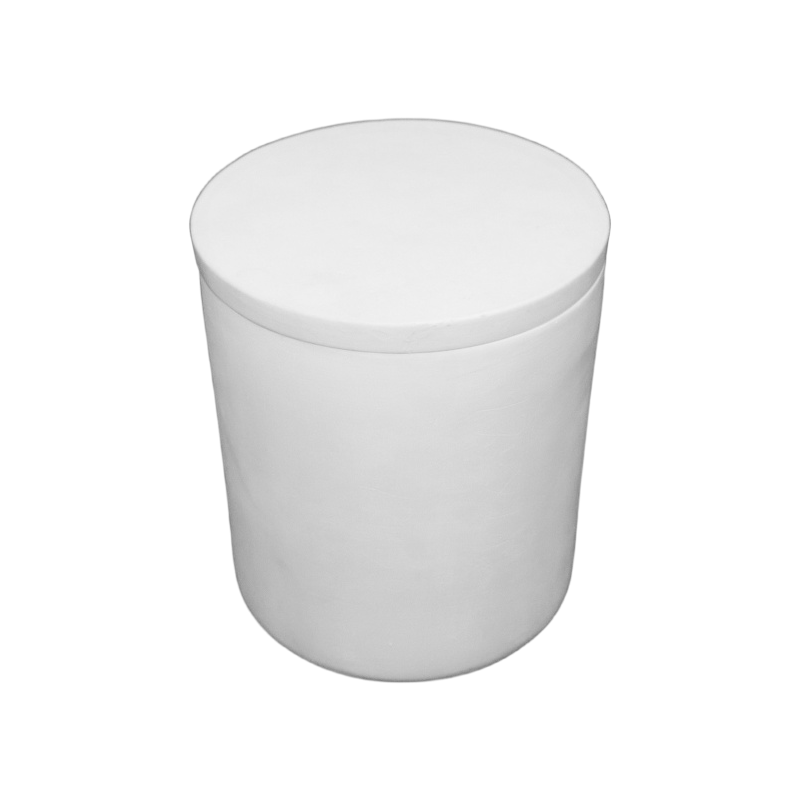
Compatibility: beaker, mill, sample and adjacent equipment
Compatibility is not a general property of the line, but the result of testing a specific pair of “glass - mill” and “glass - sample”. It is convenient to check it at three levels.
Geometric and mechanical compatibility
The glass must fit into the socket of the carrier, be fixed without play and closed so that the lid does not move during rotation. The weight of the headset affects the balancing: a set of glasses of different weights creates vibration, which accelerates the wear of the seals and bearing units of the mill. Overloading the volume and weight of grinding media increases the load on the drive and does not provide a proportional gain in particle size. Therefore, acceptable combinations of glasses and grinding media are determined by the manual for a specific mill model, and are not selected by analogy.
Sample material compatibility
In addition to hardness and abrasiveness, the chemical nature of the sample is taken into account. Acidic and alkaline environments, organic solvents, and wet pastes behave differently: some require chemically resistant ceramics, others require a hermetic seal and material that is resistant to swelling or dissolution. If the sample must remain chemically unchanged, corundum is preferable, but in this case the contribution of aluminum to the final analysis is assessed.
Equipment before and after grinding
Sample preparation usually involves several steps. Coarse crushing is carried out using crushing equipment, for example stainless dustless crusher TENCAN, fine grinding - on a planetary mill with a grinding set. These are independent units with their own characteristics: the presence of equipment in the same line does not mean that the crusher and bowl of a particular mill are matched in size, productivity or material. Such issues are resolved separately, based on the actual characteristics of both machines and the sample requirements. A general list of directions and brand positioning is given on the website TENCAN.
Operation: cleaning, wear and restrictions
Cleaning and combating cross-contamination
The cleanliness of the headset affects the result no less than its material. The operating procedure is usually constructed as follows: first, the bulk of the sample is removed mechanically, then the glass is washed with a suitable solvent, and then dried. Metal brushes and abrasive tools are undesirable for ceramics: they leave metal particles on the surface, which then get into the sample. If the beaker is being used for several different materials, it is wise to assign containers to specific samples to reduce the risk of carryover. If there is any doubt about purity, a control blank grinding is carried out and its result is analyzed. Specific cleaning media and drying conditions should be agreed with the operating instructions, as they depend on the sample material and seal design.
Signs of wear
Ceramics are fragile, so the main risk is not gradual abrasion, but chips and cracks from impact or sudden temperature changes. Signs that it is time to take the glass out of service include: visible chips and cracks, deformation or loss of elasticity of the seal, a noticeable change in the inner surface, a steady increase in the aluminum content in the samples. Working with a chipped glass is also dangerous because failure under load occurs suddenly, along with the scattering of material and grinding bodies.
Temperature and chemistry
A corundum beaker is not a crucible or a reactor. It should not be used for sintering, prolonged heating to high temperatures, and especially for sudden thermal changes. If the mill is equipped with cooling, it is important to distinguish between the cooling of the workspace and the actual temperature of the sample: they are not the same, and conventional air cooling is not a cryogenic process. For cryogenic applications, special low-temperature solutions are used and cannot be attributed to a standard headset.
Selection criteria and common mistakes
It is convenient to reduce the choice of a corundum glass to a sequence of questions.
- Mill compatible. What model does the nest belong to, what mounting dimensions and method of fixation are provided, how many glasses are installed at the same time.
- Required volume. You need the volume of one container or the total volume of the set; how much sample is required for analysis after grinding.
- Acceptable impurities. Which elements are critical: iron, aluminum, zirconium, tungsten. Both the glass material and the material of the grinding media depend on this.
- Abrasiveness and hardness of the sample. The higher they are, the faster the wear and the more important it is to evaluate the contribution of the headset in advance.
- Process conditions. Dry or wet grinding, presence of solvent, sealing requirements, duration and energy.
- Service. Possibility of cleaning, availability of spare seals, wear control procedures.
Typical mistakes look like this: the parameters of one standard size are transferred to the entire range; mix the volume of the glass and the total volume; consider corundum to be completely inert and do not take aluminum into account in the analysis; use a glass with a damaged seal for wet grinding; choose a headset “by eye”, without checking the fit dimensions. Each of these errors leads either to unreliable results or to premature failure of the equipment.
Questions and answers
Is corundum the same as agate?
No. Agate is a natural silica-based mineral that is less hard and more prone to silica contamination. Corundum is sintered aluminum oxide, harder and more wear-resistant, but containing aluminum.
Is it possible to grind wet in a corundum glass?
Wet grinding is possible with the appropriate design of the lid and seal. Without a sealed unit, the fluid carries material away and upsets the balance; Therefore, the grinding method must be coordinated with the specific design of the headset.
Does a corundum glass provide complete absence of contamination?
No. Any headset wears out; corundum contributes aluminum and oxygen. The question is not the absence of impurities, but whether such a contribution is acceptable for a given task.
Can a glass from one mill be used in another?
Only if the mounting dimensions, fixation method and permissible weight match. External similarity does not confirm compatibility - it is checked against the documentation of both models.
How can you tell if a glass is worn out?
Based on chips and cracks, the state of compaction, changes in the internal surface and an increase in the aluminum content in the samples. Any damage to the case is grounds for replacement.