
Three-dimensional vibrating screen is an equipment for separating bulk materials by size using a vibrating screening surface. In the powder preparation system, it does not grind, but classifies: it separates the desired fraction, removes large inclusions, or divides the material into several classes. In the catalog TENCAN have a card 3D vibrating screen. For the laboratory and small production, it is an intermediate unit between the mill, mixer or dryer and the following operations - dosing, pressing, analysis or packaging.
The term “three-dimensional” describes the nature of the movement of the sieve and material: vibrations are distributed not in one plane, but in several directions at once. Thanks to this, the powder moves more actively along the mesh, is less likely to lie in one area and quickly finds holes of the appropriate size. However, this principle in itself does not guarantee the specified size: the result depends on the properties of the sample, the state of the mesh, the vibration mode and the correct configuration of the equipment.
The place of the screen in the preparation of powder samples
Sieving is often perceived as a minor operation, although it determines the reproducibility of further measurements. After grinding, the material usually has a distribution of particle sizes rather than one strict size. If the researcher needs a fraction with an upper limit of size, the screen allows you to separate larger particles and obtain a more homogeneous sample. This is especially important when preparing samples for analysis, pressing, sintering, coating or mixing with other components.
It is important to distinguish between grinding, deagglomeration and sieving. The mill breaks down particles or aggregates, while the screen separates pre-existing particles by size. It can gently break up weak agglomerates as it moves along the mesh, but this is not grinding and does not replace grinding equipment. If the task is to reduce particle size, a mill is first selected, and a screen is used to control the result. If the material already has the required size, but contains pelletized inclusions or foreign particles, sifting becomes an independent operation.
In a laboratory line, the screen is usually positioned after drying or grinding and before weighing, filling or pressing. At the production site, it can operate in continuous or batch mode, but the specific scheme depends on the design. When selecting equipment, it is important to understand whether the material will be fed manually, from a hopper or after another machine, and how you plan to remove the over-grid product.
How does a 3D vibrating screen work?
The operation is based on a vibration drive, which transmits vibrations to the sifting surface. Screens of this type usually use a vertically mounted vibration motor with eccentric weights: the rotation is converted into a complex movement combining horizontal circulation, vertical throwing and inclined components. To the operator, this looks like a spiral movement of the powder along the mesh. The term "three-dimensional" in this case refers to the spatial nature of the vibrations, and not to the volumetric image or measurement technology.
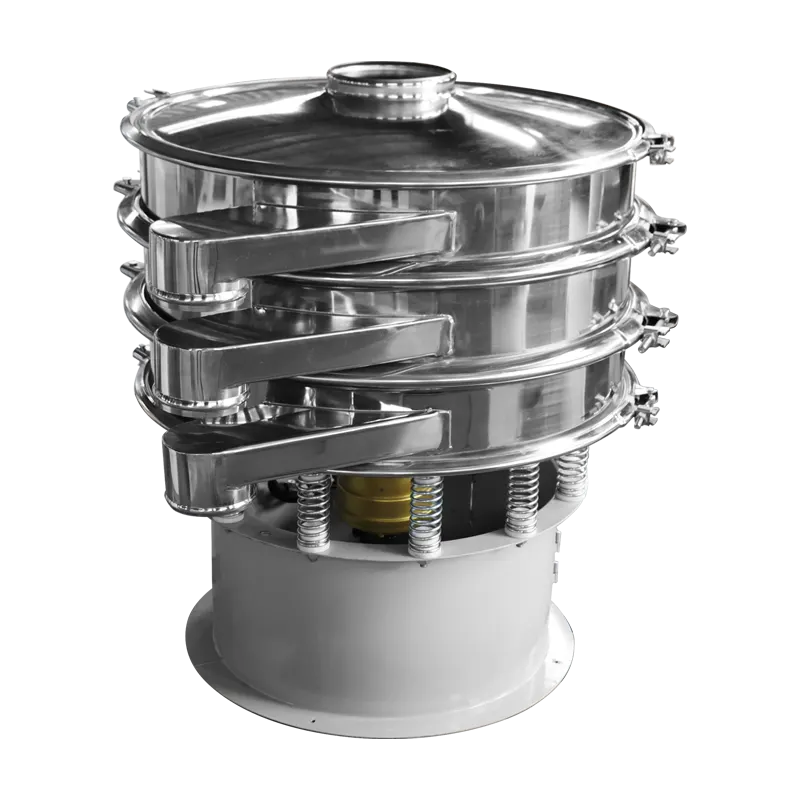
The material is fed to the top of the screen, passes through the holes and is collected under the deck, and the coarse fraction moves to the discharge pipe. The more evenly the powder is distributed over the surface, the lower the likelihood of local overload and “blind” spots where the mesh becomes clogged. Therefore, the result is influenced not only by the cell size, but also by the amplitude, frequency, loading mass, installation angle and properties of the powder itself.
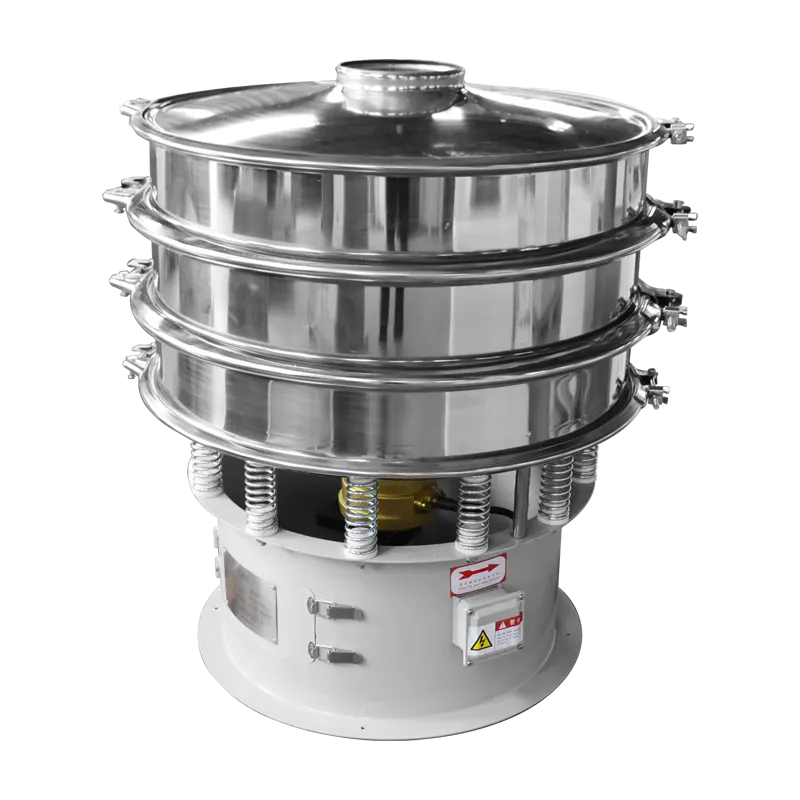
Main design elements
A typical three-dimensional vibrating screen includes a frame, a housing with a screening section, a replaceable or fixed screen, a vibrating drive, elastic elements and unloading units. In laboratory versions, the convenience of removing the sieve, access to the surface after work, and the ability to clean without damaging the mesh are of particular importance. For production purposes, tightness, organization of feeding and unloading, as well as resistance to vibration during long-term operation are important.
The specific configuration is determined by the product card. You should not assume replaceable screens, multiple tiers, a specific contact material, or a special cleaning system just because they are found on other screens. These parameters must be checked for the selected design, especially if the material is aggressive, abrasive, prone to sticking or requires special sanitary conditions.
What happens to the powder on the mesh?
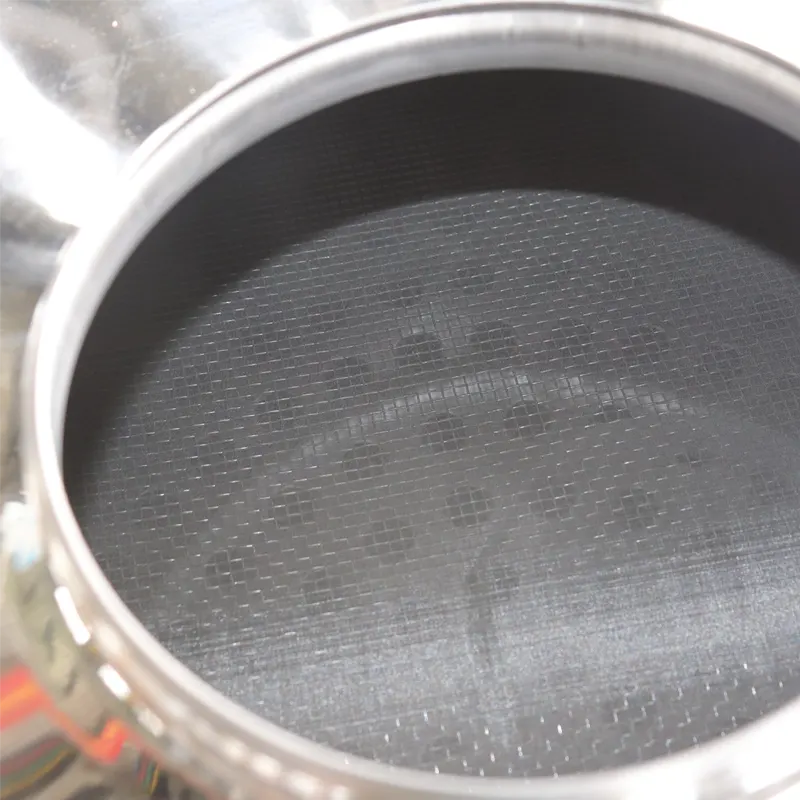
Several factors act simultaneously on the sieve. Vibration reduces friction between particles and helps them move, gravity forces the fines downward, and the flow of material carries the larger particles to discharge. If the powder is wet, sticky, or highly electrified, the holes may become clogged and separation may be impaired. In such cases, sometimes changing the feeding mode, reducing the portion or preliminary preparation of the material helps, but the possibility of wet sifting and special measures need to be clarified separately.
Do not confuse the nominal mesh opening with the actual separation boundary. Irregular particles, agglomerates and fibers behave differently than ideal spheres. Some particles slightly smaller than the cell size may not pass through at the moment due to orientation or adhesion, and some larger aggregates may be destroyed during movement. Therefore, for critical tasks, not only the mesh number is checked, but also the result of fractionation on a specific material.
What is important in the characteristics
When studying the card of 3D vibrating screen TENCAN First of all, they look at the purpose, type of drive, size of the sifting surface, number of decks and sieve parameters. For coarseness separation, cell size is key, but this value alone is not enough. You need to understand which fraction is considered target, what size limits are acceptable and how the quality of sifting will be controlled.
The performance of a screen cannot be judged by its model name alone. It depends on bulk density, flowability, humidity, particle size distribution, mesh size and permissible layer thickness on the sieve. The same device will work differently with light, fine powder and with heavy granulate. If the description indicates productivity, it is important to understand for what material and what fraction it is given; without these conditions, the figure remains a guideline and not a guarantee for a specific sample.
The number of tiers determines how many factions can be obtained in one pass. A single-tier design usually solves the problem of upper or lower screening, while a multi-tier design allows you to divide the material into several classes. However, each additional tier adds complexity to setup, cleaning, and maintenance. For a laboratory, fast screen changes and reproducibility are often more important than maximum productivity.
The material of the contact parts affects wear, corrosion resistance and the risk of introducing impurities. Stainless steel, structural alloys, polymer coatings and other options have different applications. It cannot be assumed that any stainless steel is suitable for all chemicals and that any coating eliminates contamination. Specimen compatibility, cleanability and wear tolerance should be agreed with the supplier and internal procedures.
Materials, Applications and Limitations
Three-dimensional vibrating screens are used where it is necessary to obtain a controlled powder fraction: in mineral preparation, the chemical industry, the production of ceramics, metal powders, pigments, food and pharmaceutical products. In laboratory practice, such equipment is useful in preparing a representative sample, removing large inclusions after drying, and checking particle size distribution. But the suitability of a particular machine is determined by materials, sanitary requirements and operating conditions.
The main limitations are related to the properties of the powder. Highly hygroscopic, greasy, waxy or sticky materials may form deposits on the mesh. Fine mesh with a small opening requires less loading and more careful feeding, otherwise the risk of clogging and loss increases. Abrasive powders accelerate wear of the screening surface and seals. For toxic or dusty materials, tightness and organization of dust removal are important, and for explosive materials, special protective measures are required, which cannot be implied without confirmation.
The ability to wet screen, work with slurries, heat or cool the material, as well as the use of non-standard meshes are not universal features of all screens. If the technological process requires such conditions, they are checked against the documentation of the specific design. General physical principles of vibration separation help to understand the problem, but do not replace the operating instructions and agreement with the manufacturer.
How to choose a screen and check compatibility
The choice begins not with the model, but with the description of the operation. It is necessary to determine what material will be screened, what is its bulk density and tendency to agglomerate, what is the initial size and what separation boundary is required. Then the single sample mass or required productivity, permissible operation time and the number of fractions obtained are specified. For the laboratory, low material loss, convenient cleaning and the ability to quickly replace the sieve are important; for the production site - stability of supply, unloading and maintenance.
Compatibility is checked in three areas. The first is the contact material: it must withstand the environment and not introduce unacceptable impurities. The second is the size and type of screen: the opening must correspond to the target fraction, and the design must withstand the specified load. Third, operating conditions: available space, power supply, noise, dust emissions and safety requirements. If multiple materials are to be handled, consider changing screens and cleaning between products to avoid cross-contamination.
There is a separate issue of integration. The screen can operate as an independent laboratory device or as a line unit. In the first case, simplicity and repeatability of the manual operation are more important, in the second - consistency with the feeder, hopper and unloading system. The characteristics of one design should not be transferred to the entire range. TENCAN. Even if the devices look similar, differences in drive, seals and screen material can make a difference.
As a guide to the current version, use catalog TENCAN and a card of the selected model. The name, purpose and available options are checked on the card, and the missing information is requested from the supplier. This approach is more reliable than choosing by appearance or by one parameter, for example, only by the diameter of the sieve.
Frequently asked questions
How is a 3D screen different from a regular vibrating screen?
Both devices separate the material by size, but the nature of the movement and design may differ. The three-dimensional screen creates complex spatial motion that helps the powder move across the entire surface of the screen. Specific differences are determined by the drive, amplitude and design, so you need to compare the passport data, and not just the name.
Can a screen be used for grinding?
No. Screening separates the particles but does not reduce their size in the same way that a mill does. Unstable agglomerates may be partially destroyed, but this is a side effect and not the purpose of the screen. Mills are used to reduce particle size, and screens are used to control the fraction or remove large inclusions.
Is it possible to sift wet powder?
Wet or sticky material sifts less well: it sticks to the mesh and forms lumps. The possibility of wet sieving, selection of sieve and permissible operating conditions should be clarified for a specific design. It cannot be assumed that any screen is suitable for slurries or wet powders.
What should I check before ordering?
It is worth preparing a description of the material, initial and target size, unit mass or required productivity, number of fractions, requirements for contact material and cleaning. It is also useful to indicate whether the job will be dusty, whether sealing is required, and how the over-grid residue is planned to be removed. These data allow you to select a design without making unreasonable assumptions.
Do I need to check the sieve after each operation?
The frequency of inspection depends on the abrasiveness of the material, load and internal requirements. In practice, it is important to inspect the mesh for damage, sticking and clogging, and also check the result on a control sample. If the fraction no longer meets expectations, the search for the cause begins with the state of the sieve, the properties of the powder and the loading mode.
3D Vibrating Screen TENCAN — This is not a universal replacement for a mill or mixer, but a specialized unit for obtaining a controlled fraction. Its value manifests itself when the task is formulated in terms of material, size, loading and cleanliness requirements. This approach allows you to choose equipment consciously and not expect properties from it that may not be present in a particular design.