
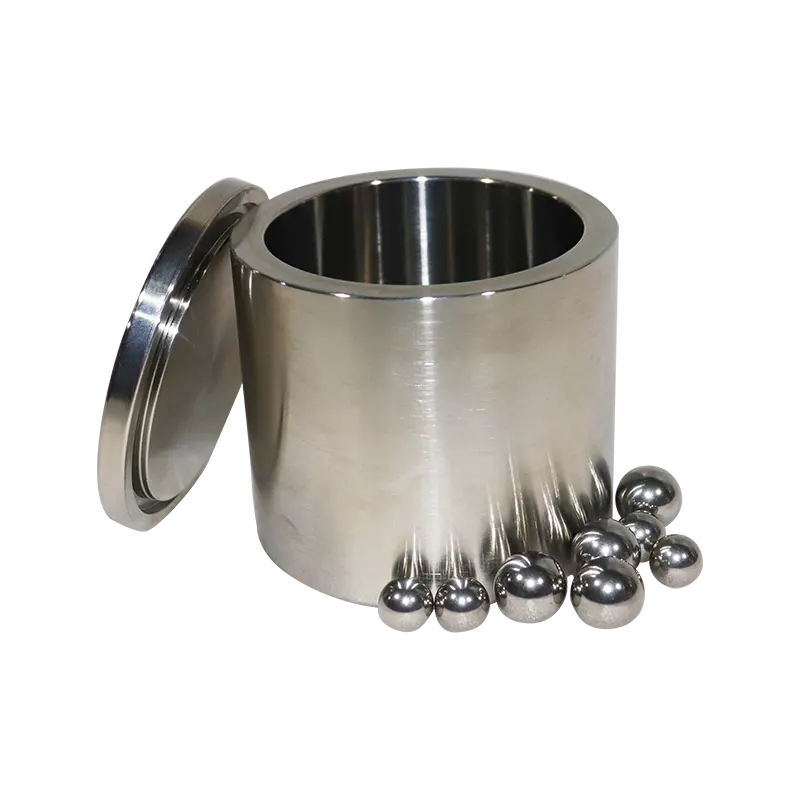
The 304 stainless steel grinding bowl for planetary mill is a replaceable working chamber that holds the sample and grinding media during grinding. The glass is installed in a planetary mill, participates in transmitting motion to the grinding media, limits the working space and separates the sample from the external environment. In the catalog TENCAN the product is presented in card "304 stainless steel grinding bowl for planetary mill". This is not a stand-alone grinder: without a compatible planetary grinder, counter-fitting and a proper seal, the beaker does not perform the grinding function.
When selecting, it is important to separate the glass material, its geometry and the operating mode of the mill. 304 steel determines chemical resistance and wear patterns, geometry determines compatibility with a specific seat and grinding media, and mode determines the actual load on the walls, cover and seal. Even the same name of the material does not mean the same volume, wall thickness or lid design, so the parameters of one model cannot be automatically transferred to the entire range.
The role of the glass in the planetary mill
In a planetary mill, the glass undergoes a complex movement: it rotates around its own axis and at the same time around the common axis of the carrier. The grinding bodies inside the glass, under the influence of centrifugal forces, are pressed against the walls, rise and then collide with the material and with each other. The intensity of this impact depends on the geometry of the glass, the mass and size of the balls, the ratio of material and grinding bodies, as well as on the given speed. The glass here is not just a container, but part of a mechanical system that sets the conditions for collisions and energy transfer.
For fine grinding, not only the shape of the internal cavity is important, but also the tightness. Dusting dry powder should not be lost through a loose lid, and when grinding wet, liquid should not leak. However, tightness does not automatically appear from the product name: it depends on the design of the cover, the condition of the seal, proper assembly and compliance with the limitations of the particular mill. If the seal is worn or the lid is installed incorrectly, the grinding result and reproducibility of the experiment will change.
The glass also sets the boundaries of the workload. Geometric volume, payload, sample mass and ball mass are different quantities. You cannot fill the glass “to the top” just because it looks free: free space is needed for the movement of grinding media, and exceeding the load increases the load on the drive, lid and fastening. Specific limits are determined by the mill manual and cup design, not by a general recommendation from the article. The final particle size depends on the initial particle size, material, medium, time and method of measurement; The type of glass alone does not guarantee it.
Key Elements and Focus Points
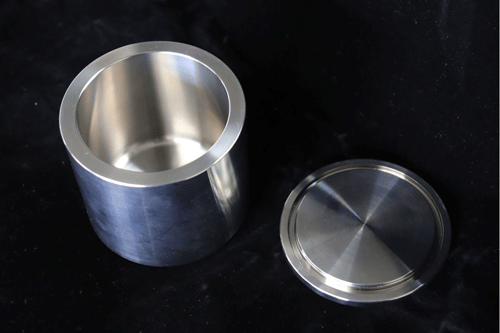
A typical grinding bowl for a planetary mill includes a body, a lid, a sealing element, and seating surfaces that secure the bowl in the mill. The inner surface is in contact with the sample and grinding media, so its condition affects wear and cleaning. The lid is responsible for closing and holding the contents, and the seal is responsible for the absence of leaks and dust within the limits provided by the design. The seating surfaces should not be deformed: misalignment or loose fit creates vibration and uneven load.
Before each use, check the cleanliness of the internal cavity, the condition of the edges, threaded elements and seals. Cracks, deep scoring, loss of seal shape or signs of deformation of the cover are reasons to replace the element or seek advice rather than try to “seal tighter”. Repair using random materials is unacceptable: it can change the geometry and create a risk of destruction during rotation.
Steel 304: properties and limits of applicability
304 stainless steel is a common austenitic steel used for its manufacturability, corrosion resistance in moderate environments, and good ability to maintain integrity under mechanical stress. For a grinding bowl, these properties are useful: the body must withstand repeated installation, cleaning and contact with the sample without deteriorating from normal laboratory influences. But corrosion resistance and wear resistance are not the same thing. A material that is resistant to rust in domestic conditions can noticeably wear out when subjected to abrasive grinding.
In a planetary mill, impact and abrasion loads predominate. If the sample is hard and abrasive, the inner surface of the glass will gradually wear away, and wear debris may become powdered. For 304 steel, this means that iron, chromium and nickel can be transferred into the sample, especially during long grinding times and high impact energies. The statement about “zero contamination” for such a glass is incorrect: any metal material in contact with an abrasive wears out, the only question is the speed and acceptable level.
304 steel should not be considered universally inert to all acids, salts and wet environments. For aggressive compounds, solutions with chlorides or samples sensitive to metal impurities, a separate chemical compatibility check is required. If the analysis procedure specifies the content of iron, chromium or nickel, the steel cup may not be suitable even if its corrosion resistance is good. In such cases, other materials are considered, but their choice also requires confirmation for the specific task, and not just by name. Tungsten carbide, ceramic or zirconia do not mean zero contamination either: each material has its own wear profile and limitations.
The advantage of steel 304 is maintainability and understandable behavior under normal loads, and not “absolute protection” of the sample. For soft, non-abrasive materials, where container and sealing are the primary concerns, this material may be practical. For highly hard minerals, carbides, oxides and other abrasive powders, wear becomes a major limitation. Therefore, the decision is made based on the “sample - glass material” pair, and not on the name of the mill alone.
Volume, dimensions and compatibility
When choosing a glass, the first thing to check is compatibility with a specific planetary mill. You need to know the mill model, seat, fixation method, permissible glass dimensions and requirements for the lid. You cannot rely only on the outer diameter: the height, bottom configuration, protrusions, fasteners and free space around the glass during rotation are important. If the glass does not fit tightly or protrudes beyond the permissible dimensions, the work becomes dangerous and irreproducible.
The volume of one glass is the capacity of one working chamber, and not the total volume of all glasses of the mill. The working load is usually less than the geometric volume, because part of the space is needed for the movement of the grinding media. The mass of a sample depends on its bulk density: the same volume of different powders gives different masses. Therefore, when transferring a technique from one material to another, it is impossible to maintain the “same mass” without checking the volume and filling.
The size and number of grinding media are also related to the geometry of the bowl. Balls that are too large can restrict movement and increase local loads, while balls that are too small can slow down grinding. The material of the grinding media must be compatible with the bowl material and the sample: any available balls must not be mechanically combined unless such a combination is approved by the manufacturer. If a different beaker has previously been used in the technique, its speed, time and load cannot be transferred without verification.
The grinding bowl for a planetary mill is not equal to the drum of a roller mill, the bowl of a bead mill, or the grinding chamber of another device. They have different principles of movement, fastening and sealing. Even if two vessels are similar in shape, this does not prove interchangeability. Consultation based on the product card and mill passport is more useful than selection based on a photograph.
Wear, cleaning and transfer of impurities
The wear of the glass manifests itself in different ways: abrasions, matte areas, and ring marks appear on the inner surface; edges and landing elements may lose geometry; The seal ages and no longer holds. The rate of wear depends on the hardness and abrasiveness of the sample, the duration of grinding, the size and material of the balls, and how correctly the load is selected. A slight abrasion does not always mean immediate replacement, but it requires evaluation: if the wear product is unacceptable in the analysis, the glass cannot be considered neutral.
Cleaning between samples is part of the technique, not an afterthought. First, the remaining material is removed mechanically without damaging the inner surface. Then apply a cleaning compound compatible with the steel and seal and carefully remove any residue. The drying method is chosen so that no moisture or dust remains in the cavity. Aggressive solvents, abrasive pastes and wire brushes can change the surface, so their use requires confirmation, not habit.
For analytical purposes, it is useful to check the cleaning with a blank sample: process a clean glass according to the accepted procedure and assess whether residual contaminants transfer into the sample. This monitoring does not guarantee that any sample will not carry over, but it will help spot the problem. If the sample is sensitive to iron, chromium or nickel, even a small amount of wear can be significant. In this case, a different glass material is considered or the contact effect is reduced, but the final decision is made based on the permissible limit of the technique.
The concepts of “clean glass” and “absence of impurities in the sample” should not be confused. Visible surface cleanliness does not equal chemical cleanliness, and the resistance of steel does not eliminate abrasive wear. Also, wet grinding cannot be assumed to automatically reduce fouling: the liquid may improve disagglomeration and dispersion, but it also makes cleaning more difficult and requires compaction compatibility. Dry grinding, in turn, increases the risk of dust and losses due to a leaky lid.
Selection criteria for the task
The selection of a 304 stainless steel bowl for a planetary mill is conveniently carried out through several sequential checks. First, mechanical compatibility is confirmed, then chemical and analytical admissibility is assessed, and only then proceed to the grinding mode. This procedure reduces the risk that a valuable sample will be spoiled by an inappropriate pair of “glass and grinding media”.
- Mill model and seat: checked by passport, and not by external similarity.
- The volume of one glass and the payload: they separate the capacity, the mass of the sample and the mass of the balls.
- Hardness and abrasiveness of the sample: the higher the wear, the more important the permissible content of metal impurities.
- Chemical environment: water, acid, salt or solvent requires separate evaluation of compatibility with 304 steel and seal.
- Assay sensitivity: When standardizing Fe, Cr or Ni, a steel beaker may not be acceptable.
- Grinding media: material, size and quantity must correspond to the task and the confirmed configuration.
- Cleaning and Maintenance: Cavity accessibility, cap condition, and reproducible preparation between samples.
If the task involves several samples, you should not buy glasses “for all occasions” without checking. The same material may be acceptable for coarse grinding but not acceptable for trace analysis. On the website TENCAN presented catalog of equipment and grinding accessories, however, specific compatibility is always checked against the product card and mill documentation. Brand TENCAN and full name Changsha Tianchuang Powder Technology Co., Ltd. do not replace technical inspection.
Frequently asked questions
Can I use 304 steel cup for any sample?
No. 304 steel is not suitable for all materials. It is necessary to take into account the abrasiveness, chemical activity of the sample, the permissible content of metal impurities and cleaning conditions. For sensitive analyses, a steel beaker may carry unacceptable amounts of iron, chromium, or nickel.
What is the difference between dry grinding and wet grinding in such a glass?
Dry grinding requires particularly secure closure to prevent dust loss and contamination of the work area. Wet grinding can improve particle distribution, but increases the requirements for compaction, fluid-material compatibility, and cleanability. No one option is universally best: the choice depends on the sample and technique.
Does stainless steel mean zero contaminants?
No. Corrosion resistance is not the same as wear resistance. When subjected to abrasive action, the steel wears out and wear products can get into the powder. The concept of "zero contamination" for a metal cup should not be used without experimental confirmation.
How to check the compatibility of a glass with a mill?
The mill model, mounting dimensions, fixation method, cover design and permissible modes are checked. External similarity or the same name of the material is not enough. If doubts remain, seek confirmation from the equipment supplier and do not carry out tests at extreme conditions.