
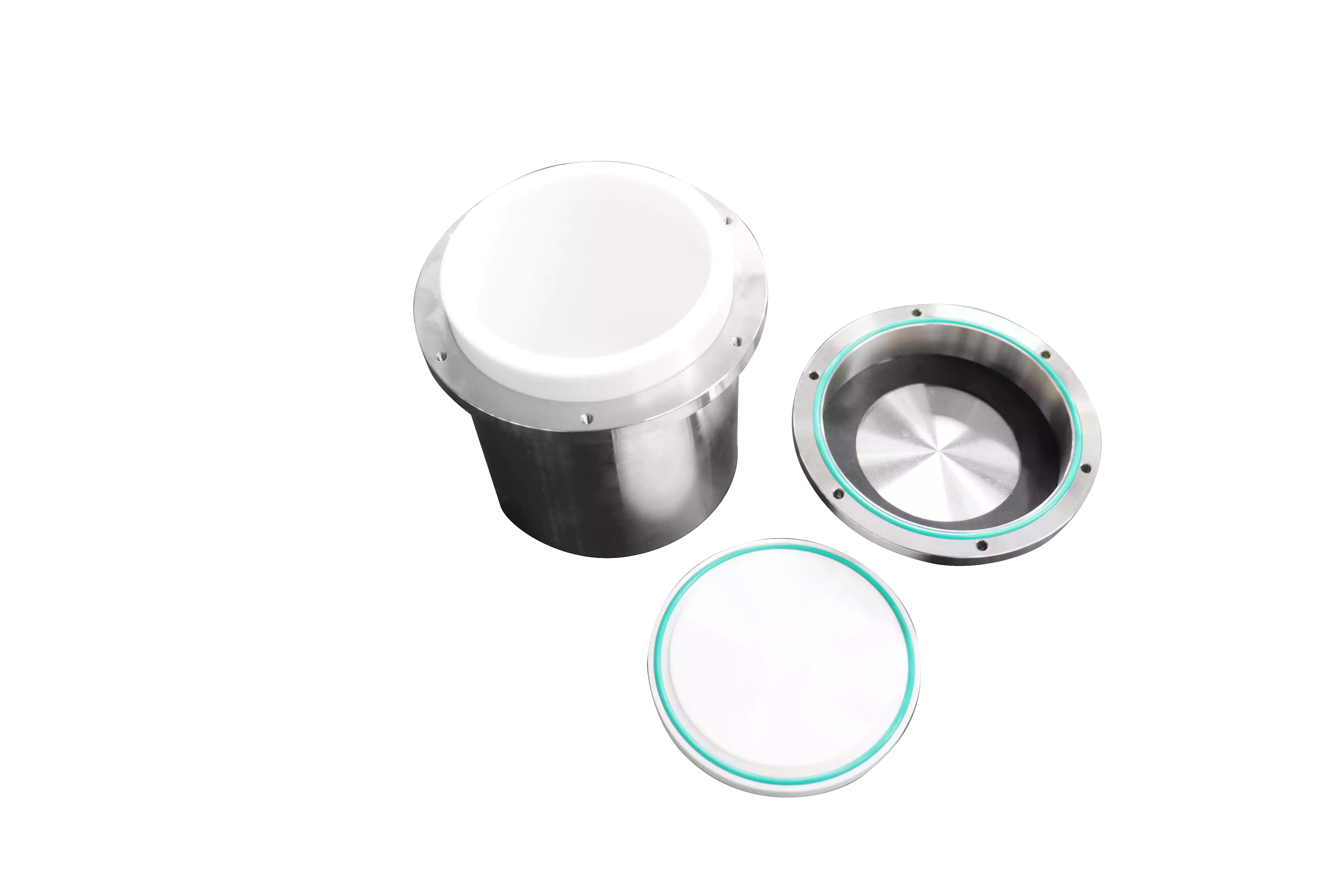
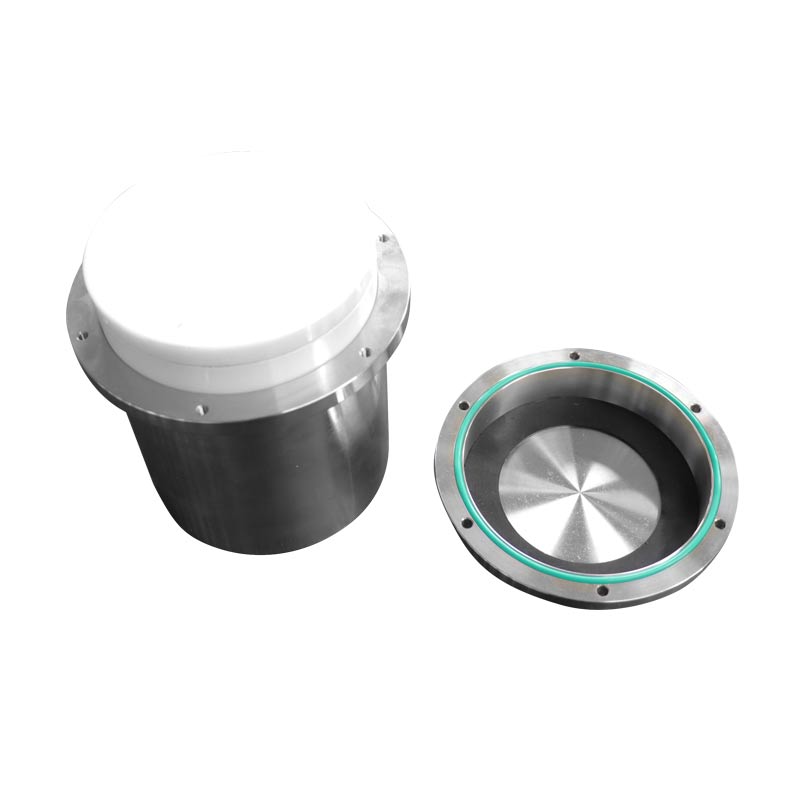
The zirconia lined 304 steel grinding bowl is the replaceable working chamber of a planetary ball mill where the sample is in contact with the grinding media and the internal surface. In the card TENCAN the product is presented as 304 steel grinding bowl with zirconia lining; it refers to grinding equipment and not to the grinder itself. The purpose of such a chamber is to accept a certain load, withstand the movement of grinding media and preserve the properties of the sample, taking into account the requirements for contamination.
The composite design makes practical sense: a 304 stainless steel load-bearing shell provides shape, rigidity and attachment points, and a zirconia working layer separates the sample from the metal surface. However, the combination of materials does not mean “zero pollution”: ceramics also wear out, and steel only becomes significant when the lining is damaged or worn. Therefore, the choice begins not with the beautiful name of the material, but with the task of grinding and the acceptable contribution of impurities.
What is this product and where does it work?
In a planetary ball mill, the glass is fixed in a holder, and the mill imparts a complex movement to it: rotation around its own axis is combined with rotation along an orbit. The grinding bodies inside the glass collide, roll and abrade the material. Grinding occurs due to impact and shear; the ratio of these mechanisms depends on the geometry of the chamber, the size and density of the balls, filling and mode. The glass in this scheme is not a passive container, but a part on which the movement of the load, heating, wear and purity of the sample depend.
It is important not to mix system levels. The mill creates movement, the grinding bodies transmit energy, the glass sets the working space and contact boundaries, and the sample changes the size and state of the agglomerates. If a glass is not suitable in terms of fit, weight or lid design, it does not become compatible just because it is similar to the previous one. For a planetary mill, they check the passport compatibility, and do not select equipment based on the outer diameter.
Construction: steel body and ceramic lining
According to the name of the card, the product consists of a 304 steel body and a zirconia lining. Zirconium dioxide (ZrO2) is a ceramic material that is used where a wear-resistant working surface is needed and it is important to reduce the contact of the sample with the metal. Steel 304 in this design primarily performs a mechanical role: it absorbs loads, maintains geometry and provides interface with the mill. This does not mean that the steel is completely insulated from the process under all conditions; The integrity of the ceramic layer is a key condition for operation.
The open description does not disclose the thickness of the lining, the method of its fastening, the sealing material and the exact operating limits. These data cannot be inferred from photographs. If the task requires tightness during wet grinding, resistance to a specific environment, or minimal transfer of impurities, the parameters must be clarified using the current card and accompanying documentation. The appearance of the glass shows the general type of the product, but does not replace checking the dimensions, threaded connections and permissible conditions.
How to read characteristics and not confuse volumes
The first difference is the nominal volume of the glass and the workload. The nominal volume describes the geometric capacity, but not the amount of sample that can be loaded into the actual grind. Part of the space is occupied by grinding media, part is needed for loading movement, and part is needed for free volume. Therefore, the volume figure in itself does not answer the question of how many grams of powder are permissible. The working load is determined according to the instructions for the specific mill and glass, taking into account the density of the material and the size of the balls.
The second difference is sample weight and productivity. Sample weight is the amount of material in one experiment; productivity - the amount of material processed in a time, which depends on the mode, the number of repeated cycles and the permissible size. It is impossible to convert the volume of a glass into hourly productivity without process conditions. Also, one should not confuse the total volume of several glasses with the volume of one: in a multi-place mill, each glass works as a separate chamber, and the loading into them is not automatically summed up.
The third difference is the size of the product and the degree of disagglomeration. The final particle size depends on the initial particle size, hardness, brittleness, humidity, environment, grinding media, time and method of measurement. The typical minimum stated for equipment or material does not guarantee the same result for any sample. Sometimes the task is not to destroy the primary particles, but to break up the agglomerates; then the mode and environment are chosen differently. To control the result, you need a particle size distribution and a clear sampling technique, and not a single photograph.
The fourth difference is speed, heating and cooling. Increasing the speed increases the impact energy, but also increases wear, heat and the risk of damage to sensitive material. Air cooling of the mill is not equal to cooling of the sample inside the beaker, and the temperature of the working chamber is not identical to the measured temperature of the powder. If the material is heat-sensitive, pause mode or special cooling is discussed separately; Conventional grinding cannot be called cryogenic without a proven cryogenic system.
Materials, wear and contamination
For a glass lined with zirconium dioxide, the main issue is not only chemical resistance, but also wear of the working surface. Abrasive powder, coarse or sharp-edged particles, high speeds and prolonged grinding gradually attack the ceramic. Wear product may enter the sample; its contribution depends on the hardness of the sample, time, state of the glass and grinding media. Therefore, the expression “ceramics does not pollute” is too broad: it is more correct to talk about a different composition of possible impurities and the need to control their permissible level.
The steel body becomes a risk factor if the ceramic layer is chipped, abraded or damaged during cleaning. In such a place, the sample can come into contact with stainless steel, which means that iron, chromium and nickel can be transferred - in quantities determined by conditions. For trace analysis this is essential; for coarse grinding the contribution may be less important. The decision is made based on the analytical problem, and not on one name of the material. If the requirements for impurities are strict, a control experiment is carried out and the background is assessed taking into account the analysis technique.
Grinding media must be considered together with the glass. Balls made of zirconium dioxide, corundum, agate, tungsten carbide or steel have different contributions to wear and different hardness and chemical limitations. There is no universal “glass-balls” pair that is suitable for all samples. Hard balls can accelerate wear of softer linings; metal balls are undesirable where metallic impurities are controlled; large balls change the energy of the blow. Compatibility is checked by materials, sizes and mode, and not just by diameter.
Chemical compatibility also needs to be checked. Zirconium dioxide is stable in many environments, but this does not make it universal for all acids, alkalis and solvents. For wet grinding, not only the lining material is important, but also the tightness of the lid, seal resistance and cleanability. Aggressive reagents, including hydrofluoric acid, are used only with confirmed compatibility and according to the instructions; In a review article, you cannot specify a dangerous recipe. If the environment is unknown, it is safer to select another fixture or obtain written confirmation of suitability.
Compatibility, purification and selection criteria
The first criterion is compatibility with the mill. You need to check the size, seat, fixation method, permissible weight of the glass with loading, maximum speed and requirements for the lid. A composite cup may differ in weight from its steel or ceramic counterpart, so balancing and load on the drive are important. You cannot put a product in a planetary mill just because it looks similar to the previous glass. Also, one cannot assume that a glass for a planetary mill automatically fits a roller mill: these are different types of equipment and different working parts.
The second criterion is compatibility with the sample. Hardness, initial particle size, tendency to agglomerate, humidity, temperature, chemical activity and permissible impurities are taken into account. For soft or heat-sensitive materials, heat and time are more important; for abrasive - wear; for analytical samples - background of impurities. If the material reacts with zirconium or with residue from a previous sample, even a properly sized beaker may not be the correct size. The choice is made along the entire chain: sample, grinding media, glass, mill, cleaning, analysis.
Cleaning must be reproducible and gentle enough for the lining. Begin by removing residue with a soft tool, then, if necessary, use the recommended cleaning fluid and dry. Abrasive powders, hard brushes and strong friction can damage the ceramic layer; After cleaning, it is important to ensure that there is no material left in the corners and near the lid. It is useful to maintain a separate cleanup and control log for different samples, especially when analyzing trace elements. The cleaning method should not be more aggressive than the specific product allows.
Before each use, inspect the internal surface: chips, cracks, darkening, changes in roughness and signs of wear are more important than the general appearance of the outside. A damaged lining cannot be considered harmless if the purity of the sample depends on it. If in doubt, the product is removed from critical experiments and replaced. You should not try to “polish” the ceramics with improvised means: this can remove the layer and increase uncertainty. For serial work, it is useful to have a spare glass so as not to mix repairs and continuation of experiments.
In stock TENCAN There are also other equipment, for example large roller ball mill, but this does not automatically make it compatible with the glass being described. A roller mill operates with a drum on rollers, while a planetary mill operates with a glass fixed in a holder. The general word “ball” does not negate the differences in equipment. For guidance on product areas, you can use website TENCAN, but specific compatibility is always checked using the card and documentation.
Brief answers to frequently asked questions
Can this beaker be used in any planetary mill? No. The size, seat, permissible weight and mode must match. External similarity does not confirm compatibility.
Does the zirconia lining completely eliminate impurities? No. It changes the composition of possible contamination and usually reduces contact with the metal, but ceramic wear remains. Trace analysis requires background control.
Is the glass suitable for wet grinding? This depends on the tightness of the lid, the strength of the seal and the specific environment. Without confirmation from the manufacturer, any glass cannot be considered suitable for liquids and aggressive reagents.
What should you consider when choosing a volume? Not only the nominal volume, but also the working load, the size of the grinding media, the density of the sample and the requirements of the mill. The specific load is determined according to the instructions, and not according to the principle “the more, the better.”
Is it possible to clean a glass with acid? Only if compatibility has been demonstrated for the lining material, seal and specific acid. In many cases, gentle mechanical cleaning and the recommended cleaning fluid are sufficient.