
A wet-grind sample, filter cake or washed grinding vessel must be dried to a point where it can be weighed, sifted and re-analysed. At this moment, errors appear that are easy to overlook: overdried powder forms dense agglomerates, underdried powder produces an unstable mass, and too hot drying changes the surface of the particles. Vertical drying cabinet TENCAN with forced convection — one of the tools for this operation, but the result is determined not only by the set temperature. It is affected by air speed, sample location, layer thickness, pan material, initial humidity, and how often the door is opened.
There is no universal regime for all powders. The same cabinet can dry coarse quartz sand well and be too intense for light organic sediment. Therefore, the selection begins not with a search for the “best” temperature, but with a description of the sample, permissible heating, target residual moisture and a method for monitoring the result. This approach is more useful than transferring numbers from someone else’s methodology without taking into account the load and properties of the material.
Why drying after grinding is not a minor operation
Drying is often perceived as an auxiliary step between grinding and analysis. In practice, it often determines how reproducible subsequent weighing, sieving and particle size distribution measurements will be. In a porous particle, water is retained on the surface, in open pores and between aggregates. When moisture is removed, capillary forces pull the particles together, and after drying, aggregates may form that were not in the original suspension. Therefore, drying does not replace deagglomeration, and its mode affects how soft or strong the resulting mass turns out to be.
The boundary between “dried” and “overdried” depends on the method of analysis. Gravimetry often requires constant mass under selected conditions, but this does not always mean complete removal of bound water. For X-ray phase analysis or subsequent sintering, it is more important not to damage the phase composition and not to remove volatile components. If the method specifies residual moisture, it must be measured and not assessed by touch. If such a criterion is not available, it should be agreed in advance what is considered the end point: constant mass, absence of visible moisture, free-flowing state or the result of a control analysis.
In addition to moisture, heating may cause surface oxidation, loss of volatile substances, partial decomposition and color change. For sensitive materials, increasing the temperature to speed up the process can give quick but unusable results. The drying cabinet does not crush the material and does not solve the problem of destroying durable units. Its function is the controlled removal of moisture under specified conditions, and not a replacement for a mill, deagglomerator or sintering furnace.
How does a vertical cabinet with forced convection work?
In a vertical cabinet, the working chamber is elongated in height, and samples are placed on shelves or baking sheets. In a typical design, air passes through a heater, is blown into the chamber by a fan, and is returned back. Forced convection means that air movement is created not only by natural draft, but also by a fan. This changes heat transfer: the directed flow reduces the thickness of the boundary layer at the surface of the sample, so heat is transferred more actively, and the temperature throughout the chamber volume is equalized faster than with natural convection.
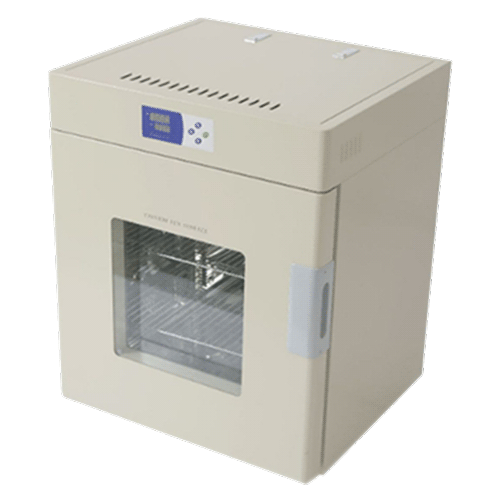
The advantage of forced convection does not mean perfect uniformity at any point. The air follows the path of least resistance: along the walls, between baking sheets, through free gaps. A tightly packed chamber, tall containers or a baking tray blocking the flow outlet will change the distribution pattern. Therefore, the same set mode can give different results on an empty and a fully loaded shelf. This is important for laboratory work: comparing data from different batches is only permissible if the loading and arrangement of the samples are similar.
A standard sensor usually measures the temperature in the working chamber or in the circulation zone, and not the temperature of the powder itself. At the beginning of drying, the wet sample evaporates the water and remains cooler than the air. As it dries, its temperature approaches the ambient temperature, but local differences remain. The display reading cannot be automatically interpreted as the material temperature. If the technique is sensitive to heat, it is useful to control the process by the mass, condition of the sample and, if suitable equipment is available, by an independent sensor that does not interfere with the normal operation of the cabinet.
To remove moisture, it is not enough to simply circulate air in a closed loop. If the design provides for controlled air exchange or exhaust, they affect the drying speed and temperature distribution. When the circuit is closed, moisture accumulates in the chamber and the process slows down. With intense air exchange, moisture leaves faster, but fine dust can be carried out along with it, and the temperature may take longer to recover after opening the door. Specific capabilities should be checked from the product documentation, and not assumed based on appearance.
Which parameters to read on the card and which ones to clarify?
The product card sets the limits of applicability, but does not replace the methodology. IN vertical drying cabinet card you should look not at one number, but at a set of characteristics: temperature range, accuracy of maintenance, chamber volume, shelf design, control and protection. If a value is given without conditions, it cannot be transferred to any sample. For example, the uniformity stated for an empty chamber does not guarantee the same uniformity when fully loaded with wet pans.
| Parameter | What does it show | What to clarify |
|---|---|---|
| Temperature range | Lower and upper heating limits | What temperature is allowed for long-term operation, and what is the limit? |
| Uniformity | Temperature spread at chamber points | At what load, at what points and for an empty or filled chamber was the value obtained |
| Precision and stability | Maintaining a task and fluctuations over time | How the characteristic was measured and where the standard sensor is located |
| Volume and shelves | Geometric chamber capacity | Useful height, shelf pitch, permissible distance to air flow |
| Load | Permissible weight per shelf and total load | Shelf material, baking tray size, saving mode when fully loaded |
| Air exchange | Removing moisture from the working volume | Is there an adjustable hood and how does it affect the temperature? |
| Materials | Chamber, shelves, seals, sensor | Corrosion resistance, cleaning, possible transfer of impurities |
| Control and protection | Programs, timer, alarm, shutdown | What is included in the basic version and what is an option |
The maximum temperature in the description is not always equal to the long-term operating temperature. For some materials, a short-term rise to the upper limit is acceptable, for others it accelerates wear of the seals and impairs stability. If the documentation separates the maximum and operating temperatures, the mode is based on the operating temperature. If there is no such division, the upper limit value should not be considered recommended for daily work.
The heating power itself does not indicate how quickly the sample will warm up. The speed depends on the mass of the load, the thermal conductivity of the baking sheet, humidity, air exchange and the initial temperature of the chamber. The large volume of the chamber also does not mean that it can accommodate as many samples: payload is limited by shelves, air flow and weight capacity. Options like additional shelves or an interface do not automatically become standard; their presence must be confirmed for a specific performance.
Loading the chamber: air must pass through, not around, the sample
Forced convection only works where the air has a path. If the trays are placed close together and the containers block the flow, the fan will continue to operate, but less air will flow through the sample. As a result, moisture is removed unevenly: the side closest to the flow dries faster, while the area behind the obstacle remains wet. Therefore, the load is positioned so that there are gaps between the shelves and walls, and the flow is not directed directly into the open layer of light powder.
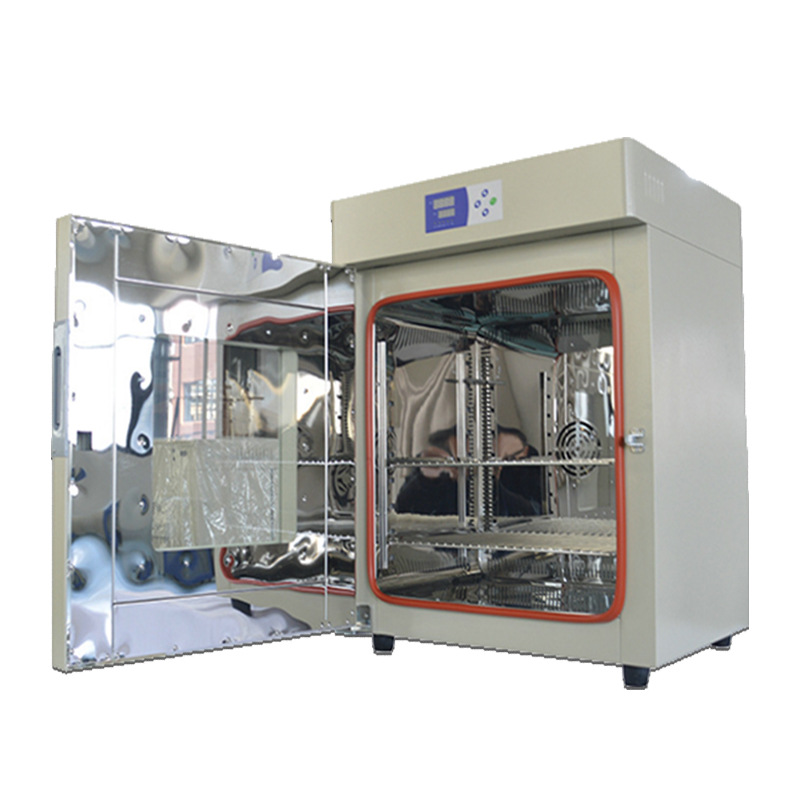
The thickness of the layer affects the path of moisture to the surface. A thin layer dries faster, but too thin a layer of light powder may be carried away or spread unevenly across the pan. A deep layer saves space, but a dried crust forms on top, and moisture remains inside. For reproducibility, it is better to record not only the temperature, but also the weight of the sample, the area of the baking sheet, the thickness of the layer and the position in the chamber. These notes are more useful than the general phrase "dried until dry."
Closed lids and tightly sealed containers trap moisture. If a cover is needed to keep out dust, you need to understand that it changes heat transfer and can turn drying into a slow temperature soak. A ventilated lid or loose placement on the baking sheet gives different results. The material of the baking sheet also matters: a metal substrate transfers heat faster, a ceramic one has greater thermal inertia, and an incompatible coating can become a source of impurities. For each task, dishes and substrate are selected separately, and not just according to the convenience of size.
When checking the mode, it is better to place replicas on different shelves and in different zones, and not just in the center. This shows the actual spread in the selected configuration. Opening the door interrupts the flow and reduces the temperature; The more often it is done, the less sense it makes to compare the drying time with the passport guideline. If the method requires intermediate control, it is better to plan it in advance and equally for all samples in the series.
Modes for different sample preparation tasks
Drying mode is not only about temperature. This includes air speed, pan position, duration, time of unloading and cooling method. For one task, holding at a constant temperature is sufficient; for another, a stepwise rise or more careful heating is needed. Specific values are set according to the heat resistance of the material and the requirements of the methodology; It is impossible to transfer the regime from another powder without checking.
Drying wet powders and sludge
For wet powder, two extremes are dangerous: heating too quickly to form a dense crust, and holding too long at a temperature that gradually changes the material. It is better to start with the conditions acceptable for the most sensitive component, rather than with the maximum capabilities of the cabinet. If the sample tends to clump, reduce the layer thickness and check that the pan is not blocking the flow. The end point is confirmed by mass or by an agreed criterion, and not by appearance alone. After unloading, the hygroscopic powder can quickly pick up moisture from the air, so cooling and weighing conditions must be the same for all samples.
Drying dishes, baking trays and tools
Dry utensils and instruments separately from samples if there is a risk of transferring dust or contamination. Residual water in closed cavities, under seals and in threads remains longer than on an open surface. Therefore, the position of products during drying is more important than it seems: water must have a path for drainage and evaporation. Do not mix clean dishes and samples with unknown composition in one load. For laboratory practice, it is useful to separate the sample and accessory runs, even if the same cabinet is used.
When an oven does not replace an oven or reactor
The forced convection oven should not be described as a sintering oven, reactor or any atmosphere unit. Unless the card specifically acknowledges high temperature conditions, an inert environment, or a special gas exchange system, such conditions are not attributed to the product. Heating in air is suitable for removing moisture, but not for processes that require a reducing atmosphere or precise control of gas composition. Working with flammable volatile substances requires a separate safety assessment based on guidelines and regulations, not just the choice of temperature.
Risks that appear after unloading
Some problems are discovered not during drying, but later: during weighing, sifting or redispersing. In order not to explain them by “features of the powder”, it is worth checking several typical reasons.
- Surface overheating. The sensor shows the temperature of the chamber, and the thin layer near the heated shelf may warm up differently. An externally dry sample has sometimes already changed color or tended to aggregate.
- Uneven loading. Replicas from different shelves may have different residual moisture. If this has not been tested, conclusions about reproducibility are premature.
- Transfer of impurities. Dust, particles from the previous sample, corrosion or substrate material may change the result. Cleaning the camera and shelves should be part of the methodology, and not a one-time event.
- False reproducibility. Different initial humidity, sample weight, layer thickness and door opening time result in a scatter that is mistakenly attributed to the properties of the material.
- Re-hydration. A hot, hygroscopic powder may absorb moisture when cooled in air. Cooling conditions and intervals before weighing must be the same.
Security requires special attention. Hot shelves, baking trays and the door remain a source of burns after switching off. Fine dust can be carried by the current, and volatile substances can accumulate in the chamber or room. The procedure for loading, unloading and cleaning is determined by the equipment manual and internal laboratory rules; The article on mode selection does not replace these documents.
How to check the mode, go to the series and what to report for selection
The test begins with a representative sample, and not with an average mixture of different batches. The initial mass, estimated humidity, material and size of the baking sheet, layer thickness, position in the chamber, set temperature, time and actions performed during the process are recorded. If the technique allows, a mass loss curve is constructed: it shows when the change in mass becomes small and when further exposure no longer gives a practical effect. For hygroscopic materials, it is important to cool and weigh samples equally, otherwise the difference in mass will reflect room conditions rather than drying.
To check homogeneity, several replicas are placed in different zones and not only the final mass is compared, but also the condition of the material. An empty chamber and a chamber with a loading simulator may behave differently; this is normal if the difference is explainable and taken into account in the methodology. An independent temperature sensor is useful, but it is not installed in such a way that it blocks the flow or changes the operation of the standard control. It is better to formulate acceptance criteria before testing: residual moisture or constant weight, no noticeable color change, no foreign inclusions, preservation of flowability and repeatability between replicates.
The transition from one sample to a series requires not a simple increase in loading, but the preservation of the same conditions per unit area. If the layer on the baking sheet is increased, the drying time changes. If several samples are placed instead of one, the air flow changes. Therefore, when scaling, a new configuration is fixed and the control is repeated, rather than transferring time from a single experiment. For serial work, it is convenient to keep a log where the batch, load, position, mode and result are indicated; this helps to separate changes in material from changes in conditions.
To select a cabinet and test drying, it is useful to report: the type of material and its thermal sensitivity, initial and target humidity, the weight of one sample and the planned number of samples, bulk density, permissible temperature, material and dimensions of the dishes, air exchange requirements, accessible communications and the required level of documentation. This information is more important than the general wish for a “bigger closet.” From them you can understand what capacity and configuration of shelves are really needed, what parameters should be specified in the card and what to check on your own material.
Official website TENCAN helps to verify brand positioning and the composition of equipment lines, but the final choice is made based on the documentation of a specific design and the results of trial drying. If the meaning in the description is contradictory or the units are in doubt, it is not corrected with a guess: it is better to fix the question and clarify the condition under which the characteristic is confirmed. This approach reduces the risk of transferring to the sample a parameter that relates to a different configuration or to other test conditions.