
A planetary ball mill grinds the sample due to the impact-attrition action of the grinding media inside the grinding bowl. The process goes quickly, and for this reason the glass ceases to be just a dish: it determines what will go into the sample along with the crushed material and what will leave the sample - moisture, oxygen, volatile components. For powders sensitive to air and moisture, a conventional open glass does not provide control over the atmosphere, and the problem is solved by a closed volume with the possibility of pumping out or replacing gas. A vacuum grinding bowl for a planetary mill is a tool for just such work. But choosing it does not come down to the question of whether it will fit the mill: the lining material, wear, cleaning, the actual workload and the permissible level of impurities are important. Below are practical criteria that make sense to check before ordering and before the first trial grinding.
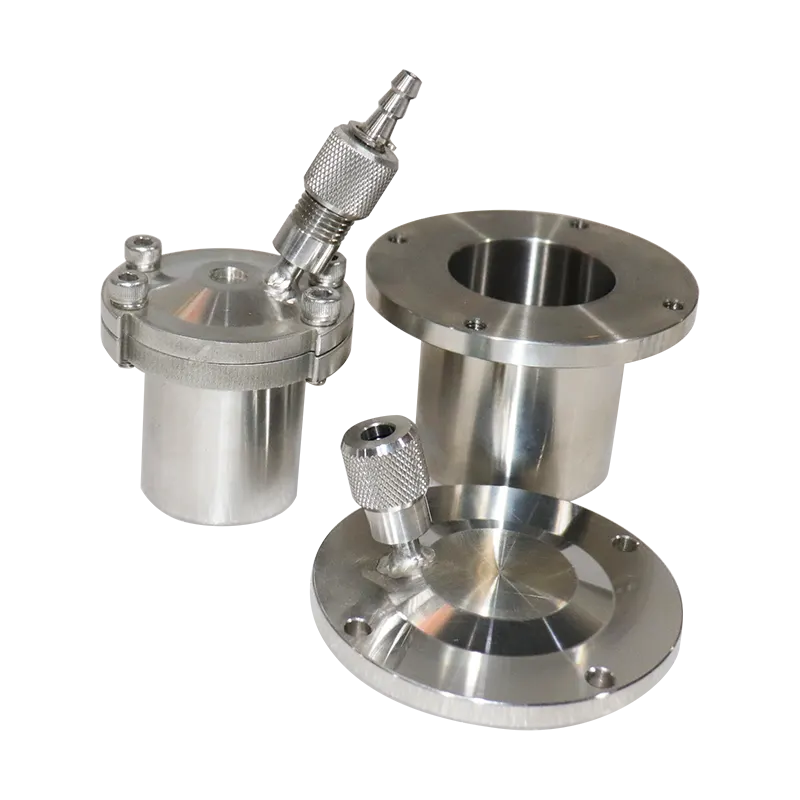
When closed volume is really needed
Grinding in a planetary mill is accompanied by two processes simultaneously: a reduction in particle size and surface renewal. A fresh surface is chemically active. The smaller the particle, the higher the proportion of surface atoms and the more readily the material reacts with oxygen, moisture and carbon dioxide that are in the air inside the glass. For some materials, this does not mean slight oxidation, but a change in phase composition: an increase in the oxide or hydroxide content, loss of magnetic characteristics, and a shift in the results of X-ray phase analysis. That is why the question of the atmosphere inside the working volume arises earlier than the question of grinding fineness.
Signs that atmospheric control is really needed are quite specific: metal powders that are prone to oxidation; hydrides; compounds that react with moisture; materials in which the formation of an oxide film during grinding is undesirable; composites, where it is important to maintain the phase boundary. The second typical case is the opposite - the sample itself releases volatile components or solvent vapors, and then the closed volume protects not the sample, but the laboratory and neighboring samples.
It is worth distinguishing between similar but different tasks: protection from oxygen, protection from moisture and retention of volatile components. Pumping reduces the partial pressure of gases and accelerates the removal of moisture from the surface, the inert environment prevents reaction with oxygen, and the hermetic seal simply prevents the contents from exchanging with the room air. The same glass can help in all three cases, but the mode of operation will be different and selected experimentally.
Separately, it should be said about what a closed volume does not do. It does not convert regular grinding into cryogenic grinding: air cooling, running water cooling, and liquid nitrogen cooling are different schemes, and the reduced pressure inside the beaker does not replace any of them. It also does not eliminate heat from friction and impact - on the contrary, in a vacuum, heat removal is worse. And finally, it does not eliminate the requirements for the sample material itself: if a substance decomposes when heated, the closed volume will only slightly shift the moment when this happens.
How a vacuum grinding bowl works and what changes during grinding
Structurally, such a glass differs from a conventional one in that it has a sealed shutter and a unit through which air is removed from the working volume and, if necessary, filled with inert gas. The number of connections and valves, seal type, and delivery contents—whether it includes a pump, adapters, or pressure controls—are determined by the specific model and order configuration. This information is taken from the current product card, for example from the description vacuum grinding bowl for planetary mill, and not from general considerations: the solutions differ for different series.
Evacuation, gas replacement and sealing are three different tasks
Pumping removes most of the air and along with it moisture from the surface of the particles and from the walls of the glass. Gas replacement solves another problem: after pumping out, the volume is filled with argon or nitrogen, and further grinding occurs in an environment with a low oxygen content. Tightness is responsible for ensuring that the achieved condition is maintained throughout the entire cycle, including heating from friction and shock loads on the valve.
Practical conclusion: it is not enough to pump out the glass once and close the valve. Gases adsorbed on the walls and on the grinding media are gradually released into the volume, therefore, in critical cases, several cycles of “pumping - filling with inert gas” are used. How many cycles are needed depends on the residual oxygen requirements; There is no universal number, and it is checked by analyzing the sample, and not by using a pressure gauge.
It is also important how the state of the atmosphere is controlled. The vacuum gauge reading refers to the volume of the pump and connecting lines, and not to the gas environment between the powder particles. The real assessment is the result of the analysis: the oxygen, moisture or oxide phase content of the sample after grinding compared to the original material.
What does reduced pressure give and what does an inert environment give?
Reduced pressure reduces the partial pressure of oxygen and water vapor, that is, it slows down oxidation and humidification. At the same time, it impairs heat removal: convection weakens, and most of the heat escapes through the walls, the holder and the thermal conductivity of the residual gas. In practice, a glass in a vacuum heats up noticeably more than in the same mode with air inside. Heating affects both the sample (agglomeration, phase transitions, decomposition) and the compaction, so cycles are often made intermittent, with pauses for cooling.
An inert environment at normal pressure retains the usual heat removal and often turns out to be a simpler solution if the task is precisely protection from oxygen, and not removal of moisture. Vacuum is preferable when moisture interferes or when the gaseous environment itself must be excluded. Both options require testing on a specific material: residual oxygen, residual moisture, and changes in thermal conditions affect the final result.
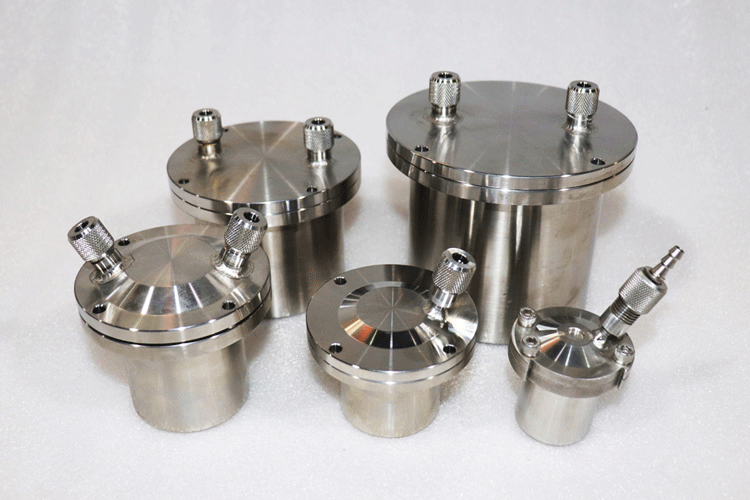
Material of lining and grinding media: wear against the introduction of impurities
The introduction of impurities during grinding is determined not only by the glass. Contact with the sample includes the grinding media, the inner surface of the chamber and, to a lesser extent, the seal. Therefore, it makes no sense to choose the material of the glass separately from the material of the balls: the pair “glass - grinding bodies” works as a single system, and it is this system that determines what gets into the sample.
The general pattern is this: the harder and more wear-resistant the material, the less its abrasive wear, but the more noticeable the consequences if it does wear out. Metallic materials provide iron, chromium, nickel, cobalt, tungsten; ceramics - zirconium, aluminum, silicon, yttrium. Polymer coatings and elastomers scratch the sample less, but they themselves wear out faster and are less resistant to heat and aggressive solvents. Tungsten carbide, ceramics and zirconia are not synonymous with zero contamination: they are just different sets of elements that may end up in a sample.
The selection criterion is formulated through analytics, and not through purity in general. If the sample is sent for X-ray diffraction analysis, it is critical what phases the lining material can produce. If magnetic properties are measured, ferromagnetic contamination is not allowed. If the content of microelements is determined, those elements that coincide with those being determined are important. In other words, the most inert material is a relative concept, and no option provides absolute zero pollution.
The second factor is the ratio of the hardness of the sample and the lining. If the sample is harder than the chamber material, the chamber will wear out, and the faster the grinding energy and cycle time, the higher the grinding energy. The third factor is the environment: wet grinding with a solvent changes friction and at the same time places demands on the durability of seals; dry grinding produces higher abrasive wear on the walls.
Dry and wet grinding in a closed volume
In a closed glass, the difference between dry and wet grinding is more pronounced than in an open one. In wet grinding, liquid occupies part of the volume, changes the movement of the balls and participates in heat removal; at the same time it creates vapor pressure, which must be taken into account when sealing and pumping. Some solvents are not compatible with seal elastomers, and this limitation does not appear immediately, but rather after several cycles.
It is also worth distinguishing between particle destruction, disagglomeration and mixing. Grinding reduces the size of the primary particles; disagglomeration only breaks up existing aggregates without changing the size of the particles themselves; mixing redistributes the components without noticeable changes in particle size. All three processes occur in one apparatus, and from one change in the particle size distribution it is impossible to automatically judge which of them dominates.
You can control wear without special equipment: weigh the glass and grinding media before and after a series of cycles, inspect the inner surface with side light, compare the result of the analysis of impurities with the source material. Regular recording allows you to notice the moment when the glass-ball pair is no longer suitable for sensitive samples, and transfer it to less demanding tasks.
The practical procedure is as follows: determine which elements or phases are unacceptable in the sample; choose a pair of “glass - grinding media” with a margin of wear resistance; check the result with a control grind. Durability is not an end in itself here: a consumable element that wears out predictably and is controlled by mass and analysis is often more convenient than a material that suddenly produces a large chip.
Planetary Mill Compatibility: What to Check Before Ordering
A vacuum cup is a heavier and more complex part than a regular one. It does not become compatible just because it was released for planetary mills in general: different series have different mounting dimensions, fixation method and maximum weight that the drive and holder allow. Therefore, the first step is to check the geometry and fastening against the documentation for a specific mill, and not against a photograph.
Geometry, mounting and weight
Check the outer and seat diameter, height, presence or absence of its own clip, method of fixation in the holder and permissible weight on the seat, taking into account the fact that the glass will be filled with balls and material. It is separately specified whether the mill operates with one glass or requires symmetrical loading of several. Imbalance at high speed is a source of vibration, noise and accelerated wear of the drive, so asymmetrical installation is permissible only where it is provided for by the design.
Speed, Heat and Workload
Rotation speed and centrifugal acceleration determine the impact energy, and therefore the intensity of wear. A vacuum cup of the same geometry as a regular one, when closed, heats up more, and this limits the duration of the continuous cycle. A reasonable practice is to set cycles with pauses, monitor the temperature of the case and not transfer the mode selected for a regular glass to a vacuum one without checking.
Separately, it is worth distinguishing between related concepts, which are often confused during selection and load planning.
| Concept | What does it mean | A typical selection mistake |
|---|---|---|
| Volume of one chamber | Geometric grinding bowl capacity | Consider it as a working load of powder |
| Total volume of the set | The sum of the volumes of all glasses installed on the disk | Expect a proportional increase in sample mass per cycle |
| Workload | The mass of grinding media and material at which grinding is stable | Transfer the fill factor from one ball diameter to another |
| Sample weight | Weight of powder without grinding media | Confuse it with the mass of the entire loaded glass |
| Performance | Sample weight per cycle, taking into account grinding time and cooling pauses | Evaluate it only by the time of active rotation |
Neither the chamber volume nor the total volume of the kit indicates how much powder can be loaded per cycle. The working load depends on the diameter of the balls, their number and properties of the sample and is determined experimentally. Time throughput is the sample weight per cycle, including grinding and cooling pauses, and is important when planning a batch.
Cleaning, Cross Contamination and Seal Maintenance
A sealed cup is more difficult to clean than an open one: it has seal slots, valve channels and sealing elements where particles from the previous sample remain. Cross-contamination during sample preparation is one of the most common sources of unreliable results, and it is solved not so much by intensive cleaning as by organization of work.
Basic rules: assign the glass to a specific material or family of materials; keep a journal where the latest samples are indicated for each glass; change seals according to condition, and not just according to the calendar; check for leaks before a critical cycle. The procedure for disassembly and cleaning, acceptable solvents and drying temperature are determined by the documentation of the specific product - there are no universal recommendations here, and an arbitrary choice of an aggressive solvent can ruin the seal.
The seal is a consumable element, and its condition directly affects the result. Loss of elasticity, microcracks, swelling after contact with a solvent lead to a slow loss of vacuum, which is easy to mistake for a feature of the material. Signs: unstable reproducibility, increase in oxide content in samples that should be protected, change in powder color compared to previous batches.
Grinding media are cleaned separately, and it is important not to mix balls from different materials in the same storage container. Sorting by diameter and material saves time and reduces the risk that the next cycle will include balls with remnants of a previous sample or bodies of another material accidentally left over from a previous job.
Before critical grinding, it is useful to carry out a simple tightness check and make sure that the valve maintains the condition set before the cycle. The methodology for such a check - holding time, permissible drop in readings, procedure - should be taken from the documentation for a specific glass, and not chosen arbitrarily.
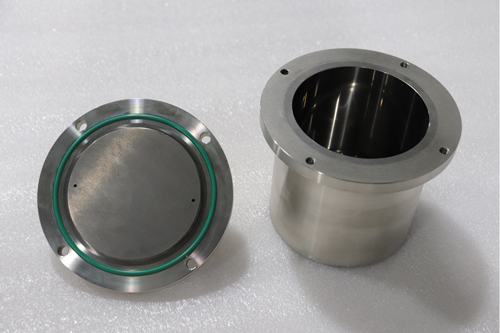
From laboratory sample to larger batch
The transfer of the regime from a small glass to a large one is not linear. As the volume increases, the ratio of the mass of the balls and the powder, the path that the ball travels, the conditions for heat removal, and the distribution of energy throughout the volume change. Usually you have to re-select the grinding time and filling, and sometimes you have to switch to another type of equipment: a bead mill, a drum mill on rollers and a planetary mill solve different problems and do not directly replace each other.
For the vacuum version, an atmospheric scale factor is added: the larger the volume, the larger the surface of the walls and the more adsorbed gases that need to be removed. The number of pumping cycles and holding time when moving to a larger glass are usually increased and checked by analysis.
It is also worth remembering the next step after grinding. If the ground powder is then sintered, it is a different operation and different equipment: e.g. sintering oven PLUS — independent installation with its own temperature conditions, working atmosphere and loading requirements. A grinding bowl is not a furnace, and it is correct to talk not about the compatibility of the glass with the furnace, but about the continuity of the chain of operations: the sample should not oxidize or gain moisture at the time of transfer from the glass to the next installation. If between grinding and sintering the sample comes into contact with air, all protection inside the glass becomes meaningless.
Finally, it is worth deciding in advance whether repeatability at the individual sample level is needed or whether batch reproducibility is sufficient. The required number of glasses and how strict the requirements for their cleaning and sorting of grinding media must be depends on this.
What to check with trial grinding and what data to report to the supplier
Test grinding is needed not to get results at any cost, but to check the stability of the process. It is useful to define acceptance criteria in advance and measure them before and after.
- sample material, its original size and method of measuring it;
- sample mass per cycle and target size;
- grinding medium: dry or wet, what solvent;
- whether a vacuum, an inert environment or a hermetically sealed closure is sufficient;
- mill model, mounting dimensions and permissible weight of the glass;
- diameter, material and number of grinding media;
- elements or phases whose content in the sample is critical;
- permissible heating of the sample and duration of the continuous cycle;
- Cleaning requirements between samples.
The reproducibility of the particle size distribution is checked in several repeated cycles; absence of agglomeration - comparison of dry and wet grinding; level of impurities - analysis sensitive to the material of the lining and balls; preservation of the atmosphere - by comparing samples crushed with and without pumping. The condition of the seals and ease of disassembly should also be assessed during the first cycle: if the glass is difficult to clean, errors will accumulate from sample to sample.
A vacuum grinding bowl is not a universal solution, but a tool with a specific area of application. It is justified where air and moisture inside the working volume really distort the result, and requires attention to compatibility with the mill, wear and cleaning management. A small set of sequential steps - determining acceptable impurities, checking the geometry and mass with the documentation of the mill, choosing a pair of "glass - grinding media", carrying out test grinding with predetermined criteria - gives more than trying to guess the most inert material. It is more convenient to check the complete list of equipment areas using catalog TENCAN, and specific dimensions, materials and completeness - according to the current product card.