
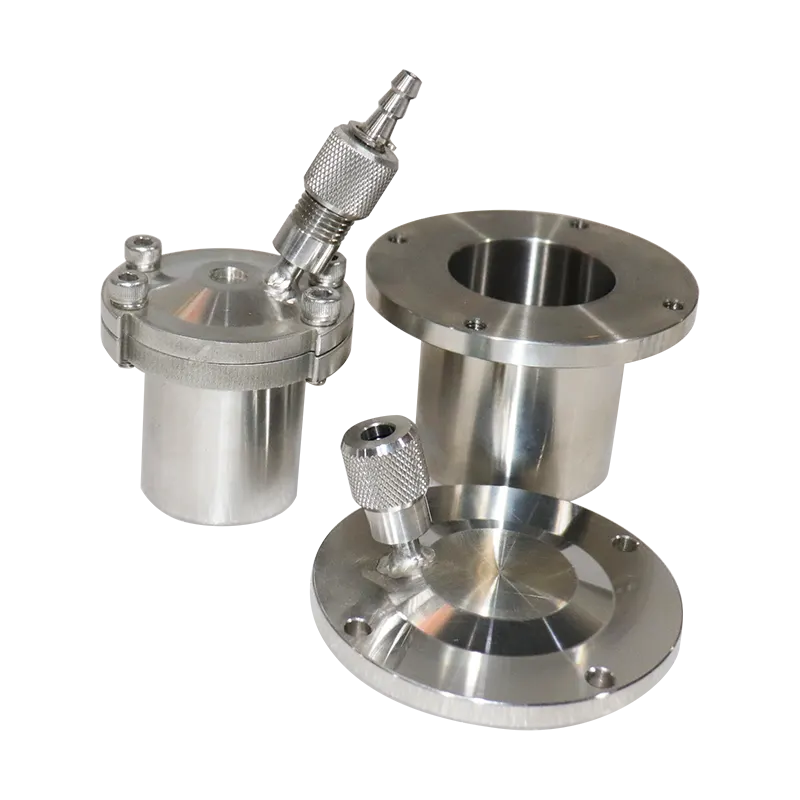
The planetary ball mill is often perceived as the main element of a laboratory setup, while the grinding bowl seems to be an interchangeable accessory. In practice, it is the enclosed volume, the wall material and the condition of the seals that determine whether a representative sample can be obtained without appreciable carryover of impurities. Vacuum grinding bowl for planetary mill TENCAN refers to those consumables where the choice cannot be reduced only to volume: tightness, compatibility with a specific machine, abrasion resistance and the possibility of high-quality cleaning are important.
Below we consider a practical question: how to select a vacuum cup so that it solves the problem of the grinding medium, but does not create hidden problems with contamination, wear and fastening. Specific materials, sizes, volumes and permissible modes should be taken from the current product card and documentation for the mill. General principles help frame questions, but are not a substitute for checking compatibility.
Why does a vacuum cup require a separate choice?
In a conventional grinding bowl, the powder comes into contact with air, which occupies the free volume. With fine grinding, this can affect the oxidation of sensitive materials, moisture transfer and the behavior of the dust fraction. A vacuum cup allows you to reduce the amount of gas in the working volume, but the name itself does not reveal either the achievable residual pressure, the type of seal, or the material of the housing. This information must be confirmed for the specific product.
In addition, a vacuum beaker is not just a container with a lid. It combines a housing, a sealing element, a pipe or valve, and mounting surfaces that must withstand installation in a planetary mill. If the cap or seal is not designed for the selected mode, the vacuum may deteriorate and the sample may not be exposed to air as intended. Therefore, when selecting, it is useful to separate the questions: what happens to the powder, what happens to the gaseous medium, and what happens to the glass itself during rotation.
Vacuum in a glass and vacuum in a mill chamber are not the same thing
Sometimes “vacuum grinding” means operating the mill in a vacuum or inert chamber. This is a different design. The vacuum grinding bowl creates a local environment inside a closed volume, which is fixed in the planetary mill holder. The presence of such a glass does not mean that the mill itself has a vacuum chamber, and vice versa. When discussing with the supplier, you need to clarify where exactly the vacuum is created, how the tightness is controlled and what operations are performed before and after grinding.
For some applications, it is sufficient to reduce the amount of oxygen; for others, leakage through the seal, desorption from internal surfaces, or volatile components of the sample itself are critical. There cannot be a universal promise of a “completely inert environment” here: the result depends on the design, assembly, cleanliness of surfaces and material properties. If the card does not contain a confirmed residual pressure or composition of the medium, these parameters should not be speculated.
Material of housing and grinding media: resistance to the transfer of impurities
For a grinding bowl, the material has two functions: it must withstand mechanical stress and interact with the sample as little as possible. These are different requirements. The hard material reduces wear but is not necessarily chemically inert. Chemically resistant material may not perform well under high impact loads. Tungsten carbide, zirconium dioxide, ceramics and stainless steel behave differently, but the presence of one or another option in the assortment should be checked using the current card, and not inferred from the general name of the series.
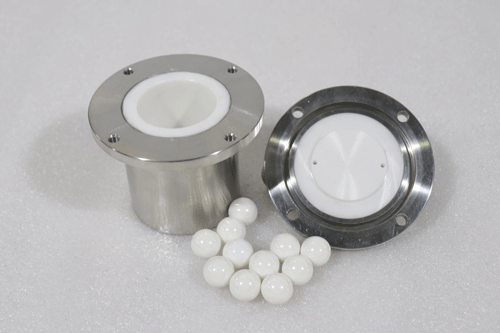
The second source of impurities is grinding media. If the ball material differs markedly in hardness and toughness from the lining, wear may be biased towards the softer element. There is no combination that guarantees “zero contamination” for any powder. It is more correct to pose the question this way: what elements are in contact with the sample, what is known about their wear in the chosen environment, and how the transfer of impurities into the sample is controlled.
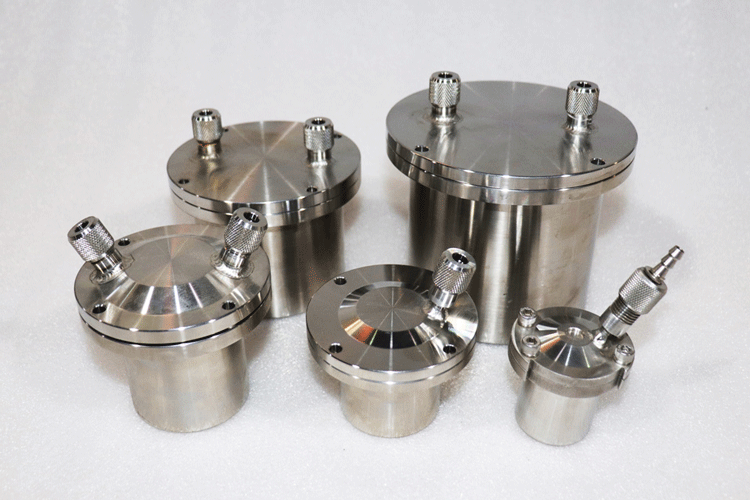
When choosing a material, it is useful to consider not only the hardness of the sample, but also its abrasiveness, tendency to stick, acidity or alkalinity after mixing with the liquid, and the acceptable level of metal or ceramic inclusions. For subsequent analysis, these inclusions can be an interfering factor even at low mass. If the analysis technique is sensitive to a certain element, the material of the cup and balls is checked specifically for this element, and not just according to the general description of “wear-resistant”.
Volume, loading and mass of sample: different values
One of the common mistakes when selecting is to mix the nominal volume of the glass with the amount of powder that can be loaded in one cycle. Nominal volume describes the geometric capacity. The working load depends on the density of the sample, the size and number of grinding media, the allowable free space and the load movement requirements. The mass of the sample is another independent quantity that is not equal to either the volume of the glass or the total mass of the load.
| Concept | What does it mean | What to clarify |
|---|---|---|
| Nominal glass volume | Geometric capacity of one vessel | Is the volume indicated for one glass or for a set? |
| Total volume | The sum of the volumes of all glasses in the set | How many glasses are actually used in the selected mill? |
| Workload | Amount of powder and grinding media allowed for grinding | Are there restrictions on weight and filling for a specific model? |
| Sample weight | Mass of analyzed powder without grinding media | Is the sample sufficient for further analysis? |
| Performance | Amount of material processed in a given time | Not to be confused with glass volume and single load |
When moving from a laboratory sample to a larger batch, you cannot mechanically increase all parameters. Coarseness, ball-to-powder mass ratio, rotation speed and grinding time are interconnected. If a product card confirms a certain volume, this does not mean that it can effectively grind any mass of material. For a vacuum cup, a free volume factor is added: a gas cavity that is too large may require a longer evacuation, and a load that is too dense may interfere with the movement of the balls.
Wear, cleaning and transfer of impurities
The wear of a glass is manifested not only in a change in appearance. Gradual loss of wall material, damage to sealing surfaces, and contamination of hard-to-reach areas can affect repeatability. For a vacuum product, the condition of the edges and seal is especially important: even a small defect can impair the seal. Therefore, the cleaning must be compatible with the material of the body, seals and valves; aggressive or abrasive products chosen “just in case” can themselves cause damage.
The cleaning procedure depends on the design. In general, first remove the bulk of the powder using a dry method, avoiding deep rubbing of the abrasive over the surface. Then apply the method permitted by the documentation for a specific material. Removable elements are cleaned separately if this is provided for by the design. After wet cleaning, it is important to ensure that the sealing areas and connections are dry so that solvent residues will not affect the next grind. It should not be assumed that the glass can be washed with any solvent or heated to any temperature: this information must be confirmed.
- Inspect seal and seating surfaces before each assembly.
- Do not use metal scrapers if they may leave marks on the work surface.
- Separate cleaning procedures for different materials so as not to transfer difficult-to-remove impurities.
- Keep the glass closed and dry if the instructions allow.
- Check for powder accumulation in valve or thread areas.
It is also worth considering that the transfer of impurities can come not only from the walls, but also from the grinding media, lid, seal and previous sample. If the analysis shows an unexpected element, the material of the glass cannot be immediately declared the cause. First, the entire chain is checked: sample preparation, balls, instrument cleanliness, possible contamination during sampling. Without diagnostic data, a specific malfunction is not considered proven.
Planetary Mill Compatibility: Geometry, Mounting and Mode
The vacuum cup must not only be suitable in volume, but also be correctly installed in the holder of a specific planetary mill. They check the external dimensions, seating elements, method of fixation, permissible weight, access to the pipe and the possibility of balancing. Even if two glasses are similar in appearance, this does not prove interchangeability. The mill manufacturer usually specifies the type of bowls and the maximum parameters at which safe operation is maintained.
Rotation speed, cycle time, and sample properties affect heating and loading. A vacuum cup may have a different heat transfer compared to a regular one, so you should not transfer the mode without checking. Air cooling, if provided, is also not the same as liquid nitrogen cooling: they are different methods. Conventional grinding should not be called cryogenic simply because a sample is heat sensitive.
Equipment from other sections of the site, such as a stainless steel dust-free crusher, is intended for pre-reduction of pieces and does not confirm the compatibility of the glass with a planetary mill. The crusher, mill and grinding bowl have different functions. If the sample is first crushed, this may change the original size and loading, but does not eliminate the geometry and compaction check.
What to tell the supplier for selection
For a meaningful answer, it is not enough to name a “planetary mill” and “a vacuum glass is needed.” It is helpful to list the mill model, holder type, volume required, number of beakers, sample material, sample size, target size, and allowable air contact. If wet grinding is planned, indicate the liquid and its quantity; if dry, the powder is prone to dusting and sticking. For sensitive materials, it is important which elements are unacceptable in the sample.
You also need to clarify how the vacuum will be created and controlled, which seals require maintenance, how to clean the glass, and what signs of wear are considered grounds for replacement. If the supplier does not provide a residual pressure value, you should not substitute it yourself. If the units in the description seem unclear, it is better to ask for confirmation than to correct the specification by guessing.
Test grinding
A trial grind helps identify not only the achievable fineness, but also practical limitations. First, the assembly and tightness are checked without a sample, if permitted by the instructions. A small representative sample and a minimum set of grinding media are then used to evaluate the behavior of the load. After the cycle, inspect the seal, internal surfaces and the absence of powder in areas where it should not accumulate. The result of the granulometric analysis is compared with the measurement conditions: the distribution of particles depends on the method, sample preparation and the tendency to agglomerate.
You should not expect that the same mode will give the same result for different materials. For brittle powder and viscous material, the failure mechanisms are different; Disagglomeration is also not equal to the grinding of primary particles. If, after grinding, an increase in particle size is observed according to analysis, aggregation is possible, and not necessarily insufficient grinding. In this case, not only the time is changed, but also the method of sample preparation, medium and loading.
Practical checklist before ordering
- Specify the exact model of the planetary mill and the acceptable type of grinding bowl.
- Check that the volume indicated is for one product and not for a set, and relate it to the workload.
- Request confirmed housing, seal and grinding media material, as well as environmental and cleaning restrictions.
- Find out which elements are in contact with the sample and how their wear is controlled.
- Do not consider the vacuum cup to be automatically compatible with any mill TENCAN or with equipment from another section.
- Discuss trial grinding and acceptance criteria: tightness, absence of damage, reproducibility of cleaning.
- Save test conditions: sample weight, number and size of balls, environment, time and speed.
Choosing a vacuum grinding bowl is not only a choice of accessory, but also a choice between correct sample preparation and a hidden source of error. It is wise to start with the sample task, then check the material and cleaning, and then match the geometry and mode to the specific mill. For the latest product information, see vacuum grinding bowl card, and general directions of equipment TENCAN — on сайте www.tencanballmills.com. If a parameter that affects the safety or purity of the sample is not specified for the selected model, it must be clarified before grinding, and not inferred from the name of the series.