
Preparing a sample for granulometric analysis, for sintering or for subsequent synthesis almost always comes down to the same question: how to obtain a powder of the required size without changing the phase composition of the material, without introducing unnecessary impurities and without losing reproducibility from sample to sample. A planetary ball mill solves most of these problems, but there is a class of materials where mechanical action alone is not enough. These are submicron and nano-sized powders that are prone to agglomeration; concentrated suspensions and pastes with high viscosity; plastic and layered materials in which fresh surfaces of particles stick together faster than further destruction occurs. In such cases, a combined effect is used: planetary rotation of the grinding bowl and ultrasonic vibrations.
Ultrasonic planetary ball mill is a separate category of equipment in the line TENCAN. The purpose of this article is to analyze the practical issue of selection: how to coordinate the mode, grinding bowl and grinding media so that the grinding result is reproducible. We will talk about the meaning of parameters, the physics of processes and limitations, as well as what information needs to be clarified in the card of a specific model and checked by trial grinding.
When mechanical grinding is not enough
A typical laboratory situation looks like this: there is a powder with a known initial size, there is a requirement to obtain a fraction smaller than a certain threshold, and there is a mill that, in principle, reaches this threshold. The difficulty is discovered later - when repeated analysis shows that the particle size has stopped decreasing, and the suspension or powder does not behave as expected. There are usually three reasons, and all of them are related not to a lack of mechanical energy, but to the behavior of the material itself.
The first reason is agglomeration. Fresh particle surfaces have high surface energy, and as size decreases, the gain from further destruction becomes less than the gain from adhesion. Mechanical grinding continues to crush aggregates, but at the same time creates new ones, and the process reaches saturation. The second reason is plasticity. Soft metals, polymers and layered materials are not destroyed upon impact, but are deformed and stick to the grinding media and glass walls by cold welding. The third reason is the viscosity of the medium: in a concentrated suspension, particles are retained by the liquid, the impacts of the grinding media are softened, and grinding efficiency decreases.
It is important here to distinguish between three different processes that are often referred to by the same word. Grinding is a reduction in the size of primary particles. Disagglomeration is the separation of existing aggregates into primary particles without further destruction. Mixing is the redistribution of components without changing their size. For nanosized powders, the main task is most often deagglomeration, and it is solved not so much by impact energy as by shear in a liquid medium. If you mix these tasks, it is easy to get a mode that crushes well, but does not separate aggregates, or vice versa - gently disperses, but does not reduce coarseness.
An ultrasonic planetary ball mill is designed for this case: the mechanical action of the grinding media is supplemented by ultrasonic vibrations, which create cavitation and local shear flows in the medium. This is not a universal solution and not a replacement for the correct selection of the mode, but in a number of problems it is the combination of two types of influence that allows you to get out of the saturation mode, when regular grinding no longer gives an increase.
Design and operating principle of ultrasonic planetary ball mill
The basis of the design is a planetary mechanism. The grinding glasses are mounted on a rotating disk, and each glass simultaneously rotates around its own axis. The resulting centrifugal forces press the grinding media against the walls of the glass, and the complex trajectory of movement leads to the balls repeatedly passing through the same volume, causing impacts and creating intense friction. The energy transferred to the material depends on the geometry of the installation, gear ratio, rotational speed, size and density of the grinding media, as well as on the properties of the sample itself.
The second subsystem is the ultrasonic unit. The vibration source (piezoceramic transducer) transmits high-frequency mechanical vibrations to the working area. The specific implementation of the connection between the transducer and the working area - transmission through the wall of the glass, a submersible emitter into the suspension volume, or an ultrasonic bath - determines exactly how the energy enters the sample and how evenly it is distributed throughout the volume. These details relate to the design of a specific model, so they should be clarified according to the technical documentation and product card, and not transferred by analogy with another device.
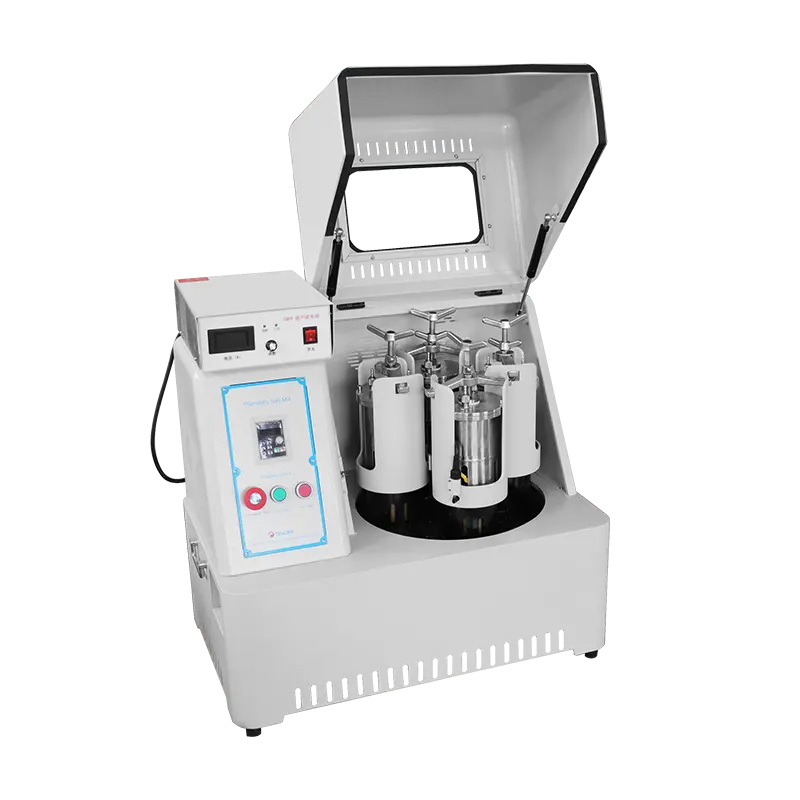
Combining planetary rotation and ultrasound
Planetary rotation is responsible for the transfer of mechanical energy: the balls crush particles and renew the surface. Ultrasound works differently. In a liquid medium, at a sufficiently high intensity of vibrations, cavitation occurs: bubbles form, grow and collapse, creating local areas of high pressure and microflow. These microcurrents separate particles from the surfaces of balls and walls, destroy aggregates along the contact boundaries and maintain the suspension in a homogeneous state. In practice, this means that ultrasound supports the operation of the mechanical part, preventing it from stalling at the saturation stage.
This combination also has a downside. Ultrasound introduces additional energy into the system, which almost entirely turns into heat. Cavitation can change the surface chemistry of particles and destroy not only aggregates, but also the particles themselves - including fragile crystals of layered compounds, polymers, and biological samples. Therefore, ultrasonic treatment is selected according to intensity and duration, and is not turned on “to maximum” by default: in some systems it is this, and not grinding, that determines the final state of the material.
What ultrasound doesn't do
Ultrasonic treatment does not replace grinding media and does not compensate for gross errors in the ratio of balls and material. It does not guarantee a nanoscale result for any sample and does not eliminate wear of working elements. Finally, ultrasound does not turn conventional grinding into cryogenic: cooling the installation and cooling the sample are two different things, and we can only talk about a cryogenic process if we have truly appropriate equipment and coolant in the circuit. Conventional air cooling is not cryogenic, no matter how low the temperature appears in the installation description.
Grinding bowl loading, sample weight and ratio of grinding media to material
The most common mistake when posing a problem is confusion between volumes and masses. The grinding bowl has a nominal volume; for the installation - the number of glasses and their total volume; Inside the glass, part of the space is occupied by grinding bodies, and part by the spaces between them, into which the material or suspension falls. Therefore, the indicated volume of the glass does not mean at all that the same volume of powder can be loaded: the working load is always less than the nominal one, and this is not a limitation of a specific model, but a consequence of the geometry of the balls.
The key parameter is the ratio of the mass of grinding media to the mass of the material. It is this, along with the density and size of the balls, that determines how much energy each particle receives. A small amount of material with a large number of balls increases wear and the transfer of impurities, and a significant part of the energy is spent on collisions of balls with each other. Too large a load reduces the chance of effective collisions and leads to uneven grinding from batch to batch.
In a planetary mill, the filling factor of the glass is also important: if there are too few balls, the material does not move throughout the entire volume; if there is too much, the balls lose mobility and the impact energy drops. For wet grinding, the volume of the liquid phase is added to this: the liquid should fill the spaces between the balls and the material, providing mobility, but not dilute the suspension so much that the impact and shear effects become meaningless.
Numerical loading recommendations are specific to a specific cup size and installation. It is impossible to transfer them from one apparatus to another: a different gear ratio, a different diameter of the glass and a different density of the balls will give a completely different energy to the particle. The correct procedure is to look up the acceptable ranges in the model documentation, and then test them on a small sample of your material, recording the result after each change.
Material of grinding bowl and grinding media: wear and impurities
The material of the glass and grinding media performs two functions: it transfers energy and remains chemically inert in relation to the sample. The requirements are contradictory, because the harder and denser the working element, the more effective the grinding - and the higher the risk of its own material getting into the sample. Any grinding is accompanied by wear; the question is not whether there are impurities, but what exactly elements get into the sample and whether this interferes with further analysis.
The choice of material is determined by the hardness and abrasiveness of the sample, the requirements for cleanliness and the energy of the regime. For soft and medium-hard materials, where it is important to avoid metal contamination, non-metallic grinding media are used. In line TENCAN are presented, in particular, agate grinding balls: natural agate is chemically inert, does not introduce metals and is suitable for tasks where the elemental composition of the sample is controlled.
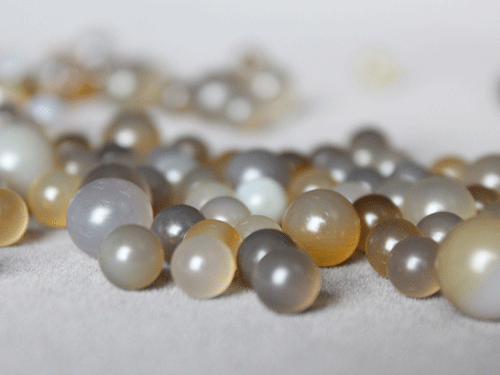
Agate balls have limitations that should be considered in advance. Agate's density is lower than most metal and oxide materials, so the impact energy for the same ball diameter is less. Agate is fragile: under intense conditions and when working with very hard or abrasive materials, it can chip and fragments will get into the sample. This makes agate balls a poor choice for rough grinding of hard ceramics and for long-term high-energy conditions, but a reasonable choice for disagglomeration and soft grinding, especially in combination with ultrasonic action, where shear rather than impact takes on the main job of breaking up aggregates.
The compatibility of grinding media with a specific apparatus and glass is checked separately. The material of the balls must match the material of the beaker lining: a combination in which the beaker is noticeably harder or noticeably softer than the balls leads to either rapid wear of the beaker or contamination of the sample. The size and number of balls are selected for the task: large balls provide impact and are suitable for coarse grinding, small ones increase the contact area and work for shear and fine grinding.
A separate practical issue is cleaning. Non-metallic materials require careful washing and drying between samples; the remains of the previous sample in pores and microcracks are invisible visually, but give false traces in the analysis. There is no single cleaning regime: it depends on the material of the balls, the glass and the sample itself. And most importantly: even an inert lining does not mean a complete absence of contamination - it is more correct to talk about reducing the transfer of impurities to a level acceptable for a specific task.
Dry and wet grinding, medium and thermal conditions
Dry grinding is technologically simpler: there is no need to introduce liquid and then remove it from the product. But it has predictable limitations - dusting, sticking to walls and balls, and the formation of aggregates. Wet grinding usually gives a narrower particle size distribution and is better suited for disagglomeration, but requires the selection of a liquid: it should not dissolve the sample, react with it, or enter into side reactions when heated. In addition, the removal of liquid after grinding itself can glue the particles back into aggregates if drying is unsuccessful.
For ultrasound, the presence of a liquid medium is fundamental: cavitation occurs precisely in the liquid. Therefore, the main application area of the ultrasonic planetary ball mill is in processes where the sample is in suspension or paste. If the task requires exclusively dry grinding, the role and mode of the ultrasonic unit must be clarified according to the documentation of the specific model: the mechanism of action in a gas environment differs from cavitation, and it cannot be assumed by analogy.
Thermal conditions are the second most important factor after loading. Mechanical energy expended on impact and friction turns into heat, to which heating from ultrasound is added. An increase in temperature inside the glass affects the sample: phase transitions, oxidation, decomposition, and changes in plasticity are possible. It is important here not to mix two different quantities: the temperature of the working space or thermostatic circuit and the temperature of the sample itself are not the same thing, and one cannot judge the second by the first value.
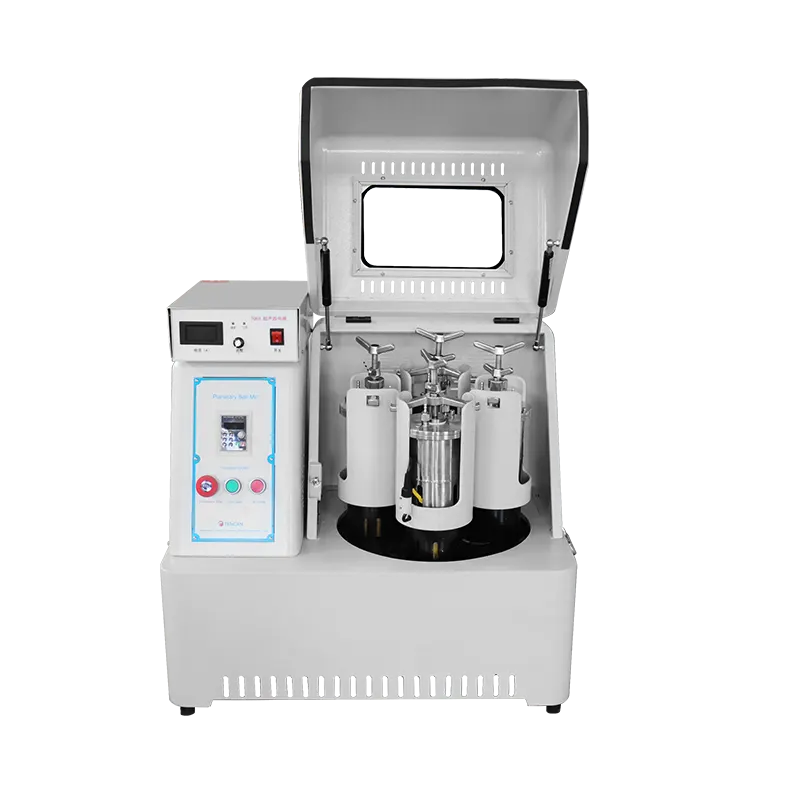
Cooling also varies. Air cooling removes heat from the case and is not cryogenic. Cooling with liquid nitrogen is a separate technology with its own requirements for the materials of the bowl and grinding media, for tightness and for handling condensate; it cannot be attributed to installation without confirmation. In practice, an intermittent mode is often sufficient: short grinding cycles with pauses, during which the system has time to release heat. But this technique also requires temperature control, and not the assumption that the sample does not heat up.
Achievable fineness and control of the result
The final particle size is not a characteristic of the mill, but the result of the combined action of many conditions. It depends on the hardness and ductility of the material, the initial particle size distribution, the density and diameter of the grinding bodies, their ratio to the sample mass, rotation speed, processing time, properties of the liquid medium and ultrasound intensity. The value indicated in the catalog as a typical minimum refers to specific conditions and is not guaranteed for any sample.
Equally important is how exactly the result is measured. Laser diffraction gives values of D10, D50 and D90, but the procedure itself involves dispersing the sample, and if the aggregates are destroyed in the measuring cell, the instrument will show the size of the primary particles, not what is actually in the powder. Electron microscopy shows the shape and degree of aggregation, but it is difficult to obtain a statistically reliable distribution from it. The BET method gives a specific surface area, which indirectly indicates the size, but depends on the porosity and shape of the particles. It is incorrect to compare the results of different methods with each other in absolute numbers.
The practical conclusion is simple: the readiness criterion must be set in advance and using one method chosen as the main one. If the result is assessed by laser diffraction, the dispersion conditions during the measurement are fixed and repeated from sample to sample. If microscopy is used, it is specified in advance what is considered an aggregate and what is considered a primary particle.
Sample selection requires special attention. The material in the glass is distributed unevenly: larger or denser particles accumulate near the walls and at the bottom, and small ones accumulate in the upper part of the suspension. A sample taken from one location may give a biased picture. For wet-milled products, the effect of drying is added: if the suspension is dried before analysis, aggregates may re-form and the measurement will show a different state than the product was in the mill.
Selection of mode, data for trial grinding and compatibility check
The selection of a configuration begins not with the choice of mode, but with a description of the task. The equipment is selected for the material, and not vice versa, so it is useful to formulate in advance what exactly needs to be obtained and what restrictions cannot be violated.
| What to clarify | Why is this important |
|---|---|
| Material and its composition | Determines hardness, ductility, chemical resistance and acceptable materials of working elements |
| Initial size and method of its measurement | Without a baseline, it is impossible to assess whether the regime has produced results. |
| Target size and metric (D50, D90, specific surface area) | Different metrics lead to different readiness criteria |
| Sample weight per glass and total quantity | Determines the ratio of grinding media and material and the number of parallel bowls |
| Acceptable impurities | Specifies the choice of glass material and grinding media |
| Dry or wet process, liquid medium | Affects the efficiency of deagglomeration and the operation of ultrasound |
| Temperature restrictions | Determines the need for cooling and intermittent operation |
| Further operations with powder | Sintering, analysis or coating place different demands on the product |
Next, it makes sense to test grind, done as an experiment, and not as an attempt to immediately obtain the final product. A reasonable sequence: fix the basic configuration (glass, grinding media, relationship with the material, medium), take a deliberately small sample and carry out several short cycles, controlling the coarseness after each. Change only one parameter at each step. This is slower than immediately setting the maximum values, but this is how it becomes clear which factor in a particular system determines the result: load, dispersion medium, treatment duration or ultrasound intensity.
Technical characteristics of a particular model - rotation speed ranges, available grinding bowl volumes, ultrasonic unit parameters, cooling options - should be taken from the product card ultrasonic planetary ball mill, and not transferred from descriptions of other devices. A general overview of the areas of equipment and consumables is given at website TENCAN.
What changes when moving from one sample to a series
When the regime is found on a small sample, the question arises of transferring the result to the series. The most predictable way is to increase the number of identical glasses operating in parallel: the geometry, energy per particle and the ratio of grinding media to material are maintained. The transition to a glass of larger diameter changes both the trajectory of the balls and the distribution of energy throughout the volume, so this scale requires a separate check. In addition, as the batch increases, the amount of heat that needs to be removed also increases, which means that the thermal regime has to be revised even with other parameters unchanged.
The compatibility of consumables is checked separately. If non-metallic grinding media, such as agate balls, are being considered for the application, it is necessary to ensure that they are consistent with the material of the particular bowl model and will withstand the selected energy. Agate is suitable for soft and medium grinding intensity and for disagglomeration; for hard abrasive materials and high-energy conditions, its use is limited by its fragility. Compatibility is not derived from a general similarity of purpose - it is confirmed by the characteristics of a particular pair of “grinding bowl - grinding media”.
Finally, it is worth remembering that selecting a mode does not replace the installation manual. Working with hazardous and reactive substances, with organic media and with nano-sized powders requires your own risk assessment, and the selection criteria discussed here relate only to the hardware part of the task. If information about a model is inconsistent or the units of measurement seem ambiguous, it is better to stop and clarify the parameter rather than making an assumption.