
A planetary ball mill is often perceived as a universal tool: you load the powder, set the speed, and get a fine fraction. In practice, the result is determined not by a single number on the control panel, but by a combination of sample properties, grinding bowl design, grinding media, processing time and cooling conditions. When ultrasonic exposure is introduced into equipment, another factor is added that can be useful, but requires intelligent mode selection.
In the catalog TENCAN presented ultrasonic planetary ball mill — equipment in which the planetary movement of the grinding bowls is supplemented by ultrasonic action. This combination is interesting primarily for tasks where conventional mechanical grinding is not enough or where it is important to reduce particle agglomeration. However, the name of the category does not negate the verification of the compatibility of consumables, thermal conditions and achievable fineness for a particular material.
Below we consider a practical question: how to approach the choice of mode and configuration of an ultrasonic planetary ball mill, without mixing the volume of the beaker with the load, the ultrasonic power with the temperature of the sample, and the passport minimum size with a guaranteed result. This analysis is useful for researchers, materials engineers and specialists who need to plan trial grinding and obtain reproducible results.
What does ultrasound change in planetary grinding?
In a planetary ball mill, the grinding bowls rotate around a common axis and at the same time around their own axes. The grinding bodies, under the influence of centrifugal and Coriolis forces, move inside the glass, creating impact and abrasive loads on the material. It is these loads that ensure grinding, and not just mixing. The degree of impact depends on the diameter of the glass, rotation speed, mass and size of the balls, filling and properties of the powder.
Planetary motion and ultrasound are different mechanisms
Ultrasound adds high-frequency mechanical vibrations. In a liquid environment, they can cause acoustic currents and cavitation effects, which promote wetting, destruction of loose agglomerates and more uniform distribution of particles. In dry powder, the transmission of vibrations and their influence depend on the design, filling and contact between particles. Therefore, effects observed in suspension should not automatically be transferred to dry grinding.
Ultrasound does not replace the correct selection of the glass and grinding media. If the material is ductile, prone to sticking or cold welding, additional energy can speed up undesirable processes. If the material is brittle and abrasive, wear of the cup and balls, rather than ultrasound, may be the main contributor to contamination. Understanding these differences helps you avoid turning an optional feature into a generic promise.
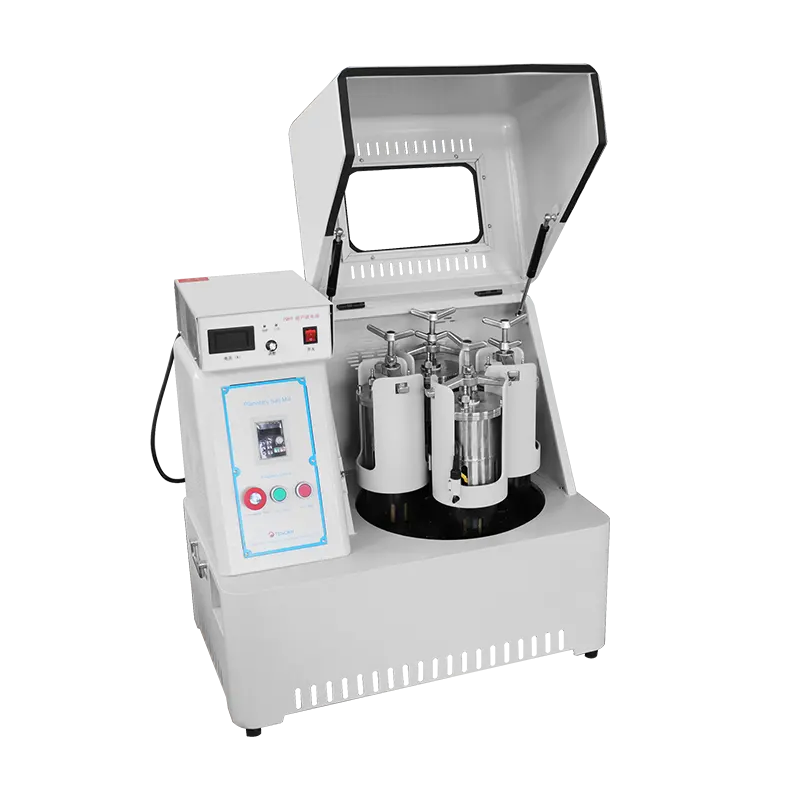
For wet grinding, ultrasonication is often considered as a way to combat agglomeration and improve suspension uniformity. For dry grinding, the issue is more complex: vibrations can promote deagglomeration, but can also increase heat, sticking or uneven processing. The specific effect is tested on a sample, and is not assumed by the name of the equipment.
Sample conditions: what to check before choosing a mode
The first mistake when choosing a mode is to start with speed and time. First you need to understand what a sample is and what task is considered completed. For some materials, it is sufficient to reduce the particle size; for others, it is more important to open agglomerates, maintain the crystalline structure, avoid oxidation, or obtain a narrow particle distribution. These purposes may require different modes and different consumables.
- The hardness and brittleness of the material: these determine whether particle fracture or plastic deformation will predominate.
- Initial fineness and particle size distribution: Without this information, the actual fineness gain cannot be assessed.
- Target size and permissible distribution width: sometimes it is not the minimum that is more important, but the stability of the fraction.
- Sensitivity to heat, moisture and oxygen: These factors limit processing time and media type.
- Tendency to sticking, aggregation and accumulation of static charge.
- Available sample mass and material value: losses and contamination must be assessed in advance.
Ductile metals and polymers behave differently than brittle oxides and minerals. Soft material can smear along the walls, and hard abrasive powder can accelerate wear on the glass. For a mixture of components, it is important to take into account not only the average hardness, but also the difference in properties: one component can be crushed faster, while the other can accumulate in a coarse fraction. This affects homogeneity and the interpretation of the result.
Dry and wet grinding: different tasks
Dry grinding is convenient when introducing liquid is unacceptable or when the product must immediately be a powder. However, in a dry system, the role of agglomeration, electrostatic effects and sticking is greater. Wet grinding often produces more even distribution and allows for better heat dissipation, but requires compatibility of the fluid with the beaker, seals, and material. After wet grinding, a liquid separation and drying stage is added, which can also change the aggregate state of the powder.
The wet grinding mode cannot be mechanically transferred to dry grinding just because the same mill is used. Even with the same material, the rheology of the suspension, the nature of the movement of the balls and the heat generation change. If the equipment sheet provides general capabilities rather than parameters for a specific slurry, they should be taken as a guide for discussion rather than as a ready-made recipe.
How to read characteristics and not mix values
When describing grinding equipment, it is useful to separate geometric, kinematic and technological parameters. The same number can refer to different values, and moving a value from one line to another causes errors in load calculations and performance expectations.
| Parameter | What does it mean | What to check |
|---|---|---|
| Grinding bowl volume | Internal capacity of one glass | Not to be confused with the total volume of all glasses and with the workload |
| Workload | Weight or volume of material and grinding media allowed in a particular configuration | Specify for the selected glass, and not for the entire series |
| Rotational speed | The speed of rotation of the disk and glasses in the adopted reference system | Do not identify with the linear speed of balls without geometry |
| Ultrasonic parameters | Power, amplitude or other characteristics of the impact | Find out how vibrations are entered and the conditions to which the value applies |
| Processing time | Grinding or cycle duration | Consider pauses, cooling and cycle repeatability |
The volume of one glass, the total volume of the installation, the mass of the sample and productivity over time are different values. It is impossible to calculate the mass of powder only by the volume of the glass if the permissible degree of filling, the density of the material and the mass of the grinding media are unknown. Also, do not assume that increasing the number of beakers automatically results in a proportional increase in productivity: sample preparation, quality control, and cleanup time all have an impact.
The rotation frequency of the planetary disk and the rotation frequency of the cups can be described in different ways. If the description does not indicate which axis the value belongs to, you should not recalculate it yourself using the expected formula. For ultrasonic exposure, it is important to understand whether the stated power refers to the generator, the transducer, or the work area. Without these clarifications, comparison with other equipment becomes meaningless.
Grinding media are characterized by material, diameter, density and quantity. Large balls give stronger impacts, small ones give more abrasive contacts, but this is a general rule and not a ready-made recommendation. A brittle material may benefit from one load profile, while a soft material may benefit from another. The mass of the balls and the degree of filling affect the movement inside the glass; Overloading may reduce grinding efficiency and increase heat.
The typical minimum fineness stated for equipment or glass type is not guaranteed for any sample. The final particle size depends on the initial particle size, hardness, medium, time, heat removal efficiency and measurement method. The particle size distribution may include agglomerates, which the instrument counts as coarse particles. Therefore, the grinding result is confirmed by analysis, and not just by visual assessment.
Heating, agglomeration and cooling
During grinding, a significant part of the supplied energy is converted into heat. Additional ultrasonic exposure can also increase the energy input into the working area. Heat affects adhesion, oxidation, phase changes, and stability of sensitive materials. Therefore, a discussion of the regime without a discussion of cooling is incomplete.
Air cooling and liquid nitrogen cooling are not the same thing. Conventional air cooling does not make the process cryogenic. Unless the equipment is certified to operate in a cryogenic environment, it should not be called a cryogenic mill. The temperature of the working space or housing is also not equal to the measured temperature of the sample: the powder can heat up locally, especially in areas of impact and friction.
For heat-sensitive materials, it is useful to provide temperature control and, if necessary, intermittent operation with pauses. However, specific pause durations and permissible temperatures cannot be assigned according to a general clause: they depend on the material, glass, load and safety requirements. If the material is prone to degradation or oxidation, a separate assessment of atmospheric and temperature compatibility is required.
Agglomeration after grinding can be the result of several reasons: insufficient disagglomeration, excessive grinding, humidity, static charge or chemical interaction of particles. Ultrasound in a liquid environment can help break up loose aggregates, but it does not eliminate composition or drying-related causes. In a dry system, the result is less predictable and requires testing on a specific powder.
You should not set the maximum ultrasonic power just because it is available. Excessive exposure may increase heat, change the structure of the material, or accelerate wear. A smart approach is to start with a moderate setting, check particle distribution and temperature, and then change one setting at a time. This plan provides more information than changing all settings at once.
PTFE grinding bowl: compatibility, wear and cleaning
In the catalog TENCAN presented separately PTFE grinding bowl for planetary mill. Polytetrafluoroethylene is known for its chemical resistance and low friction, so such cups are considered for applications where surface inertia and gentle handling of the material are important. However, PTFE is a relatively soft material, and this must be taken into account when choosing grinding media and energy conditions.
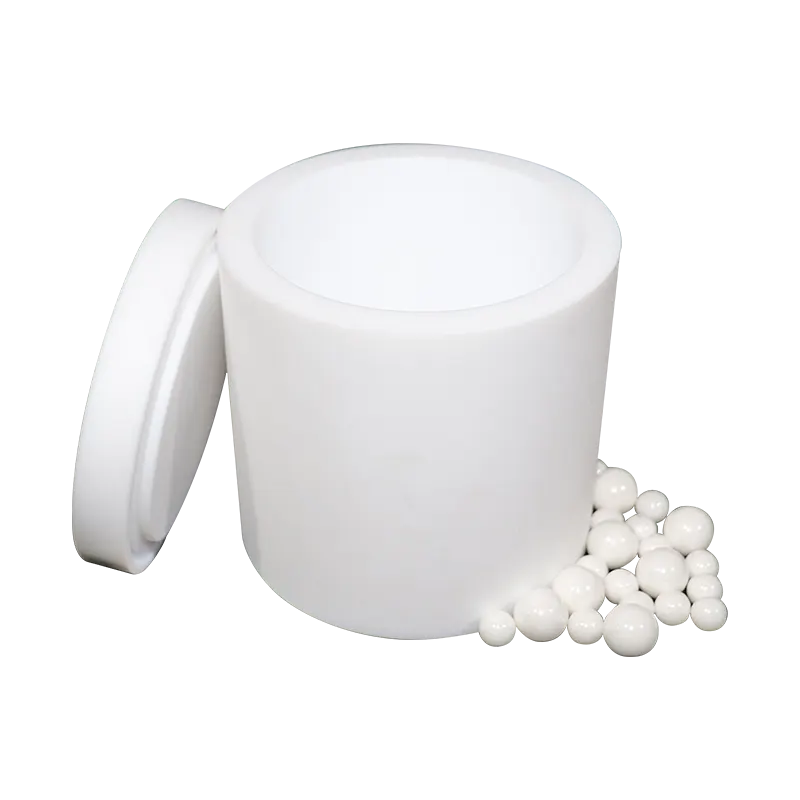
A PTFE cup does not mean it is completely free of contamination. During abrasive wear, contact with hard balls and intense loading, wear debris can enter the sample. Resistance to chemical environments is not the same as resistance to mechanical abrasion. For hard abrasive powders and high-energy grinding, the most suitable bowl material is selected separately, weighing the risk of contamination, wear and cleanliness requirements.
For soft, chemically sensitive or stick-prone materials, PTFE may be suitable, but temperature limitations and deformation must be taken into account. You cannot go beyond the conditions specified for a particular product, and you cannot assume that a glass will withstand any regime just because it is intended for a planetary mill. Geometry, wall thickness, lid and seal vary from cup to cup.
Compatibility with an ultrasonic planetary ball mill must be confirmed in terms of mounting dimensions, method of fixation and permissible operating conditions. The fact that a glass is a planetary mill does not in itself prove compatibility with a particular design. If the equipment or glass card does not contain the required confirmation, this question should be asked to the supplier before ordering, and not tested experimentally on a valuable sample.
Cleaning PTFE requires care: harsh abrasive tools can damage the surface and increase the risk of subsequent contamination. After work, it is important to remove any remaining material from the corners, cover and seals, and check for signs of wear. If multiple materials are used, it is helpful to maintain separate dishes or carefully monitor cleanliness between samples.
Repeatability: How to go from one sample to comparable results
Grinding reproducibility does not only depend on the mill. The result is influenced by the mass of the sample, the degree of filling of the glass, the mass and diameter of the balls, loading order, humidity, temperature and even the method of sampling. If these parameters are not recorded, comparison of the two results may be futile: the differences will be due not to the material, but to changes in conditions.
The cup loading must leave enough free space for the movement of the grinding media. There is no universal filling percentage, but overfilling and too little loading are equally inconvenient: in the first case, the mobility of the balls decreases, in the second, the proportion of contacts with the walls increases and efficiency decreases. Specific limits are determined by the design of the glass and the manufacturer's recommendations.
The ratio of the mass of grinding media to the mass of powder should not be copied from another problem without verification. It depends on the density of the material, the size of the balls, the target size and acceptable contamination. Increasing the proportion of balls can speed up grinding, but also increase wear and heat. For brittle materials this is one compromise, for ductile materials it is another.
The sequence of operations also matters. Pre-crushing large pieces, stirring components before grinding, adding liquid and the order in which additives are added can change the result. If the process includes pauses for cooling, they need to be recorded. Test grinding without recording these details is difficult to repeat even on the same equipment.
The analysis of the result must correspond to the task. To control particle size, particle size distribution is used; Microscopy is useful for assessing agglomeration; for chemical purity - suitable methods of elemental or phase analysis. The same powder may appear fine visually, but contain strong aggregates. Therefore, a conclusion about goal achievement is made based on a set of signs, and not on one picture or one number.
When moving from a laboratory sample to a larger batch, you cannot simply increase the grinding time proportionately. Scaling is related to energy per unit mass, heat dissipation, and geometry. If one beaker was used in the laboratory, but several beakers were used in the new configuration, the mixing conditions also change. First, the comparability of specific parameters is checked, then the result is confirmed on an intermediate load.
Trial grinding: plan and questions for the supplier
It's best to plan a trial grind as a small study rather than a one-time demonstration. First, the initial properties of the material and the goal are recorded, then safe conditions are selected, and after each change in the regime the result is evaluated. If the material is hazardous, toxic, or atmosphere sensitive, discussion of selection is not a substitute for guidance on safe handling of the specific equipment.
- Prepare a description of the material: composition, hardness, initial size, humidity, sensitivity to heat and chemical environments.
- Determine the target result: particle size, acceptable distribution width, absence of agglomerates, phase retention.
- Choose one grinding method - dry or wet - if there are no restrictions on safety and compatibility.
- Change one parameter at a time: time, speed, load or ultrasonic mode.
- Monitor temperature and external signs of overheating, sticking or discoloration.
- Check the cleanliness of the glass, balls and seals before and after testing.
- Repeat the experiment under comparable conditions to separate the pattern from the random result.
Before ordering or setting up equipment, it is useful to clarify which grinding bowls and grinding media are compatible with the selected design, what restrictions apply to the ultrasonic mode, how heating is controlled and what data is needed to select the configuration. If the supplier provides a catalog, you should rely on the specific product card rather than general series descriptions. IN catalog TENCAN you can compare the main equipment and consumables, but compatibility is still checked based on the parameters of a specific model.
The right choice of ultrasonic planetary ball mill is not the maximum power and not the finest powder promised. This is a reproducible mode in which the material reaches a given state, the bowl and grinding media can withstand the load, heating remains under control, and contamination does not exceed the permissible level. For some tasks, planetary grinding without ultrasound is sufficient; for others, ultrasonic exposure produces a beneficial effect, which is confirmed by breakdown. This approach allows you to choose equipment and consumables consciously, without unnecessary assumptions.