
Problem conditions: what exactly determines the choice of glass
A planetary ball mill grinds material in a closed volume: everything that is abraded from the walls of the grinding bowl and from the grinding media remains in the same sample, which is then weighed, sintered or sent for elemental analysis. Therefore, the grinding glass is not a consumable item, but part of the sample preparation technique. A tungsten carbide grinding bowl is selected when conventional materials cannot withstand abrasive loads or when it is important to limit the transfer of iron and oxide ceramics into the sample. But this choice has its own price, weight and set of restrictions.
Before comparing materials, it is worth fixing the conditions of the problem. These include the hardness and brittleness of the starting material, the required fineness after grinding, the acceptable level of impurities based on the analytical method, the amount of sample required for further operations, and the acceptable process temperature. If a sample is analyzed for tungsten or cobalt, the tungsten carbide beaker will obviously contribute to the result, and this must be taken into account in advance rather than after the spectrum has been obtained.
Frequent confusion arises from mixing closely related quantities. The nominal volume of the glass, the useful volume for loading, the mass of the sample, the mass of the grinding media and productivity over time are different parameters. A glass with a volume of X does not mean that X samples are loaded into it: part of the volume is occupied by grinding bodies and the free space necessary for their movement. In the same way, the coarseness after grinding is not a property of the glass - it depends on the sample material, the initial particle size, the medium, the ratio of the masses of the grinding media and the sample, time and rotation mode.
Finally, dry and wet grinding solve different problems. Dry grinding is easier to prepare, but is prone to sticking and aggregation of fine particles; Wet grinding with a liquid media often produces a narrower particle size distribution, but adds liquid separation steps and the risk of contamination from the media itself. The glass must be compatible not only with the mill, but also with the selected mode: lid seal, material resistance to the environment and ease of cleaning become practical criteria.
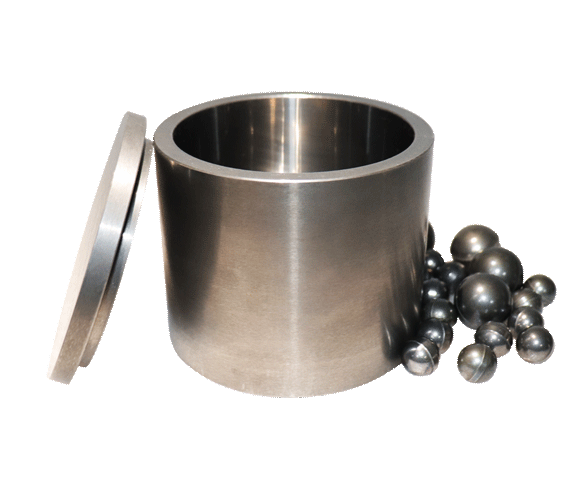
Tungsten carbide: what the material provides and what it does not provide
Composition and hardness
Tungsten carbide grinding bowl is a sintered carbide in which the tungsten carbide grains are bonded with a metal bond, most often cobalt. This structure provides a combination of high hardness and toughness: the material resists both abrasive abrasion and shock loads that are inevitable when grinding bodies fall and roll. In terms of resistance to abrasive wear, the hard alloy is noticeably superior to most ceramics and stainless steel, so it is used for difficult-to-grind and abrasive materials.
Density and grinding energy
The second important property is high density: for typical sintered grades it is about 14–15 g/cm³, that is, approximately twice as high as that of zirconium dioxide and several times higher than that of agate. Grinding bodies made of the same material with the same diameter have a greater mass, which means that at the same rotation frequency they transfer more energy to the sample per impact. In practice, this makes it possible to reduce grinding time, but at the same time increases the load on the mill drive, on the beaker fastening and on the beaker itself.
Increased density is not an absolute advantage. This means greater inertia, greater wear on mill components, and higher balancing requirements. If the task is soft material and moderate coarseness, a heavy carbide kit may be overkill: it will accelerate equipment wear and increase the proportion of beaker material in the sample.
Where the material is justified
Carbide is appropriate in the preparation of abrasive minerals, oxides, carbide, cermets and other materials that quickly attack agate or steel. It is also justified in cases where iron in the sample is unacceptable, and tungsten and cobalt are not included in the list of elements being determined. It is also justified when it is necessary to work with high grinding energy, when light grinding media simply do not give the desired result.
What the material doesn't solve
Tungsten carbide is not an “inert” material and provides zero contamination. During the grinding process, the glass and balls wear out, and tungsten and cobalt get into the sample - in quantities depending on the hardness of the sample, grinding time, mode and surface condition. The cobalt binder is sensitive to strongly acidic and strongly alkaline environments: the aggressive liquid phase accelerates the chipping of the binder and the release of particles. Carbide is brittle under shock loading and is more expensive than most alternatives.
Hence the practical conclusion: tungsten carbide is appropriate where the gain in speed and durability outweighs the risk of introducing tungsten and cobalt, and is not appropriate where these elements are included in the list of determinable ones. The choice of glass material is always a trade-off between wear resistance, introduced impurities, weight and cost.
Compatibility of beaker and planetary mill
Seat and fastening
The glass must physically fit into the socket of the planetary disk, close with a lid and be fixed so that centrifugal forces do not displace it. Not only the outer diameter and height must match, but also the base profile, fixation method, thickness and type of lid seal. The seal determines two things: sample loss during dry grinding and the ability to work with a liquid medium without leaks. Even a slight discrepancy in height changes the pressure of the lid and can lead to depressurization.
Weight, speed and safety
The heavy carbide sleeve increases the load on the bearings and drive. Each mill model is designed for a certain mass of one glass and a certain maximum rotation speed; exceeding these values is not a “margin of safety”, but a risk of destruction. At high speeds and a large mass of the kit, kinetic energy increases, so issues of balancing and fastener condition come to the fore. Limitations on the diameter and mass of grinding media are also set by a specific model, and not by the material of the glass.
Temperature and cooling
During prolonged grinding, the beaker, grinding media and sample heat up, and the heating affects both the material itself and the lid seal. Air cooling of the case and cooling with liquid nitrogen are fundamentally different solutions: the first reduces the temperature of the components and the case, the second is used for temperature-sensitive samples and requires special design. The temperature of the working space of the installation is not equal to the measured temperature of the sample, and it is impossible to call ordinary air cooling a cryogenic process without confirmation.
Check by documentation, not by guesswork
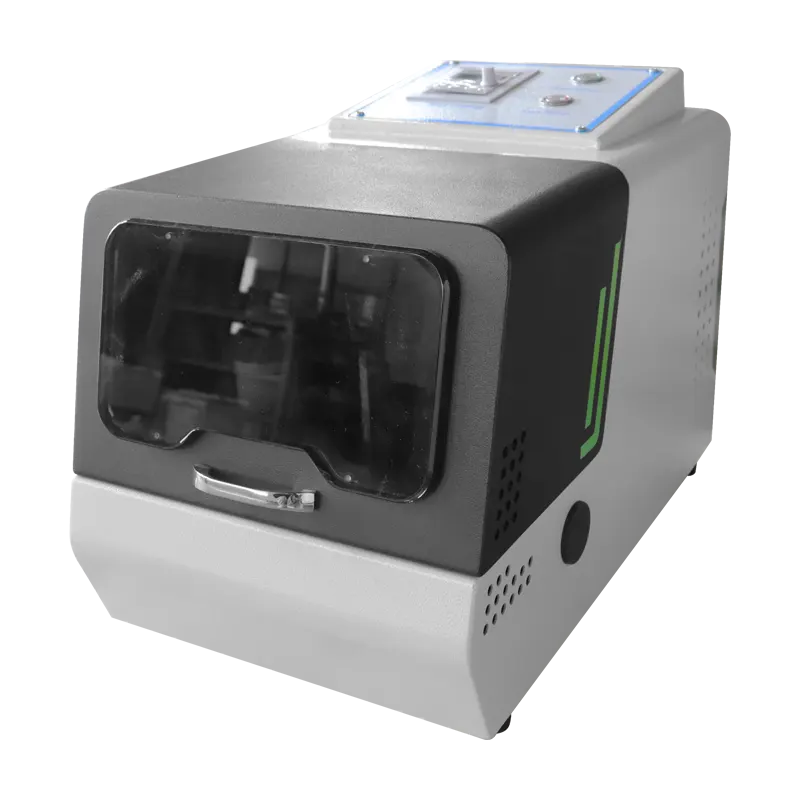
Compatibility cannot be deduced from general considerations. Just because a glass and a grinder come from the same manufacturer does not automatically match a specific model. For example, in the line TENCAN there is a compact one micro planetary ball mill XQM-0.2; its dimensions and seats are designed for certain standard sizes of glasses, and the compliance of the tungsten carbide glass with this model must be checked using the current product card, and not assumed. The procedure is simple: determine the mill model, find the acceptable standard sizes of the glasses and the weight of the set in the documentation, and only then select the material and volume.
It is also worth checking the availability of spare seals and the possibility of replacing them. The seal is a consumable element, and its wear is manifested first by loss of sample during dry grinding, and then by leakage during wet grinding. If replacement of the seal is not provided for the selected glass, the life of the entire product is limited by the life of the seal.
Addition of impurities and wear: process mechanics
Where does pollution come from?
Contamination of a sample with lining materials consists of several mechanisms. Abrasion occurs where solid particles in the sample slide across the surface of the beaker; adhesive wear - where the sample material adheres to the metal; corrosive destruction of the ligament - when working with chemically active media. In a planetary mill, an impact component is added to this: the balls fall onto the wall and onto the layer of material, causing local chipping.
The proportion of added material depends not only on the properties of the glass. The harder and more abrasive the sample, the longer the grinding, the higher the speed and the greater the mass of the grinding media, the greater the wear. The fine fraction, which has already been ground, continues to contact the surface and acts as an abrasive. Therefore, the estimate of “how much impurity will get into the sample” is correct only for a specific “material-mode” pair and is verified by control experiment, and not taken from a general statement.
Comparison of materials: general guidelines
The characteristics given below describe classes of materials in general and do not replace data on a specific product card.
| Material | Density (qualitatively) | Main elements introduced | Resistance to abrasive wear | Restrictions |
|---|---|---|---|---|
| Agate | low | silicon | low | fragility, low mass of grinding media |
| Zirconium dioxide | average | zirconium, yttrium | high | moderate impact strength |
| Stainless steel | average | iron, chrome, nickel | average | unsuitable if iron is determined |
| Tungsten carbide | high | tungsten, cobalt | very high | weight, cost, sensitivity of the ligament to acids |
How to formulate cleanliness requirements
The “minimum pollution” requirement is meaningless without specifying which elements are critical. If the sample is being analyzed for iron, stainless steel is not acceptable, but tungsten carbide may be acceptable. If tungsten or cobalt is determined, the picture is the opposite. Agate does not contribute metals, but is fragile and does not tolerate heavy balls and prolonged intensive grinding. Zirconium dioxide is more stable than agate, but adds zirconium and a stabilizing additive. There is no universal material, and you need to choose according to the list of defined elements and the level of their permissible content.
Cup volume, loading and grinding media
Volume matching is the most common reason for grinding failure. The nominal volume of the glass, the usable volume for loading and the mass of the sample are three different values. The grinding bodies occupy a significant part of the internal space, in addition, the balls need free space to move. If the glass is filled too tightly, the balls do not accelerate, the energy of the collisions drops, and the grinding slows down instead of speeding up. If the load is too small, efficiency decreases because most of the energy is wasted in contacting the balls with each other.
The ratio of the mass of the grinding media to the mass of the sample is a key parameter. Increasing it speeds up grinding, but at the same time increases the wear of the glass and balls and increases the proportion of introduced material. For a carbide set, this compromise is especially noticeable: heavy balls work more efficiently, but also wear out the surface more intensively.
The size of the grinding media affects the result no less than their mass. Larger balls provide higher impact energy and are suitable for coarse grinding of brittle materials; Small balls increase the number of contacts and work better for fine grinding and disagglomeration. A mixture of balls of different diameters sometimes gives a wider particle size distribution. The selection of a specific combination is a matter of trial grinding, and not a ready-made recommendation.
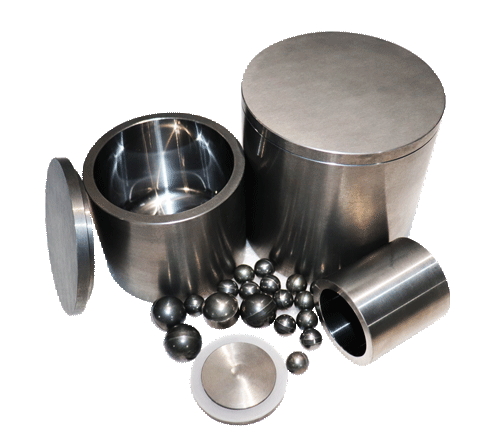
It makes sense to coordinate the material of the grinding media with the material of the glass. If the glass is selected for low iron transfer, steel balls reduce this advantage to zero. And vice versa: carbide balls in a soft ceramic glass will lead to rapid wear of the glass itself. The question of whether grinding media are supplied from the same material as the glass and in what diameters is decided on the product card.
Separately, it is necessary to distinguish between grinding and disagglomeration. If the powder consists of aggregates, the task may not be to destroy the primary particles, but to separate them, and then a mode with lower energy and a suitable environment will be more correct than aggressive grinding. Likewise, mixing powders in a grinding bowl does not replace a separate mixing operation: the result of such mixing is uneven.
Cleaning the glass and preventing cross-contamination
Cleaning procedure
Cleaning begins with mechanical removal of residues: with a soft brush or scraper made of material that does not scratch the surface. A scratch is not a cosmetic defect: it retains particles from the previous sample and increases local wear. This is followed by washing with a suitable solvent - usually ethanol or isopropanol is used; For water-soluble residues, use water followed by thorough drying. Strongly acidic and strongly alkaline compounds, as well as prolonged exposure to aggressive environments, destroy the cobalt binder of the hard alloy, so their use requires caution and justification.
Ultrasonic cleaning is convenient for hard-to-reach places, but for heavy carbide parts, you need to take into account the weight and prevent the parts from colliding with each other in the bath. After cleaning, the glass and balls are dried: residual moisture during dry grinding leads to sticking and clumping.
Cross contamination between samples
The most reliable way to eliminate cross-contamination is organizationally: assign a separate glass to a specific type of material and label it. If this is not possible, a dry load is performed between samples - grinding a small amount of inert or similar material, which is then discarded. Idle loading does not guarantee complete removal of traces, but it significantly reduces their level.
Condition monitoring and cleaning check
The condition of the glass should be inspected before each important grinding: the surface of the internal walls, edges, fit of the lid, seal, condition of the balls. The appearance of deep scratches, chipping, discoloration of the bond, deformation of the seal are signs in which it is better to remove the glass from work for critical samples and transfer it to auxiliary tasks. The resource of a carbide nozzle is not infinite, and its wear is a direct measurement of the impurities introduced.
The effectiveness of cleaning is checked in the same way as the level of contamination: by blank grinding and subsequent analysis. If, after a blank load, tungsten and cobalt are detected in the inert material, it means that the cleaning procedure is insufficient for the current state of the surface, and the glass itself may already require replacement.
Test grinding: what to check and what data to prepare
Test grinding is the cheapest way to test assumptions. It is constructed in such a way as to separate the influence of the glass material from the influence of the mode. It is useful to carry out control experiments: grinding in a glass of the selected material and, for comparison, a blank load without sample or with inert material to assess the wear of the set. Then the particle size distribution before and after grinding is measured, and, if necessary, the content of elements that can be introduced by the glass material.
What to note during trial grinding:
- sample mass and mass of grinding media, their diameters and material;
- nominal volume of the glass and actual degree of filling;
- dry or wet grinding, type and amount of liquid medium;
- rotation speed, grinding time and number of cycles if intermittent mode is used;
- the temperature of the beaker and body after grinding is a guide, and not the temperature of the sample;
- size measurement result and measurement method;
- the state of the surface of the glass and balls before and after grinding.
Data that is needed to select the configuration: mill model, acceptable standard sizes of glasses and the weight of the set according to the documentation, required sample volume, material properties (hardness, abrasiveness, fragility), a list of elements that cannot be added, and requirements for the final size. Specific product specifications, including available tungsten carbide grinding bowls, are listed on the card tungsten carbide grinding bowl; general list of equipment areas - on website TENCAN.
Frequently asked questions
Can one tungsten carbide cup be used for different materials? Technically possible, but subject to thorough cleaning and, in critical cases, empty loading between samples. For trace analysis, it is more reliable to assign a separate kit for each type of sample.
Does carbide produce a finer grind than ceramic? The material of the glass itself does not guarantee this. Dense grinding media increase the energy of collisions, which can speed up grinding, but the final fineness is determined by the combination of the mode, environment and properties of the sample, and not just the lining.
What to do if the environment is aggressive? For strongly acidic and strongly alkaline media, a separate compatibility assessment is required: the cobalt binder of the hard alloy is sensitive to them. In such cases, alternative materials are compared and the result is verified by a control experiment.
Bottom line: choosing a tungsten carbide grinding bowl comes down to four checks - compatibility with a specific mill model according to the documentation, permissible weight and speed, acceptable level of tungsten and cobalt addition for a given analysis, as well as seal and surface life under the selected mode. All four are checked before purchase and refined by trial grinding, and not after receiving an unsatisfactory result.