
Preparation of a powder sample for phase or elemental analysis depends not only on the power of the mill drive. Equally important are the consumables: grinding bowl, grinding media and grinding medium. Grinding balls made of tungsten carbide are chosen when high impact energy and resistance to abrasive material are needed, but the same density and hardness determine how much material of the balls will pass into the sample, how quickly their geometry will change and what restrictions will arise on the glass and mode.
A practical issue that is worth considering separately is the compatibility of consumables. The link “sample - grinding media - glass - mill - grinding medium” works here: an error in at least one link leads either to unachieved fineness or to contamination, which depreciates the measurement result. Below are the selection criteria and a list of parameters that are confirmed by testing on a real sample, and not assumed by analogy.
Let us separately mark the boundary of the topic: equipment from the same catalog with a consumable item does not automatically become compatible with it. Even if the mill and grinding media are supplied by the same manufacturer, the standard size of the bowl, the permissible load weight and the cooling mode are agreed upon separately.
Sample conditions: what is fixed before selecting grinding media
Any selection begins with a description of the sample, and not with a catalogue. The material determines abrasiveness, stickiness and chemical reactivity. Hard crystalline phases - quartz, corundum, carbides, oxides - wear out both the grinding media and the cup lining faster than soft or layered materials. Ductile metals and polymers behave differently: they deform, stick to walls and bodies, and sometimes require cooling in order to become brittle and begin to collapse along cracks.
Next, the initial particle size and target particle size are recorded. These are different quantities. The initial particle size distribution determines what body diameter to start with and how many grinding steps will be required, while the target size determines to what extent grinding is even worthwhile. The achieved fineness depends on the material, initial fineness, medium, mode and method of measurement, therefore the typical minimum specified for the equipment cannot be considered guaranteed for a specific sample.
The third block of conditions is analytical. The analysis method determines the permissible contamination: for X-ray phase analysis, new crystalline phases and background growth are critical, for elemental analysis - the increment of the elements being determined, for granulometry - aggregates and adhesion. If tungsten or cobalt is determined in a sample, grinding media made of tungsten carbide with a cobalt binder fall into a zone of direct conflict with the task, and this is realized in advance, and not after the measurements.
Separately record the sample weight per grinding and losses during preparation. There is an inverse relationship here: the smaller the mass of the sample, the more noticeable the contribution of wear products to its composition. When planning sample preparation, it is useful to decide in advance how much material will be spent on setting the mode and how much will be used for measurement, and provide a reserve so as not to repeat grinding under other conditions and not to compare incomparable results.
Finally, the available equipment is taken into account: the type of mill, available cups, their material, volume and internal diameter, restrictions on loading weight and rotation speed. Only after this does it make sense to discuss the material and diameter of the grinding media, as well as which part of the problem is solved by changing consumables, and which part by changing the mode.
Tungsten carbide grinding balls: material and its consequences
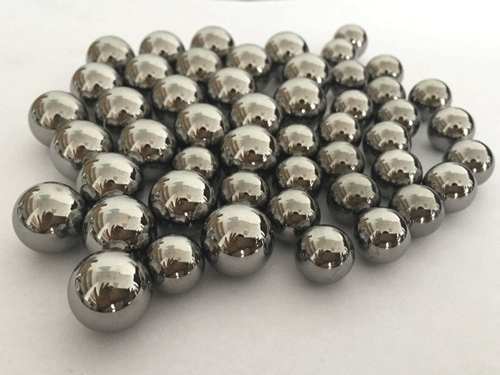
Products of this class are produced by sintering tungsten carbide with a metal binder, most often cobalt. Carbide grains provide high hardness and wear resistance, and the binder gives the material toughness, without which the body would collapse upon impact. It is the combination of “hard grain - viscous binder” that explains why such bodies are used both for abrasive mineral samples and for materials that require high grinding energy.
The second consequence is density. The material of this class is noticeably denser than steel and oxide ceramics, and the body mass is directly included in the kinetic energy of the collision. At the same speed and diameter, a tungsten carbide ball transfers more energy to particles than a ball made of a lighter material. This is an advantage when shredding tough materials, but also a risk: excess energy accelerates wear, heat and the accumulation of impurities.
The third consequence is not “zero pollution”, but only a different set of impurities. Tungsten carbide is not a chemically inert material: during abrasive action, tungsten and cobalt are transferred into the sample, and upon contact with the glass, lining material is added. Therefore, the correct formulation of the problem is not “what bodies do not contaminate the sample”, but “what level of impurities is acceptable for the chosen analysis method and how to control it.”
Body shape also matters. The ball is isotropic: it does not have a designated direction of impact, so the result does not depend on how the body lay in the load and how it turned when the glass rotated. This is one of the reasons why balls are widely used in planetary and vibratory mills, where the loading path is complex and changes during the cycle.
Specific brands, diameters, tolerances and configurations relate to the product, and not to the material as a whole, and should be viewed in the product card. For example, product tungsten carbide grinding balls described on the website TENCAN; it is from there that confirmed sizes and designs are taken, and not from general considerations about the material.
How the parameters of the balls affect the grinding result
Mass and diameter: single impact energy
The kinetic energy of a collision is proportional to the mass of the body and the square of the velocity. The diameter enters the mass cubically, so the transition from a small diameter to a large one increases the impact energy disproportionately. Large bodies quickly destroy the original particles and agglomerates, but give a coarser distribution and wear out the lining more strongly. Small bodies transfer less energy per collision, but form more contacts per unit load volume.
Number of contacts and particle size distribution
With the same filling of the glass, reducing the diameter increases the number of bodies and the total contact area. This is favorable for fine grinding and disagglomeration—the destruction of loose aggregates without abrasion of the primary crystals. The opposite situation is a lack of energy: small bodies do not destroy strong large particles, and grinding is delayed, increasing the time of contact of the sample with the material of the bodies, and hence the accumulation of impurities.
Glass filling and mass ratio
The degree of filling of the glass affects the trajectory of the load: if there are too few bodies, collisions are rare, if there is too much, the movement is slowed down, heating and load on the drive increase. The ratio of the mass of the grinding media and the sample determines how much energy is consumed per unit of material; with a small sample mass, wear losses are distributed over a smaller amount of substance, and the relative increase in impurities is higher. Specific values are selected within the limits established by the mill management, and not according to a universal table.
The rotation speed affects everything at once: it increases the frequency of collisions and the energy of each of them, and at the same time heat and wear. Therefore, increasing speed is not a universal way to achieve smaller particle size: beyond a certain threshold, the increase in dispersion slows down, while the increase in impurities continues to increase.
Contamination and wear: two sides of one contact
Carry mechanics and control points
Material transfer is a two-way process. Bodies lose mass under the influence of abrasive particles of the sample, and the sample acquires wear products. The intensity depends on the hardness and shape of the particles, grinding duration, speed, medium and surface condition of the bodies. A fresh, slightly rough surface will wear differently than a polished surface; chips and local areas increase material removal.
In an analytical sense, two questions are important: what elements this particular set contributes and what is their proportion in relation to the mass of the sample. The answer cannot be obtained from general reasoning: different samples under the same conditions give different wear. Quantitative assessment is based on comparison: grinding the same sample under the same conditions, but with different sets of bodies, shows the difference in the content of impurities, which can be associated with the material of the set. Such experience requires equality in mass, environment and time, otherwise the difference will reflect the mode and not the material.
Factors that accelerate wear
Speed and time are the main, but not the only factors. Dry grinding of an abrasive material wears out bodies more than wet grinding, all other things being equal, since the particles are in contact with the surface longer. The chemically active medium does not only act mechanically: for materials with a metal bond, it is important how aggressive the liquid is and how long the contact lasts. Overheating of the glass is a separate signal: it indicates a high energy intensity of the mode, prolongs the interaction and can change the properties of the sample.
How to assess wear and contamination
It is convenient to monitor wear by weighing: the mass of the dry set before and after a series of grindings, related to the number of hours of operation or to the mass of processed material, gives a comparable estimate. At the same time, the bodies are inspected: chips, spalling, loss of sphericity, local areas. A change in the color of the sample, an increase in the background on the diffraction pattern, or the appearance of uncharacteristic lines are indirect signs that are worth checking, but cannot be interpreted as evidence of a specific cause without additional data.
| Observation | Possible reason | What to check |
|---|---|---|
| Increase in tungsten and cobalt content in the sample | Abrasive wear of tungsten carbide bodies | Sample hardness and abrasiveness, grinding time, surface condition of bodies |
| Silicon or zirconium impurity | Cup lining wear | The ratio of the hardness of bodies and glass, glass material |
| Coarseness does not improve with increasing time | Lack of impact energy or agglomeration | Body diameter, glass filling, grinding medium |
| Darkening or change in color of the powder | Wear products, oxidation, heating | Process temperature, environment, kit cleanliness |
Dry and wet grinding: what difference does the medium make?
Wet grinding typically produces a narrower particle size distribution and less buildup, so it is often preferred for fine grinding. However, the liquid medium is an additional chemical variable. For materials with a metal bond, it is important how aggressive the environment is towards the bond and how long the contact lasts; a neutral organic liquid and an aqueous medium behave differently, and dissolved oxygen and impurities can accelerate the interaction. This is a general consideration and not a recommendation for a specific liquid: the medium is consistent with the method of analysis and safety requirements, and the permissibility of contact with the product is clarified with the manufacturer.
Dry grinding eliminates drying and the risk of introducing elements from the liquid, but increases sticking, dust formation and heating. For ductile materials, dry mode is often ineffective without cooling, which causes the sample to become brittle. This effect applies to the sample and not to the bodies: the grinding set itself, when cooled, only requires protection from condensation and subsequent drying.
It is useful to distinguish between comminution and disagglomeration. When the target product is a suspension of small particles, the main task is often to separate pre-existing aggregates, and excessive collision energy does not help here, but creates new impurities. In such cases, choosing smaller bodies and a soft mode may be more rational than increasing the diameter and speed. Surfactants and process fluids facilitate dispersion, but leave a trace in the sample: residual carbon, alkaline components or metal ions can distort subsequent analysis, so their addition is coordinated with the measurement method, not just the convenience of grinding.
Compatibility, cleaning and cross-contamination
Pair of “grinding media - lining”
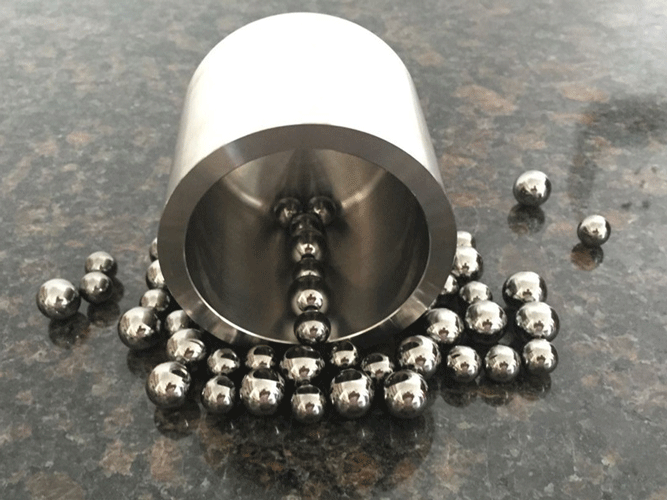
The basic rule is the consistency of the “grinding media - lining” pair. If both elements are made from the same material, the sample will contain a predictable set of elements rather than a mixture of wear debris from two different sources. If the materials are different, their hardness is taken into account: a softer glass wears out faster, and this limits the resource not of the bodies, but of the glass. When combined with solids, an agate, polyurethane or nylon glass is consumed noticeably more actively, and the sample receives silicon, zirconium oxide or polymer particles - depending on the lining.
Geometry, loading and equipment limitations
The diameter of the body is selected based on the initial size: first, a size is selected that can destroy the largest particles of the sample, then smaller bodies for finishing are selected. The body must pass freely into the loading hole and correspond to the inner radius of the glass, otherwise the movement of the loading changes and part of the volume does not participate in grinding. A mixture of two or three diameters is often used, but this solution requires verification: a mixed load changes the distribution of contacts, and the result is confirmed by measuring the size. It is not recommended to mix bodies of different materials in one glass - this creates a non-uniform load and makes it difficult to interpret contamination.
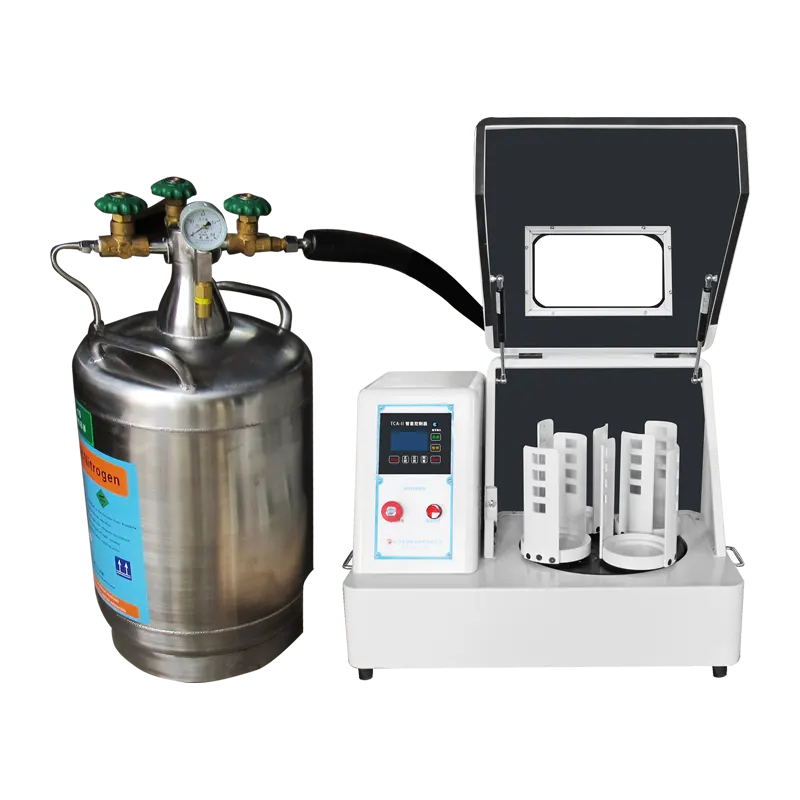
For planetary mills, the total load weight is also important: it determines the load on the drive and is permissible only within the limits specified by the equipment manufacturer. Compatibility with a specific installation is specified separately. For example, planetary ball mill with liquid nitrogen It works with cooling of the grinding space, and the permissible glasses, their volume and cooling modes are set by the manufacturer. The presence of such equipment in the catalog does not in itself mean that a set of tungsten carbide balls is automatically compatible with it: you need to confirm the standard size of the bowls, the load weight and the lining material. Also, one should not confuse cooling with a gaseous environment in the grinding space with cryogenic treatment of the sample itself - these are different processes, and their effect on the sample is assessed separately.
Cleaning, storage and cross-transfer
The grinding media comes into contact with each new sample, so the cleanliness of the set is as much a part of the technique as the grinding mode. A reasonable sequence: remove residual material mechanically, rinse with a suitable solvent, if necessary use an ultrasonic bath with a compatible liquid, then dry and store in a closed, dry container. Aggressive acids and other reagents capable of dissolving the binder are used only with explicit confirmation from the manufacturer: otherwise, instead of cleaning, surface changes and increased wear are obtained.
Ultrasonic cleaning is effective against stuck particles, but its mode is selected carefully: intense cavitation in combination with an aggressive liquid affects the surface of bodies. After any wet cleaning, the kit is dried completely - the residual moisture in the closed glass acts as an additional chemical variable.
Cross contamination is limited organizationally: separate kits for different classes of materials, separate labeling, separate containers. If one kit is still used for different samples, a full cleaning cycle is needed between them, and for sensitive analyzes a control blank run in the same environment is required. Storage affects the result no less than cleaning: moisture and dust on the surface of bodies can lead to an increase in impurities in the first sample, and the admissibility of specific detergents depends on the design of the product and is clarified with the supplier.
What to check before ordering and trial grinding
Test grinding is not a formality, but a way to test a bunch of consumables on a real sample. To ensure that the result is interpretable, information about the sample, equipment and target indicators is collected before work begins.
- Sample: material and phases, initial size, weight per grind, hardness and abrasiveness, humidity, chemical activity.
- Purpose: target particle size and method of measuring it, acceptable content of tungsten, cobalt and other impurities.
- Glass: lining material, volume, internal diameter, surface condition, compatibility with selected bodies.
- Grinding media: material, diameter or set of diameters, total mass, number of media, history of use.
- Mill: model, number of glasses, available range of rotation speeds, restrictions on loading weight and temperature.
- Mode and medium: dry or wet grinding, medium, duration, pauses, temperature control.
| Question | Why is it important? | Where is it specified? |
|---|---|---|
| What cup lining material is compatible with the bodies? | Determines the main source of impurities and the resource of the glass | Product card and manufacturer |
| What diameters are available and what range is acceptable? | Links target size to impact energy and geometry | Product card |
| What loading weight is allowed for the mill? | Affects drive load and repeatability | Mill Operation Manual |
| Is the selected environment acceptable for prolonged contact? | Chemical exposure of the ligament changes wear | Manufacturer, method of analysis |
| Who will assess the level of introduced impurities? | Without testing, it is impossible to confirm the suitability of the kit | Analysis laboratory |
The results of the trial grinding should be documented: weight of the set before and after, mode, medium, achieved coarseness, content of controlled impurities. Such a record makes it possible to distinguish changes in the properties of the sample from changes in the state of consumables and serves as the basis for repeating the regime on the next batch.
The bottom line is simple: tungsten carbide grinding balls are an effective tool for tough and abrasive samples, but their benefits can only be realized when used in the right combination. The lining material, the diameter of the bodies, the mass of the charge, the medium and the duration of grinding form a single set of conditions. This set should be tested on a real sample, comparing the achieved coarseness with the permissible level of contamination, and not based on promises of complete inertness or an ideal result.