
Preparing a sample for analysis rarely comes down to simply “grinding it harder.” The laboratory needs a sample that is representative of the entire batch of material, is sufficiently homogeneous for reproducible resampling, and does not change its composition or phase state during abrasion. Therefore, part of the working parts is made of agate, and the three-headed agate mill is considered as an independent tool for preparing samples, and not as a smaller copy of a ball mill.
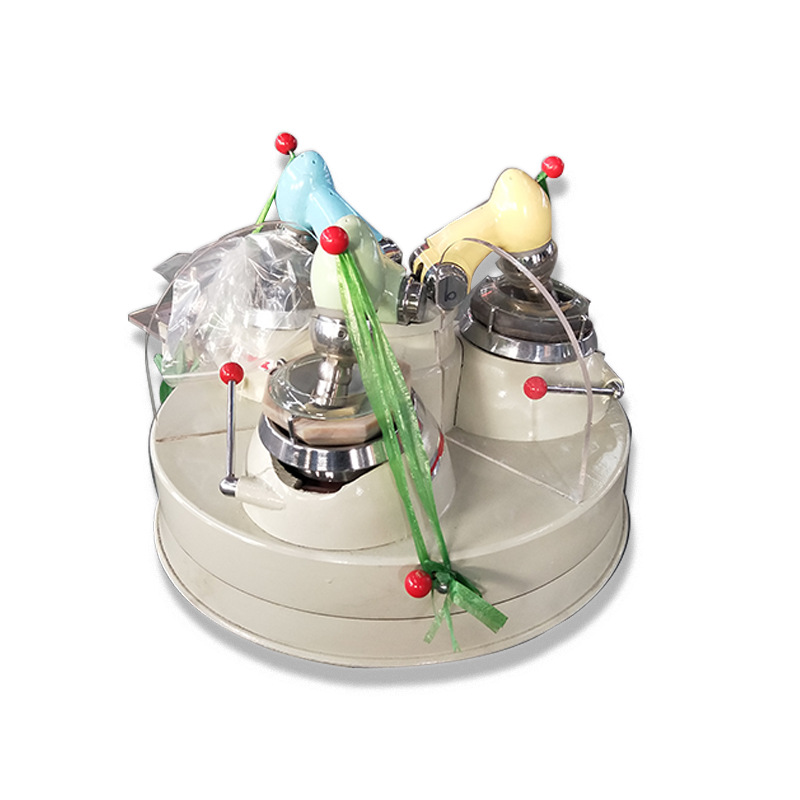
A three-head agate mill is an equipment with three working positions in which the sample is ground between agate working surfaces. This arrangement allows you to prepare several small samples in parallel or compare the behavior of different samples under the same conditions. Below we discuss what properties of the sample determine the choice of mode, where the limits of applicability of agate working bodies lie, why overheating is dangerous, and what information should be clarified before ordering and before the first trial grinding.
How does a three-headed agate mill work?
The operating logic of a laboratory abrasive installation is simple: a sample is placed in a working unit, where it is repeatedly crushed and sheared between two surfaces. In a three-head agate mill there are three such units, so three samples can be processed independently. From a practical point of view, this means that a series of samples does not have to wait until a single mortar is free, and the operator is able to compare results obtained under identical conditions.
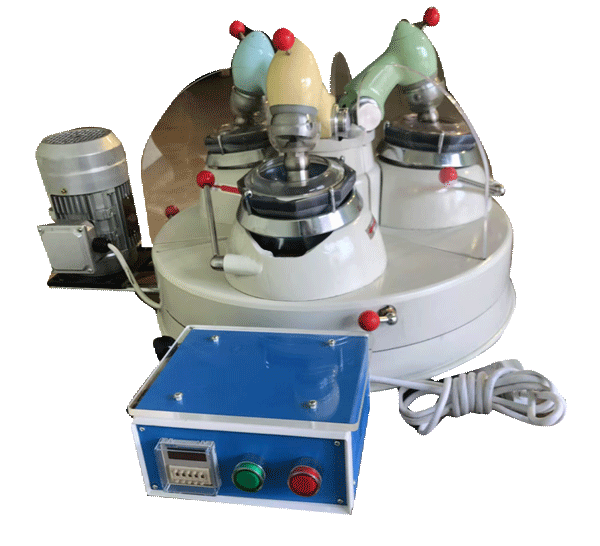
The work surfaces are made of agate - this follows from the name of the product. Agate does not belong to superhard materials of the tool class, therefore it is used where the purity of the sample is more important than the ultimate strength of the working element. For the same reason, the installation is suitable for abrading material that has already been reduced to grit or small grains: large pieces and solid inclusions are not the load for which stone worktops are chosen.
The specific kinematics of the working heads, speed range, permissible processing time and maximum initial size are determined by the model passport. Below we discuss the principles by which these parameters are selected and not replaced with passport values. You can familiarize yourself with the design and clarify the characteristics on the product page three-head agate mill.
Three working positions and their purpose
The three positions are used differently, and the entire organization of work depends on this.
- Three different samples. Parallel processing of a series is the main scenario. The abrasion conditions for all three samples must be the same, otherwise the comparison becomes meaningless.
- Three portions of one sample. This is done when you need to obtain more material or check repeatability. After processing, the samples are combined and carefully averaged, and the uniformity of the particle distribution is verified by measurement rather than by assumption.
- Sample, blank and control. Blank grinding without a sample or with an inert material shows what the working parts and glassware produce under real conditions in a particular laboratory.
Independence of positions does not mean isolation: dust, fines and particles of the previous sample are carried by the tool and air. Therefore, cleanliness between samples is as much a part of the technique as the timing of abrasion.
How does this class differ from ball mills?
Planetary ball mill, drum mill and three-head agate mill solve different problems and should not be confused. In a planetary mill, the sample and grinding media are contained in a grinding bowl, and grinding is achieved by impact and abrasion of freely moving balls. In an abrasive installation with agate working bodies, the role of the tool is played by the working surfaces themselves, and there may be no free grinding media at all.
The practical consequences are as follows: in a ball mill, energy is transmitted through the mass and number of grinding media, so their material and diameter are critical; For an abrasive installation, contact pressure, duration and surface condition are more important. The final fineness in both cases depends on the material, but the methods of controlling the process differ.
Agate as a work surface material: benefits and limitations
Agate is a fine-fibered variety of chalcedony, that is, natural silicon dioxide. Its Mohs hardness ranges from about 6.5 to 7, which is higher than most laboratory-grade structural steels but lower than tungsten carbide. Chemically, this material is quite inert and reacts weakly with most common reagents.
It is the combination of high hardness and chemical inertness that makes agate suitable for sample preparation, where the introduction of iron, chromium, nickel and other elements coming from metal working parts is unacceptable. If the sample is then examined using metal-sensitive methods, replacing the steel instrument with an agate instrument is a logical step.
What is meant by sample purity?
The expression “agate does not contaminate the sample” is a simplification. There is always wear on the working surface, the only question is its speed and what elements it brings. For agate, the main potential contribution is silicon. For silicate rocks and materials, where silicon is already the main component, this is usually not critical. But when determining silicon in a matrix where there is little of it, even slight abrasive wear can distort the result.
The rate of wear depends on the hardness and abrasiveness of the sample. Quartz sand, corundum, cement clinker, and ore concentrates wear out stone surfaces much faster than, for example, plant materials or soft polymers. Therefore, the promise of “zero pollution” should not be taken as a characteristic: it is more correct to talk about risk reduction and control through blank samples.
Purification and cross-transfer
Between samples, work surfaces are cleaned according to the manufacturer's recommendations. Common practice is to remove residue with a brush or dry cloth, blow with compressed air, wipe with a suitable solvent if necessary, dry completely before loading the next sample. Abrasive powders should not be used for cleaning agate surfaces: they accelerate wear.
A separate risk is the “memory” of the material: if the previous sample was finely dispersed and sticky, its particles may remain in the corners of the assembly. For trace analyses, checking with a blank sample after a complex sample helps.
What determines final size and reproducibility
The final particle size is not a constant of the apparatus, but the result of the combined action of several factors. The same mode on different materials gives different coarseness, so the standard minimum from the catalog should be taken as a guideline under certain conditions, and not as a guarantee for any sample.
Initial size and weight of sample
The larger the initial grain, the more time is required for abrasion and the more important the pre-crushing stage. Material that does not fit into the working unit or is too large for the selected model is first crushed using suitable equipment, and only then fed into an agate mill.
The weight of the sample affects it differently than is commonly thought. Too large a load slows down processing: part of the material leaves the active contact zone and acts as a “cushion”. A sample that is too small provides scant material for analysis and increases the relative contribution of losses during unloading. A reasonable range is determined by the position's working volume and sample quantity required, and is worth checking for a specific model.
Abrasion time and useful effect limit
The dependence of size on time is nonlinear. In the first minutes the effect is noticeable, then the growth slows down: small particles aggregate, and energy is spent on heating and on already crushed material. It makes no sense to continue processing “just in case” - this increases heating, wear and the risk of composition changes.
A useful practical trick is to create a short curve for your material: three or four points in time and checking the size using the same method. Such a curve quickly shows where growth stops and further attrition no longer yields gains.
Moisture, dry grinding and sample properties
Abrasion in agate working bodies is often carried out dry. Wet, greasy or plastic material tends to stick to surfaces, reducing processing efficiency and making cleaning more difficult. Highly hygroscopic powders, after abrasion, begin to absorb moisture from the air, so unloading and weighing are carried out quickly and, if possible, under stable conditions.
The properties of the material - hardness, brittleness, tendency to aggregation - also enter into the equation. Brittle material fractures predominantly along cracks and produces a narrower particle distribution; plastic deforms and behaves differently, often requiring a completely different approach to preparation.

Serial preparation at three positions and cross-contamination
When a laboratory receives a series of samples, the temptation to run all three items at the same time is great. This mode saves time, but requires discipline.
- All positions are assigned the same parameters: the same time, the same weight, the same loading method.
- Samples are numbered and assigned to positions in advance so as not to confuse them during parallel unloading.
- The processing order is planned so that the abrasive materials come after the “clean” ones, and not vice versa.
- The series includes a blank sample - it shows the contribution of the tool, utensils and air.
Cross-contamination is often associated not with the working part itself, but with intermediate containers: scoops, brushes, bags, gloves, table surfaces. Three positions work simultaneously, and it is in this area that it is easy to create confusion. Simple rules—separate instruments per sample, or at least cleaning after each sample—save far more time than it costs to follow them.
Another point is scaling. The result obtained on a gram sample cannot be automatically transferred to a kilogram batch. If the task is to move from a laboratory sample to a larger batch, first check the homogeneity and representativeness of the laboratory sample, and only then make a decision on other equipment and a different mode.
Sample heating and abrasion mode control
Any mechanical processing converts part of the work into heat. During abrasion, heating comes from friction between the working surfaces and the material. For most mineral samples this is not a problem, but there are classes of materials where heating is critical:
- samples with volatile components that may partially lose weight;
- materials prone to phase transformations;
- polymers, organic compounds, substances with low softening points;
- mixtures in which heating accelerates undesirable reactions.
If heating interferes, what usually helps is not “more powerful cooling”, but a mode: short cycles with pauses, smaller weight, less time per pass. Sometimes the sample is processed in batches with intermediate cooling to room temperature.
It is important here not to confuse different things. Air cooling of the housing or working parts does not make the process cryogenic. Cryogenic preparation involves the supply of liquid nitrogen or operation at a controlled low temperature, and this is a separate function that must be documented. The temperature of the working space of the installation is also not equal to the temperature of the sample: sample heating depends on the material, sample and processing time.
Compatibility of consumables and selection of materials
The consumable element is selected according to two criteria: it must be suitable for a specific device in design and not spoil the composition of the sample. The second criterion is often overestimated, while the first is underestimated.
For example, grinding bowls for planetary mills and working units of an attrition installation are different classes of equipment. Nylon grinding bowlpresented in the catalog TENCAN, designed for a planetary mill: it is installed in a planetary apparatus and works together with the grinding media. This does not mean that it can automatically be used in another machine - compatibility is determined by the fit dimensions and kinematics of a particular model, and not by the similarity of the material. This question should be addressed to the manufacturer before ordering.
Based on the materials of the working surfaces, the general guideline looks like this.
| Material | Hardness and wear | Possible contribution to the sample | Restrictions |
|---|---|---|---|
| Agate (natural SiO2) | Mohs hard but brittle | Silicon for abrasive wear | Afraid of impacts and large solid inclusions |
| Nylon (polyamide) | Soft, little wear on the tool | Traces of organics and polymers | Not for hard abrasive samples, temperature limited |
| Zirconium dioxide | High hardness and density | Zirconium in trace amounts | Fragility, cost |
| Tungsten carbide | Very high hardness and density | Tungsten and cobalt bonds | Large mass, risk of contamination with heavy elements |
The table reflects the general properties of materials, and not the passport data of specific products; When choosing equipment, check the product card. The main conclusion is simple: there is no absolutely inert material. Each option has its own contribution, which is assessed in relation to the elements being determined and the required detection limit.
For agate working bodies, practical limitations are associated with fragility. Sharp impact loads, the ingress of metal particles, an attempt to process a large piece - all this increases the risk of chipping. It is more correct to perceive such a mill as a tool for the fine preparation of already prepared material.
What to check before ordering and check during trial grinding
It is convenient to select equipment based on the task, rather than on a list of functions. Below is a minimum set of information that makes the conversation with the supplier substantive.
Sample information
- material and its approximate composition, including identifiable elements;
- initial size and maximum piece size;
- hardness, brittleness, moisture, tendency to stick;
- required final size and method of its control;
- the required amount of sample and the number of samples in the series;
- permissible introduction of impurities and detection limit of the analytical method.
Mode and installation information
- working volume of each position and recommended hitch weight;
- processing time range for typical tasks;
- cleaning requirements between samples;
- presence and type of cooling if the sample is heat sensitive;
- power supply, installation location, room ventilation requirements.
Test grinding is the most informative way to check. It looks not only at the size, but also at the entire cycle: how the sample is loaded, how much material is lost during unloading, how easy it is to clean the unit, as shown by the blank sample. To ensure comparability of results, test grinding is performed using the same size control method that will be used in further work.
Briefly about frequently asked questions
Is it possible to prepare large pieces using a three-head agate mill? No. This is abrasion equipment, not crushing equipment. Coarse material is pre-crushed using a jaw crusher or a suitable type of mortar.
Does an agate mill replace a planetary mill? No, these are different classes of equipment. The planetary mill offers different energy and different fineness and scale capabilities, especially with wet grinding.
Is the minimum particle size from the catalog guaranteed? No. This is a guideline for certain conditions. For a specific sample and a specific mode, the size is checked by measurement and is not accepted by default.
The result of the selection is not “the most powerful installation,” but a coordinated pair: apparatus, mode and equipment, which produce a sample of the required size and fall within the acceptable level of impurities. For metal-sensitive applications, this often means agate work surfaces and moderate rather than extreme abrasion. Three-headed agate mill TENCAN (Changsha Tianchuang Powder Technology Co., Ltd.) is presented on the website along with other solutions for the preparation and processing of powder materials; general composition grinding equipment it is convenient to evaluate it by comparing it with your task, and not with a list of functions.