
Drying a powder or paste seems like a simple operation: load the sample, set the temperature and wait for a constant mass. In practice, everything depends on what exactly is being removed - water or an organic solvent, how sensitive the material is to heat and oxygen, how quickly moisture leaves from the depths of the particle, and whether the powder is sintered into a dense monolith. For heat-sensitive, oxidizing and solvent-containing materials, a conventional drying oven may be too rough a tool. Vacuum drying oven TENCAN They are used precisely in such tasks where it is important to reduce the partial pressure of vapors and carry out drying under milder conditions. In the catalog TENCAN on www.tencanballmills.com different areas of laboratory and production equipment are presented; Below we talk about choosing and checking the mode specifically for vacuum drying.
Why vacuum drying is a separate task
At atmospheric pressure, moisture evaporates at a temperature below boiling if the partial vapor pressure above the sample is less than the saturation pressure. Heating increases saturation pressure and accelerates transfer, but also increases the risk of material degradation. Vacuum changes the balance: fewer molecules remain in the gas phase, vapor removal is easier, and the desired speed can be achieved at a lower temperature. However, vacuum does not replace heat and does not automatically make the process safe. If no heat is supplied, evaporation quickly cools the sample and the process slows down, even while the pump continues to run.
The second feature is thermal physics. In a rarefied environment, convection is weakened, so heat to the sample comes mainly through contact with the shelf, radiation and thermal conductivity of the baking sheet. If the powder is laid in a thick layer, the top part dries faster than the bottom, and there may be closed areas with solvent inside. Evaporation also cools the surface: the sample temperature is not the same as the shelf temperature or the controller reading. This is one of the most common reasons for the discrepancy between the specified regime and the actual result.
For powders, not only residual moisture is important, but also the condition of the particles. Drying too quickly sometimes leads to the formation of a crust, which makes it difficult for steam to escape from the depth of the layer; too slow - crystal growth, oxidation or unwanted sintering. Therefore, the regime is selected for a specific material and confirmed by analysis, and not just by appearance. Vacuum drying oven TENCAN — tool for controlled devolatilization, but the limits of applicability are set by the properties of the sample and the configuration of the installation.
Vacuum drying should not be mixed with other sample preparation operations. It does not replace grinding if the particle size needs to be reduced, nor does it replace disagglomeration if the powder has already aggregated into aggregates. Drying removes volatiles, but does not correct the granulometry and does not guarantee flowability. Understanding this boundary helps to correctly formulate the task and not impose requirements on the cabinet that apply to other equipment.
How does a vacuum drying cabinet work? TENCAN
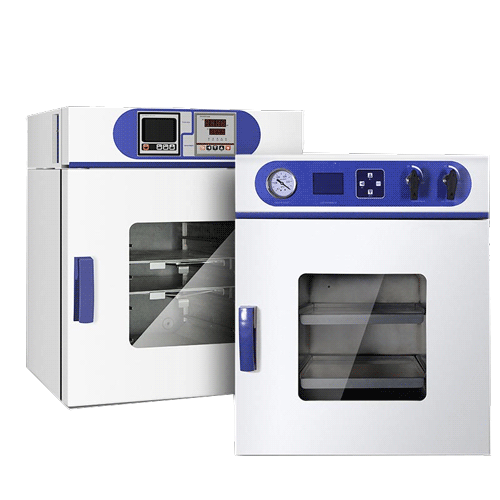
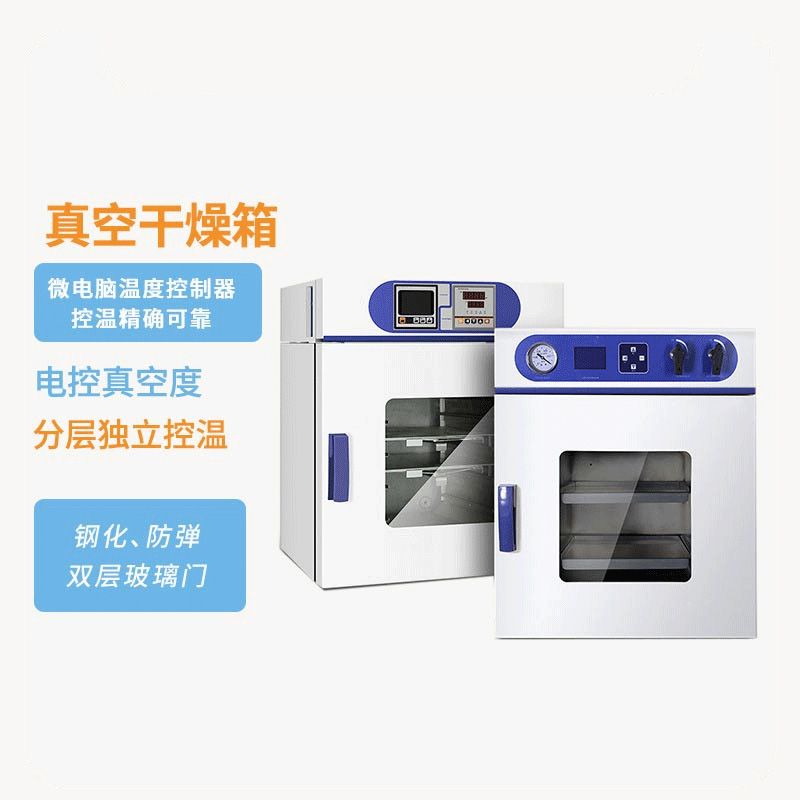
In a typical design, a vacuum drying cabinet includes a working chamber, heating elements, shelves or trays, a door with a seal, an evacuation system, temperature and pressure sensors, and a controller with safety interlocks. The specific layout depends on the design, so dimensions, materials and options must be checked against the card of the selected model. Vacuum drying oven TENCAN refers to equipment for laboratory and preparative drying; it should not be confused with a high temperature vacuum sintering oven or a freeze dryer.
The chamber must withstand pressure differentials and remain sealed after heating and cooling cycles. The door seal comes into contact with solvent vapors, so its resistance is as important as its temperature range. Shelves and baking sheets affect heat transfer: a thin layer on a metal surface dries differently than powder in a deep container. If an inert gas purge is provided, it can reduce the oxygen content, but only if the configuration is confirmed and the procedure is correct.
The pumping system is not a universal unit. Water vapor and organic solvents require different protection measures: steam trap, cold trap, compatible pump and seal materials. The performance of the pump must correspond not only to the volume of the chamber, but also to the amount of steam released by the load. If this balance is not checked, the pressure in the chamber increases and drying proceeds more slowly than expected.
Control may include programs, timers and interlocks, but automation does not cancel sample testing. The sensor readings refer to the medium or surface, not the interior of the powder. Therefore, it is useful to include in the test drying protocol not only the settings, but also the actual mass, the temperature of the sample at a separate point, the pressure and the moment of reaching a constant mass.
Maintenance requires special attention. Seals age, shelves become dirty, sensors need checking, and condensation and dust can accumulate in places not visible during normal inspection. Cleaning must be compatible with the chamber materials and not destroy the seal. The maintenance schedule and list of consumables should be specified for a specific model, and not transferred from other equipment.
Temperature, pressure and load: what exactly does the parameter mean?
When choosing a cabinet, it is easy to compare only one number, but for drying at least three groups of parameters are important. They are related, and transferring a value from one model to another without checking may result in an incorrect behavior.
Working chamber temperature and sample temperature
The description may include maximum and long-term operating temperature, as well as uniformity throughout the chamber. These are different characteristics: the short-term maximum is not equal to the recommended long-term mode, and one measurement point does not describe the entire workspace. The sample temperature depends on the heat input, evaporative cooling and layer thickness. For a heat-sensitive material, not only the upper limit is important, but also the rate of temperature rise and fall. If a material is prone to degradation in air, temperature alone is not enough: the environment in the chamber must also be assessed.
Residual pressure and pumping speed
Residual pressure is often understood as the limiting value that an empty chamber reaches. During drying, the operating pressure is higher because the sample releases steam. Pumping speed affects how quickly this vapor is removed; Removing too slowly will delay the process, and releasing pressure too quickly can cause foaming or powder carryover. Values in mbar, Pa and kPa must be compared in the same units and conditions. It is also useful to know whether chamber pressure is measured directly or indirectly and how the readings are affected by solvent vapors.
Chamber volume, shelf area and sample weight
Chamber liters do not translate into kilograms of loading without density, permissible shelf load and layer height. The usable area of the baking sheets and the distance between them are often more important than the total volume. A thin layer shortens the vapor path, but increases the risk of dusting; a thick layer requires more time and sometimes mixing, which is unacceptable for fragile or friable materials. These limitations should be fixed before choosing a model, otherwise a nominally suitable cabinet will turn out to be inconvenient to use.
| Parameter | What to clarify | Why is this important |
|---|---|---|
| Temperature | Maximum or long-term; uniformity; shelf sensor | The sample may collapse before it dries |
| Pressure | Limit and working; units; pumping speed | Operating pressure depends on steam generation and leakage |
| Loading | Shelf area, layer height, weight | The volume of the chamber is not equal to the mass of the sample |
| Compatibility | Materials of seals, shelves and pump | Solvent vapors can destroy nodes |
Solvent, air and safety
Water and organic solvents require different solutions. Water vapor is less corrosive for many pumps, but large amounts still need to be condensed or removed. Organic vapors can dissolve oil, contaminate the system and form flammable mixtures with air. Therefore, the compatibility of the pump, trap, seals and chamber materials is checked by the safety data sheet of the substance, and not by its boiling point. It is impossible to transfer the regime worked out for water to an organic solvent without separate evaluation.
Vacuum itself does not create an inert atmosphere. If oxygen remains in the chamber, oxidation is possible; filling with nitrogen or other inert medium can reduce its content, but this is a separate function that needs to be confirmed for a specific design. Any vacuum cabinet cannot be assumed to be suitable for flammable vapors simply because it does not contain air at operating pressure. It is also important how the pressure is released and where the gas is discharged: a sudden release and release into the room can be dangerous.
Volatile and toxic substances require ventilation, condensate collection, leak control and personnel training. Acids, ammonia and chlorinated solvents are particularly demanding on materials. The article does not provide specific temperatures and pressures for hazardous substances: such modes are determined by the operating manual, safety data sheet and local procedures. Laboratory testing is not a substitute for industrial risk assessment.
If the composition of the sample is unknown, first determine which volatiles may be released and how they interact with the cabinet materials. The presence of condensation on the door or in the pipes is not just a cosmetic problem: it indicates steam load and the need to check the trap, seals and maintenance procedures. Safety assessment should precede mode selection, not follow it.
Selection errors that appear after launch
Listed below are not diagnoses for a specific installation, but typical reasons why vacuum drying does not reach the expected mode.
- Focus only on maximum temperature. In this case, long-term operation, uniformity, heat supply and solvent properties are not taken into account.
- The expectation is that the vacuum will speed up any process. Without heat and effective vapor removal, evaporation cools the sample and pressure increases.
- Camera overload. A layer that is too thick makes it difficult for moisture to escape, and the shelves may not provide the necessary heat transfer.
- Ignoring the solvent. The pump, seals and trap must be compatible with the vapors, otherwise contamination and accelerated wear may occur.
- Mixing drying and deagglomeration. Removal of moisture does not destroy durable aggregates and does not replace subsequent grinding.
- Rating based on appearance only. The powder may appear dry but retain residual solvent or moisture within the particles.
- Transferring a mode from another model. Different chambers, shelves and pumping systems give different dynamics even with similar settings.
From laboratory sample to larger batch
When increasing the load, you cannot simply multiply the drying time by the weight. In a large chamber, heat is applied to a larger mass through a limited area of shelves, and vapors must be removed from a larger volume. Therefore, the performance of the pumping system, heat transfer area and temperature uniformity become more critical than in laboratory experiments. In addition, in a large chamber it is more difficult to ensure the same conditions at different points.
The loading geometry changes: a thin laboratory layer is difficult to reproduce on a large baking sheet, and pouring powder is not always acceptable. If the material is prone to caking, a lower bed height or intermediate mixing may be required, but each such action is checked on a representative sample. It is impossible to promise the same result for every batch: raw materials, initial moisture and granulometry affect the drying curve.
It is useful to set the criteria for moving to a larger batch in advance: residual moisture or solvent, bulk density, color, crystallinity, solubility, flowability. The analytical method must be reproducible. Test drying is carried out in steps, changing one parameter at a time; otherwise it is difficult to understand what exactly improved the result. If temperature, pressure and layer height change simultaneously, the interpretation becomes unreliable.
How the material is loaded and unloaded is also important for scaling. In the laboratory, the sample is often handled by hand, and larger batches involve pallets, shelving, and exposure time to air. These operations may affect moisture transfer and contamination. They should be included in the test plan and not treated as an afterthought.
What to check during test drying and what data to transfer to the supplier
To select a vacuum drying cabinet TENCAN It is not enough to name the material and the desired temperature. It is useful to prepare a short technical passport of the task.
- Chemical composition and hazardous properties of the sample, including possible volatiles.
- Initial moisture or solvent content and method for its determination.
- Sample weight, bulk density and permissible layer height.
- Temperature limit of the material and signs of its degradation.
- Required final moisture content or residual solvent.
- Permissible operating pressure and method of measuring it.
- Necessity of inert environment, cold trap and ventilation.
- Materials with which the sample is in contact and restrictions on the transfer of impurities.
- Result control method: gravimetry, titration, thermogravimetry or other available method.
- Limitations on cycle time and conditions for subsequent unloading.
During test drying, the mass, sample temperature, pressure, presence of condensation and appearance are recorded at intervals. If the result is not as expected, first check the tightness, loading and steam release, rather than changing all the settings at once. Vacuum Drying Oven Page TENCAN helps clarify the execution, but the final configuration must be appropriate for the task and safety regulations. To correctly compare options, it is useful to maintain the same sampling procedure and indicate at what point in the cycle the measurement was taken.