
Why does the grinding result differ from sample to sample?
The practical situation when starting out with a stirring mill usually looks the same. The sample is crushed, but the particle size distribution diverges from sample to sample, and the grinding time has to be increased in order to “reach” the desired size. Along with time, heating, wear of grinding media and the proportion of aggregates in the finished powder increase. The reason is most often not in the machine itself, but in the inconsistency of three quantities: the mass of the sample, the mass and size of the grinding media and the peripheral speed of the mixing shaft.
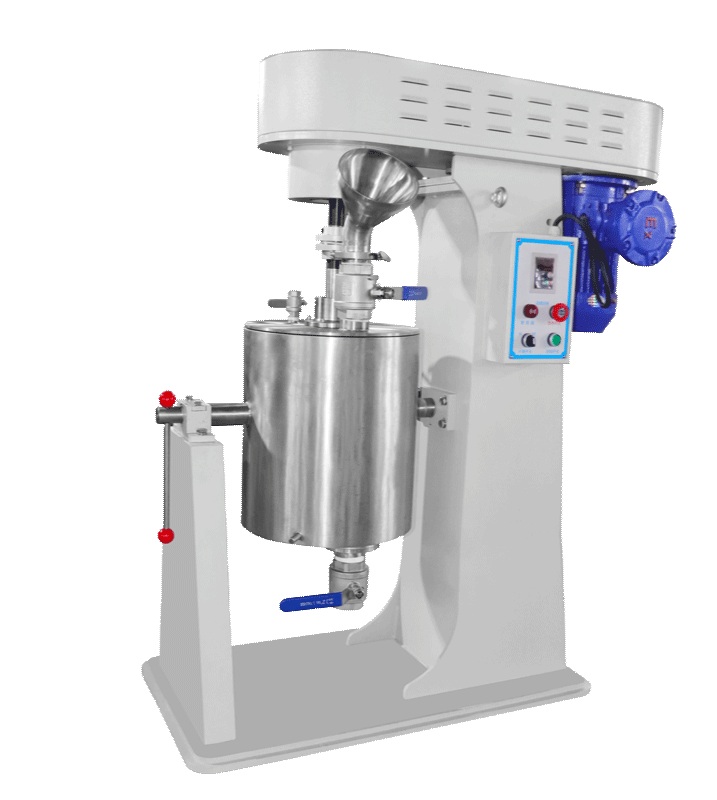
Lightweight Stirring Ball Mill from TENCAN — a laboratory apparatus for fine and ultrafine grinding, in which the grinding media are driven not by free fall, but by a rotating stirrer. This scheme provides stable mixing at moderate speeds and allows you to work with both dry powders and suspensions. But precisely because the energy is transmitted through the “mixer - grinding media - material” contact, the result depends more strongly on the loading recipe than on the “speed” parameter alone.
Below are the criteria that make sense to fix before a series of experiments: workload, diameter and material of the balls, speed and time, thermal conditions, as well as a method of controlling the size. Actual values for a specific design - working chamber volume, speed range, permissible load weight, lining and grinding media materials, available cooling options - are given in the product card and in the accompanying documentation, and they must be checked before starting. The general principles discussed below do not replace the installation passport.
How does a lightweight stirring ball mill work?
Energy transfer through the mixing shaft
A shaft with disks, pins or pins rotates inside the working chamber. It carries away the grinding bodies, which move along complex trajectories: part of the energy is spent on impact, but the main share is spent on shear and abrasion in the gaps between bodies, between bodies and walls, between bodies and elements of the mixer. It is shear loading that makes this scheme effective for fine grinding of soft, plastic and fibrous materials that are difficult to crush by impact.
The kinetic energy of an individual body is proportional to its mass and the square of its speed. The speed is set by the peripheral speed at the periphery of the mixer, that is, the product of the angular speed and radius. Therefore, an increase in the diameter of the mixer at the same speed increases the impact energy, and an increase in speed increases it even faster. At the same time, heat generation and wear increase. The practical conclusion is simple: it is better to regulate the process not with the “speed” lever alone, but together with the mass and size of the grinding media.
Differences from planetary and drum mills
The planetary ball mill accelerates the grinding bowls along a complex trajectory, where centrifugal forces and impact play a decisive role. The roller drum mill operates by lifting and collapsing the charge, and its typical application is coarse to medium grind, large batches, long cycles. A stirring mill occupies a niche between them: it produces a finer grind than a drum mill of comparable volume, and at the same time is usually less aggressive in terms of shock loads than a planetary one.
Limitations follow from this. A bead mill with a fine medium is a different apparatus with different hydrodynamics, and its modes cannot be transferred to a ball mill with stirring. The roll crusher and mixer solve other problems. If the question is specifically about fine grinding in a liquid medium with controlled heating, a mixing circuit is often more practical; if maximum impact energy is needed for large brittle material - planetary.
Information about a specific design, including the working chamber and drive, can be conveniently checked using light ball mill card with stirring on the website TENCAN: The available options are also listed there.
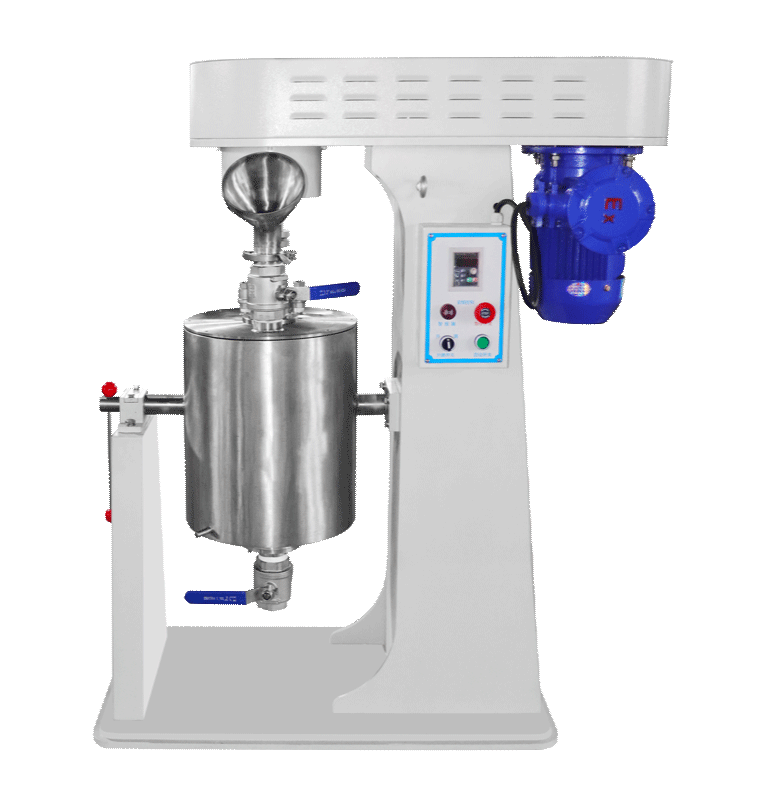
What do the characteristics mean: volume, load, speed
Beaker volume, workload and sample weight
Three different quantities are often confused: the total volume of the chamber, the useful volume that the load actually occupies, and the mass of the sample. Total volume is a geometric parameter. The working volume is always smaller: part of the space is occupied by grinding bodies, part is the free volume necessary for their movement. For ball mills, a typical guideline is filling about 40–60% of the geometric volume of the chamber with grinding media; the exact value depends on the mixer design and the viscosity of the medium and must be specified by the manufacturer.
The mass of the sample is a value that is useful to include in reports along with the volume and loading. There is no point in focusing on “how much you can fit”: when overfilled, the medium becomes too viscous, bodies lose mobility, and the process degenerates into mixing. When underloaded, the contact frequency drops and grinding slows down without benefit to quality. A reasonable starting point for a trial is the middle of the recommended range, not the extreme end.
Grinding media: diameter, density, material
The diameter of the ball determines two competing effects. Large bodies carry more energy per collision and destroy the initial particles well, but produce fewer contacts per unit volume. Small bodies create many contacts and work at the fine stage, but cope worse with large source material. A practical strategy is either one fraction selected for the target size, or two-stage loading: first with large bodies, then with small ones.
The density of a body’s material affects the same energy: with an equal diameter, a body made of a denser material carries more mass. However, density is not the only criterion. Hardness and wear resistance determine the service life and contribution to contamination, while chemical compatibility with the sample and liquid medium determines the very possibility of use. For soft materials and tasks where it is important to avoid metallic inclusions, choose ceramics or zirconium dioxide; for maximum rigidity - tungsten carbide. Each option comes with a cost in terms of wear and possible transfer of material into the sample.
It is convenient to record the ratio of the mass of grinding media to the mass of the sample in a journal: this is one of the key parameters of reproducibility. When switching to another material or another initial size, it has to be revised, and without recording the initial values, it is pointless to compare the results of different series.
Circumferential speed and grinding time
It is more convenient to express the mixing speed through the peripheral speed of the working part, and not just through revolutions: devices with different stirrer diameters at the same speed give different intensities. As speed increases, productivity growth slows down, and heat generation and wear increase almost linearly; after a certain threshold, further acceleration does not improve the size, but worsens it due to the aggregation of small particles.
The grinding time is a parameter that should not be extended “just in case.” It is useful to build a curve: several points in time, sampling and measurement. There is usually a rapid decrease in size at the beginning, then a plateau, and sometimes a reverse increase in the measured size due to agglomeration. The point at which the curve plateaus is the reasonable working time for a given material.
Heating: where grinding ends and material degradation begins
Almost all mechanical energy supplied to the load is converted into heat. In a closed volume with poor drainage, the temperature rises quickly, and along with it the properties of the material change: soft polymers soften and stick, some crystalline substances lose water, and temperature-sensitive components degrade. Outwardly, this manifests itself as “the mill has stopped grinding”: the coarseness stops falling, the load sticks together, and after disassembly a dense layer is found on the walls.
Air cooling removes heat from the body and work area, but does not set the temperature of the sample. It is important to differentiate: cooling the body and cooling the suspension are two different things. The measured temperature of the working space is not equal to the temperature of the material inside the load, especially during intensive mixing. To control the process, it is more useful to measure the temperature of the suspension or body at several points and record it along with the mode.
Cryogenic options with liquid nitrogen are a separate option and not a feature of any installation. This mode can only be used in a configuration where the manufacturer confirms operation at low temperatures and appropriate component materials. Conventional air cooling does not become cryogenic just because it is called that in a report.
For heat-sensitive materials, a reasonable sequence of actions is to reduce the input power (through speed, mass of bodies, time), increase pauses, reduce one-time loading, and only then consider cooling as a separate task. If the material requires cryogenic conditions, this must be confirmed by the equipment manufacturer.
Material of the glass and grinding media: wear and impurities
Any grinding is wear and tear. The grinding media and lining lose material, and some of it goes into the sample. Absolute resistance does not exist: “zero pollution” is an advertising formula, not a technical characteristic. The real question is different: how much impurity, what element, and whether this is acceptable for subsequent analysis.
It is convenient to estimate based on conditions. Hard abrasive material at high speed quickly wears out both bodies and walls; soft material under moderate conditions makes a minimal contribution. The higher the density and hardness of the bodies, the higher their service life is usually, but also the more noticeable the trace of metal in the sample, if the material of the bodies is metal. Ceramics and zirconium oxide reduce metal contamination, but their own wear is still present and depends on the material-medium pair.
A separate topic is cleaning and transferring material between samples. Between series it is not enough to rinse the chamber: remnants of the previous sample in the gaps, under the disks and in the pores of the lining cause cross-contamination. The order of work from soft to hard material, separate sets of bodies for different tasks and washing followed by drying reduce this effect.
Nylon grinding bowl: where it is appropriate and where it is not
Polymer cups are used when it is more important to avoid metal and ceramic contamination than to obtain maximum grinding energy. The grinding bowl made of reinforced nylon is an easy solution for planetary mills: it does not rust, does not leave a metal trace, and is easy to handle. But it has limitations: relatively low surface hardness, sensitivity to heat and aggressive solvents, and a tendency to wear when working with abrasive powders. Temperature range and compatibility with specific media should be verified in the manufacturer's documentation.
It is important here not to transfer the properties of belonging to the entire assortment. The nylon glass is positioned for planetary mills, that is, for an apparatus with a different loading pattern than that of a mixing mill. Compatibility of the cup with the working chamber and mounting of another machine is not confirmed by random selection: it must be requested separately. This item is described at grinding bowl made of reinforced nylon.
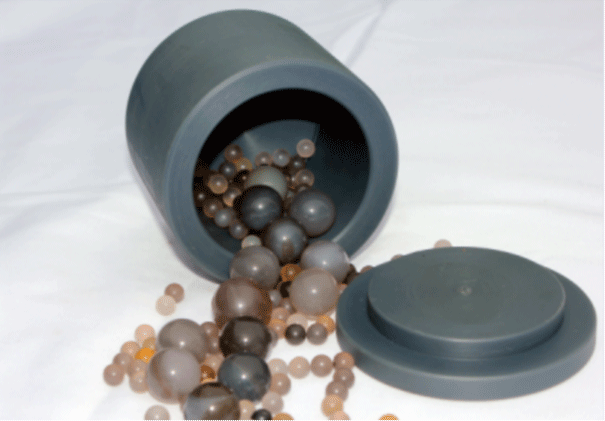
Practical conclusion: the material of consumables is selected according to the “sample - analysis method” pair. If further analysis is sensitive to iron, metal bodies are inappropriate; if the sample is abrasive and is processed for a long time, the polymer will quickly wear out. A trade-off is sought between durability, contamination and replacement cost.
Achievable fineness and how it is measured
The final particle size depends on the material, initial size, medium, mode and method of measurement. The minimum from the catalog is not a guarantee for any sample, but a limit achieved on a certain material under certain conditions. Hard brittle material is crushed differently than plastic material; fibrous requires shear, not impact.
The control technique is no less important. Sieve analysis provides mass distribution and works well for coarse fractions, but does not distinguish between aggregates and primary particles. Laser diffraction is sensitive to sample dispersion before measurement: insufficient disagglomeration overestimates the result, excessive disagglomeration destroys agglomerates. Microscopy shows the shape and presence of stuck together particles, which the device considers as large. The specific surface area determined by the BET method is sensitive to porosity.
Therefore, the same powder may look different in different reports, and it is correct to compare the results only with the same sample preparation. The experiment certificate should record the method, dispersion mode, number of measurements and scatter.
Finally, distinguish between comminution and disagglomeration. If the task is to separate nanocrystalline material that has stuck together into aggregates, the mode is selected soft: minimum energy, short time, suitable environment. Intensive grinding does not help in this case - it creates new bonds between particles and spoils the distribution.
What to prepare for a trial grind and how to move on to a larger batch
A trial grind makes sense when it can be compared with another result. To do this, determine in advance what exactly is being recorded: the mass of the sample, the mass and fraction of the grinding media, the volume and material of the chamber, speed, time, medium (dry grinding or suspension indicating the liquid and its quantity), temperature, method of particle size control. Without this, the next series will not be comparable.
The information that the manufacturer usually requests when selecting a configuration includes the type and hardness of the material, the initial and target size, the required mass of the finished sample, the admissibility of introducing impurities and their limit, sensitivity to heat, the need to work in an inert or protective environment, requirements for unloading and cleaning. The more specific this data is, the fewer iterations will be needed.
An important step is the transition from a laboratory sample to a larger batch. Simply increasing the volume of the chamber and loading does not automatically preserve the result: at the same grinding time, the specific energy input drops, and the thermal regime changes due to worse heat removal from the larger volume. The guideline is the specific energy per unit mass of the material; when scaling, they strive to maintain it, and the speed and time are adjusted according to the actual heating and the particle size curve.
The mixing mill is also sensitive to geometry: the ratio of chamber diameter and height, shaft design, and the size of the working gap affect the circulation of the charge. Therefore, scaling by one volume is incorrect. General idea of the range and directions of equipment TENCAN, including the full name of the manufacturer Changsha Tianchuang Powder Technology Co., Ltd., can be obtained from main page of the site, and the discussion of a specific configuration begins with a product card and technical specifications.
Frequently asked questions
Can the same grinding media load be used for different materials?
Formally it is possible, but the result will not be comparable. When changing materials, the hardness, sticking tendency and contamination requirements change. The load is reviewed along with the regime and recorded in the journal.
Does higher speed always produce finer powder?
No. After a certain threshold, heating and aggregation increase, and the measured fineness ceases to improve and may deteriorate. It is useful to plot the size-time curve at several speeds.
Does a nylon cup replace a metal one when working with abrasives?
Does not replace. The polymer is inferior in terms of wear resistance and permissible temperatures; For abrasive materials, ceramics, zirconium oxide or hardened materials are usually chosen, focusing on the permissible level of impurities.
Selecting a light agitated ball mill is a series of small testable decisions: feed, speed, time, heat and size control. The values obtained for one material are not automatically transferred to another, and the parameters of a specific design are always confirmed by the manufacturer’s documentation and trial grinding.