
The transition from static crucible firing to continuous processing of bulk material almost always reveals a trade-off: a fixed bed is easier to control, but it is heated unevenly, while a rotating tube gives more uniform contact with the gas environment, but adds new variables. Rotary tube furnace TENCAN refers specifically to this class of equipment: the material moves through a heated pipe, which rotates, and heating, atmosphere and feed speed form a single mode. IN rotary tube furnace card the product category is presented; Specific performance parameters, temperature ranges, pipe sizes and equipment require verification with the current specification. Therefore, it is useful to start not with a list of numbers, but with a problem: what needs to change in the powder, what restrictions the material imposes, and how the result will be confirmed.
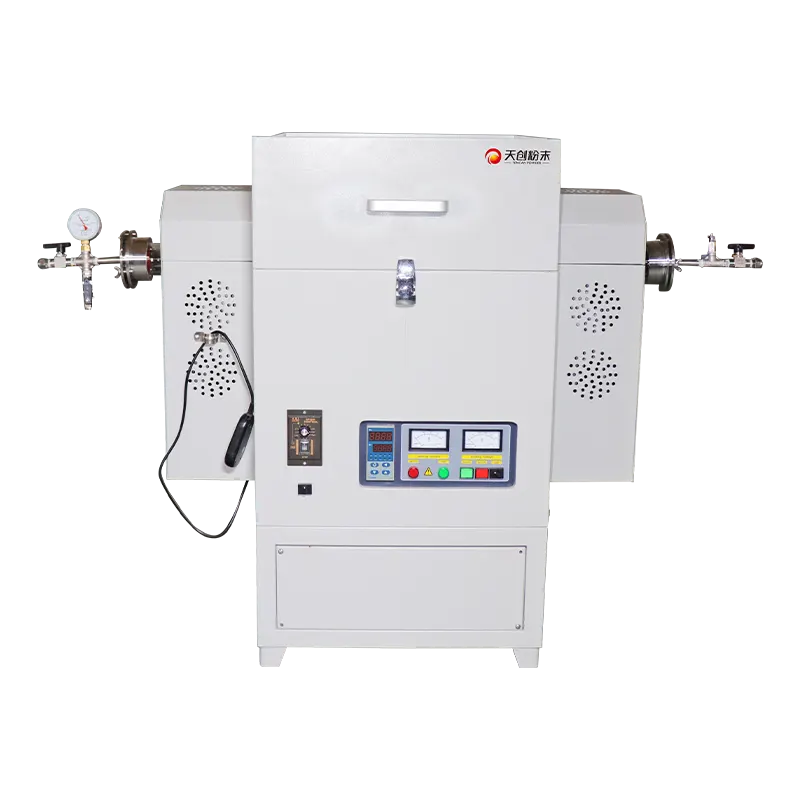
Rotary tube furnace in the powder preparation chain
In laboratory practice, heat treatment is often confused with grinding, mixing or drying, although these are different operations. Grinding reduces coarseness and breaks down agglomerates, mixing evens out the composition, and the furnace changes the phase state, removes the binder, and carries out reduction, oxidation, carbonization, activation or sintering. The rotary tube furnace takes the place of the thermal link: it can work with loose powder, granulate or small pieces, if they are able to move through the pipe and do not stick together into a monolith. For samples that must retain their shape, remain on a substrate, or be subjected to a strictly defined one-sided attack, a static oven is often clearer. For powders where renewed surface contact with the gas and prevention of local overheating is important, a rotating tube is advantageous but requires testing.
The practical question is usually whether it is possible to obtain a reproducible result when moving from grams to larger amounts of material. The answer depends not only on the maximum temperature. You need to understand how the powder behaves when heated: does it sinter, melt, swell, release volatiles, oxidize, stick to the wall, or form dust. Rotation helps to mix the layer, but at the same time creates abrasive contact with the pipe wall and can increase dust entrainment. Therefore, the selection of a rotary tube furnace begins with a description of the material and the target result, and not with a search for the highest temperature.
Heat treatment of the powder is rarely the only operation. Before firing, the material can be crushed, sifted, granulated, dried or mixed with an additive. After firing, sinter grinding, sieving or phase analysis are sometimes required. If the previous operation produces a wide particle size distribution or a wet, clumping product, the rotor tube may become unstable: large lumps will move differently than fines, and the residence time of different particles will vary. This does not make the furnace unsuitable, but it does mean that batch preparation and moisture control are part of the process setup.
How does a rotating pipe work and what exactly does rotation do?
In a typical design, the pipe passes through the heating chamber, rests on supports and is rotated. At the ends there are loading and unloading units, as well as gas supply and gas phase outlet. Depending on the design, the pipe can be horizontal or have an adjustable slope; tilt, rotation speed, internal elements and feed rate affect the axial movement of the material. Heaters create a wall or work area temperature, but the sample temperature is not equal to the controller reading. The powder receives heat through the wall, gas convection and contact between particles; when moving, the layer is renewed, so heat transfer can be more uniform than in a stationary boat.
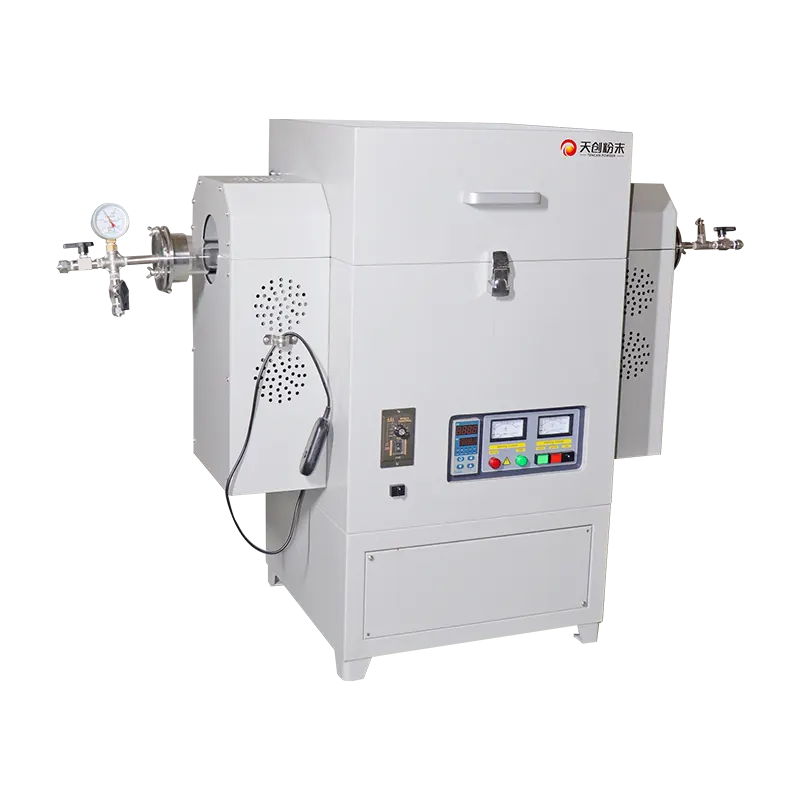
Rotation serves several functions. It prevents the formation of a fixed layer, reduces the likelihood of local hot spots near the wall, helps the escape of gases and renews the surface of contact with the atmosphere. At the same time, rotation is not mixing in a ball mill: there are usually no grinding bodies inside, so intensive grinding should not be expected. If lifting vanes or spirals are provided within the pipe, they may improve transport and mixing, but their presence and geometry must be confirmed for the specific design. You cannot transfer the design of one model to the entire range.
The axial movement of material in a rotor tube is not described by simple “furnace time”. The particles are distributed according to their residence time: some pass faster, some are retained near the wall or in stagnant zones. The wider the residence time distribution, the more difficult it is to guarantee the same degree of conversion. This is affected by inclination, rotation speed, loading, flowability, humidity, presence of lumps and operation of the unloading unit. Therefore, during test firing, it is important to take samples not only from the general container, but also to evaluate how the result changes over time and during unloading.
Temperature, atmosphere and residence time
Maximum, operating and sample temperature
Furnace documentation usually distinguishes between maximum temperature, long-term operating temperature and permissible temperature for a specific pipe, lining and atmosphere. The maximum value does not mean that any process can be carried out at this level all the time. The service life of heaters, pipe and seals depends on wall temperature, gas composition, heating and cooling cycles, and emissions. In addition, the controller usually shows the temperature in the sensor area, not the temperature of the powder. When loading cold material, the sample may noticeably lag behind the wall; in an exothermic reaction, on the contrary, the local temperature of the powder can exceed the specified one. To select a mode, you need information about where the sensor is installed, whether there is pipe temperature control, and how the sample temperature is confirmed.
Sealing and gas flow
The atmosphere is no less important part of the installation than the heating. An inert gas prevents oxidation, a reducing gas changes the chemistry of the process, and an oxidizing environment may be necessary for annealing or carbon removal. However, the gas supply itself does not guarantee the absence of oxygen: air remains in the volume after loading, penetrates through leaks and diffuses through materials. What is needed is purging, flow control, a clear gas outlet diagram and a leak test. For rotating pipe, special attention is paid to the seals at the ends: they wear, require maintenance, and must be compatible with the temperature and chemistry of the process.
The gas flow can carry away fines, condensates and decomposition products. If the outlet or filter becomes clogged, the pressure and composition of the atmosphere changes and the process becomes unstable. The test should include monitoring of the pressure drop, outlet temperature and trap condition. Conventional purging should not be described as a cryogenic process or assumed that any gas supply makes the furnace a vacuum unit. Vacuum, overpressure and purge are different modes, and each requires confirmation for a specific design.
Loading, rotation speed and tilt
Loading affects the movement pattern of the layer. If the mass is too large, the material occupies a significant part of the cross-section, flows worse and can form a dense layer near the wall. If the load is too small, the role of dust entrainment and uneven feeding increases. The rotation speed varies from slow rolling to more intense mixing, but there is no universal value: free-flowing coarse granulate and fine cohesive powder behave differently. Tilt speeds up axial movement, but also reduces dwell time; Increasing the incline for the sake of performance without checking the degree of conversion is risky.
| Selection option | What to clarify | Why is this important |
|---|---|---|
| Temperature | Maximum and continuous operating temperature permissible for pipe and seals | Short-term highs do not equal daily work |
| Atmosphere | Gas flow, purge, permissible pressure, seal compatibility | Oxidation and leaks change product chemistry |
| Pipe | Material, diameter, length of heated zone, method of fastening | Determines loading, heat transfer and sample contact |
| Transport | Tilt, rotation speed, internals, feed and discharge | Forms residence time and risk of stagnation zones |
| Cleaning | Access to the pipe, disassembly of components, compatibility with cleaning | Residues from the previous batch may become an impurity |
Pipe material, loading and cleaning
The tube is in contact with the sample and the gas at high temperature, so its material is considered part of the process. Quartz is convenient for observation, but is sensitive to thermal shock and some chemical environments. Aluminum oxide ceramics are resistant to many impacts, but also require careful heating and cooling. Metal pipes may be more technologically advanced to install, but they can interact with aggressive substances or catalyze reactions. These are general principles and not a statement that a particular rotary tube furnace TENCAN Comes with all options listed. Pipe material, permissible atmosphere and temperature limits must be confirmed in the specification.
The introduction of impurities is another factor that cannot be reduced to just the word “inert.” The powder wears out the wall, especially with prolonged rotation and high loads. Soft materials contaminate the product faster, while abrasive materials accelerate pipe wear. Cleaning between batches is important not only for purity, but also for reproducibility: residues of sinter or reduced metal can change the behavior of the next sample. If switching between materials requires a complete pipe change or a lengthy washdown, the actual laboratory productivity will be impacted. You should clarify which surfaces are accessible for inspection, how the pipe is removed, and what cleaning products are compatible with the seal materials.
The load is determined not only by the volume of the pipe. It is necessary to distinguish between sample mass, bulk density, section filling fraction and time productivity. Two powders of the same mass can occupy different volumes and move differently. If a pipe size is specified on the card, it does not automatically translate into a recommended load: the limit depends on the process, inclination, rotation and material properties. For test firing, it is useful to start with a batch that can be fed in uniformly and reliably discharged, and then assess whether a stagnant layer is forming or whether dust entrainment is growing.
Moving from a lab sample to a larger batch
Scaling a rotary tube furnace cannot be reduced to a proportional increase in mass. When moving to a larger diameter pipe, the heat transfer area, filling fraction, gas dynamics and residence time distribution change. If in the laboratory the sample lay in a thin layer, but in the pilot tube there was a dense layer, the previous temperature may give a different degree of conversion. Therefore, when scaling, not only the temperature is preserved, but also the “time - temperature - atmosphere” history. In practice, this means checking gas flow per mass of material, heating rate, holding time and cooling conditions.
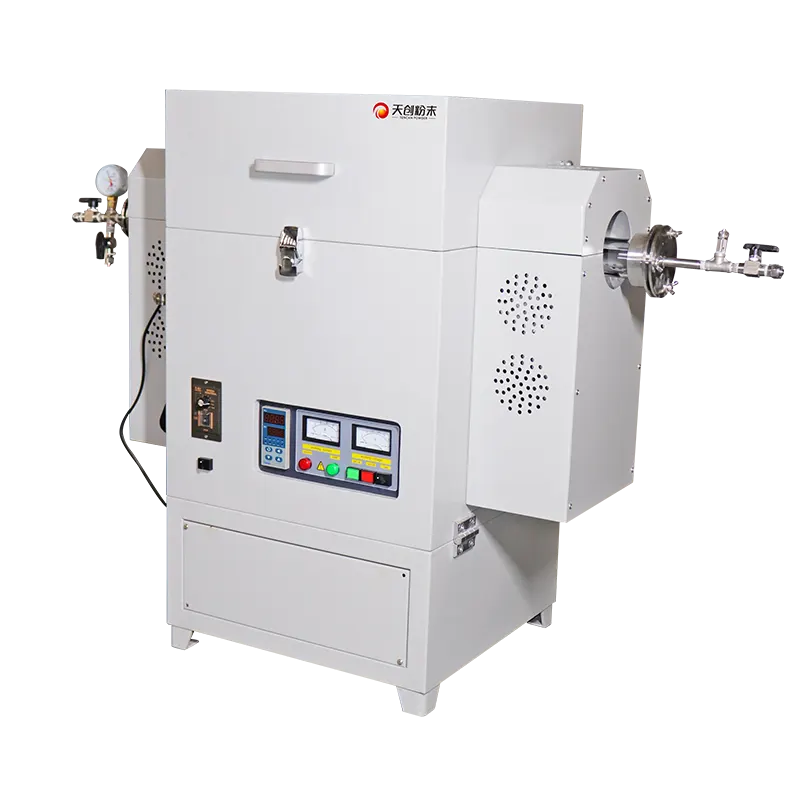
Performance depends on what is considered acceptable. If only partial dehydration or debinding is desired, the acceptable conversion may be less sensitive to variation in residence time. If deep phase transformation or sintering is required, even a small fraction of particles with a short residence time can spoil the product. In a trial run, it is worth changing one factor at a time: load, rotation speed, inclination or gas flow. This plan provides more information than trying to immediately reach peak performance. However, you should not promise specific performance without testing on real material.
A separate issue is cooling. If hot powder is discharged into a container, it may continue to interact with air and oxidize or sinter. Sometimes a controlled atmosphere at the outlet, a heat exchanger or slow cooling in the pipe is needed. These solutions are not a universal part of every oven and must be checked in the configuration. It is also important how the unloading is organized: a free dump, a collector, an auger or another unit creates different conditions for dust and large lumps.
Practical problems and verification methods
An observed problem rarely has a single cause. If the powder sinteres into dense lumps, you cannot immediately declare a furnace malfunction: the sample temperature may be too high, the mixture may be too wet, there may be insufficient bed movement, an unsuccessful feed rate, or a chemical reaction that actually produces a melt. If the material adheres to the wall, the properties of the particles, the temperature of the wall, the pipe material and the presence of condensate are affected. If the product is uneven in color or phase, it is worth checking the residence time distribution, mixing, gas flow and sensor accuracy. A diagnosis without data would be a guess.
- Dust carryover. Check gas flow, fractional composition, loading and condition of the filter. Fine particles can be carried away even with moderate flow.
- Caking and sticking. Compare the temperature of the wall and the sample, humidity, heating rate and holding time. Sometimes it is not raising the temperature that helps, but lowering it or changing the supply.
- Clogging the exit. Inspect the pipe, condensate drain, trap and unloading unit. Decomposition products may condense in the cold zone.
- Unevenness. Check pipe filling, tilt, rotation and sampling over time. Don't limit yourself to one average sample.
- Wear of seals. Assess pipe end temperatures, gas purity, and material compatibility. The seal is a consumable item, not a permanent part.
For verification, it is useful to keep a log that records not only the set values, but also the actual flow, pressure drop, outlet temperature, product appearance and discharge weight. If the oven allows the sensor to be mounted in the material zone, this helps separate the wall temperature from the powder temperature. If this is not possible, it should not be assumed that the exact temperature of the sample is known. For many processes, repeatable operation is sufficient, but sensitive materials require additional thermocouple or reference testing.
What to prepare for test firing and configuration selection
Before contacting the supplier, it is worth collecting a technical description of the task. The nature of the material and its limitations, original particle size, bulk density, moisture content, heating behavior, acceptable atmosphere, target temperature and time, acceptable impurities, cooling and analysis requirements are required. It is useful to specify whether the process is batch or continuous, how the material will be supplied, and what is considered a finished product. If the material is hazardous, emits toxic gases or forms flammable mixtures, the discussion should be based on safety regulations and protective equipment, not just the choice of oven.
For test firing, a plan is formulated: batch weight, charge preparation, heating rate, gas flow, rotation speed, tilt, holding time and cooling method. It is determined in advance what samples will be taken and what methods will confirm the result: mass loss, x-ray phase analysis, particle size distribution, density, microscopy or other suitable measurements. Quality cannot be confirmed by appearance alone. It is also important to agree on how cleanup will be assessed between runs and how much material remains in the pipe.
When choosing a rotary tube furnace configuration TENCAN It makes sense to discuss separately the pipe material, temperature range, atmosphere, supply and discharge system, cleaning access and control points. It is convenient to compare with other areas of equipment at website TENCAN, but you cannot transfer the parameters of one model to the entire series. If the task involves pre-shredding, this is a separate operation and separate equipment; the furnace does not replace the mill. If the main goal is heat treatment of bulk material, a rotary tube can become a working solution, but only after checking the compatibility of the material, mode and components. The resulting specification should capture validated parameters rather than assumptions derived from the general description of the category.