
The laboratory task is usually formulated briefly: to bring the sample to the desired size and not to introduce anything foreign into it. If the material is soft, fibrous or prone to sticking, and the subsequent analysis is sensitive to metals, the choice is often a polyurethane grinding bowl for a planetary mill. The solution looks simple: the elastic polymer does not produce metal shavings, absorbs the impacts of grinding media and is quieter than its steel or ceramic counterpart. However, the polymer beaker has its own limitations, and much of the problem in laboratory practice is due to the fact that these limitations were not taken into account in advance.
Practical questions are discussed below: how such a glass is constructed, where the contamination comes from, how wear manifests itself, what is the limitation of cleaning, and what data needs to be clarified before ordering and before trial grinding. Numerical characteristics - nominal volume, mounting dimensions, permissible temperatures, equipment - are taken from the specific product card and mill documentation. The principles by which these characteristics are compared to the sample's task are discussed here.
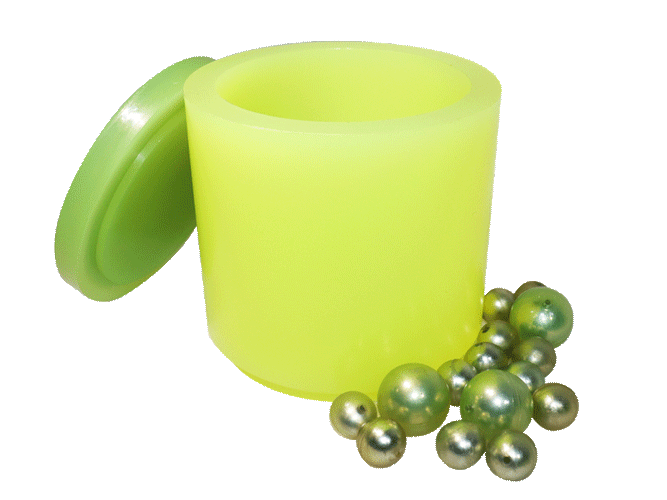
When does a polyurethane cup solve a problem, and when does it create a new one?
A typical scenario is the sample preparation of materials that are undesirable to grind in metal or hard ceramic equipment: polymer composites, carbon materials, plant and biological raw materials, soft minerals, some salts and pigments. What is important here is not the extreme hardness of the equipment, but the absence of metal contact, resistance to sticking and the ability to work with small samples. Polyurethane is convenient in this role: it is elastic, does not produce metallic inclusions, and is relatively easy to form into a glass with a closing lid.
The second advantage of elastic equipment is the nature of the impact on the sample. Grinding bodies in a polymer cup spend part of their energy on wall deformation, and not just on particle destruction, so the impact is softer. This helps where it is necessary to carefully destroy agglomerates without turning the sample into fine dust, and where part of the material may decompose or change structure during a hard impact. At the same time, the same softness means that the glass is not designed for constant work with abrasive materials.
The limits of applicability are determined by a combination of properties: hardness and abrasiveness of the sample, process temperature, chemical composition of the medium, requirements for organic purity, and the service life of the glass. If the sample is hard and abrasive, wear of the polymer accelerates, and along with it, the contribution of the equipment to contamination increases. If grinding is carried out for a long time and without a pause, the polymer limits the temperature regime. If a solvent is used as a medium, the chemical resistance of the cup material and seal must be separately verified. Therefore, the question “is polyurethane suitable” is decided not by the name of the material, but by a set of conditions.
It is worth mentioning the common expectation. The polyurethane cup is often seen as a way to get a “clean” grind with no contaminants at all. This expectation is not justified: any equipment wears out and introduces something into the sample, the only difference is what exactly and in what quantity. The practical goal is to reduce the contribution of equipment to a level acceptable for the analysis method used, and to be able to control this contribution.
Glass design: what affects operation and wear
Body, cover and seal
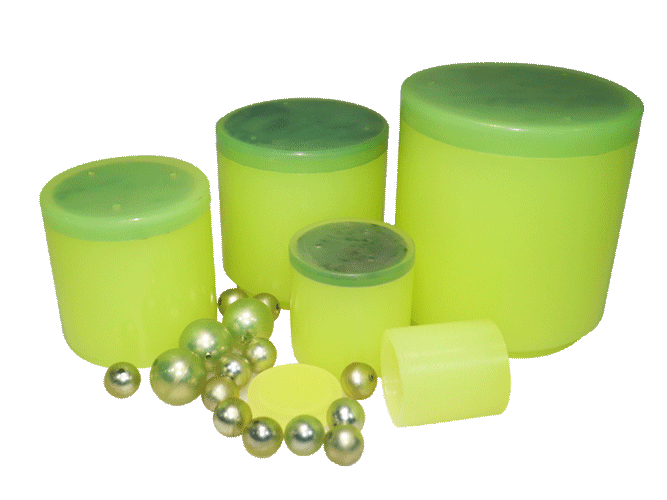
A grinding bowl is more than just a container. It consists of a body, a cover and a sealing element, and in some versions also an internal lining on a supporting base. For the grinding result, what is most important is what comes into contact with the sample: the inner surface, edges, bottom and compaction zone. This is where sticking begins, residues from previous tests accumulate and the first signs of wear appear.
The lid and seal are responsible for the tightness. With wet grinding, tightness limits liquid loss and evaporation; with dry grinding, it limits the carryover of fine fractions and dusting. The elastic seal loses its properties over time: it can harden, crack or deform, and then the glass begins to leak or let dust through. This is not a cosmetic problem: the loss of tightness changes the material loss and the reproducibility of the result.
- internal surface: smoothness, absence of seams and pores - sticking and completeness of unloading depend on this;
- edges and bottom-wall transition: zones of stress concentration and onset of wear;
- sealing: resistance to the environment and temperature, elasticity life;
- Lid Retention: Reproducibility of closure from sample to sample.
The practical conclusion is simple: when examining a glass, they look not at the appearance as a whole, but at these four elements. Cloudiness, loss of gloss, local depressions, “tracks” on the inner wall, surface stickiness, damage to the seal - all these are signs that need to be recorded and taken into account when planning a replacement.
Compatible with specific planetary mill
The most common source of error is the assumption that the grinding bowl is universal. Planetary mills of different series differ in seating, diameter and height of the nest, method of fixation, number of glasses on the rotor and permissible loading weight. A glass that fits one model may not fit another - and it's not just a matter of geometry: an unbalanced or improperly secured pair of glasses creates vibration, which causes the lid to deform and the seal to break.
Therefore, before ordering, the parameters of the glass are checked with the documentation of the device, and not with the general description of the category. The name “Polyurethane Grinding Bowl for Planetary Mill” describes the type of product, but does not indicate compatibility with a specific model. Current product parameters are shown in the card polyurethane grinding bowl; Compatibility with the device available in the laboratory is checked separately according to its passport.
In addition to geometry, the mode is taken into account: permissible speed, duration of continuous operation, maximum load volume. Exceeding these limits leads to overheating of the polymer, deformation of the glass and accelerated wear. If the documentation of the device and the glass differ or the value is indicated ambiguous, it is more reasonable to clarify it with the supplier than to select the mode experimentally according to the principle “until it collapses”.
Cup volume and workload are different values
In descriptions of equipment, it is easy to confuse three different things: the nominal volume of the glass, the volume of the working load (grinding media plus the sample) and the mass of the sample itself. Nominal volume is a geometric characteristic of a container. The working load is always smaller: part of the volume must remain free, otherwise the grinding media will not be able to move. The mass of the sample is determined not by the volume of the glass, but by the grinding technique and the required mass ratio.
In practice, this means that the same task may require a glass of different volumes, and vice versa: two glasses of the same volume will give different results with different loads. When moving from a single sample to a series, it is worth checking whether the ratio of grinding media to sample is maintained, and not just the volume. If this ratio changes, the grinding energy, tool wear, and particle size distribution also change.
Introduction of impurities: two independent sources
When discussing pollution, it is useful to separate sources. The first is the material of the glass and its wear. The second is grinding media, which in many cases contribute significantly more to the sample than the glass itself. A third, often underestimated source is the remains of a previous sample if the glass is not washed thoroughly enough. All three contributions add up and need to be dealt with separately.
Polymer wear: organic contamination
Polyurethane is an organic material. Its wear introduces organic particles into the sample, as well as, depending on the composition and condition of the material, low-molecular components. For elemental analysis of metals, such a contribution is often not critical, but for methods sensitive to organics - thermogravimetry, IR spectroscopy, determination of total organic carbon - it can be significant. Therefore, when working with a polymer beaker, it is important to decide in advance what methods will be applied to the sample after grinding.
The intensity of the organic contribution increases with wear. A new, gently used glass and a glass with significant signs of abrasion behave differently, which is another reason to keep a log of the condition of the equipment. In addition, the contribution depends on the mode: the more severe the grinding conditions, the more wall material is involved in the process.
Grinding media: the main source of metal
A polyurethane cup does not automatically make the system metal-free. If it uses steel or other metal grinding media, the metal gets into the sample precisely from them - due to the abrasion of the balls and their collisions. The choice of grinding media material is determined by the task: for soft materials, heavy and hard balls are not needed; for hard abrasive materials, soft balls are ineffective, and wear will be high on both sides.
A reasonable approach is to consider the beaker, grinding media, and sample as a single system. The material of the balls, their size and size distribution, total mass, density - all this affects both the grinding result and contamination. The polyurethane cup in this system is responsible for the absence of metal contact with the wall and for the softer nature of the impact, but not for the cleanliness of the grinding media.
When polyurethane is not the best choice
There are conditions under which a polymer cup is inferior to other materials. First of all, this is long-term grinding of hard abrasive materials: quartz, corundum, carbides, metal oxides. Here the wear of the polymer will be rapid, and with it contamination. The second case is high requirements for purity specifically in organic matter. The third is working at temperatures close to the thermal resistance limit of the polymer, especially without pauses or cooling. In all these situations, the choice of a different tooling material is a matter of resource and reliability of the analysis, and not of preference.
The opposite situation also occurs: for a soft, sticky, metal-sensitive sample, hard equipment turns out to be worse because it produces metal traces and requires longer grinding. There is no universal solution; there is a correspondence between the properties of the sample, the capabilities of the equipment and the requirements of the analysis method.
Wear: causes, signs and time of replacement
What accelerates wear
The wear rate of a polyurethane cup is determined by several factors simultaneously:
- abrasiveness of the sample: solid particles with sharp edges act as an abrasive;
- initial size: the larger the particles at the inlet, the higher the local loads;
- density and hardness of grinding media: heavy balls transfer more energy to the wall;
- mass ratio of grinding media and sample: overload accelerates wear;
- rotation speed: increases impact energy and heat;
- grinding duration: wear accumulates in proportion to time;
- dry grinding: the absence of a liquid medium increases friction and dust;
- temperature inside the glass: the higher it is, the softer the polymer.
There is also feedback that is often forgotten. As wear occurs, the internal surface becomes less smooth, material begins to stick, unloading becomes difficult, and the operator increases the grinding time to achieve the desired coarseness. Longer grinding speeds up wear. It turns out to be a vicious circle that is easier to prevent than to break.
How to notice wear and when to change the glass
The wear of the polymer cup appears gradually, so it is convenient to track it using several simple signs:
- change in the appearance of the inner surface: clouding, loss of gloss, “matte” areas;
- local depressions, ring “paths”, traces of ball trajectories;
- change in edge geometry, deformation of cover seating elements;
- loss of seal elasticity, cracks, hardening;
- appearance of stickiness or odor, change in color of the material;
- deterioration of reproducibility under unchanged conditions: the same sample requires a different time.
The moment of replacement is determined not only by appearance. If purity requirements are imposed on the sample, the criterion becomes the result of a blank experiment or control analysis. It is useful to agree in advance within the laboratory what is considered a reason for replacement: the appearance of visible signs of wear, exceeding the permissible contribution in the blank sample, or a change in reproducibility. This criterion eliminates disputes and work “until the last minute.”
Cleaning and cross-contamination between samples
Cleaning is the part of working with a polymer cup where mistakes are most often made. The requirements for it arise from the properties of the material. Polyurethane has limited resistance to solvents and heat, so the usual techniques for metal or ceramic equipment - aggressive solvents, hot drying, hard brushes, sandblasting - are not suitable for it. Instead, a more accurate but equally reproducible protocol is required.
What polyurethane doesn't like
- concentrated solvents and their prolonged contact: swelling and cracking are possible;
- high drying temperatures: the polymer softens, deforms, and the seal loses its properties;
- abrasives and metal brushes: leave scratches, which then accumulate dirt;
- sudden temperature changes during wet cleaning;
- long-term exposure of the sample without cleaning: some media gradually penetrate the surface.
Specific permissible environments and cleaning temperatures are specified in the product documentation; General limitations arising from the nature of the material are listed here. If the grinding medium is aggressive, the issue of its compatibility with polyurethane is decided before starting work, and not after the first unsuccessful test.
Blank sample and operating procedure
Cross-contamination from a previous sample is a real risk with any tooling material, but with a polymer cup it is additionally associated with an increased tendency to stick. Practical measures are known: thorough mechanical cleaning, washing with an approved medium, drying at an acceptable temperature, visual inspection and separation of sample flows. When different types of samples are prepared in the same laboratory, a simple and reliable option is to allocate separate beakers for individual groups of materials.
The second tool is blank experience. Its purpose is to evaluate the contribution of the equipment: grinding is carried out without a sample or with an inert carrier, and then the resulting material is analyzed using the same method as working samples. This way you can see what exactly gets into the sample from the glass and grinding media, and compare the modes with each other. The order of the blank experiment is based on the protocol accepted in the laboratory and the requirements of the analysis technique.
Selection of grinding mode
Glass filling and mass ratio
The grinding mode starts with loading. The general rule: the grinding media and the sample together should not fill the container entirely - part of the free volume is necessary for the movement of the balls. Overloading the glass leads to the fact that the grinding media stop working as grinding media, but begin to put pressure on the walls; the temperature rises, the lid is deformed, and the wear of the polymer accelerates. Underloading, on the contrary, lengthens grinding and increases the time of contact of the material with the wall.
The ratio of the masses of the grinding media and the sample cannot be assigned arbitrarily. It is related to the required coarseness, material properties and grinding kinetics. Specific values are taken from the methodology and accompanying documentation, and when switching to a new material, they are checked experimentally. The same numerical value transferred from another task without verification does not guarantee anything.
Dry and wet grinding
Dry and wet grinding differ not only in the presence of liquid. The liquid medium dissipates heat, reduces dusting, reduces sticking and often helps achieve a narrower particle size distribution. But it imposes additional requirements: the tightness of the glass, the chemical resistance of the polyurethane and seal to the selected medium, the absence of interaction of the medium with the sample. Dry grinding is easier to prepare, but for a polymer cup it is more severe: higher friction, greater abrasive load, more noticeable heating.
Separately, it is necessary to distinguish between grinding and disagglomeration. In the first case, the task is to reduce the size of the particles themselves; in the second, to destroy aggregates without changing the primary particles. These tasks require different amounts of energy and time, and soft-impact polyurethane tooling is more often used where gentle impact is required. Confusion between the two tasks leads to excessive grinding times and, as a result, accelerated wear.
Speed, time and temperature
The rotation speed increases the impact energy, but at the same time increases both heating and wear of the equipment. The polymer does not remove heat well, so long-term continuous operation without a pause leads to a gradual heating of the glass and softening of the material. A practical technique is to break up long grinding into intervals with pauses, but the specific schedule is determined by the capabilities of the apparatus and the properties of the sample.
Here it is worth distinguishing between concepts that are often confused. Air cooling of the working chamber of the installation and cooling with liquid nitrogen are fundamentally different modes, and the first is not cryogenic. The temperature of the working space of the apparatus is not the same as the temperature of the sample inside the glass: between them are the material of the glass, the grinding media and the friction process itself. Therefore, it is impossible to judge the heating of the sample based on the readings of the camera sensor.
Pre-crushing and its connection with glass wear
Large pieces of material are not fed directly into the planetary mill: first the sample is reduced in size, and one of the apparatus for this stage is jaw crusher. This is a separate device with its own working chamber and its own surface materials; its presence in the preparation chain does not mean compatibility with a polyurethane cup - the stages solve different problems and work under different conditions. The crusher reduces the size of the piece, after which the sample is usually reduced before being sent to the mill.
The connection with glass wear is very direct here. The larger and harder the particles entering the mill, the higher the abrasive load on the polymer wall in the first minutes of grinding. A uniformly prepared sample of uniform size reduces both the load and the scatter of results. Therefore, the “crushing-reducing-grinding” chain is considered as a single process: optimizing only the last stage does not compensate for poorly prepared material at the input.
What to check before ordering and before trial grinding
It is convenient to summarize the questions discussed above in one table. The right column indicates where to look for confirmation: in the product card, in the mill documentation or in your own test.
| Parameter | Why is it important? | Where to find out |
|---|---|---|
| Glass material and condition of the inner surface | Determines the contribution of equipment to contamination and tendency to stick | Product card |
| Nominal volume and permissible working load | The choice of mode and grinding reproducibility depend on them | Product card, device documentation |
| Fitting dimensions and method of fixation | Compatible with specific planetary mill | Mill documentation, clarification with the supplier |
| Grinding media: material, size, total mass | The main source of metal and the main wear factor | Grinding technique, testing |
| Chemical resistance to grinding media | Wet grinding in an unsuitable environment destroys equipment | Product card |
| Permissible temperature and cleaning method | Exceeding the regime deforms the glass and seal | Product card |
| Replacement criteria and signs of wear | Allows timely removal of equipment from work | Internal regulations of the laboratory |
| Blank sample | Shows the real contribution of the glass and grinding media | Laboratory test |
The table does not replace documentation, but it helps not to forget points that are usually clarified after work has begun. Most disappointments in polymer equipment are associated not with the material itself, but with the inconsistency of these points: the glass was selected without checking the seat, the grinding medium was not checked for compatibility, the mode was assigned without taking into account heating.
What to tell the supplier for selection and trial grinding
The selection of equipment and mode is accelerated if you prepare information about the task in advance. For trial grinding and configuration, you usually need:
- type and model of the existing mill, number of glasses on the rotor;
- required glass volume and expected workload;
- sample material, its hardness, initial and target size;
- method for controlling particle size and size distribution;
- dry or wet grinding, composition of the liquid medium;
- proposed grinding media: material, size, weight;
- pollution restrictions and methods by which it is controlled;
- operating temperature and permissible pauses;
- number of samples per shift and cleaning requirements between them.
It is useful to record this same information in a laboratory journal along with the results of blank experiments. Then, when changing materials or moving to another batch of equipment, there is something to compare with, and the decision to replace is based on data, not impressions. A general list of areas of equipment and accessories is given on the website TENCAN.
Frequently asked questions
Is a polyurethane cup suitable for hard abrasive materials?
For long-term grinding, such materials, as a rule, are not available: the wear of the polymer will be rapid, and the contribution of the equipment to the sample will be noticeable. For short operations and mild regimes, the issue is resolved by testing.
Does it guarantee no contamination?
No. Any equipment wears out; polyurethane makes an organic contribution, the grinding media makes its own. The task is to reduce the contribution to an acceptable level and control it with a blank test.
Will the glass fit any planetary mill?
No. Compatibility is determined by the mounting dimensions, method of fixation and permissible loading of a particular device and is checked against its documentation.
Does the glass material affect the final coarseness?
Indirectly, yes: it determines the nature of the impact, heating and tendency to stick, and therefore the achievable size at a given time. The achievable minimum depends on the sample, mode and method of measurement, and not just on the beaker.
Practical conclusions
The polyurethane grinding bowl is a solution for soft, sticky and metal-sensitive samples that operates within its abrasiveness, temperature and media limitations. Its resource and contribution to the sample depend on the mode no less than on the material. Compatibility with a specific mill, media resistance, load capacity and replacement criteria are data that need to be obtained before starting work, not after. If you combine this information into one request to the supplier and back it up with pure experience, the choice of equipment ceases to be a guess.