
In laboratory practice, a PTFE grinding drum is chosen when a metal or ceramic set interferes due to the chemical activity of the sample, sticking, the need for wet grinding, or increased requirements for the composition of impurities. In the catalog TENCAN presented PTFE grinding drum; its name indicates a polymer working element rather than a universal mill. Therefore, the first question when selecting is which installation will rotate the drum, what grinding media are allowed and what materials are in contact with the sample.
PTFE, polytetrafluoroethylene, is often called fluoroplastic. It is valued for its chemical resistance, low surface energy and low powder adhesion. These properties are indeed useful in sample preparation, but chemical inertness does not equal mechanical strength. The polymer is softer than steel, zirconium oxide, tungsten carbide and most ceramics. When solid particles and grinding media move, it wears out, gets scratched, and can leave its own particles in the sample. Selecting PTFE is a compromise between chemical purity, cleanability, and abrasion resistance.
Next are practical criteria: compatibility with a specific mill, relationship between geometry and loading, behavior during dry and wet grinding, wear, cleaning and preparation of a test request. Where a characteristic depends on the model, it should be checked against the current card, and not transferred to the entire range.
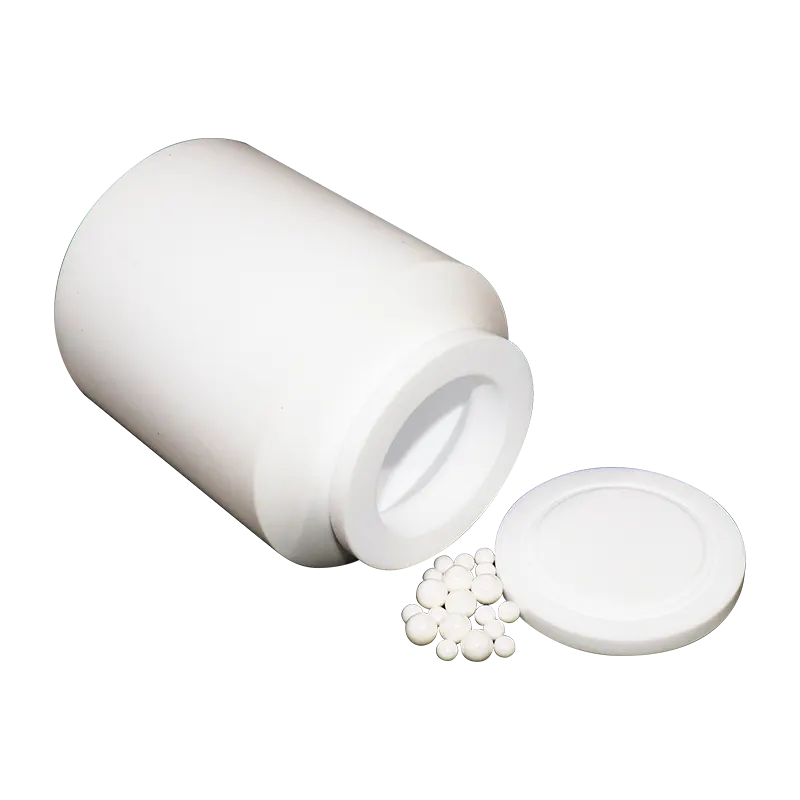
Why PTFE is chosen for grinding drum
The main argument in favor of PTFE is the combination of chemical resistance and low adhesion. In a drum made of this material, there is less risk that wet or sticky powder will remain on the walls and lid, and cleaning will require harsh abrasives. For samples sensitive to metal contamination, a polymer fitting may be preferable to a steel one if its mechanical suitability and absence of unacceptable wear are simultaneously confirmed. However, it is not a one-size-fits-all solution: PTFE does not replace hard ceramics where wear resistance is important.
The second argument is the possibility of wet grinding with solvents and liquid media. PTFE is resistant to many chemical environments, but the list of compatible substances depends on the specific brand, temperature, concentration and contact time. You cannot make a conclusion about durability just by the name of the polymer. It is not only the drum itself that needs to be considered, but also the cover, seal, plug, fasteners and grinding media: these are often the less noticeable source of impurities or degradation.
The third argument is the electrical insulating properties and the absence of a pronounced catalytic effect, characteristic of some metals. For samples where traces of iron or other metals are not desired, this may be important. But here, too, verification is required: the composition may contain fillers, dyes or additives, and traces of technological media remain on the surface after manufacturing. If the card does not indicate the composition and method of surface preparation, the properties of a particularly pure material cannot be attributed to the product.
Restrictions start with gentleness. PTFE is prone to deformation under load, has low thermal conductivity and relatively high thermal expansion. In a closed drum, this means that frictional heat is distributed unevenly and the gap between the lid and the body may vary. For practice, it is not the fact that “PTFE is chemically resistant” that is important, but the design: wall thickness, sealing method, lid rigidity, the presence of a metal casing or fastening belt. These elements may not be PTFE and should also be included in the compatibility assessment.
Finally, “PTFE drum” and “PTFE bowl” are not always interchangeable terms. The drum for a roller mill is usually cylindrical in shape and has external seating dimensions that must rest on the drive rollers. The glass of the planetary mill fits into a socket with a different fastening and experiences different loads. If a card specifies a drum for a roller mill, this does not prove its suitability for a planetary plant. Compatibility is confirmed by dimensions, documentation and testing, not by external similarity.
Drum and mill compatibility
The drum is not an independent grinding device: the movement is imparted to it by the mill. Therefore, the selection begins with the installation, and not with the polymer. For a roller mill, the outer diameter and length of the drum, surface condition, weight with loading, permissible peripheral speed and method of fixation are important. A drum that is too large or too heavy can overload the drive; too smooth or uneven body - change the nature of rotation. These parameters cannot be deduced from the name “PTFE” alone.
Card PTFE grinding drum located in the section of drums for roller mills. This is a guideline for testing and is not a guarantee of compatibility with any model. Before ordering, you should compare the mounting dimensions, permissible load on the rollers, speed range and requirements for the cover. If the mill operates in inclined mode or with reverse, you need to separately check whether the cover is held when changing the direction of rotation. For a laboratory installation with frequency regulation, it is useful to know not only the speed range, but also the permissible torque.
The situation with the planetary mill is different. There, the drum or glass experiences centrifugal loads, and the lid must withstand repeated cycles. Even if the product geometrically fits into the socket, this does not mean that it is designed for such loads. The equipment manufacturer must confirm compatibility; drum supplier - extreme modes. The characteristic “for a roller mill” cannot be transferred to a planetary mill.
Separately, it is necessary to say about drying equipment. The vacuum drying cabinet from another section of the catalog is not a mill or a grinding device. Its presence in the nomenclature does not confirm that a particular PTFE drum can be dried in it at any temperature and pressure. If drying is planned after wet grinding, check the permissible temperature of the polymer, the heat resistance of the seals, resistance to vacuum and the absence of deformation under its own weight. Air cooling of the mill is also not cryogenic: these are different thermal regimes, and ordinary blowing cannot be called cryogenic processing.
The practical compatibility check includes several points: external dimensions, empty and loaded weight of the drum, method of fastening the lid, permissible speed, direction of rotation, presence of a seal and availability of spare parts. If at least one point is unknown, it is recorded as a question to the supplier, and not closed with an assumption.
Size, volume and loading
The drum description may indicate a nominal volume, but this is not equal to the mass of the sample and is not equal to the payload. Part of the internal space is occupied by grinding bodies, part is needed for their movement, and powder with a high bulk density with the same mass occupies a smaller volume. Therefore, when selecting, you cannot mechanically recalculate “liters into kilograms”. Data is needed on bulk density, initial particle size, desired sample weight and acceptable ratio of material to grinding media.
A drum that is too full limits the movement of the grinding media: the impact energy decreases and mixing can become uneven. A drum that is too empty, on the contrary, increases friction and wear on the walls. Specific limits depend on the diameter, length, number of revolutions and size of the bodies. This is especially important for a PTFE drum: a soft wall is less resistant to local abrasive contact than a steel or ceramic one. If the mode is selected with a large margin of time and speed, the polymer wears out faster.
Grinding media are selected separately. Their material must be compatible not only with the sample, but also with the drum. Hard zirconium oxide or tungsten carbide balls can severely abrade PTFE; soft polymer bodies damage the wall less, but grind hard particles worse. The mass and diameter of the bodies affect the impact energy and the particle size distribution. You cannot promise the same size for any material just because the drum is called a grinding drum.
It is useful to distinguish several quantities: the geometric volume of the drum, the free volume after loading the bodies, the mass of the sample, the volume of the suspension and the productivity per cycle. For wet grinding, the volume of liquid is added, which also needs to be taken into account. If the card shows only one volume, the remaining parameters are determined from the documentation or in trial grinding. For a series of experiments, it is better to record not the “optimal loading in general,” but a specific recipe: sample mass, mass and size of bodies, medium, speed, time.
Finally, reel size is related to scaling. Increasing the diameter changes the trajectory of the bodies and the thermal regime; The result obtained in the snare drum is not automatically transferred to the large drum. When moving from a laboratory sample to a larger batch, not only the proportional increase in loading is checked, but also the conservation of specific energy, time and temperature. Otherwise, the distribution of particles and the degree of contamination may be different.
Dry and wet grinding in PTFE drum
Dry grinding is easier to prepare, but produces more dust, static charge and frictional heat. Powder may stick to the lid and sides, especially if the material tends to agglomerate. PTFE reduces adhesion but does not eliminate it completely. After the cycle, it is important to evaluate not only the coarseness, but also the loss of material on the walls, the condition of the surface and the temperature of the drum. For heat-sensitive substances, this may be more important than the appearance of the powder suggests.
Wet grinding is introduced to reduce dust, improve dispersion and heat dissipation, but it requires compatibility of the fluid with the PTFE, seal and sample. Water, alcohols, oils and other media behave differently. Even a chemically resistant polymer does not guarantee that the seal and lid will not retain traces of the environment. If a volatile solvent is used, the seal of the lid and ventilation conditions must be checked. "PTFE is inert" should not be taken to mean that it will not react with any liquid.
Wet grinding is often confused with disagglomeration. Mechanical action can break up aggregates and improve the dispersion of the suspension, but does not necessarily reduce the primary particles. To formulate the problem, it is important to indicate what exactly is being measured: the size of aggregates, the size of primary particles, specific surface area or rheological properties. The choice of medium, time and grinding media depends on this. The same regime can give good results for one indicator and mediocre results for another.
Temperature is a separate factor. PTFE has low thermal conductivity, so the heat generated by friction is distributed unevenly. The temperature of the working chamber of the installation is not equal to the temperature of the sample inside the drum. If the mill is air cooled, this helps dissipate heat, but does not make the process cryogenic. True low-temperature grinding requires specialized equipment and proven techniques; a conventional PTFE drum by itself does not provide such properties.
With wet grinding, it is also important how the suspension is separated. The PTFE surface is easier to clean, but small particles can become trapped in rough spots and on the edge of the lid. The finer the powder and the more additives, the more difficult it is to estimate losses. If the material is expensive or toxic, it is better to balance by mass and flushing fluid, and not be limited to a visual assessment of cleanliness.
Wear, contaminant transfer and cleaning
Wear of a PTFE drum manifests itself in different ways: darkening, scratches, changes in geometry, film on the walls, and the appearance of polymer particles in the sample. The wear rate is influenced by the hardness and shape of the particles, the material and size of the grinding media, rotation speed, cycle time, temperature and the presence of abrasive additives. Chemical resistance does not protect against mechanical abrasion. Therefore, for hard and abrasive materials, PTFE is not always the best choice, even if it is inert to the environment.
Sources of contamination are not limited to drum material. The grinding media, cover, seal, fasteners, funnel and sampling tool can all contribute. If the assay is sensitive to iron, zirconium, silicon or tungsten, the entire sample path must be assessed, not just the wall. A fluoroplastic fitting can reduce the risk of metal contamination, but does not make the process sterile. The formulation “zero contamination” is technically untenable: there is always wear, remnants of the previous sample and cleaning errors.
Cleaning begins with disassembly and removal of the bulk of the material. You should not immediately fill the drum with an aggressive solvent: first you need to understand what kind of sample it is and how it reacts with the environment. Non-abrasive brushes and soft wipes are suitable for PTFE; metal scrapers and sandpaper leave scratches, which then trap powder. Water and a mild detergent are not suitable for all stains; organic solvents are selected based on compatibility with the polymer, sealing and safety requirements. After washing, the drum is thoroughly dried under the conditions specified for the specific product and inspected for cracks and discoloration.
Cleaning and Inspection Procedure
A reasonable sequence looks like this: remove the lid, remove the bulk of the powder in a dry manner, without blowing dust around the laboratory; rinse with a compatible liquid; use a mild detergent if necessary; rinse with clean water or solvent; dry; inspect the walls, edge and seal; assemble and perform a dry run. A dry run with clean grinding media and subsequent analysis of a background sample can help determine whether the media is contributing to contamination. If background analysis is not performed, the purity claim remains an assumption.
For trace analysis, it is often useful to assign a separate drum to one type of material or one group of samples. This does not eliminate purification, but reduces the risk of cross-contamination. The markings on the drum itself must be permanent and not interfere with inspection. Do not store the drum closed after wet cleaning: residual moisture and odor may remain. The seal and cover are checked separately because their material may be different from PTFE.
To monitor the condition, it is useful to keep a simple log: date, sample, medium, load weight, speed, time, cleaning method, inspection result. After a few cycles, it becomes clear whether the darkening is due to a specific material or due to insufficient cleaning. Photographs of the surface under the same lighting help to notice changes in geometry. If there is no original state in the log, arguing about whether the defect was there before becomes futile.
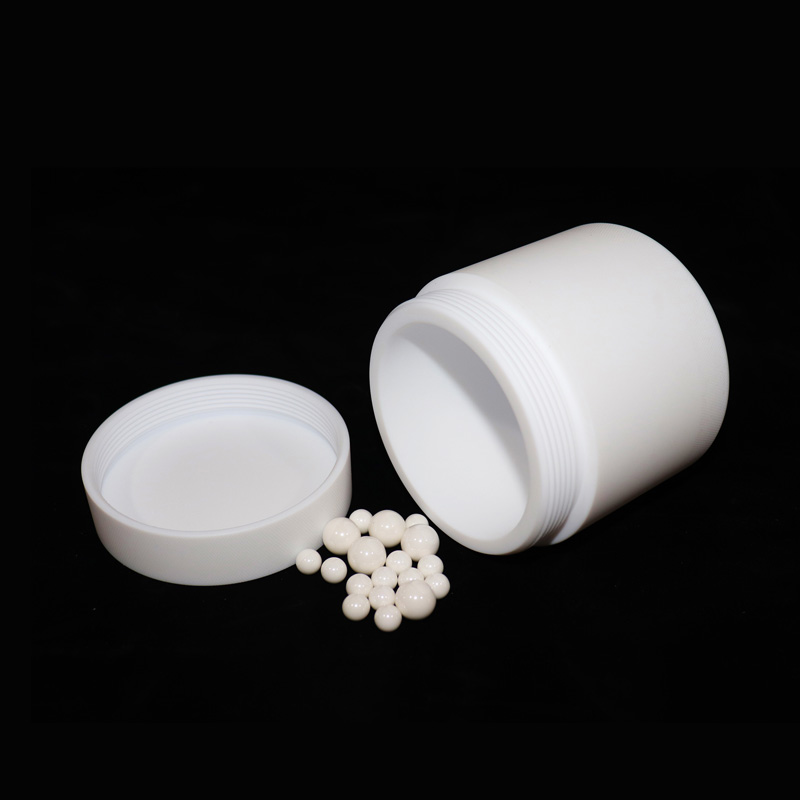
Once worn, the PTFE surface becomes more susceptible to particle retention. You shouldn’t polish it yourself: you can change the geometry and increase the deformation. If deep risks have appeared, the color has changed or the drum no longer closes reliably, its further suitability is determined by the manufacturer or person responsible for the equipment. Using a damaged drum can cause not only contamination, but also loss of tightness during wet grinding.
When working with powders that are sensitive to moisture and oxygen, the PTFE drum itself does not create an inert atmosphere. If air protection is required, a separate solution is needed: a glove box, a controlled environment chamber, or a sealed system proven for the specific application. You cannot attribute functions to a drum that it does not have. The same applies to vacuum and heating: a conventional grinding drum is not a vacuum oven or drying chamber.
What to report for selection and trial grinding
To select a PTFE grinding drum and avoid getting an incompatible pair with the mill, it is useful to provide the supplier with: the make and model of the mill, external mounting dimensions, permissible load weight, speed range and direction of rotation; required drum volume; sample material, its bulk density, initial size and chemical activity; the purpose of grinding is to reduce size, disagglomerate, mix or prepare a suspension; medium - dry grinding, water, solvent, inert gas; temperature and cycle duration; material, diameter and weight of grinding media; cleaning requirements and acceptable levels of impurities. The more specific the data, the less uncertainty remains.
For trial grinding, it is worth preparing a representative sample and an analysis plan. It is necessary to decide in advance how the result will be measured: sieve analysis, laser diffraction, microscopy, specific surface area or chemical analysis. Without a measurement method, modes cannot be compared. The trial cycle should include background control: clean drum, clean bodies, same environment and procedure. If the background is high, first deal with cleaning and materials rather than increasing the grinding time.
It is useful to carry out not one, but two or three short cycles with different loads or speeds, recording the temperature, losses on the walls and coarseness. This gives a more reliable picture than one long experiment, after which it is difficult to understand the cause of the result. For a PTFE drum, the condition of the surface after each cycle is separately noted: the appearance of scratches, plaque and deformation is no less important than the final size. If the surface changes quickly, further experiments may give a different background of contamination.
When moving to a larger batch, do not simply increase the mass in the same drum. It is necessary to check whether the ratio of the sample, bodies and free volume is maintained, whether the headset is overheating, whether the lid is deformed, and whether the cycle time does not increase disproportionately. To scale, it is better to rely on specific indicators and risk analysis, rather than on the visual similarity of the process. If performance is more important than fineness, you may find that a PTFE drum is suitable for pre-conditioning and the final grinding is best done in another tool.
They record separately which information is confirmed by documentation and which was obtained in trial grinding. For example, the outer diameter and seal material may be the rating data, while the actual wear and ease of cleaning may be the test result. This division helps not to turn a single experience into a characteristic of the entire assortment and to correctly discuss the replacement of a headset.
Current cards and technical clarifications on products TENCAN available at company website. When making a request, it is important to separate confirmed data from assumptions: for example, “the drum is suitable for such and such a mill” should be supported by documentation, and not just a photograph. If temperature, vacuum, speed, or solvent compatibility data are not available, this is a test condition and not a reason to make an optimistic guess.
The bottom line is simple: PTFE drum is valuable where chemical resistance, low adhesion and metal contamination reduction are needed, but it cannot be considered outside of the mill, grinding media and cleaning procedures. The correct selection begins with sample and setup parameters, continues with checking dimensions and materials, and ends with trial grinding and background analysis. This approach does not promise “perfect purity”, but it shows real limitations and allows you to reproducibly repeat the result.