
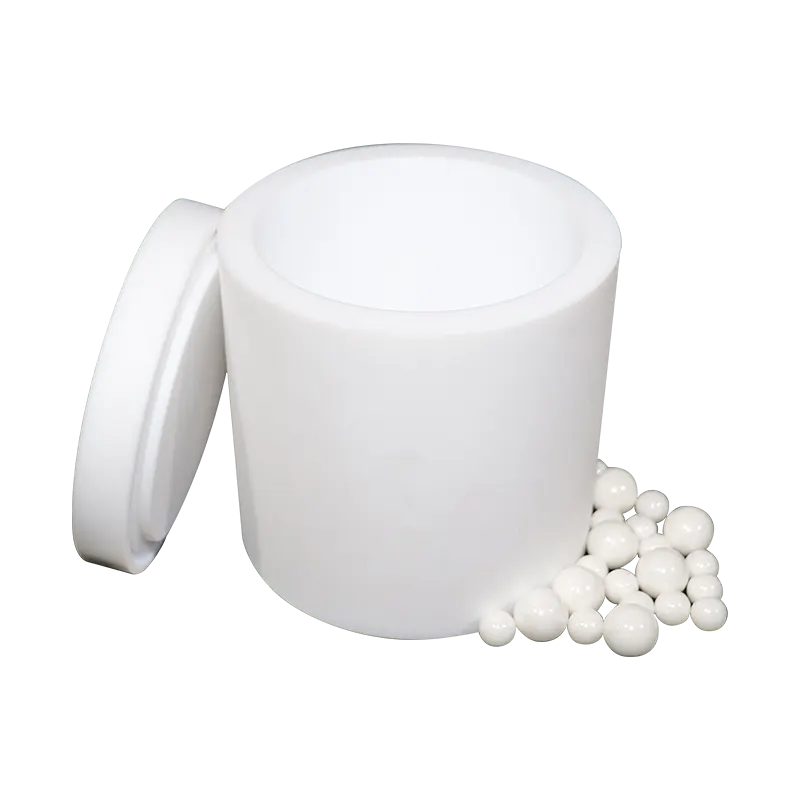
Sample preparation in a planetary ball mill begins not with the choice of speed, but with determining which materials come into contact with the powder. The grinding bowl, grinding media, lid and seal form the working chamber where shock and shear loads act. Therefore, replacing the glass changes not only the ease of cleaning, but also the wear pattern, the risk of transferring impurities and the reproducibility of the result. PTFE Grinding Bowl for Planetary Mill — A clear example of such a choice: the material is useful in some tasks and completely unsuitable in others.
Below is a practical question: how to understand where a PTFE cup is appropriate, what limitations it introduces, and what data you need to check before purchasing. This is not a replacement for the instruction manual and is not a guarantee of results for any sample. We are talking about criteria that help avoid two extremes: underestimating contamination and wear, or expecting that one material will solve all sample preparation problems.
What determines the performance of a PTFE cup?
PTFE is a fluoropolymer valued for its chemical resistance, low surface energy, and low coefficient of friction. In laboratory practice, these properties explain the interest in PTFE beakers when working with chemically active media, wet and sticky powders, as well as with samples for which contact with metal is undesirable. However, the listed properties do not mean the absence of interaction with the sample. Low surface energy rather reduces the tendency to stick, but does not exclude the adhesion of fine powders, electrostatic transfer and retention of particles in the microrelief.
The second important consideration is the mechanical softness of PTFE compared to ceramics, agate, zirconium dioxide or tungsten carbide. The polymer is less resistant to abrasive wear and is more easily deformed under the influence of grinding media and clamping force. This does not make it unsuitable: for soft and low-abrasive materials such a compromise may be justified. But when grinding hard minerals, oxides, carbides and other abrasive powders, the wear of the glass becomes an independent source of contamination. Polymer particles can get into the sample, and changes in geometry can affect the movement of the grinding media.
The third factor is the specific brand of material and product design. PTFE is available in a variety of forms, including filled compositions, which vary in stiffness, thermal conductivity and wear resistance. If the accompanying documentation does not indicate the brand, presence of filler, manufacturing method and permissible operating conditions, general reference values cannot be transferred to the product. For a planetary mill, it is especially important to understand how not only the beaker wall will behave, but also the lid, seal, thread or lock: it is these elements that often limit the pressure, temperature and permissible cleaning.
When is PTFE justified and when is the risk greater than the benefit?
It makes sense to consider a PTFE glass when the sample is soft or medium hard, does not have high abrasiveness, and contact with metal is undesirable. It may be useful for samples that tend to stick to walls, although this property should be tested on a specific powder and not taken as a universal advantage. Chemical resistance of the polymer is also important when working with aggressive media, but it does not replace compatibility with the cap and seal, which may be made of other materials.
Limitations begin where high grinding energy, prolonged work with abrasive material or particularly low transfer of impurities are required. A soft polymer should not be considered a “zero contamination” material: wear products, as well as particles from previous samples retained by the surface, may enter the sample. For trace analysis, where the content of fluorine, organic inclusions or polymer particles is standardized, this risk requires a separate assessment. It is also impossible to promise in advance the achievement of the same particle size as in a harder glass: the final particle size depends on the material, initial particle size, grinding media, loading ratio, medium and mode.
The practical test of PTFE suitability comes down to a few questions. How abrasive is the sample? Are polymer particles acceptable in the sample? What temperatures and pressures occur in the cycle? How will the glass be cleaned between samples? Is there confirmation of compatibility with a specific mill? If at least one answer is not determined, it is better to postpone the decision until testing or clarification with the manufacturer.
Wear, deformation and transfer of impurities
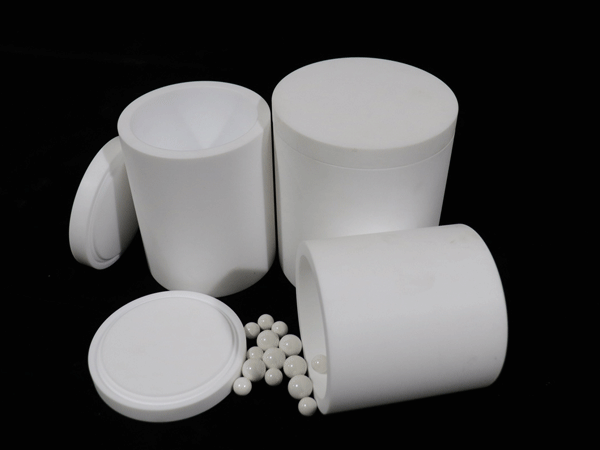
PTFE cup wear rarely appears as uniform abrasion. In a planetary mill, the grinding media deliver impacts and create shear, so abrasions, dents, local thinning and traces of plastic deformation may appear on the inner surface. The polymer is capable of cold fluidity: under prolonged load or strong clamping, the shape of the product gradually changes. This is especially critical for the lid and seal, since even a small change in geometry affects the seal.
A visual inspection is useful, but does not give the full picture. The light-colored material makes it easier to detect dark inclusions, but polymer wear particles may be colorless and not visible to the naked eye. If the technique is sensitive to contamination, a control experiment is needed: grinding without a sample or with a representative inert material, analysis of the washing liquids and comparison with the original sample. For routine tasks, it is enough to record the appearance of scratches, changes in color, odor, stickiness and tightness of the lid. It should not be assumed that any scratch immediately disables the glass, but damage in the sealing area cannot be ignored.
A distinction is made between grinding and disagglomeration. In a soft polymer glass, the impact energy is partially spent on deformation of the wall and the material itself, so for aggregates and agglomerates the result may differ from grinding in a hard glass. This does not mean that PTFE is not suitable for fine grinding; this means that it is impossible to transfer a regime selected for another material without verification. If the goal is to break up tough crystals or produce a narrow particle size distribution, testing should include a pre- and post-grind size analysis rather than just a visual assessment of the powder.
Volume, geometry and loading
When choosing a glass, it is important to separate the nominal volume, useful volume, mass of loaded powder and mass of grinding media. The nominal volume is not equal to the working load: part of the space is occupied by the balls, part is needed for the movement of the medium, and too full a load can lead to squeezing out the powder, overheating and increased wear. Performance over time is another parameter that cannot be automatically derived from the glass volume. Each model and mode has its own reasonable load, and it needs to be clarified in the documentation.
Geometry also affects mill compatibility. The outer diameter, height, bottom shape, wall thickness, method of fixation and location of the cover must correspond to the holder of the specific device. A small discrepancy may seem insignificant, but at high speeds it leads to runout, incomplete closure or increased vibration. If the glass is purchased separately, it is not enough to know that it is intended for a planetary mill: you need to check the mill model, seat and acceptable mode.
| Parameter | Why is it important? | What to clarify |
|---|---|---|
| Nominal and useful volume | Affects loading, ball movement and sample loss | Working volume, maximum mass of balls and sample |
| Internal dimensions | Determine the distribution of grinding media and stagnation zones | Diameter, height, bottom shape, wall thickness |
| Cover and seal | Responsible for tightness and transfer of impurities | Seal material, fixation method, permissible cleaning |
| Grinding media material | Can be a major source of wear and contamination | Compatibility of balls with glass and sample |
| Mill mode | Speed and energy affect heating and deformation | Allowable speed and duration for a given glass |
Compatible with mill and lid
Compatibility is not just about geometric fit. It is necessary to take into account the clamping method, the weight of the filled cup, vibration, heating and sealing requirements. The planetary mill creates a complex movement during which the lid experiences variable loads. If the seal is designed for a different material or closure method, even the correct diameter cup may not be suitable. Therefore, the words “planetary mill glass” are only the beginning of a test, and not proof of compatibility with any model.
Working at low temperatures requires special attention. Availability in the catalog planetary ball mill with liquid nitrogen does not mean that a particular PTFE cup, bonnet and seal are automatically qualified for this process. With the cryogenic option, the properties of the polymer and the behavior of the seal change, condensation and thermal shock during loading are possible. If low temperature grinding is considered, the compatibility of the beaker with the mill, temperature range and loading procedure must be confirmed separately. The properties of room mode should not be transferred to cryogenic mode without written confirmation from the manufacturer.
Another practical point is grinding media. Even a chemical-resistant glass does not protect the sample from wear and tear of the balls. Hard balls can accelerate the wear of the polymer surface, while soft balls can more quickly contaminate the sample with their own material. The selection of the “glass - grinding media - sample” pair is done jointly, taking into account the permissible transfer of impurities and size requirements. If the documentation does not contain data on a specific combination, it is checked by trial grinding and not assumed by analogy.
Cleaning between samples
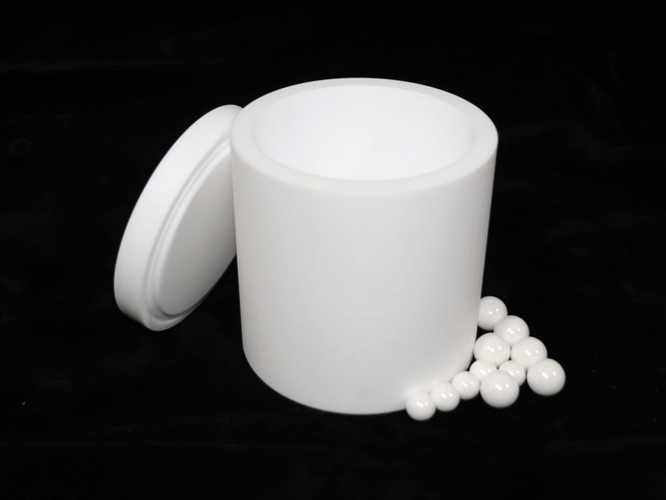
Cleaning the PTFE cup should remove sample residue without damaging the surface or seal. Abrasive powders, wire brushes and rough scrapers are undesirable: they leave micro-scratches in which particles become trapped. First, the glass is freed from grinding media, then the bulk is removed with a dry, lint-free cloth or soft instrument. If the powder sticks, it is soaked in a suitable solvent, but the solvent is chosen taking into account not only PTFE, but also the material of the lid, seal and markings.
After washing, the glass is thoroughly dried under the conditions permitted by the manufacturer. Do not use high-temperature drying, autoclaving or aggressive oxidizing agents without confirmation: the polymer may be chemically resistant, but the seal or design is not. For trace tasks, it is useful to have a separate beaker for a certain type of sample, so as not to rely only on the washing procedure. If a beaker is used for multiple techniques, the risk of cross-contamination increases, even when the surface is visibly clean.
- Remove the grinding media and remove most of the powder with a soft tool.
- Wash with a compatible solvent, being careful not to swell or damage the seal.
- Check the surface for scratches, dents, discoloration and tightness of the cover.
- Dry in a manner permitted for a specific product.
- For sensitive procedures, perform a control blank and analyze the wash liquid.
Trial grinding and questions to the supplier
Test grinding is not needed to “check everything at once,” but to answer specific questions. Does the glass remain sealed under load? Are there visible signs of wear? Does the color or flowability of the powder change? Is the particle size distribution as expected? For a correct comparison, the initial size, mode, loading weight, ball material, duration and method of measurement are recorded. One successful grind does not prove suitability for all samples, but it reveals gross inconsistencies and helps formulate a request to the manufacturer.
Before ordering, you should request: the exact name and design of the glass, material and presence of filler, nominal and usable volume, internal and external dimensions, lid and seal material, permissible speed and temperature, cleaning recommendations, compatibility with a specific mill model and grinding media. If cryogenic equipment is to be used, these questions are asked separately and confirmed for the specific combination. It is also useful to clarify what documents are provided for the material and how batch traceability is ensured if this is important to the methodology.
A PTFE grinding bowl is not a universal replacement for other materials, but a conscious choice for certain conditions. Its strengths are chemical resistance and low friction, but its limitations are softness, deformation, wear and possible transfer of polymer particles. The solution becomes more reliable when it is based on sample properties, purity requirements, proven mill compatibility and trial grinding results. To select a specific design, you can refer to the card PTFE grinding bowl for planetary mill and compare its data with the parameters of existing equipment, without accepting compatibility by category name.