
A planetary ball mill grinds the sample not “in the air”, but inside the grinding set: the glass, lid, seal and grinding media form the medium with which the sample is in contact from loading to unloading. Therefore, the choice of glass is part of the sample preparation technique, and not a secondary accessory to the device.
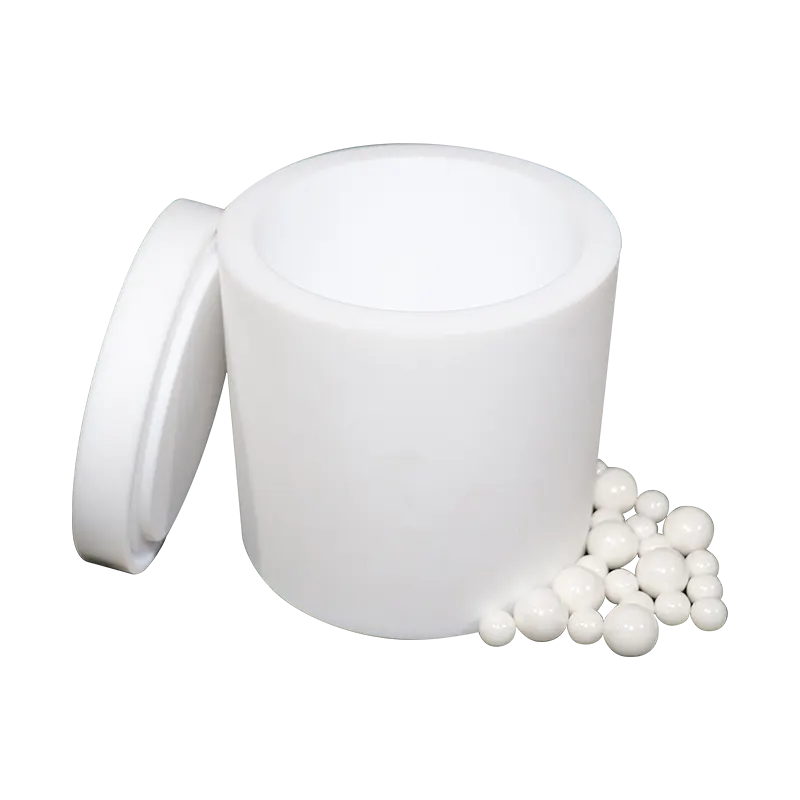
A PTFE grinding jar is considered when the sample is chemically aggressive, contains metal-reactive components, or when subsequent analysis is sensitive to traces of iron, chromium, nickel and other elements introduced into the sample from the metal fitting. In the catalog TENCAN the product is presented as PTFE grinding bowl for planetary mill; specific standard sizes, connecting dimensions and components should be taken from the product card, and not from general discussions about the material.
The material also has a downside: PTFE is softer than ceramics and metal, it deforms under load and wears out when in contact with abrasive powders. Below we discuss where the limit of applicability of a fluoroplastic cup lies, how to count the load, where the impurities come from, how to organize cleaning and what issues need to be resolved before the first grinding.
Sample conditions: when a fluoroplastic cup is justified
The first condition is the chemistry of the sample. PTFE is inert to most acids, alkalis, salts and organic solvents; it does not swell or dissolve in them. That is why a fluoroplastic beaker is often chosen for wet grinding in an aggressive environment, when water or a neutral solvent is not suitable, and a metal beaker can react with the components of the sample. Inertness is not absolute: there are known environments with which PTFE is incompatible, so for an unfamiliar composition it is wise to carry out a short test on a small sample rather than relying on a general rule.
The second condition is the analytical task. If elemental analysis is planned after grinding, it is important to understand what exactly the headset contributes. A metal glass yields iron, chromium, nickel and manganese; PTFE releases carbon and fluorine when worn. For metal determination, the polymer impurity is usually less critical, but for thermogravimetry, carbon and hydrogen analysis, or IR spectroscopy, fluoroplastic particles can be a hindrance. There is no universal answer: the criterion is selected for a specific measurement.
The third condition is the abrasiveness and hardness of the sample. Quartz, corundum, carbides, slag, cement clinker and similar materials intensively wear out the wall. A soft fluoroplastic glass in this mode will wear out faster, and the wear product will get into the sample. A conscious compromise looks like this: a polymer impurity is acceptable, but a metal impurity is not, and grinding does not take long.
The fourth condition is the target size. The grinding mechanism in a planetary mill is determined by the impact and abrasion of the grinding media, and not by the wall material. The soft wall does not “interfere” with grinding, but limits the choice of heavy hard grinding media if intensive mode is needed: the denser and harder the balls, the more noticeable the wear of the glass.
The fifth condition is temperature and subsequent processing. The thermal conductivity of PTFE is low; heat from grinding is dissipated worse than through metal or ceramics, and in long-term operation this is essential for temperature-sensitive samples. In addition, the glass cannot be calcined for cleaning: during the thermal decomposition of fluoroplastic, aggressive fluoride compounds are released, so dry ashing as a cleaning method is not applicable here.
Bottom line: PTFE is justified in chemically aggressive environments, when there is a requirement to exclude metal, when wet grinding in a solvent, and when the sample is moderately abrasive. It is less suitable for hard abrasive materials, long-term intensive grinding and tasks where the polymer impurity itself interferes.
Material and design: what PTFE provides and what it does not provide
A grinding bowl is more than just a container. In a planetary mill, it absorbs centrifugal loads, holds the lid with a seal and transfers heat from grinding to the environment. Each of these actions places different demands on the material, and PTFE meets them in different ways.
Chemical resistance
The low surface energy of PTFE means that powder and slurry adhere less to the walls and bottom, making sample unloading and cleanup easier. The material does not swell, does not dissolve in common solvents, and retains its shape in contact with most reagents. This is the main argument in favor of fluoroplastic, but it does not turn the glass into a universal vessel: for each new medium it is worth checking compatibility with the supplier or checking it experimentally.
Mechanical limitations
The elastic modulus and hardness of PTFE are low, so the material creeps under constant compression. We are talking about cold fluidity: a lid that is tightened at room temperature may loosen after heating and prolonged use, and the fit may change. The coefficient of thermal expansion of fluoroplastic is noticeably higher than that of steel and ceramics, so the gaps between the glass and the holder parts change when heated. Low hardness also means scratches: they are easy to leave with a scraper or an abrasive sponge, and scratches retain particles from previous samples.
Heat and static
Low thermal conductivity leads to the fact that the heat generated when the balls hit accumulates in the sample and near the wall. For heat-sensitive substances, this may be more important than the material of the grinding media and requires either a reduction in continuous grinding time or pauses between cycles. The second practical point is the accumulation of static charge: dry powders stick to fluoroplastic, and unloading requires care.
The design of a particular product—the thickness of the wall and bottom, the design of the lid, the presence of a seal, the method of fixation in the holder—is described in the product card. The properties of one standard size should not be transferred to the entire series: small and large glasses of the same series may differ in both geometry and weight.
Wear and introduction of impurities: why there is no “contamination-free”
In a planetary mill, several wear mechanisms operate simultaneously. The balls hit the wall and slide along it, a layer of powder or suspension works between the balls and the wall, and part of the material is transferred to the balls in the form of a thin film. The larger the initial particles, the more difficult the running-in period; The denser and harder the grinding media, the higher the load on the wall.
The wear product of a fluoroplastic cup is polymer particles. They do not dissolve in acids during subsequent sample preparation; they can float in solution, clog filters and introduce carbon and fluorine. In X-ray diffraction, an amorphous polymer gives a blurred background; in thermal analysis, it gives an additional stage of decomposition. This does not make the material unsuitable, but it does mean that the phrase “zero contamination” does not apply to it: it is more correct to talk about a qualitatively different composition of the impurity.
Signs of wear that can be noticed upon inspection: changes in internal geometry, scratches and abrasions on the wall and bottom, darkening, loosening of the lid, loss of seal tightness. A diagnosis cannot be made based on appearance alone—an examination and, if necessary, a control experiment are required.
A useful technique is idle grinding. The set is loaded with grinding media and medium without a sample, kept for a comparable time and the medium is analyzed for impurities. In this way, the contribution of the headset itself to contamination is assessed and at the same time it is checked whether particles have accumulated in scratches after previous tests. The result of idle grinding is not automatically transferred to another mode, but provides a reference point.
Wear can be reduced by reducing the density and size of the grinding media, shortening the continuous grinding time, reducing the load and refusing to work “at the limit” of the mill’s capabilities. Sometimes it is wiser to adopt a softer mode with intermediate sifting than to intensify grinding and obtain a noticeable polymer impurity.
Cup size, loading and grinding media
When selecting a headset, it is easy to confuse similar values. The nominal volume of a glass is not yet the amount of sample that can be ground in it. A distinction is made between the total volume of the vessel, the useful working volume taking into account the free space above the load, the mass of the sample, the mass of the grinding media and the productivity of the finished powder. Mixing these concepts leads to overload, overheating and accelerated wear.
Free space is necessary: the balls need movement, and the powder needs room to move. If the glass is filled “under the lid”, the blows become less effective, the load on the seal increases, and the suspension may splash out during wet grinding. The ratio of the mass of grinding media and the mass of the sample is selected for the material and target size; There is no universal number, and in the methodology it is recorded separately.
For a planetary mill, balance is important: the glasses in the holder must be of the same mass and equally loaded. The difference in mass causes vibration, which accelerates wear of components and impairs reproducibility. This is another argument in favor of checking the mass of an empty glass, and not just its volume.
| Parameter | Why is it important for a fluoroplastic glass? |
|---|---|
| Internal volume and geometry | Determine the permissible load and the nature of the movement of the balls |
| Wall and bottom thickness | Links stiffness, mass and abrasion resistance |
| Empty glass mass | Needed for balancing the holder and calculating the load |
| Cover and seal | Wet-grinding tightness and heating behavior |
| Permissible temperature conditions | Limits the duration of continuous grinding and drying methods |
| Compatible grinding media | Hard and dense balls increase wear on the soft wall |
| Mill fixation method | Fitment into the holder is checked according to the passport of the specific model |
Cleaning and preparing the glass between samples
Fluoroplastic is easy to wash, but also easily damaged. The main rule is not to create scratches: metal scrapers, abrasive powders and hard brushes leave grooves on the wall, which then trap particles. The remaining sample is removed mechanically with a soft instrument, then washed with a suitable solvent and dried.
The drying temperature should remain moderate. Calcination, ashing and any treatment in which PTFE may decompose are unacceptable: the released fluorine compounds are aggressive and dangerous. The same limitation applies to attempts to “burn out” organic matter from a contaminated glass.
The cover seal is a consumable element that wears out faster than the housing. It is inspected, replaced if necessary, and no attempt is made to compensate for wear by over-tightening: due to the cold fluidity of the material, the force drops over time, but the deformation remains.
It is convenient to control cross-contamination between samples organizationally: attach glasses to classes of materials, mark them, and keep the equipment closed from dust. If the same beaker is used for different samples, a blank grind with clean media in between is useful. It is better to clarify the admissibility of ultrasonic cleaning and specific solvents for your application, rather than applying a general rule to all cases.
Mill compatible and larger batch sizes
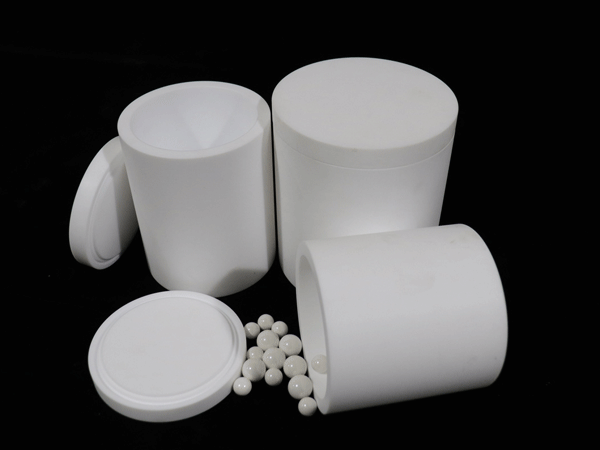
The glass must fit the specific mill geometrically and in terms of weight: outer diameter and height, fit in the holder, method of fixation, design of the lid and clamping force. Just because the glass and mill are from the same manufacturer is a good starting point, but it is not proof of compatibility. You need to check it using your passport and product card; If in doubt, ask the supplier before ordering.
We should also talk about scaling. The planetary mill is a laboratory instrument, and its beaker is designed for a weighed portion, not a batch. Production bead mill — another class of equipment: grinding takes place in a chamber with grinding media while pumping a suspension, with different hydrodynamics and other requirements for the environment. The laboratory beaker for the planetary mill is not directly related to it, and the result of laboratory grinding is not mechanically transferred to production.
The practical transfer path looks like this: first, the laboratory fixes the regime at which the desired particle size distribution is achieved, then checks its reproducibility on several samples, and only after that discusses the pilot scale. At each step, the issue of the headset material is separately resolved: what is suitable for a small sample may turn out to be unacceptable in terms of wear or heat removal with a larger load.
General information about the line of equipment and areas of work is given at website TENCAN; the selection of a specific design is still based on the sample parameters and requirements for the finished powder.
Test grind: what to check and what to report
The first grinding should be considered as an experiment and not as a production operation. It is useful to determine in advance what exactly is considered success: achieved size, absence of noticeable heating, preservation of phase composition, level of impurities, ease of unloading.
- Material and origin of the sample, initial size, estimated weight of the sample.
- Chemical aggressiveness, presence of solvents, requirements for dry or wet grinding.
- The target size and the method of its measurement - the comparability of the results depends on this.
- Temperature sensitivity and permissible duration of continuous grinding.
- Requirements for impurities: which elements or compounds are unacceptable in the sample.
- Proposed grinding media: material, density, size.
- Mill model, number of glasses, holder restrictions on weight and dimensions.
This information allows the supplier to propose execution and the researcher to plan the control experiment. If there is no data, it is more honest to start with a small load and a short mode than to immediately work at the maximum load.
Can a PTFE cup be used for dry grinding?
Yes, but you need to take into account powder adhesion due to static and low surface energy, as well as more intense abrasive wear of the wall due to dry solid particles. Sometimes dry grinding is combined with subsequent sieving to break down agglomerates.
Is it necessary to use grinding media from the same material?
No. The material of the balls is selected based on density, hardness and acceptable impurities, and compatibility with a soft fluoroplastic cup is assessed separately: the harder and denser the balls, the higher the wear of the wall and the more important it is to control impurities.
The competent choice of a PTFE grinding bowl is based on three questions: what kind of sample is it, what is unacceptable in it after grinding, and what conditions will a particular mill provide. The answers to them do not provide the “best” solution in general, but a reasonable solution for a given problem - with understandable restrictions on wear, temperature and cleaning.