
A PTFE grinding drum is selected when chemical resistance of the contact surface, low adhesion and the ability to be thoroughly cleaned are important to the sample. But material alone does not solve the problem of preparing a representative sample. The result is influenced by the geometry of the drum, grinding media, grinding mode, cleaning method and compatibility with a specific mill. Therefore, choosing a PTFE drum is not replacing a “regular” glass with an “inert” one, but checking the entire chain: sample - drum - grinding media - installation - control method.
In laboratory practice, an error often does not appear immediately. The first grinding looks successful, but when repeated, the coarseness changes, a hard-to-remove coating appears, or an element is found in the sample that was not in the original material. The reason may be due to wear on the drum, contamination of the grinding media, insufficient cleaning, or the fact that the drum has the correct diameter but is not designed for the selected load. It is useful to separate the issues of material, design, mode and methodology in advance, rather than looking for one universal solution.
The following discusses the PTFE grinding drum as the main choice. Equipment from adjacent sections of the catalog is mentioned only to distinguish between classes of machines: the compatibility of a drum with a specific mill does not follow from the fact that both products are presented on the same website. The current dimensions, cover design and packaging are checked using the product card and documentation for the specific design.
Challenge: Get a representative sample, not just a fine powder
Preparing a sample for analysis begins with asking what exactly should be retained in the sample. If the material contains volatile components, is sensitive to contamination or is prone to agglomeration, then an incorrectly selected drum can change not only the particle size, but also the composition. For some tasks, dry grinding in an inert environment is sufficient; for others, wet grinding is preferable, but then the requirements for solvent resistance and tightness are added to the drum material.
The grinding drum performs several functions simultaneously. It sets the working volume, limits the contact area with grinding media, participates in heat exchange and must maintain its shape under load. In laboratory practice, they sometimes say “beaker,” but in professional texts it is better to stick to the term “grinding drum” or “grinding bowl,” depending on the design. The colloquial “can” is inappropriate here: it hides the differences between a measuring container and a mill part operating under shock and abrasion load.
For PTFE drums, typical interest is in materials that are difficult to clean or in samples where metal contact is not desired. However, low adhesion does not mean that the surface remains unchanged. PTFE is softer than many construction materials, so abrasive powder and large grinding media can leave marks, scratches and wear debris. The higher the grinding energy, the more important it is to check not only the chemical resistance, but also the mechanical resistance of the selected design.
The practical purpose of the article is to show which parameters really influence the choice and what questions to ask before the first grinding. There is no “best” drum for all samples. There is a drum that corresponds to the material, volume, grinding media, speed and cleaning method of a particular laboratory. If at least one of these factors is not confirmed, the result remains preliminary.
Material: what PTFE does and doesn't promise
PTFE, or polytetrafluoroethylene, is known for its high chemical resistance to many media, low coefficient of friction and low adhesion. This is why it is considered for drums where there is a need to reduce powder build-up and make cleaning easier. For samples that tend to form dense deposits on metal or ceramics, a PTFE surface may be more convenient. But these advantages do not replace the testing of solvent compatibility, temperature and abrasiveness of the sample.
The second important property is softness compared to metals and dense ceramics. Two opposite conclusions follow from this. On the one hand, PTFE is less likely to scratch sensitive particles and may reduce the risk of metal contamination. On the other hand, the material itself is more easily deformed and abraded. Under load, cold fluidity is possible, and with prolonged contact with an abrasive suspension, a gradual loss of geometry is possible. Therefore, the life of the drum cannot be assessed only by chemical resistance.
The low thermal conductivity of PTFE is also important. Heat is generated in the grinding zone, but it is not removed as intensely as through a metal wall. If the technique is sensitive to heat, it is necessary to control the temperature of not only the working space of the installation, but also the sample or suspension. Air cooling of the mill does not make the process cryogenic. These are different things: cooling the housing or air flow is not equal to cooling with liquid nitrogen, and certainly not equal to the measured sample temperature.
PTFE's chemical resistance does not mean "zero contamination". The sample may contain wear particles from the polymer itself, material from grinding media, residues from a previous sample, and substances from cleaning products. In addition, microparticles may remain on the surface if cleaning is limited to rinsing. Therefore, it is useful to separate chemical inertness and purity validation in a procedure. The first answers the question of whether the material is destroyed under the influence of the environment, the second - whether the blank experiment proves the absence of transfer.
If a specific product description does not specify a filler or modification of PTFE, the properties of a reinforced composite cannot be attributed to it. Fillers can change wear resistance, thermal conductivity and strength, but this must be confirmed data for a specific card. General considerations about PTFE are useful for understanding the principle, but they do not replace performance specification. In controversial cases, it is better to exclude an unconfirmed value and clarify it with the supplier than to transfer the characteristics of one brand to the entire range.
Catalog position and limits of applicability
On the website TENCAN presented PTFE grinding drum card. The name itself indicates the material and type of product, and the placement in the section of drums for roller ball mills helps to understand the intended class of application. This is a useful guide, but is not proof of compatibility with any installation where a grinding container is used.
The site also shows lightweight ball mill with agitation. This is a different class of equipment: in a mixing mill, the movement of the medium and grinding bodies is organized by the mixing element, and not just the rotation of the drum on rollers. Therefore, the PTFE drum for the roller mill should not be automatically transferred to the mixing unit. Even if the diameter seems appropriate, check the fastening, permissible load, speed, heating and method of fixing the lid.
When choosing a specific design, the external and internal dimensions, height, wall thickness, cover design, presence of a seal and method of installation on the drive are specified. Separately, they find out whether the drum is designed for wet grinding and what grinding media are acceptable. If this data is not available, you cannot substitute values by analogy with another product. The article does not contain unconfirmed volumes and modes: they should be taken from the current card and manual.
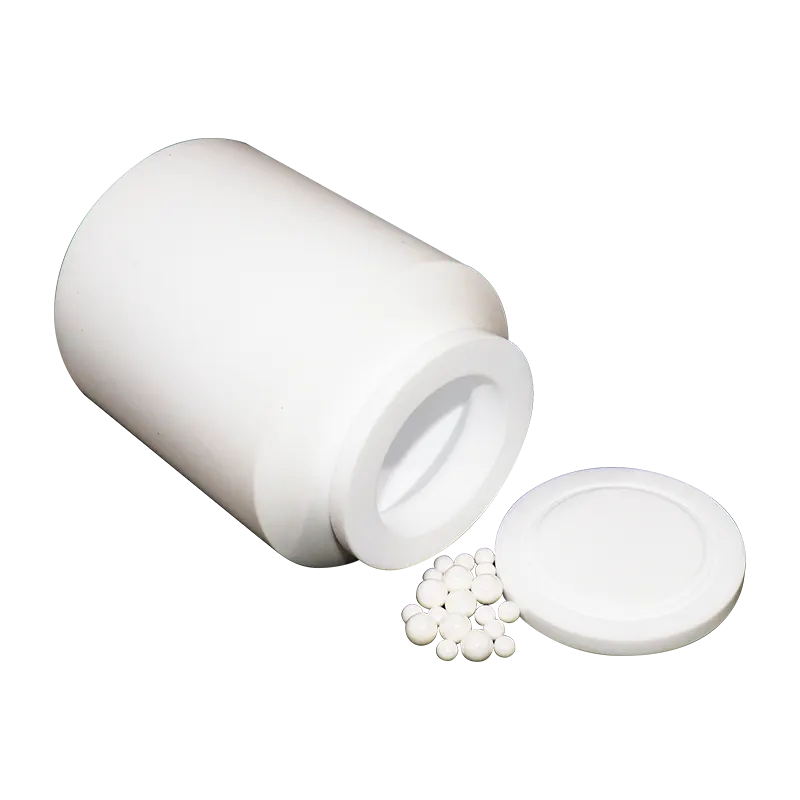
It is useful to distinguish between three objects: the mill, the grinding drum and the grinding media. The mill sets the movement and permissible load, the drum sets the contact surface and volume, and the grinding media sets the grinding energy. An error at any point can ruin the sample. For example, a load that is too heavy increases wear on the wall, and balls that are too large and have insufficient volume grip the material worse. This does not make PTFE unsuitable, but requires a regime check.
Contamination and Cleaning: Where PTFE Helps and Where It Doesn't
Three sources of pollution
The first is the drum material. PTFE can abrade, especially with abrasive powders, large balls and long grinding times. The second is grinding media. Ceramics, zirconium dioxide, tungsten carbide or steel have different resistance, but no material provides an absolute guarantee of the absence of impurities. Third - procedure: remnants of the previous sample, dust, tools, incompatible solvent, insufficient drying. Until these sources are separated, it cannot be said that the drum is "contaminated."
| Source | How it manifests itself | What to check |
|---|---|---|
| Drum material | Abrasion, scratches, film transfer, weight change | Wall condition, mass control before and after, dry grinding |
| Grinding media | Chips, abrasion, sticking, material transfer | Integrity, material, size, mass and origin of balls |
| Procedure | Cleaning residues, dust, dirty tools | Washing procedure, solvent, drying, control sample |
Low adhesion does not equal sterile cleanliness
PTFE does make many powders easier to remove: the material sticks less to a smooth surface and cleanup takes less time. But low adhesion does not eliminate microrelief, scratches and areas under the cover. If the drum is already worn out, residues may be trapped in defects. In addition, some fine powders penetrate into cracks and seals and form a dense layer when dried. Therefore, visual cleanliness is only the first level of control.
For the technique, reproducibility of cleaning is more important. Two laboratory technicians should get the same result using the same procedure. If different solvents are used for different samples, this is recorded. If the drum is used for several materials, marking and transition rules are introduced. A dedicated drum for one class of samples helps in sensitive analyses, but it also requires regular condition checks.
Cleaning procedure
- Remove the bulk of the powder using a dry method, without spreading it on the walls.
- Inspect the surface in good light: scratches, dark spots, deposits near the lid.
- Select a solvent compatible with PTFE, sample and seal; do not use an unknown mixture “just in case.”
- Wash or wipe with a soft tool, avoiding abrasive powders and hard brushes, which can increase wear.
- Remove any remaining solvent and dry in the manner recommended for the specific application.
- Check the cleanliness visually and, if the method requires, by a control wash or dry grinding.
- Record the date, sample, cleaning agent and inspection result.
Blank grinding without a sample, but with grinding media and the selected media helps to see if wear particles are appearing. However, it is not universal: the absence of visible particles does not prove the absence of dissolved contaminants. If the analysis is sensitive to trace impurities, a separate control plan consistent with the procedure is required. You can't promise "zero contamination" just because the drum is made of PTFE.
Wear and geometry: what determines the resource
The service life of a PTFE drum depends on the abrasiveness of the sample, the size and density of the grinding media, grinding duration, temperature and cleaning method. A soft polymer can not only wear out, but also deform under load. Particularly carefully inspect the edge, bottom, place where the lid fits and the areas where the drum rests on the rollers. The appearance of deep marks or a change in the fit of the lid is a reason to reconsider the mode, and not just increase the grinding time.
It is impossible to name a specific number of cycles without testing. In some conditions, the drum retains its working surface for a long time, in others, the abrasive suspension accelerates wear. If there is no confirmed resource in the card, the article and laboratory note must remain the following condition: the resource is determined based on the results of operation. This is more honest than transferring a single experience to all materials.
Geometry and fit dimensions
| Parameter | Why is it needed? | How to confirm |
|---|---|---|
| Outer diameter and height | Fitting on rollers, clearance to casing | Check with mill manual and product card |
| Internal volume | Permissible load and space for moving bodies | Do not confuse nominal volume with sample mass |
| Wall thickness | Resistance to deformation and wear | Specify for specific version |
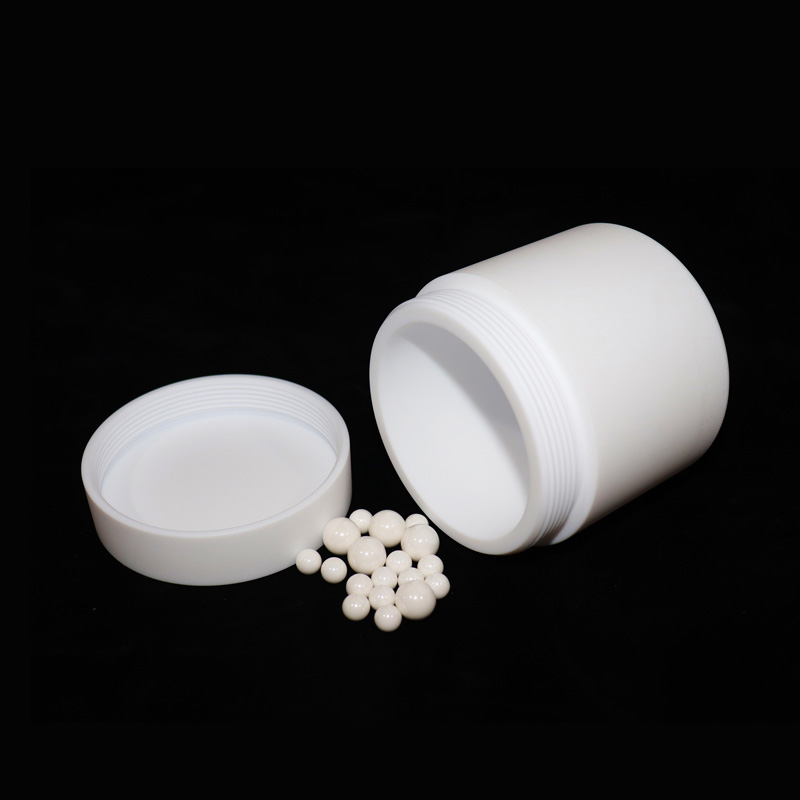
| Cover and seal | Tightness during wet grinding and dusting | Check the fit, fixation and condition of the seal. |
| Drum weight | Load on drive and rollers | Measure when assembled |
The nominal volume of the drum, loading volume, sample weight and productivity are different values. You cannot fill the drum “to the brim” just because it seems big. Grinding media need space to move, and powder needs room to redistribute. Overloading increases heat, wear and the risk of uneven grinding. If the load is too small, the result may be unstable, and wear on the balls and walls may be disproportionate to the sample volume.
The lid is a separate risk element. In wet grinding, it is not just the thread or clamp that is important, but also the condition of the seal, the cleanliness of the edge and the correct closing sequence. If the lid is not seated tightly, slurry may get onto the outside surface and onto the rollers. This is not only a loss of sample, but also contamination of the installation. After each grinding, it is useful to inspect not only the internal cavity, but also the external seating surfaces.
Compatible with mill and grinding media
Roller and stirring mill - different conditions
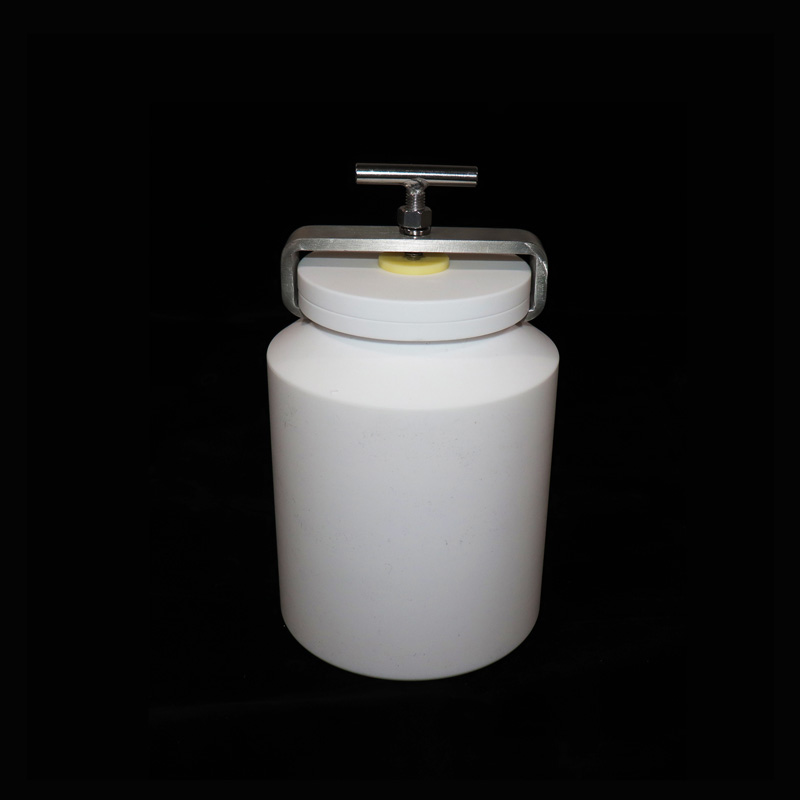
For a roller ball mill, the drum rotates on supports and must be shaped to provide a stable fit. Other parameters are important for a mixing mill: mounting method, interaction with the mixing element and permissible load. Therefore, you cannot select a PTFE drum based only on the outer diameter. First, the installation class is confirmed, then the mounting dimensions, weight, permissible speed and method of fixation are checked.
Compatibility includes heating control. PTFE has low thermal conductivity, so during intensive grinding, heat is distributed differently than in a metal drum. If the unit is air cooled, this does not make the process cryogenic and does not guarantee sample temperature. For sensitive materials, it is useful to measure the heating at idle and with actual load, and then compare with the acceptable range of the procedure.
Grinding media: material, size and quantity
Grinding media are selected based on the hardness of the sample and acceptable contamination. Ceramics, zirconia, tungsten carbide and steel offer different trade-offs between efficiency and impurity transfer. Tungsten carbide does not mean "zero pollution": it can also wear out, especially if not used correctly. Ceramics can chip and metal can oxidize or stick. For a PTFE drum, it is additionally important that the bodies are not excessively large for the selected volume and do not create an impact load for which the design is not designed.
The number and size of the balls influence the energy and distribution of contacts. Too large bodies wear out the wall faster and work worse with a small sample volume. Too fine may not provide the desired grinding. The selection begins with a minimum reasonable quantity, and not with a maximum load. If the product card does not contain data on acceptable grinding media, this issue is clarified separately; A random coincidence of sizes does not constitute confirmation.
Dry and wet grinding
Dry grinding is convenient for subsequent sifting and analysis, but can be accompanied by dust, heating and sticking. Wet grinding reduces dusting and sometimes helps deagglomeration, but adds containment, solvent, and cleanup requirements. Grinding and mixing are not the same thing: if the task is to distribute the components evenly, the mode may differ from the mode of coarseness reduction. The bead mill, roller drum and roller crusher also represent different principles and cannot be described as interchangeable.
Before wet grinding, check whether the solvent is compatible with the PTFE, the sample and the seal. The chemical resistance of the drum does not guarantee the resistance of the lid or markings. After wet grinding, it is more difficult to remove residues from the crevices, so cleaning should be described in advance. If the technique requires complete removal of liquid, indicate the drying method and readiness criterion. Drying temperatures cannot be transferred from other equipment without checking.
Test grinding: how to check compatibility in practice
The first grind is best viewed as a test rather than a finished production technique. Start with a small sample and minimal load to assess heating, dust build-up, buildup and condition of the drum. You should not immediately use maximum speed or for a long time: if wear appears, it is difficult to understand what factor caused it. After the first cycle, the walls, cover, seal and grinding media are inspected, and the sample is checked for coarseness and signs of contamination.
For repeatability, not only the mill model is recorded, but also the condition of the drum. The same PTFE drum can behave differently after different samples. If there are several drums in the laboratory, they are labeled and a log is kept. This helps separate the effects of material from those of wear and cleaning. When switching to a new batch of sample or a new design of the drum, the test is repeated, even if the product name is the same.
What to record
- Sample weight, initial particle size and method for determining it.
- Drum ID, its dimensions and condition before grinding.
- Material, size, weight and number of grinding media.
- Dry or wet grinding, medium composition and liquid volume.
- Speed, time, pauses and signs of heating.
- Cleaning method, solvent and inspection result after grinding.
- Method for measuring particle size and the result of a control experiment.
What to tell the supplier
For selection, it is useful to indicate the mill model, the required sample volume, external and internal dimensions, expected load and material of the grinding media. They also tell you whether the grinding will be dry or wet, what solvents are expected, what the abrasiveness of the sample is and what the contamination limits are. If the target size is known, it is indicated along with the measurement method. This helps distinguish the problem of particle reduction from disagglomeration or mixing.
You shouldn't ask for the "best" drum without conditions. For one sample, chemical resistance is more important, for another - resistance to abrasive, for the third - tightness and easy cleaning. A PTFE drum may be a good choice, but only after checking compatibility with the installation and procedure. Website TENCAN and the product card serve as a starting point for clarifying current designs; The final decision is confirmed by trial grinding and analysis of control samples.