
Preparing a sample for analysis is rarely a neutral operation: grinding simultaneously changes the size, surface condition and chemical composition of the sample. When the material is soft, fibrous, or sensitive to metal traces, the choice of grinding media ceases to be an afterthought and becomes part of the procedure, rather than a line item on the consumables list.
Grinding balls with an iron core and a polyurethane coating are an attempt to separate two functions: a mass that stores impact energy, and a contact surface that comes into contact with the sample. This division provides benefits in some tasks and creates limitations in others. Below we will explain how this composite is structured, where the limit of its applicability lies, how to organize cleaning and what issues need to be resolved before the first grinding.
Numerical characteristics - diameter range, tolerances, density, hardness and shell composition - should be taken from the current product card. Here we discuss the principles of behavior of such bodies in a mill and the logic of choice; specific values for the batch are confirmed by the supplier.
Ball design: core, shell and interface
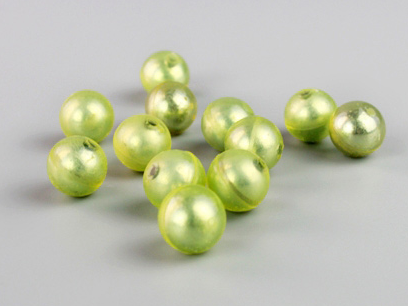
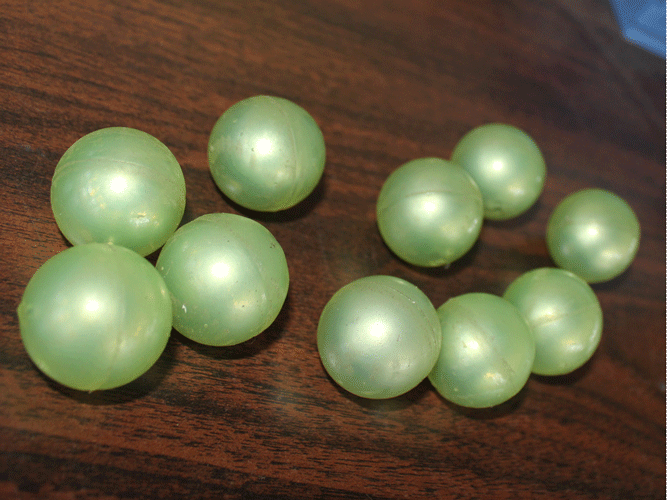
This type of grinding ball is composite. Inside there is a metal core, on the outside there is a layer of polyurethane that covers the metal and forms a working surface. From a grinding standpoint, it's not just what the core is made of that matters, but also what surface comes into contact with the powder and what happens when that surface wears out.
The working diameter is the outer diameter, that is, taking into account the thickness of the coating. This is essential when selecting based on the gap in the chamber and when calculating the number of bodies: two batches with the same core diameter, but different shell thicknesses behave differently.
Core: mass, inertia, cost
The iron core acts as ballast. The density of the metal is several times higher than the density of the polymer, therefore, with the same diameter, the ball turns out to be heavy: it gains momentum in the acceleration field of the mill and transfers to the sample energy that a monolithic polymer ball simply would not have. In addition, a metal core is cheaper than a monolithic engineering ceramic ball of the same size - this is noticeable when grinding media are consumed in batches.
Downside: The core is a reservoir of contamination. While the shell is intact, the metal is isolated from the sample. As soon as a crack, chip, or abrasion to the metal appears, iron begins to enter the sample, and along with it the alloying elements of steel. Therefore, monitoring the condition of the coating is not a formality, but part of the methodology, especially in tasks where Fe, Cr, Ni or Mn are determined.
Shell: work surface
Polyurethane is an elastomer. It deforms on contact, returns to shape after impact, and does not crack like ceramic. For the grinding media this means a larger contact patch, longer contact time and lower peak stress in the particle. The shell also dampens some of the noise and protects the core from corrosion in aqueous environments.
The thickness and continuity of the layer determine the resource. Uneven thickness, bubbles, peeling along the border with the metal are defects that do not appear immediately, but after dozens of cycles, when in one place the shell has already been worn away, but in another not yet. Hence the rule of thumb: the batch should be inspected and weighed before it is put into operation, and not after the appearance of rusty particles in the sample.
Interface
Adhesion of polymer to metal is the most vulnerable point of a composite. Under cyclic loads, stresses accumulate at the boundary; if the adhesion is weak, under-film corrosion begins and the shell swells from the inside. Visually, this appears as swelling or darkening, and not as obvious wear. Therefore, the inspection should include not only a search for abrasions, but also a check for swelling, especially after wet grinding.
Compared to monolithic steel, the composite loses in resistance to abrasive and gains in mass-contact separation. Compared to ceramics, it is softer and more elastic, it destroys hard brittle particles worse, but does not produce ceramic inclusions. This is not “better” or “worse”, but a different profile of properties.
Contact mechanics: what changes the elastic coating
Understanding how the elastic shell changes energy transfer helps predict where such a ball will be useful and where it will disappoint. The difference is not in the design of the machine, but in the physics of a single contact.
Impact, abrasion and disagglomeration
In a ball mill, a particle is destroyed in two ways: by impact - when bodies collide with each other and with the wall - and by abrasion between surfaces. Impact is effective for brittle materials and large particles, abrasion is effective for fine grinding and for the destruction of agglomerates, when it is necessary to separate already formed conglomerates without destroying the primary particles themselves.
The elastic coating shifts the balance towards abrasion. Part of the kinetic energy is spent on deformation of the shell and is dissipated into heat, and not into the destruction of the particle. For fragile quartz or sintered ceramics, this is a direct loss of performance; for a soft polymer, fibrous material or agglomerated powder - on the contrary, a softer mode, less overgrinding and less destruction of the structure.
When is elasticity useful?
There are several scenarios where the coverage works for the task:
- the material is sensitive to metal contaminants, and contact with steel is unacceptable;
- it is necessary to destroy the agglomerates, and not the primary particles themselves;
- the sample is soft, fusible or tends to stick to metal - an elastic surface is easier to clean;
- A gentle treatment is required for heat-sensitive or structurally unstable material.
In all these cases, the gain is achieved not due to the grinding speed, but due to the safety of the sample and the predictability of its composition.
When elasticity limits
The restrictions are symmetrical. Hard abrasive materials - quartz, corundum, silicon carbide, many minerals - are not only poorly crushed by the elastic body, but also quickly damage the shell. If the task is to obtain a fine powder from a solid material in a reasonable time, the coating will almost certainly lose to ceramics or steel in terms of speed and wear.
Hysteresis heating
There is also a less obvious effect. Polyurethane has low thermal conductivity, and heat is released during cyclic deformation. In a vibrating mill with a high oscillation frequency and dense loading, the surface of the ball heats up faster than it has time to transfer heat to the medium. The consequence is softening, accelerated wear and risk for the heat-sensitive sample. This is an argument for intermittent operation and temperature control rather than maximum loading.
In wet grinding, the medium partially removes heat, but adds its own factors: the viscosity of the liquid affects the mobility of the bodies, and the composition of the liquid affects the durability of the polymer. Dry grinding is simpler in terms of equipment, but more severe in terms of thermal conditions and dust formation.
Impurity introduction: three different sources
Conversations about contamination often come down to the question “does polyurethane contain impurities?” It is more correct to separate three sources - metal, ceramic and polymer - and understand which of them is critical for a particular analysis.
Metal contamination. While the shell is intact, there is no direct contact between the sample and the steel. This is a major advantage over steel balls in applications where Fe, Cr, Ni, Mn are important or where the metal catalyzes side reactions. But the guarantee is valid until the first damage to the coating.
Ceramic contamination. The gain here is not absolute: ceramics also wears out, it just produces particles of a different composition. If the method is sensitive to zirconium or aluminum, polyurethane wins; if it goes to organics, it loses.
Polymer contamination. The shell wears out, and organic particles and polymer degradation products enter the sample. For elemental analysis of metals this is usually unimportant, for CHNS, TOC, IR spectroscopy or volatile analysis it can be critical. Local heating adds thermal destruction to mechanical wear.
Shell damage is the main risk
The majority of serious contamination is associated not with uniform wear, but with local damage: cuts from a sharp edge, chipping during overload, delamination after wet grinding with an aggressive liquid. The protection here is organizational - inspection before each load, marking of sets, removal of the ball from work at the first suspicion.
It is useful to keep a simple log: date of start-up, number of cycles, environment, observed changes. After a few months, such a record provides a real resource guideline for specific conditions, which is not in any catalogue.
Electrostatics and particle entrainment
The polymer is easily electrified. The fine fraction sticks to the surface, is transferred to the next sample and distorts the result. This is not pollution in the chemical sense, but cross-entrainment, and it needs to be dealt with in the same systematic way: separate kits for groups of materials, washing, control grinding.
There is no such thing as “zero contamination” with any grinding media material. The correct formulation is not “the ball does not pollute”, but “the ball produces pollution of such a composition and in such an amount that it does or does not fit into the budget of the method.”
Compatibility with equipment: why the mill card does not confirm it
The compatibility of grinding media with a mill is a property of the system, not of an individual product. You need to check the gap in the chamber, the lining material, the permissible dimensions of the bodies, kinematics and thermal conditions.
Vibratory Mill
Vibrating mills accelerate the load due to vibrations of the chamber; energy is transferred through frequent impacts and intense abrasion. Heavy Vibrating Ball Mill TENCAN belongs to this class of equipment, however, its card describes the machine and does not automatically confirm the suitability of specific polymer-coated bodies. For such a mill, the mass of the feed, the size of the chamber and the thermal regime are critical: intensive mixing heats up the polymer faster than conventional grinding in a drum.
Planetary and drum mills
In a planetary mill, the accelerations are higher and the shock component is more pronounced. An elastic body works worse there: a significant part of the energy goes into deformation. In a drum mill on rollers, the picture is closer to a classic ball mill - the rotation speed is moderate, and the coating suffers mainly from abrasion rather than from overheating. These are different machines with different conditions, and you cannot transfer conclusions from one to another.
Bead mills are a separate class
The bead mill uses fine grinding media and liquid suspension; Other laws are at work here - hydrodynamics, separation of beads from the product, rheology of the suspension. A ball with an iron core is not a standard solution for it, and it is not worth discussing it in this context without confirmation from the manufacturer.
Check before starting: whether the selected diameter fits into the chamber taking into account the lining, whether the drive can withstand the load weight, whether there is a restriction in the manual on the material of the grinding media. The answers come from machine-specific documents, not general considerations. An overview of equipment directions is given at website TENCAN.
Diameter, density and load: parameters to be checked
The diameter of the ball is a compromise between the energy of a single impact and the number of contacts. Large bodies crush large particles, small particles are further crushed and provide a larger abrasion area. For elastic bodies, this compromise is shifted: the impact is weaker, so the emphasis is on abrasion and the number of contacts.
What to check in a batch
Diameter, ovality, size variation, weight, coating continuity. Diameter variation means mass variation, which means uneven loading and poorly reproducible results. A small sample, weighed on a laboratory balance, gives more than the stated value in the catalog. The nomenclature and parameters of the product are specified by card of grinding balls with polyurethane coating.
Effective Density
The average density of the composite is lower than that of monolithic steel because part of the volume is occupied by polymer. When loading “by mass” this means a larger number of balls for the same mass; when loading “by volume” - less weight. It is impossible to mix these methods in one series of experiments: the result will be poorly reproduced, and comparison with literature data will be incorrect.
Filling and mass ratio
The ratio of the mass of the grinding media and the mass of the sample, the degree of filling of the chamber and the proportion of free volume set the mode. For elastic bodies, it is wise to start with moderate filling and a longer time, rather than with maximum energy intensity. The exact values are selected experimentally for a specific machine and material.
When moving from a small sample to a larger batch, you should not proportionally increase everything at once. First, they check whether the size remains the same at the same mass ratio, and only then scale the time and loading.
Cleaning, drying and transfer between samples
Polyurethane forgives a lot, but not everything. The goal of cleaning is to remove sample residues without damaging the shell or saturating the polymer with solvent, which will then be released into the next sample.
The working sequence looks like this:
- mechanical removal of residues with a soft brush or cloth, without blades or abrasives;
- rinsing with water and a mild detergent, if necessary, short ultrasonic exposure in water;
- rinsing with demineralized water;
- quick rinse with ethanol or isopropanol to remove water, without prolonged soaking;
- drying at moderate temperatures, away from heating devices;
- Inspect for cracks, swelling and darkening before the next load.
Polyurethanes are sensitive to a number of organic solvents - aromatic hydrocarbons, ketones, esters; The specific durability depends on the brand. Prolonged soaking leads to swelling, loss of strength and gradual removal of the polymer into the samples. Therefore, “soaking overnight” is a bad idea, even if this technique worked with metal or ceramics.
Cleanliness control
Checking - control grinding without a sample or with an inert material and subsequent analysis for the elements of interest. If, after washing, particles of polymer or metal are visible in the control sample, the procedure must be changed and the ball removed from use. It is useful to repeat such control after changing the type of samples, and not just when putting the batch into operation.
Storage and labeling
It is better to store kits in closed containers, away from direct sun and heat sources, without squeezing and without contact with oils and solvents. Labeling by material group saves time and reduces the risk of cross-contamination, which is especially noticeable with fine powders.
Restrictions and conditions of selection
Temperature. Polyurethane retains elasticity within a limited range. When heated, it softens and wears out faster; when cooled, it becomes brittle and can crack. Cryogenic grinding with liquid nitrogen and conventional air cooling are different conditions; the first for an elastic shell requires separate confirmation and cannot be considered a standard mode. The temperature of the working space of the installation is not equal to the measured temperature of the sample.
Chemical environment. Water and aqueous solutions of moderate acidity are usually acceptable; concentrated acids, alkalis, oxidizing agents and active solvents are not. For wet grinding in a non-aqueous environment, the composition of the liquid is coordinated with the casing material, and is not checked “in fact” on a valuable sample.
Abrasiveness and hardness. The harder the material, the faster the coating wears out. For regular work with hard minerals, it is wiser to immediately consider ceramic bodies, and leave polyurethane for tasks where it really solves the problem of contamination.
What to report for trial grinding
To prevent the selection from turning into a search of options, before the test it is worth recording:
- sample material and its hardness;
- initial size and target size;
- sample mass per cycle;
- dry or wet grinding and composition of the liquid medium;
- mill model, chamber volume and material;
- permissible level of pollution for specific elements;
- temperature limits for the sample;
- number of cycles and cleaning requirements between them.
It is useful to document the test results in the same way: load weight, time, size before and after, measurement method, observed wear. Without this, comparison of series becomes meaningless, and conclusions are transferred to other conditions without basis.
The practical conclusion is simple: a polyurethane-coated ball is a tool for a specific class of tasks, and not a universal replacement for steel and ceramics. It is justified where metal contamination is more important than loss of productivity, where the material is soft or prone to agglomeration and where gentle cleaning is important. In all other cases, the decision is made based on the results of the trial grinding, and not on the product description.