
Reducing the size of plastic blanks is a typical task both in the laboratory and in production: you need to obtain a representative sample for analysis, prepare the sprues for reuse, and bring the products to a fraction convenient for dosing. Plastic crusher closes the first, coarsest stage: transforms products, plates and waste into a lump fraction, which is then weighed, pressed, extruded or transferred for finer grinding. The selection of such a machine rarely comes down to choosing the most powerful model - the result is determined by the properties of the polymer, the geometry of the workpieces, the required fraction and the permissible heating of the material.
TENCAN (Changsha Tianchuang Powder Technology Co., Ltd.) supplies equipment for the preparation and processing of lump and powder materials: crushers, mills, screening and mixing machines, presses, ovens, glove boxes and laboratory instruments. These classes are not interchangeable: a crusher does not replace a mill, and a mill does not do the job of a crusher. It is convenient to look at the general direction of the equipment website TENCAN. Below we are talking specifically about a plastic crusher: how to read its characteristics, what limitations this class of machines has, and what data is needed before trial crushing.
Where does the selection of a crusher for plastic begin?
The first question is not “how much power is needed,” but “what should happen.” A plastic crusher produces a lump fraction with a wide particle size distribution, and the typical lump size is determined primarily by the geometry of the working chamber and the openings of the interchangeable sieve. Therefore, the source material and the target result are described together and not separately.
What do you need to get out of this?
The formulation of the result includes three values: the typical size of the piece, the permissible fraction of the dust fraction and the permissible heating of the material. For sample preparation prior to analysis, homogeneity and freedom from contamination are often more important than throughput per hour. For processing gates, the stability of the fraction during long-term operation and ease of unloading are more important. The same machine can serve both tasks, but with different sieves, different feeds and different operating modes; There is no universal setting “for all cases”.
Why equipment class is more important than drive power
Polymers behave like a viscoelastic material: they do not chip like a brittle mineral, but are cut, crushed and elastically deformed. A machine designed to crush and hit fragile bodies will not make a good plastic crusher, and vice versa. Therefore, when selecting, first confirm the principle of destruction and the type of machine, and only then compare the drive power, the size of the loading window and the declared performance.
The practical procedure is as follows: describe the material and workpieces, determine the target fraction, select the type of machine and replacement elements, check the thermal conditions, and only then discuss productivity and scale. If you break this order and start with power, it is easy to get a machine that is formally more powerful, but produces sticking, excess dust and an unstable fraction. It is more expensive to correct such a result than to immediately formulate requirements for the process.
How does a plastic crusher work and what is each unit responsible for?
Crushers for polymers of this class are made according to the knife scheme: the material enters the working chamber, where the rotating knives of the rotor work in tandem with the stationary knives of the body and sequentially cut the workpiece until it passes through the calibrating sieve. Specific equipment, knife materials and drive parameters are indicated in the product card; here it is more important to understand what each node is responsible for in order to formulate requirements meaningfully, and not according to one number.
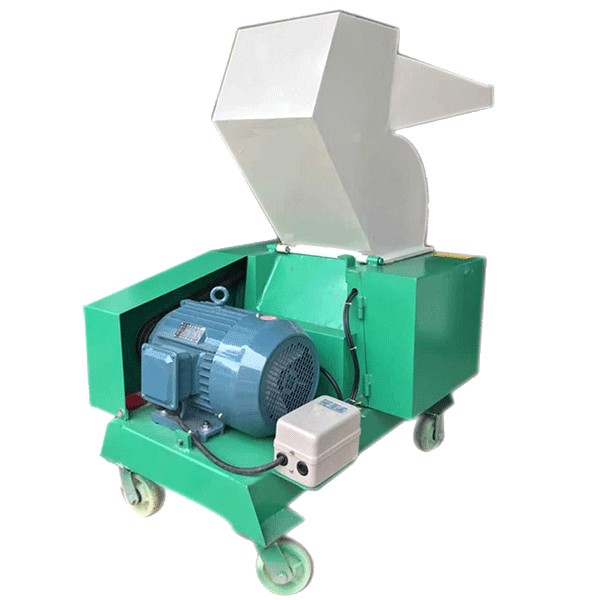
Loading hopper and working chamber geometry
The hopper determines which workpieces the machine accepts without preliminary cutting, and the working chamber determines how the material behaves inside. A workpiece that is too large or long does not have time to turn and the rotor jams; a flat thin film, on the contrary, tends to slip past the knives. Therefore, the permissible dimensions of the workpiece are not a formality, but a working limitation that must be compared with real products, and not with a convenient average figure from the specification.
Rotor, knives and bearing assembly
The rotor with knives is the main working body. Its geometry, the number of knives, the sharpening angle and the gap between the moving and stationary knives determine exactly how the material is cut and how much heat is generated per unit mass. A small gap gives a more even cut, but requires careful assembly and timely sharpening. The bearing assembly and seals determine the service life of the machine and the permissible duration of continuous operation: fine particles and dust penetrate into the units if the seals are selected without taking into account the actual dust load.
Replaceable sieve and output size
The sieve, or sizing grid, sets the upper limit on the size of the piece: the material leaves the chamber only when it passes through the holes. This does not mean that all particles will be the same size - the particle size distribution remains wide, and the proportion of fines depends on the properties of the material, the peripheral speed and the condition of the knives. Changing the sieve is the easiest way to change the fraction, but each reduction in the holes reduces the throughput, increases the residence time of the material in the chamber, and therefore increases the heating.
Drive and overload protection
The drive must provide not only the rated power, but also the torque on the shaft when jammed. Protection devices - current protection, relays, mechanical safety elements - determine what will happen if a foreign object enters or the camera is overloaded. For a laboratory machine, predictable shutdown and reverse capability are more important than maximum power: stopping with damage to the knives is more expensive than a more modest drive.
What do the parameters on the product card mean?
The characteristics of a plastic crusher are only useful in conjunction with the conditions under which they are measured. Below are typical card positions and what needs to be clarified before transferring the number to the technical specification.
Boot window size
The size of the window shows which workpieces pass into the chamber without additional preparation. But the declared window size is not equal to the maximum size of the workpiece: thickness, rigidity and shape are also important. A long thin sprue will go through easier than a short thick block of the same size. When selecting, it is correct to indicate not only the dimensions, but also the typical wall thickness and aspect ratio of the workpiece.
Rotational speed and peripheral speed of knives
The rotor rotation frequency in itself says little: with different rotor diameters, the same frequency gives different peripheral speeds at the edge of the knife. It is the peripheral speed, together with the geometry of the knives, that determines the nature of the cut and heating. When discussing the mode, it is correct to operate with peripheral speed and feed uniformity, and not just the number of revolutions per minute.
Sieve mesh diameter and particle distribution
The diameter of the sieve holes is not a promise of coarseness. This is the upper limit that passes through the calibration hole. The actual particle size distribution is determined by the material, its temperature, rotor speed, blade sharpening and residence time in the chamber. For critical tasks, the fraction is confirmed by sieve analysis of a specific batch, rather than transferring the typical value from the catalog to any sample.
Drive power and performance
Performance claims are specific to the specific material, screen and feed rate and do not automatically transfer to other polymers. Drive power is related to performance nonlinearly: part of the energy goes into heat, and part goes into overcoming friction and elastic deformation. Therefore, comparing two machines using one figure in kilograms per hour without indicating the material, screen and fraction gives almost nothing.
Material and resource of knives
Knives wear out, and the rate of wear depends on the fillers. Glass-filled and mineral-filled compounds work like an abrasive: the edge shrinks faster, the gap grows, the fraction becomes coarser, and the heating is higher. Therefore, the service life of knives is discussed in conjunction with the material, and not as a characteristic of the machine itself. Sharpening and correct setting of the gap extend the service life more noticeably than the “harder” material of the knife without taking into account the fragility of the edge.
Overheating, sticking and dust: the thermal side of polymer crushing
For polymers, thermal conditions are often the main limitation rather than performance. Thermoplastics soften when heated, begin to stick to the knives and chamber walls, stick together into lumps and clog the sieve. This is why the same machine can work perfectly on one material and fail on another with the same feed.
Where is the heat generated?
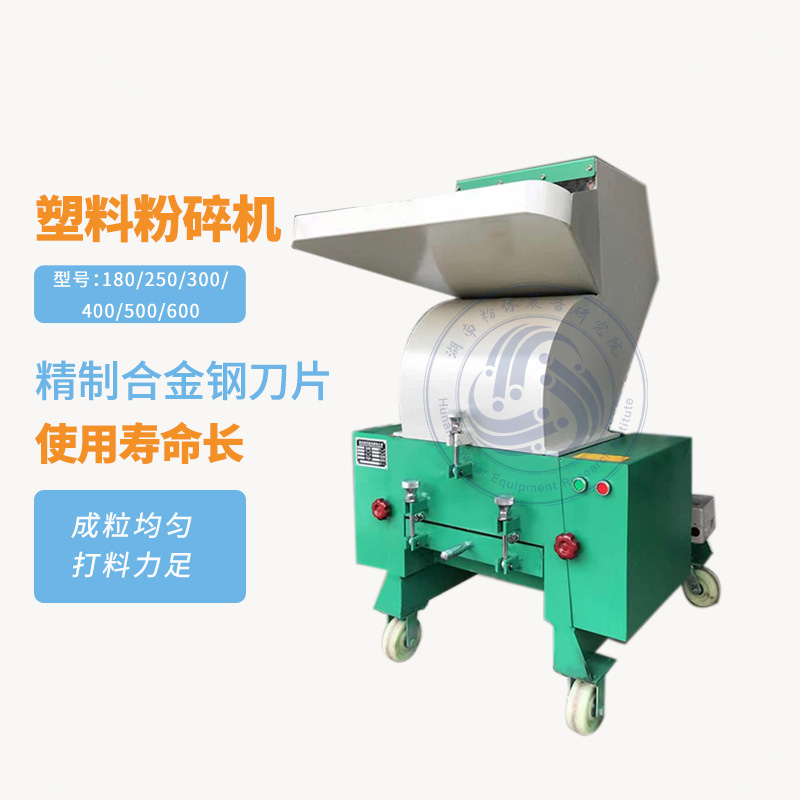
Heat is generated in the cutting zone, during friction of the material against walls and knives, during elastic deformation of pieces and during the operation of bearings. The longer the material remains in the chamber, the more heat it accumulates. Reducing sieve openings, increasing feed and dull knives work in the same direction - increasing residence time and heating.
Signs of overheating and what they mean
Practical signs: the material is warm at the outlet, the pieces stick together, a coating appears on the knives and walls, unloading slows down, the fraction becomes uneven. None of these signs by itself proves that the machine is faulty. First, they check the sharpness and clearance of the knives, the suitability of the sieve for the task, the uniformity of the feed and the temperature of the material at the inlet. A diagnosis without data on the mode and material will be a guess.
What reduces heat
Simple measures work: uniform feeding instead of a burst feed, a moderate sieve instead of the smallest one, sharp knives with the correct gap, periodic pauses for natural cooling, preliminary reduction of too large workpieces. Air cooling of the housing and material flow is a common engineering measure, but does not make the process cryogenic. It is correct to call only a process with a targeted supply of liquid nitrogen or other refrigerant into the working area cryogenic; Without confirmation of this option, the machine should not be described as a cryogenic unit. The air temperature in the room and the temperature of the sample itself are different values, and the first does not replace the second.
Sample preparation before crushing
A significant part of the problems are solved before turning on the machine. A plastic crusher is not a tool for tidying up any raw materials, and part of the preparation operations falls on the operator.
Shape, thickness and reinforcement
Thick-walled and reinforced products are more difficult to crush: metal fittings, inserts and fillers create shock loads and the risk of damage to knives. It is often wiser to reduce large workpieces first. For certain materials, cooling before crushing is sometimes used, but this is a separate technique that requires confirmation of applicability to a specific polymer, and is not a general rule.
Moisture, dirt and foreign matter
Moisture reduces flowability, promotes adhesion and sticking, and foreign inclusions - metal, stones, glass - are dangerous for knives. A simple rule: before crushing, the batch is inspected and, if necessary, cleaned and dried. This affects not only the service life of the machine, but also the purity of the sample if the material is sent for analysis.
Materials requiring caution
The dust of many polymers is flammable, and some materials release harmful substances when overheated. Crushing of unknown or mixed waste or materials with unconfirmed composition should not be carried out without a risk assessment and adequate ventilation. No article replaces the operating instructions for a specific installation and the current safety regulations in the organization.
From sample to batch: scaling, representativeness, purity
When a regime is found on a small sample, the next question arises: will the result be maintained when moving to a larger batch. The answer depends not only on the machine, but also on how representative the sample is and how cleaning is done between samples.
Sample representativeness
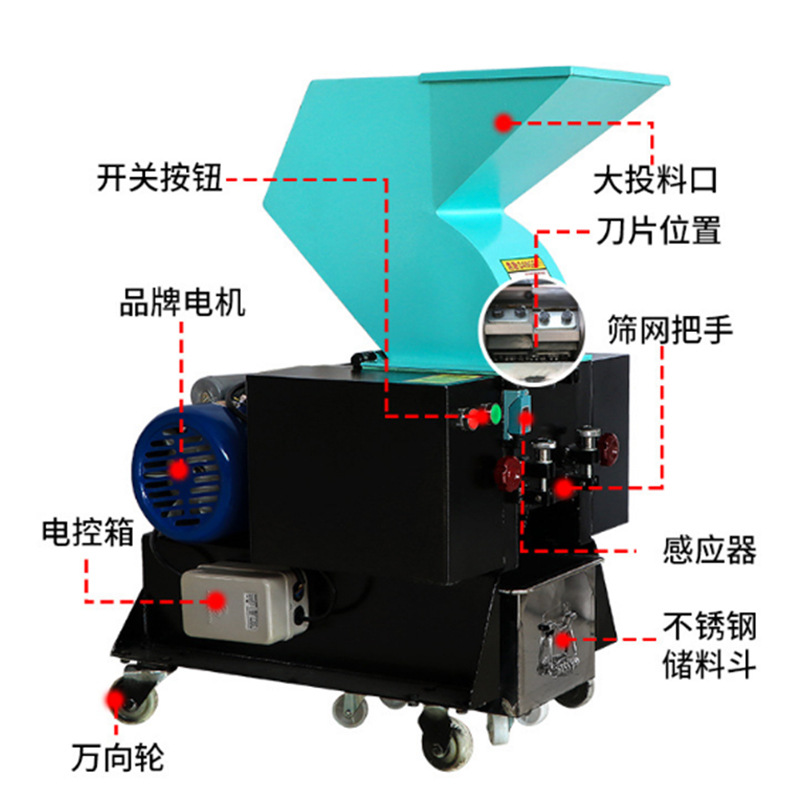
The piece that hits the crusher first does not describe the batch. For mixed raw materials, the sample is taken so that it includes different parts of the batch - by thickness, color, delivery batch. After crushing, the fraction is mixed and reduced by quartering or a divider, rather than poured “on top.” Otherwise, the particle size distribution in the analyzed sample will differ from the real one.
Cross contamination and cleanup
Between different materials, the machine is cleaned: it is purged, residues are removed from the chamber, the sieve and knife area are checked. If the laboratory crushes colored and uncolored, filled and pure polymers, the residual particles are transferred to the next sample. This effect is especially noticeable on the small fraction, which lingers in hard-to-reach places. The cleaning procedure is recorded in the methodology, as is the order of work from “clean” material to “dirty” material.
Repeatability between batches
Repeatability is ensured by fixed conditions: the same sieve, the same feed, the same condition of the knives, the same duration of work. If you change the sieve or feed “according to the situation,” comparing batches becomes meaningless. It is reasonable to record the parameters of each crushing - material, sieve, mode, sample weight, time - this is cheaper than repeating the experiment.
Trial crushing: what to check and what data to report
Test crushing solves two problems: it confirms the suitability of the machine for a particular material and provides initial data for adjustment. It is useful to decide in advance which observations are being recorded so that the result is not reduced to a general impression.
What is tested in the sample?
- Does the workpiece pass into the hopper without jamming and is preliminary cutting necessary?
- How the material behaves in the chamber: smooth cutting, sticking, dust, sticking of pieces.
- What fraction is obtained on the selected sieve and what is the proportion of fines.
- Outlet material temperature and process stability over time.
- Behavior when stopping and restarting, protection activation.
- Clean discharge and easy cleaning of the chamber and sieve between samples.
What data is needed for selection
- Type and composition of the polymer, presence of filler and reinforcement.
- Shape, dimensions and thickness of blanks, approximate batch weight.
- Required fraction and permissible fraction of dust fraction.
- Limitations on heating and time of continuous operation.
- Requirements for purity and admissibility of introducing impurities.
- Operating mode: one-time samples or regular processing.
This information allows you to select a sieve, feeding mode and assess whether preliminary preparation of raw materials is necessary. Plastic crusher TENCAN described on the product page, which lists available model-specific information; The general composition of the equipment is shown on main page of the site. If, after crushing, finer grinding is required, this is a different operation and a different class of equipment, with its own requirements for the material of the grinding media and lining.
The selection of a crusher for plastic ends not with the choice of model, but with a proven mode: a confirmed sieve, an understandable feed, controlled heating and a reproducible fraction. You should start with the material and the target result, and compare power, window size and performance in relation to them. The catalog value describes typical conditions and not any sample, so trial crushing of a specific batch on a specific sieve remains decisive.