
The nylon grinding drum may seem like a simple replacement part, but it sets the limits for sample purity, load capacity and ease of cleaning. In laboratory practice, purchasing decisions are often made based on the name of the material and the outer diameter, and then they find out that the drum does not fit the rollers, the lid does not hold the suspension, or an odor remains after washing. Below is a practical analysis without promises of “zero pollution”: what nylon does, what it doesn’t, and what information you need to collect before trial grinding.
Why the drum is part of the technique, and not just a container
The grinding drum simultaneously performs several functions: it separates the sample from the environment, transmits movement to the grinding bodies, sets the geometry of the chamber and contacts the material with the entire internal surface. Therefore, replacing the drum can change not only the ease of operation, but also the particle size distribution, the speed of achieving results and the composition of impurities. Even with the same mill, the same load and the same grinding time, a new chamber with a different roughness, wall thickness or lid shape can give a different result.
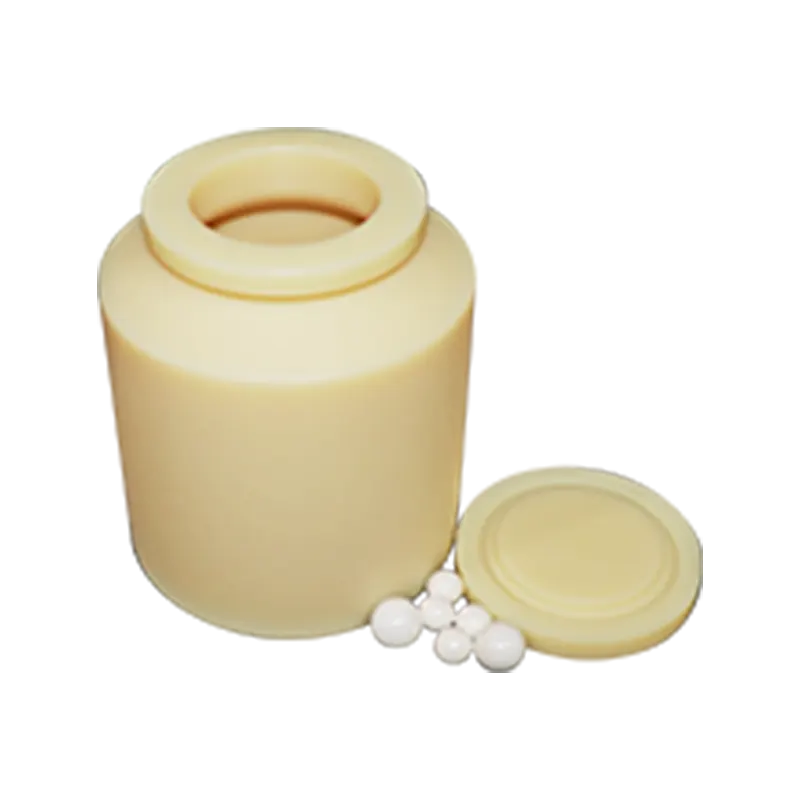
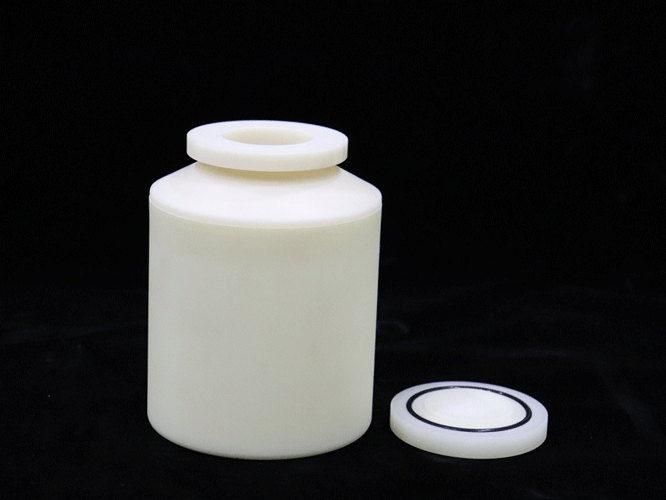
In the catalog TENCAN presented nylon grinding drum for roller ball mills. The name indicates the housing material, but does not replace checking the geometry, cover design, wall thickness and permissible operating conditions. This information should be verified against the current card and manufacturer's confirmation and not transferred from another product.
The practical conclusion is simple: the drum is chosen not “for a mill in general”, but for a specific task - sample material, medium, permissible level of impurities, cleaning method and rotation mode. If any of these points are not confirmed, trial grinding remains an investigation and not a guarantee of reproducibility.
What nylon does and what you shouldn't expect from it
The word "nylon" does not describe one universal grade. This is a family of polyamides, the properties of which depend on the composition, fillers, moisture absorption, heat resistance and manufacturing technology. In the context of a grinding drum, it is not advertising epithets that are important, but a combination of mechanical viscosity, abrasion resistance, chemical compatibility and the ability to maintain shape under load. Nylon may be useful where you want a chamber that is relatively lightweight, can withstand accidental impacts, and doesn't make as much noise as a heavy metal container, but that doesn't make it suitable for every material.
Material is a whole family
The polymer chamber is usually inferior to metal and ceramics in terms of resistance to abrasive wear and heat resistance. When grinding hard, angular or abrasive particles, the surface can gradually matt, become covered with marks and release the material into the sample. The extent of this transfer depends on the load, time, grinding media, environment and properties of the particular polyamide. Therefore, the correct wording is not “nylon does not pollute”, but “nylon requires compatibility assessment and wear monitoring.”
Limits of applicability
For soft to moderately abrasive materials, delicate dry grinding, or applications where a metal chamber is not desired, a nylon drum may be a reasonable option—as long as chemical resistance and mechanical compatibility are proven. For high-energy grinding, large solids, high heat, or aggressive environments, the name of the material alone is not enough. Temperature, vapor pressure, swelling potential, cap and seal resistance, and permissible rotation speed are all important factors here.
You should not choose a drum only according to the principle “polymer is better than metal” or “metal is more reliable than plastic.” Each option has its own cost of error: metal can cause intense abrasive wear and noticeable transfer of elements, polymer can cause deformation, swelling, retention of residues and the formation of wear particles. The decision is made based on sample data and confirmed product limitations.
Sample contamination: four sources and one control
When people talk about contamination during grinding, they often only mean the material of the drum. In practice, there are several sources, and they act simultaneously. The polymer chamber may release wear particles, but the grinding media often contribute more; In addition, impurities come from the remnants of the previous sample and from the environment. To blame nylon without separating the contributions is to risk replacing one unknown with another.
- Drum material: abrasion, edge chipping, additives and colorants in polymer.
- Grinding media: their material, surface condition, fragments and abrasion products.
- Sample transfer: residues in micro-risks, threads, seals and hard-to-reach areas.
- Environment and maintenance: dust, water, cleaning agents, improper drying or storage.
A control experiment is useful, reproducing the same loading of grinding media, speed and time, but without the material being studied or with subsequent analysis of washouts. This experience does not prove suitability for any test, but it does help to see the camera and environment's own contribution. If certain elements are critical in a sample, the analytical method and detection limit are chosen in advance, before grinding, otherwise a single “pure” result does not confirm anything.
It is better to have separate drums for different materials or at least a documented transition procedure. Washing the same drum between incompatible samples saves time but increases the risk of cross-contamination. This is especially noticeable when working with small samples, when even trace amounts of the previous powder distort the result. Nylon does not provide "zero pollution"; it only sets its own risk profile that needs to be checked.
Wear, aging and surface condition
Drum wear rarely shows up immediately. First, the gloss of the inner surface changes, matte areas, ring marks, small marks and darkening appear. Then the geometry of the cover may be disrupted, play, smell or deformation may appear. Not every change means immediate failure, but any signs require evaluation: the polymer may accumulate damage gradually, and a crack or loss of tightness makes further work pointless.
The wear rate is influenced by the hardness and shape of the particles, the mass and size of the grinding media, rotation speed, grinding duration, temperature and environment. You cannot transfer the service life of one drum to the entire range: even seemingly identical products made from different brands of polyamide behave differently. It is useful to keep a log of the start date, materials, modes, cleaning method and changes noticed. This helps not only to plan replacements, but also to separate the effect of the drum from the change in the sample itself.
- Inspect the inside surface and edges after each grinding.
- Check the cover, threads and seal for play, contamination and deformation.
- Check permissible temperatures, environments and modes with the manufacturer’s documentation.
- Do not use abrasive sanding unless approved for the material.
Strong heating is dangerous for the polymer not only due to softening. It can accelerate aging, change sizes and reduce sealing. Conventional air cooling of a mill should not be called a cryogenic process: they are different things. If the technique requires low temperatures, it is necessary to separately confirm that the specific drum and seal allow such conditions, and not transfer the properties of the installation to the product.
Sizes and compatibility: what to check before ordering
For a roller mill, the geometry of the drum is critical. It is necessary to confirm the outer diameter, the length of the cylindrical part, the location and shape of the cover, the permissible gap to the rollers and racks, and the method of fixation. Even a slight misalignment can result in slippage, runout, or uneven rotation. The appearance in the photograph does not replace the dimensions: the wall thickness, lid fit and permissible load cannot be reliably determined from the image.
Separately, the nominal volume of the drum, the useful working load, the mass of the sample and the mass of the grinding media are distinguished. It is impossible to fill the chamber “to full volume”: free volume is needed for the balls to move, and exceeding the load increases heating, wear and the risk of damage. Specific limits must be specified for the product and mode; if they are not in the available materials, this is a question for clarification, and not a field for guesswork.
Rotation speed, roller diameter and loading weight are interconnected. A drum designed for one load class does not automatically become suitable for a more powerful installation. Before ordering, you should inform the supplier of the mill model, the diameter and length of the rollers, the planned rotation speed, the type of grinding media and the maximum load weight. This allows you to check mechanical compatibility without making the assumption that “a similar drum will do.”
In the catalog TENCAN there is also mill and soil sieve, but this is a different sample preparation unit. The presence of both products in the same catalog does not prove that the nylon drum is installed in this machine or is compatible with it in terms of geometry and drive. Such conclusions are only permissible if directly confirmed in the documentation.
Cleaning, dry and wet grinding
Dry and wet grinding have different effects on cleaning. Dry powder is easier to remove from a smooth surface, but it can be pressed into grooves and edges. The liquid medium penetrates deeper, especially if the polymer is prone to moisture absorption or swelling; After drying, dissolved substances remain in the pores. Therefore, the cleaning method is chosen taking into account not only the material of the drum, but also the solubility of the sample, its danger and acceptable contact with the cleaning composition.
Aggressive solvents, hot water and abrasive sponges are not universal solutions for nylon. Chemical compatibility, washing temperature and drying time must be checked with the documentation. If the manufacturer does not confirm exposure to a specific environment, it is safer to consider it unconfirmed. Detergent residue is also a contaminant, so final rinsing and drying should be as well thought out as the grinding itself.
The operating procedure usually includes removal of the bulk of the sample, cleaning in an approved environment, washing, drying without deformation and visual inspection. For critical tasks, separate drums for each class of materials and a control idle run after changing the procedure are useful. This sequence should not be described as a universal instruction for hazardous substances: specific measures are determined by the safety manual and the chemical product data sheet.
- Do not use metal brushes or abrasives without permission from the manufacturer.
- Do not dry the polymer at temperatures exceeding confirmed ones.
- Do not store the drum closed after wet cleaning without allowing it to dry completely.
- Do not mix incompatible samples in the same drum without transition validation.
Grinding and mixing are not the same thing. If the task is disagglomeration or homogenization, the mode and environment may differ from those needed for size reduction. The nylon drum in this sense does not have a hidden “universal” function: it only provides a chamber for the selected process, and the result is determined by the entire system - material, grinding media, filling and time.
Test grinding and transfer of task
Before trial grinding, it is worth recording the initial data: the nature of the material, initial coarseness, hardness and abrasiveness, humidity, sensitivity to heat, intended environment, sample weight and target result. To make a request, the supplier also needs information about the mill, roller diameter, desired rotation speed, type and weight of grinding media, and cleaning method. The more specific the conditions, the less the risk of getting a drum that is formally suitable, but inconvenient to operate.
It's best to use a trial grind as a comparison rather than as a single attempt. First, mechanical compatibility is checked without dangerous load, then tightness and heating are checked, after which they move on to short grinding while monitoring the condition of the drum. At the same time, the particle size distribution and signs of contamination are assessed using an available analytical method. The result of one mode does not become a characteristic of the entire range and does not prove suitability for other materials.
| What to check | Why is this important |
|---|---|
| Geometry and fit | Rotation, runout and safety on rollers depend on it |
| Material and surface condition | Determine the risk of wear and contamination transfer |
| Cover and seal | Affects tightness during dry and wet grinding |
| Workload | Related to heat, wear and grinding efficiency |
| Cleaning method | Determines cross-carryover and service life |
Based on the results of the test, it is worth saving not only photographs, but also a record of the modes, load weight, surface condition before and after, and cleaning method. If there is any doubt about dimensions, chemical resistance or load capacity, the product should not be converted to standard procedure until confirmed in writing. For a nylon drum, it is especially important to separate three questions: is it mechanically suitable, is it chemically compatible, and is its wear contribution acceptable in a particular sample.
Rational choice begins not with a search for the “purest” material, but with a description of the problem and limitations. Nylon grinding drum TENCAN can take its place in sample preparation if its geometry is confirmed for the mill, operating conditions are within the scope of the documentation, and cleaning and wear control are thought out in advance. If this data is missing, the smart solution is not to guess, but to request clarification and conduct a limited trial grinding.