
Sample conditions: what determines the requirements for the grinding drum
A nylon grinding drum is selected not according to one criterion - “soft material for soft grinding” - but according to the totality of sample preparation conditions. In a drum-type mill, the drum simultaneously serves as a working container, an element that transmits rotation from the drive rollers, and a wear part that is in contact with the sample. Therefore, the decision on the material and size of the drum is made after the sample requirements are formulated, and not vice versa.
Before selection, it is useful to record the following conditions in writing.
- Hardness and abrasiveness of the material. Quartz sands, oxides, slags, carbides and other abrasive powders wear out the polymer faster than soft or layered materials. The wear forecast depends not only on the hardness, but also on the shape of the particles: rounded grains wear the wall differently than splintered grains.
- Tendency to stick. Wet, greasy, fusible and highly electrified powders form a film on the wall. It changes the movement of the grinding media, reduces grinding efficiency and makes cleaning between samples more difficult.
- Thermal sensitivity of the sample. You need to understand at what temperature undesirable processes begin: loss of volatiles, melting, decomposition, phase transition, change in crystallinity.
- Cleanliness requirements. If carbon, nitrogen or organic compounds are determined in a sample, polyamide wear products directly affect the result. Mechanical inclusions of the drum material are also significant for X-ray phase analysis and microscopy.
- Sample weight and volume. It is necessary to distinguish between a single sample, a total batch for accumulating material, and the number of repetitions.
- Target size. For one material, deagglomeration is enough - separation of aggregates without deep reduction in particle size; for another, actual grinding is required.
- Grinding medium. Dry and wet grinding - different modes for load, heating and cleaning. When wet grinding, the chemical resistance of the polyamide to the selected liquid is important.
- Apparatus. The drum diameter and length, seating dimensions, fixation method, roller rotation speed and permissible load are specified by a specific mill.
Nylon is not a universal solution, but an option with clear limitations. It is appropriate where it is important to avoid the introduction of metal and reduce collision energy, but is poorly suited for long-term grinding of highly abrasive materials and for processes in which the drum wall heats up above what is permissible for the polymer.
How does a nylon drum work in a roller mill?
In a drum-type machine driven by rollers, a cylindrical drum rests on two rotating rollers and is rotated by friction against them. The grinding media inside rise up the wall and then roll or fall, providing a combination of abrasion and impact. The rotation frequency, as a rule, is below the critical one, at which the bodies are pressed against the wall and stop doing useful work; This is one of the reasons why such grinding is softer than planetary grinding.
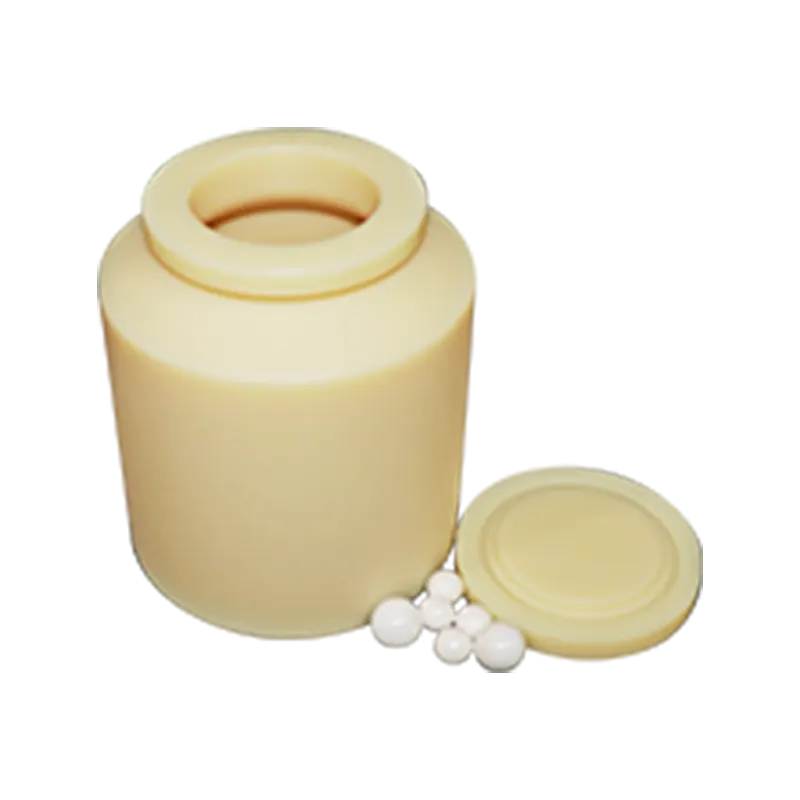
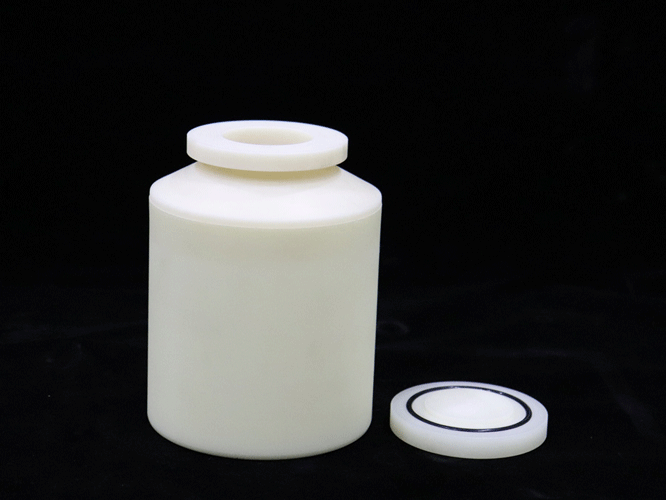
Structurally, such a drum consists of a body with a blind or opening end, a cover with a seal and fixing elements, as well as seating surfaces with which the drum rests on the rollers. It is these surfaces that determine the stability of rotation: their wear or deformation leads to slipping, beating and changes in the grinding mode. The presence of an internal liner, ribs or removable lining depends on the design - this is looked at in the description of a specific item, and not assumed from the photograph.
The dimensions, volumes and materials declared for this design are indicated in the product card: Nylon grinding drum. These values cannot be transferred to other equipment: the geometry and seating elements differ for different drums.
Difference from planetary ball mill
In a planetary mill, the grinding bowls are fixed in a carrier and move along a complex trajectory with a centrifugal acceleration many times greater than the acceleration of gravity. The loads on the wall, the impact on the grinding media and the heating there are significantly higher, and the glass experiences alternating forces at the attachment point. A drum designed for free rolling on rollers is not intended for such conditions: the possibility of its operation in a planetary apparatus requires separate confirmation by the manufacturer, and not a conclusion by analogy “also a cylinder”.
Difference from Screening Drum Ball Mill
A drum-type unit with a sifting unit is an independent machine with its own grinding drum, drive and unloading (see. Ball mill with screening). The general principle - a rotating drum with grinding media - does not mean the interchangeability of equipment: the mounting dimensions, method of fastening and operating mode differ for different machines. The installation of a specific nylon drum in a specific apparatus is confirmed by the fitting dimensions and manufacturer's instructions.
| Device type | How does the grinding container move? | Load nature | What to check when selecting equipment |
|---|---|---|---|
| Planetary Ball Mill | The glasses are fixed in the carrier, the rotation is planetary | High impact energy, centrifugal forces, intense heating | Cup type, fastening lock, permissible speed |
| Roller (drum) mill with replaceable drums | The drum rests freely on the drive rollers | Abrasion and moderate impact, less heat | Drum diameter and length, landing belts, roller speed |
| Drum Ball Mill with Screening | Own drum as part of the unit with unloading and sifting | Determined by the design of the machine | Completeness, dimensions and mode according to the manufacturer's documentation |
What do drum characteristics mean?
Drum volume, loading volume and sample weight
The geometric volume of the drum is not yet the working load. The useful volume is always less than the full volume, since part of the space is occupied by grinding bodies and the free volume necessary for their movement. It is impossible to mix these values when selecting: an error leads either to underloading with accelerated wear of the wall, or to overloading, in which the grinding media work in a “cushion” of material and almost do not crush the sample.
In the practice of laboratory grinding, approximately 30–50% of the drum volume is filled with grinding media, and the sample mass is taken in an approximate ratio of 1:5...1:10 to the mass of the grinding media. These are general guidelines, and not the passport values of a specific drum: for deagglomeration, the proportion of material is higher, for deep grinding – lower. The recommended loading mode for the selected version should be obtained from the manufacturer.
Separately, it is necessary to distinguish between the volume of one drum and the total volume of mill positions, if it is multi-place, as well as the volume of a single sample and productivity over time. Productivity is determined by cycle time, which depends on the required coarseness, and not on the drum volume alone.
Grinding media: material, density, size
The choice of grinding media is related to the material of the drum. Dense bodies, such as zirconium dioxide, transfer more energy to the material, but place more stress on and wear out the polymer wall. Bodies made of soft polymers hardly crush solid particles, but are suitable for destroying agglomerates, adhering films and soft materials. Metal bodies provide the greatest impact energy, but introduce metal grinding.
The size and number of bodies affect the number of “body-particle-wall” contacts. Large bodies give impact, small bodies give abrasion; a mixture of different sizes changes the particle size distribution. A specific pair of “nylon drum and such and such bodies” cannot be considered automatically compatible: wear depends on the hardness of both materials, the size of the bodies, the degree of filling and the speed of the rollers.
The range of equipment and drums made of other materials is specified in the product catalog. If ceramic, corundum, zirconium or carbide options are being considered, they should be compared according to their own cards, and not according to the description of the nylon drum.
Wear and grinding: what to really expect from nylon
A polymer drum wears differently than a steel or ceramic drum. The metal loses material in the form of small particles, but retains its geometry for a long time; When overloaded, the polymer changes shape faster, and its wear begins from the surface layers where there is contact with the grinding media and the drive rollers.
Wear mechanisms
- Abrasive abrasion. Solid particles and bodies scratch and polish the wall; the speed of the process increases with the hardness and size of the particles.
- Impact loading. When large, dense bodies roll, they produce pinpoint impacts, leading to chipping and scuffing of the inner surface.
- Thermal deformation. Heating softens the surface, the seat belts lose their shape, beating appears, and then slipping on the rollers.
- Aging and swelling. Polyamide absorbs moisture and is sensitive to a number of solvents, concentrated acids and alkalis; swelling changes size, and aging changes strength.
Practical signs of wear: discoloration and appearance of matte stripes, roughness of the inner surface, scuffing at the ends, increased play of the cover, vibration during rotation, displacement of the drum relative to the rollers. Any of these signs means that the mode or equipment is selected incorrectly, and it is not worth continuing grinding in the same cycle.
"Inert material" does not mean zero pollution
Polyamide wear products are organic material that introduces carbon, nitrogen and hydrogen, and additives and pigments in the polymer may also contain inorganic components. The composition of a particular drum material and the presence of fillers or coloring additives in it should be clarified with the manufacturer if the purity of the sample is critical.
Solid materials - tungsten carbide, zirconium dioxide, corundum, agate - also wear out, it’s just that their grinding is inorganic and for some analyzes is more critical than a trace of polymer. There is no tooling with absolutely zero material transfer; choose the option whose grinding least interferes with the adopted method of analysis.
Temperature: overheating and polymer limitations
During grinding, mechanical energy turns into heat. In a metal drum, it is removed through the wall, and the polymer has lower thermal conductivity, so heat accumulates in the surface layer, and the local wall temperature can significantly exceed the temperature of the installation’s working space. The air temperature in the room or in the chamber of the device is not equal to the temperature of the sample and the temperature of the drum wall: they are measured separately if the mode is in doubt.
Overheating manifests itself sequentially: first, the inner surface softens and becomes “greasy,” then the seat belts become deformed, an odor appears, the lid begins to jam, and only after this irreversible changes in geometry are possible. For heat-sensitive materials, this is enough to ruin the sample - sintering, loss of volatiles or phase transformations occur before noticeable deformation of the drum.
Moderate measures against heating: shortening the continuous cycle with pauses for cooling, reducing the speed of the drive rollers, reducing the mass of grinding media and the degree of filling, switching to less dense media, abandoning long-term high-energy mode. The permissible temperature range for a specific drum design depends on the grade of polyamide and design and must be confirmed by the manufacturer.
Separately, it is worth distinguishing between conventional air cooling and cryogenic solutions with liquid nitrogen. These are different technologies: forced airflow does not make the process cryogenic, and it cannot be called that. Brittle fracture during deep cooling and conventional grinding at room temperature produce different particle size distributions and place different demands on tooling.
Cleaning and sample transfer between samples
Polyamide is hygroscopic: it absorbs moisture from the air and from washing liquids, and when dried it can change size. Therefore, the drum should not be left wet, dried at high temperatures or stored open in a damp place. For cleaning use soft brushes and compatible solvents; abrasive powders, metal scrapers and harsh alkalis damage the surface and accelerate subsequent wear.
The main places where residues accumulate are the corners at the end, the transition area to the lid, the thread or locking lock and the O-ring. It is there that the material from the previous sample remains, and it is from there that it enters the next one. When changing materials, intermediate blank grinding with an inert sample and a “sacrificial” portion of the same sample, which is discarded after grinding, are effective.
The suitability of a particular solvent for wet cleaning is checked on a small area or on a sample of the material, since the resistance of polyamide to different environments is not the same. If cleaning requires aggressive reagents or ultrasound with active detergent additives, the method must be agreed upon with the drum manufacturer so as not to destroy the polymer.
Compatibility: drum, mill, grinding media and mode
Compatibility is checked using four connections. The first is the drum and mill: diameter, length, seating belts, weight, method of fixing the cover, permissible roller speed. The second is the drum and grinding media: material, density, size, total mass. The third is the drum and sample: abrasiveness, acidity or alkalinity of the medium, temperature, tendency to stick. The fourth is the drum and mode: dry or wet grinding, cycle duration, presence of pauses, reverse, required coarseness.
Breaking at least one bond gives a characteristic result: the drum “does not pull” on the rollers, the lid weakens, the sample heats up, the wall quickly wears out, or the material sticks and stops being crushed. The diagnosis is made by observation, and not by assumption: without data on speed, load, temperature and cycle time, a specific malfunction cannot be declared proven.
What to check before ordering
| Parameter | What to clarify |
|---|---|
| Geometry | Outer diameter and length of the drum, diameter of the landing belts, permissible runout |
| Cover fastening | Type of seal, method of fixation, permissible pressure inside |
| Material | Polyamide brand, presence of fillers and pigments, permissible environments and temperatures |
| Loading | Recommended mass of grinding media, media size, sample share in the load |
| Apparatus | Mill model, roller speed, number of positions, delivery set |
General directions of equipment and brand positioning are given on the website TENCAN; specific values are taken from the cards of the corresponding products.
Test grinding: what data is needed for selection
Test grinding answers questions that cannot be answered from a catalog: how a specific material behaves in a specific drum, how long it takes to reach the target size, and how quickly contamination builds up. To ensure that the result is meaningful, it is reported before the test:
- name and nature of the material, its hardness, abrasiveness, tendency to stick;
- initial size and method of its measurement, target size and permissible distribution width;
- the mass of a single sample, the total number of samples, the need to accumulate a batch;
- method of subsequent analysis and permissible content of tooling material in the sample;
- grinding medium: dry process or liquid, its composition and chemical activity;
- temperature restrictions and permissible sample heating time;
- type and model of the mill, available grinding media, possible roller speed;
- cleaning requirements between samples and drum storage procedures.
Test grind results depend on the size measurement method: sieve analysis, laser diffraction and microscopy give different numbers for the same powder. It is correct to compare equipment options only under the same loading, mode and measurement conditions, and the typical minimum size from the catalog cannot be considered guaranteed for any sample.
Short answers to frequently asked questions
- Is it possible to put a nylon drum in a planetary mill? This combination requires confirmation by the manufacturer: the roller mill drum is designed for a different type of load.
- Does nylon prevent sample contamination? No. Polymer wear products are organic, and this is significant when determining carbon or nitrogen.
- What to do with highly abrasive material? Assess wear rates during test grinding and consider other tooling materials based on their own characteristics.
The practical conclusion is simple: a nylon grinding drum is selected for the sample, apparatus and mode at the same time, and the decision on suitability is made based on the results of trial grinding, and not on promises from general descriptions.