
In laboratory practice, a nylon grinding drum is chosen not according to the principle of “the cheapest” or “the most versatile”, but for a specific task: sample material, permissible level of impurities, type of mill and cleaning conditions. In a roller ball mill, such a drum simultaneously serves as a working chamber, transmits movement to the grinding media and is in contact with the sample. Therefore, its material and condition affect not only the ease of use, but also the reproducibility of sample preparation. Card nylon grinding drum TENCAN shows the basic purpose of the product; Specific dimensions, volume and limitations must be checked against the documentation of the selected design.
Why Nylon Drum Requires a Separate Selection
Drums made from different materials may be available for the same mill, each having a different effect on the sample. Nylon attracts laboratories as a relatively impact-resistant and lightweight polymer: it can soften some loads, is easy to handle and does not require the same handling as fragile ceramics. However, these advantages do not replace the issues of wear, cleaning and chemical compatibility. If the sample is sensitive to organic inclusions and the grinding mode is intensive, the same drum may be quite acceptable for one task but risky for another.
In a roller mill, the drum rolls on drive rollers. Its outer diameter, weight, bottom shape and surface condition are no less important than the internal volume. A drum that is too heavy or incorrectly centered will increase the load on the rollers and may cause slippage. Too light at high speeds behaves unstable. Therefore, the selection begins not with color or appearance, but with checking geometric compatibility and the mode for which the product is intended.
In the catalog TENCAN Nylon drum belongs to the grinding containers for roller mills. This is not a universal chamber for a planetary, bead or vibration mill: these machines have different loads, fastenings and the principle of movement of the grinding media. Even if a catalog contains equipment for flotation, blending or pressing, this does not automatically make it compatible with a particular drum. Compatibility is confirmed by dimensions, mounting, permissible speed and operating conditions, and not by belonging to one brand.
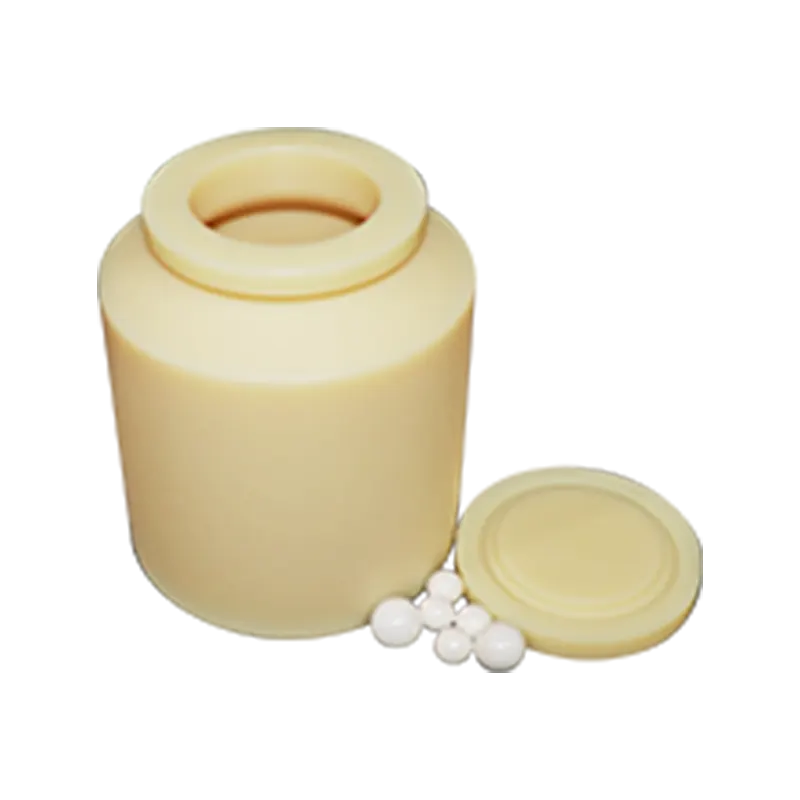
The practical conclusion is simple: the nylon drum should be considered as part of the “mill - drum - grinding media - sample” system. An error in any link is manifested either by an insufficient degree of grinding, or by overheating, or by contamination of the sample, or by accelerated wear of the container. Below are criteria that help you make a decision before purchasing and check it after the first grinding.
What does the product card confirm and what needs to be clarified?
The card indicates the name of the product - nylon grinding drum - and its placement among the containers for the roller mill. This is enough to understand the product category, but not enough to make a choice without additional data. Volume, wall thickness, maximum temperature or loading recommendations cannot be transferred to all versions unless they are given for a specific model. You need to be especially careful with the dimensions: the nominal volume does not mean that the same amount of sample and grinding media can be loaded into the drum.
| What to clarify | Why is this important | What to check in the answer |
|---|---|---|
| Nominal and useful volume | Workload is always less than full capacity | Is there a difference between geometric volume and recommended loading? |
| Internal dimensions and neck diameter | Access during cleaning and ease of unloading depend on them | Are the dimensions indicated in millimeters and for which model? |
| Wall thickness and weight | Affects stability on rollers and heat | Are the values given for a specific version? |
| Cover and seal | Sealing is important for wet grinding and dusty powders | How the drum is closed and what sealing materials are used |
| Permissible temperature and cleaning | The polymer is sensitive to overheating and some environments | Are there any restrictions on drying, solvents and detergents? |
| Recommended download | Too many grinding media increases wear and heat | Are the ranges specified for the sample and grinding media separately? |
| Compatible Mill | The drum must match the rollers and drive | Is the mill model, speed range and external dimensions indicated? |
If the response to a request contains mixed data from different models, the units look contradictory, or only the volume without dimensions is indicated, it is better not to use the dubious value in the calculation. It is more reliable to request a drawing or table for a specific design. This is especially important when moving from one batch to another: even a small change in the internal geometry can affect the movement of the grinding media and the completeness of unloading.
Separately, you need to clarify whether the cover, seal and fasteners are included in the kit. The photograph shows a general appearance but does not replace the specification. It is impossible to reliably determine wall thickness, threads, fit on rollers or permissible rotation speed from the image. These parameters relate to documentation and not to visual assessment.
Material, wear and transfer of impurities
Nylon is a polymer, not a chemically inert ceramic or metal. It can be shock-resistant and convenient to use, but when friction against grinding media and the sample gradually wears out. Wear products can get into the sample, especially during dry grinding, long-term operation and the use of abrasive material. Therefore, the expression “zero pollution” does not apply to a polymer drum. It's about how critical the drum's contribution is for a particular analysis and whether it can be controlled.
When is nylon appropriate?
It makes sense to consider a nylon drum for tasks where impact strength, relatively low weight and moderate grinding conditions are important. It is useful when working with samples that do not require harsh solvents or extreme heat. If the laboratory values simple cleaning and does not have extremely stringent requirements for the absence of organic traces, this may be a practical option. But the final decision is made after checking on real material, and not just based on the description.
When the risk is higher
The risk increases with high abrasiveness of the sample, prolonged continuous grinding, insufficient cooling and the use of liquids that are incompatible with the polymer. Some solvents can cause swelling, softening or dimensional changes, but a specific list of media cannot be assumed by the name “nylon”: different brands of polymer behave differently. This issue needs to be resolved with chemical compatibility for a specific product.
Grinding media contribute no less, and often more, to pollution than the drum material. Tungsten carbide, ceramics or zirconia do not mean “zero contamination”: they also wear out, and their fragments or fine fraction may remain in the sample. A harder material is not always better if it wears out the polymer container more intensively. For sensitive analyses, not only the material of the grinding media is important, but also their size, quantity, operating time and method of separation from the sample.
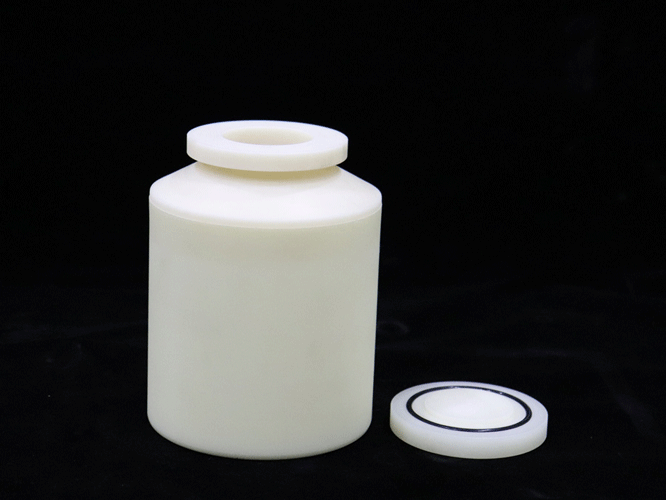
It is convenient to assess wear by several signs: changes in the color and shine of the inner surface, the appearance of persistent scratches, roughness, inclusions, deformation of edges, and improper fit of the lid. Not every scratch means that the drum needs to be replaced immediately, but a repeated mark in one area indicates the nature of the load. It is useful to keep a log: batch, material, mode, time, cleaning method and surface condition after work. This log helps distinguish normal wear and tear from operating errors.
Cleaning without damaging the surface
Cleaning the nylon drum should remove sample residue but not create new roughness. Abrasive powders, wire brushes and hard scrapers can leave marks in which particles are then trapped. Strong solvents are used only after confirming compatibility with a particular polymer. High drying temperatures also require testing: what a metal or ceramic container can withstand may not be acceptable for nylon.
- First, remove the bulk of the sample and grinding media using a dry method, without damaging the inner surface.
- Then use a detergent or solvent approved for the material and a soft tool.
- After cleaning, the drum is washed with a suitable liquid and thoroughly dried under confirmed conditions.
- Before the next test, inspect the surface, cover and seal.
- For sensitive assays, perform a control blank to assess residual contamination.
Cleaning is not the same as sterilization and does not guarantee the absence of trace amounts of the previous sample. If a laboratory is working with multiple materials, it may be wise to assign drums to groups of samples or introduce additional controls. This is especially important when determining trace elements, organic additives and when assessing particle size distribution, where even a small amount of extraneous fraction changes the result.
It is better to store the drum closed, without residual moisture and without contact with aggressive media. The seal and cover are inspected separately: it is in these places that particles often remain that are not visible during a quick inspection. If after washing a sticky layer appears, the color or smell has changed, do not use the drum until the reason is determined.
Roller mill size, loading and mode
When choosing a size, it is important to separate several quantities: the total geometric volume of the drum, the useful working volume, the volume of grinding media, the mass of the sample and the total load of several drums. The nominal volume is not equal to the sample mass. If too much material and grinding media are loaded into the drum, the free space is reduced, friction increases, mixing is poor and heat increases. If the load is too small, the grinding media hits the wall more often and the grinding efficiency decreases.
Volume, dimensions and loading
It is useful to determine in advance how much volume the sample occupies, how much is the grinding media, and how much is left for movement. Specific tolerance limits must be specified for the selected drum and mill; Interest cannot be transferred from another product. For wet grinding, the volume of liquid is additionally taken into account so as not to obtain excess pressure when closing. For dry grinding, it is important that dust does not get into the seal and disturb the seal of the lid.
The external dimensions of the drum are checked by the mill rollers: diameter, length of the working part, bottom shape and weight must correspond to the specific installation. A small difference in diameter sometimes seems insignificant, but it changes the rotation speed and the nature of the movement of the grinding media. Therefore, selection “by eye” from a photograph is unacceptable, especially if you plan to work at high speeds.
Speed, heat and dry or wet grinding
The speed of a roller mill cannot be assigned according to a universal table: it depends on the diameter of the drum, the diameter of the rollers, the gear ratio and the properties of the sample. In one case, increasing the speed accelerates grinding, in the other it causes overheating and accelerated wear. Nylon has limited heat resistance, so the temperature of the surface and the sample itself is assessed in real time. The temperature of the working space of the installation is not equal to the temperature of the sample inside the drum.
Dry grinding is convenient for subsequent unloading, but generates more dust and requires attention to compaction. Wet grinding reduces dust and can promote deagglomeration, but the liquid must be compatible with the drum and not interfere with subsequent analysis. Grinding and mixing are different tasks: long-term processing that improves uniformity does not necessarily produce the desired particle size. For each goal, they select their own regime and test it on a trial basis.
Compatible with mill and grinding media
Compatibility cannot be determined by category name alone. The nylon grinding drum is designed for a roller mill, but the specific model must be suitable in terms of seating dimensions, weight and permissible speed. A roller mill drum is not automatically suitable for a planetary, bead or vibration mill: the accelerations, mountings and thermal loads are different. For the same reason, the presence of a flotation machine or other equipment in a catalog does not mean that the drum can be used with it.
Compatibility checks include outer diameter, length, roller spacing, locking method and load capacity. If the mill has adjustable rollers, the adjustment range still needs to be checked against the drum dimensions. For heavy drums and high speeds, stability is important, not just shape. Noise, vibration or slippage during a test run is a reason to stop and check the setting.
Grinding media: material, size and quantity
Grinding media are selected based on the material and the permissible level of impurities, and not just the desired grinding speed. Large and heavy bodies load the polymer wall more heavily, small ones penetrate into narrow zones better, but are more difficult to separate. The number of bodies also affects wear: overload increases friction and heat, underload reduces efficiency. If grinding media are not included in the kit, their compatibility with the drum must be confirmed separately.
- Check that the grinding media material and its compatibility with the sample are specified.
- Check the permissible load size and weight for a specific drum.
- Assess how the bodies will separate from the sample after grinding.
- Check wear of grinding media against contamination requirements.
- Do not transfer the mode from a metal or ceramic drum without checking.
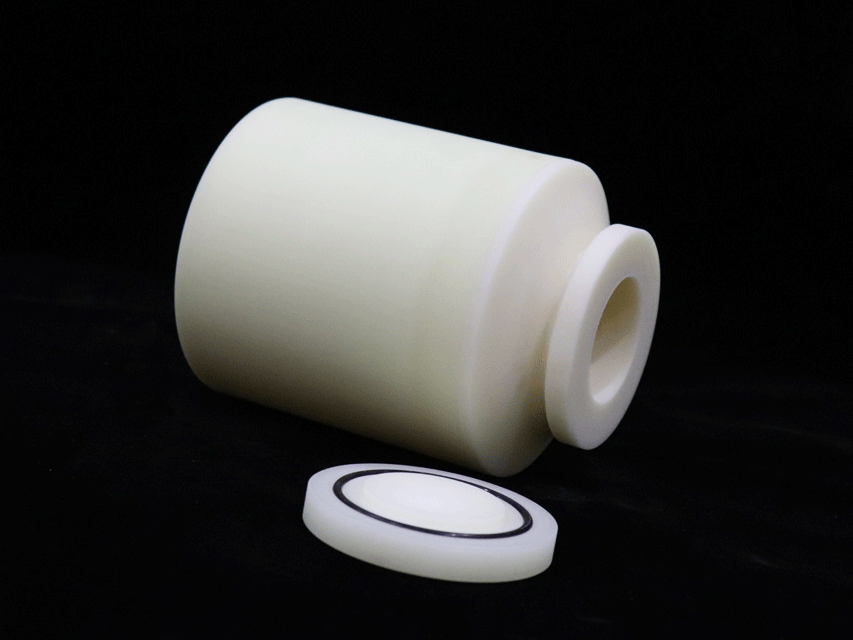
If you plan to work with aggressive liquids, highly dispersed abrasives or prolonged heating, consultation on the material alone is not enough. We need data on a specific design and, preferably, testing on a small sample. This allows you to see how the surface, lid and seal behave without compromising the entire experiment.
Trial grinding, scaling and supplier data
Test grinding is needed not to obtain the finest possible powder at any cost, but to understand the behavior of the system. A small sample is used to check tightness, heating, noise, completeness of unloading, surface condition and reproducibility. Changing all the parameters at once - speed, load, number of grinding media and time - is inconvenient: then it is difficult to understand what exactly influenced the result. It is better to fix the initial conditions and change one factor at a time.
Trial Grinding Plan
- Record the material, original size, sample weight and the required task: grinding, disagglomeration or mixing.
- Check the drum without loading for compatibility with the rollers and the absence of extraneous noise.
- Provide a moderate load of grinding media and sample, without exceeding confirmed limits.
- Check the cover and seal before starting rotation, especially for wet grinding.
- Stop the process for an intermediate inspection without waiting for overheating or odor.
- Compare the particle size distribution and evaluate the contribution of the drum material to contamination.
When scaling, you cannot simply increase the sample mass in the same drum. The ratio of grinding media and material, thermal conditions, unloading time and the probability of unevenness change. If several drums are planned for a large batch, it is important that they are of the same design and condition. Different wear or different batches of polymer can give a noticeable scatter, especially for sensitive measurements.
What to tell the supplier
- The name and nature of the sample, its hardness, abrasiveness and initial fineness.
- Required task: dry or wet grinding, grinding or deagglomeration only.
- Sample weight, desired volume and permissible workload.
- Mill model, drum outer dimensions, roller diameter and speed range.
- Requirements for permissible contamination and material of grinding media.
- Operating temperature, cleaning method and intended fluids.
- The number of drums, the planned resource and the need for repeatability between batches.
Using this data, you can select the design and determine which parameters need to be documented. If the supplier's response contains only general words about "high quality" and does not contain dimensions, seal material or limitations, this is not sufficient for a technical solution. For a critical task, it is useful to request a drawing, specification and recommendations for trial grinding.
In the end, choosing a nylon grinding drum comes down to checking four groups of conditions: geometry and compatibility with the roller mill, permissible load and mode, chemical resistance and cleaning, and acceptable contribution to sample contamination. Nylon does not promise “perfect purity” and does not replace any other container, but if selected correctly, it can be a practical solution for laboratory sample preparation. It's worth starting with a card nylon grinding drum TENCAN and general directory TENCAN, and confirm the final decision by trial grinding on a specific material.