
The choice of grinding glass is often postponed to the last moment: first they select a planetary ball mill, then the grinding speed and time, and only then they remember what exactly the sample will be ground into. Meanwhile, the material of the beaker determines how many foreign particles will enter the sample, how quickly the contents will heat up, and how reproducible the result will be from batch to batch. The nylon grinding bowl for the planetary mill is the solution when soft contact with the sample and absence of metal contamination is a priority rather than maximum grinding energy.
One practical question discussed below is how to evaluate the suitability of a nylon cup for a particular sample, taking into account material compatibility, wear, cleaning, and fitting dimensions. The glass belongs to the consumable elements of the mill, so general patterns here are more important than individual numbers: they tell you what parameters need to be clarified in the product card and with the supplier before creating a kit.
Why does the material of the glass become a selection criterion?
In a planetary ball mill, the glass rotates around its own axis and at the same time around the common axis of the carrier. The grinding bodies, under the influence of centrifugal forces, are pressed against the wall and repeatedly collide with the material. Grinding occurs due to impact and abrasion, and the wall of the glass simultaneously transfers energy and wears out. A simple rule follows from this: the harder the beaker material, the higher the permissible grinding energy and the less abrasive wear of the wall, but the more noticeable the risk of sample contamination with lining particles.
The materials of grinding bowls form a conventional series of hardness. Polymers, including polyamides, which include nylon, are inferior to agate, sintered corundum, zirconium dioxide, tungsten carbide and hardened steel. This does not mean that a soft glass is worse: it wins where contact with metal is unacceptable, where the sample itself is soft, or where the preservation of particle morphology is important.
A separate question is how the glass’s contribution to pollution is generally recorded. Indirect assessment is possible from blank grinding results and comparisons of samples ground in beakers of different materials, but requires analytical capabilities that are sensitive to the relevant elements. If the laboratory does not have such capabilities, it is wiser to rely on a lining material that is obviously more inert than to rely on the assumption of insignificant wear.
The price for softness is predictable. The polymer wall partially absorbs the impact, so less energy reaches the particles than in a steel or corundum glass. In practice, this means that the same coarseness may require more time, and the maximum achievable grinding fineness is more limited. In addition, the polymer is prone to local heating and softening in the contact zone, as well as to pressing sample particles into the surface.
Therefore, the glass material is assessed not in isolation, but in combination with four factors: the hardness and abrasiveness of the sample, the permissible introduction of impurities, the required final size and temperature conditions. The nylon cup covers a very specific region in this parameter space, and it is useful to understand its boundaries in advance. Speculation about “soft” or “hard” material without reference to the sample is of little use: the same glass may be optimal for one task and unsuitable for another.
Nylon grinding bowl TENCAN: design and mounting dimensions
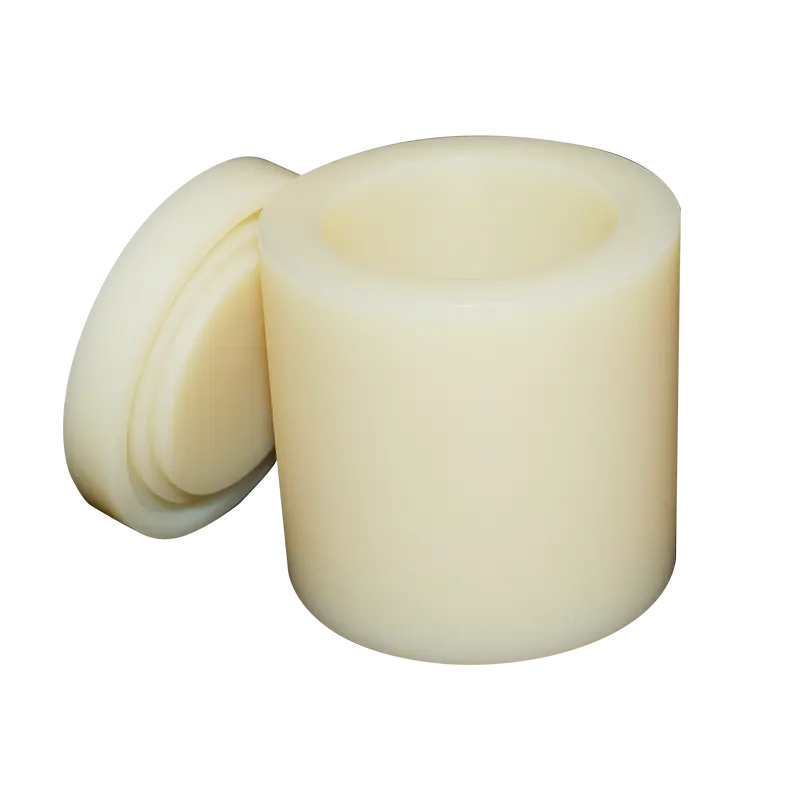
In the catalog TENCAN The nylon grinding bowl is presented as an accessory for planetary mills - a separate item in the grinding bowls section, and not part of a universal set. This is methodologically important: the glass is selected for a specific mill model and for a specific sample preparation task, and not “generally for a planetary mill.” Product card — nylon grinding bowl for planetary mill — serves as a starting point for clarifying the volume, fit size and configuration.
Construction: body, cover, seal
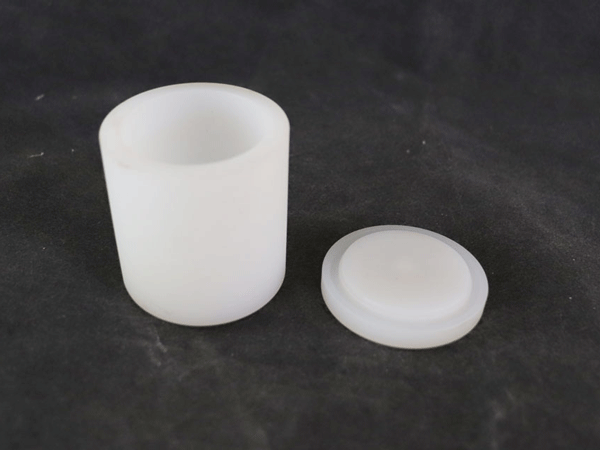
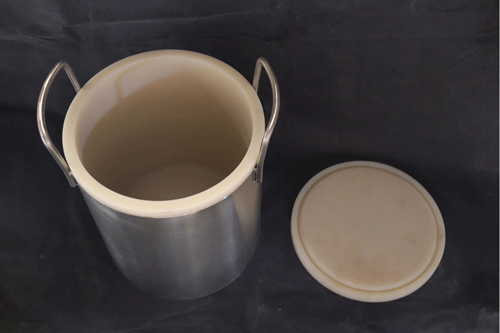
The grinding bowl for a planetary mill consists of a body, a lid and a sealing element that prevents powder from spilling out and leakage of the liquid phase during wet grinding. For polymer versions, the geometry of the seal and the condition of the seating surfaces are especially important: the lid must fit tightly, without distortion, and the lock or thread must not have burrs. Deformation of the polymer body under load leads to the fact that it is not the wall material that begins to work first, but the seal, and the cycle ends with the loss of the sample.
Nylon as a construction material provides a combination of toughness, low friction and low density. Lower density means that the empty weight of the glass is lower than that of a ceramic or metal counterpart of comparable volume, which means that the load on the mill drive is lower. However, the rigidity of the polymer is inferior to ceramics: at high speeds and a large mass of grinding media, the body can be deformed and the wall can heat up. This is a design limitation, not a manufacturing defect, and should be taken into account when selecting a mode.
Mounting dimensions and compatibility with the mill
The glass must exactly match the mill socket: the outer diameter, height, method of fixation and the number of glasses in the set are determined by the installation model. The nylon version does not automatically become compatible with any planetary mill - compliance is confirmed for a specific equipment series. If the mill has not yet been selected, it is wiser to first determine the installation model, and then select a glass of the required volume and material: the reverse order often leads to the fact that there is simply no glass suitable in terms of geometry in the selected material.
The volume range is specified separately. The line of cups for planetary mills usually includes several standard sizes, but the specific list for the nylon version must be checked against the current card and product data sheet. You should not transfer the volume or fit size from a cup of another material: even if the designation matches, the payload may differ, and the fit geometry depends on the design.
Sample material compatibility
Compatibility is the main criterion when choosing a polymer cup. It is assessed in two directions: mechanical (hardness and abrasiveness of the sample) and chemical (interaction of the sample and solvent with polyamide). Both directions are checked before trial grinding, since it is more expensive to change the solution after it.
Samples for which a soft glass is preferable
- Materials of low and medium hardness: polymers, organic and biological samples, fibers, cellulose and carbon materials, some salts and soft minerals.
- Samples for which the absence of metal contamination is critical, such as samples before elemental analysis where iron, chromium or nickel lines interfere with the determination.
- Materials that are prone to sticking and deformation in metal cups where impact rather than abrasion predominates.
- Small laboratory batches for which reproducibility is more important than extreme fineness of grinding.
In these cases, the nylon cup provides a mild abrasive effect, does not introduce metal impurities, and allows better preservation of the morphology of the particles than the impact mode in dense ceramics.
Samples for which a nylon cup is not suitable
Hard and abrasive materials - quartz, corundum, silicon carbide, ores, slag, clinker, many oxides and silicates - work on the polymer wall as an abrasive. The result is predictable: accelerated wear of the body, heating, pressing of grains into the surface and contamination of the sample with the material of the glass. The polymer wall here does not protect the sample, but itself becomes a source of impurities.
Nylon is also not suitable where extremely fine grinding is required in a short time, as well as in high-energy conditions: the higher the speed and the heavier the grinding media, the stronger the heating and deformation. Chemical compatibility is a separate issue. Polyamides have limited resistance to concentrated acids, phenols and a number of similar solvents, so wet grinding in an aggressive environment requires testing, not speculation. If the medium causes the polymer to swell, the glass loses its geometry and further conclusions about grinding become unreliable.
Wear, contamination and cleaning
These three topics are directly related: surface wear determines how much beaker material goes into the sample, and cleaning quality determines how much of the sample goes into the next sample. For a polymer glass, both effects are more pronounced than for dense ceramics, and require operating regulations.
Wear mechanisms of nylon cup
Several wear mechanisms can be distinguished in a polymer cup. Abrasive - abrasion of the wall by solid particles of the sample. Adhesive - tearing out polymer microparticles during friction against grinding media. Thermal - softening of the surface layer during local heating, after which wear accelerates. Fatigue - cracking in areas of repeated impact, primarily at the bottom and along the line of contact with the lid.
Signs that the mode has been selected too harshly include darkening or “greasy” of the surface, a persistent odor, deformation of the lid, and traces of polymer in the sample. None of these symptoms by itself proves a specific mill problem, but they all indicate the need to reduce speed, reduce media weight, or shorten cycle times. Diagnostics are carried out by the state of the glass and the repeatability of the result, and not by one observation.
Where do impurities go?
Pollution is two-way. Beaker material can get into the sample, especially during wet grinding with intense abrasion. At the same time, sample particles are pressed into the polymer surface and remain there, creating the risk of cross-contamination of the next sample. Therefore, the concept of “zero contamination” does not apply to nylon, tungsten carbide, or zirconia: different materials introduce different impurities and in different quantities, and the question is always the acceptable level, not its absence.
The practical conclusion is simple. For trace analysis in a nylon beaker, it is worthwhile to provide a control blank cycle - processing the beaker without a sample or with an inert load - and keep a log of which sample was crushed in which beaker. This discipline is cheaper than re-sampling and re-analysis.
Cleaning without damaging the surface
Nylon does not tolerate abrasive cleaners, metal scrapers, or sudden temperature changes. A reasonable sequence of actions: remove the bulk of the powder with a soft brush, rinse with warm water and a neutral detergent, if necessary, use a solvent whose resistance has been confirmed for polyamide, then rinse thoroughly and dry at a moderate temperature.
You should not dry a nylon glass at high temperatures in a drying cabinet or cool it sharply: internal stresses and deformation of the lid appear later, already during the grinding process, when the cause is difficult to determine. The seal is a separate consumable item. It is checked for elasticity and if cracks appear, it is replaced, rather than trying to press the lid by force.
Dry and wet grinding in a nylon glass
Dry grinding in a polymer cup has its own peculiarities. Without a liquid medium, friction is higher, powder sticks to the walls and grinding media, and heat is dissipated less efficiently. Materials prone to agglomeration under such conditions do not result in grinding, but in enlargement: particles stick together, and the particle size distribution expands. For nylon this is doubly critical due to the limited heat resistance of the polymer.
Wet grinding mitigates the problem: the liquid phase removes heat, reduces sticking and prevents re-aggregation. But the requirement of chemical compatibility is added. Before using any solvent, you must ensure that it does not cause swelling or cracking of the polyamide; For nylon, they are especially careful in acidic and phenolic environments. Water, alcohols and a number of hydrocarbons are usually considered safer options, but the final decision is based on the manufacturer's data and the results of a short trial cycle.
A distinction is made between grinding and disagglomeration. If the task is to destroy existing aggregates rather than crush primary particles, a soft glass with small grinding media at a moderate speed gives precisely disagglomeration: it requires less energy and places less load on the wall. An attempt to obtain a fine grind of solid material in a nylon glass will result in wear of the glass, and not in the result.
After wet grinding, the sample is separated from the liquid and dried. This is an independent operation: if a laboratory oven is used for drying, for example muffle chamber furnace, the mode is selected separately, since the heat resistance of the grinding bowl and the heat resistance of the dried powder are different characteristics. The grinding bowl is not placed in the oven, and drying should not be considered as a continuation of grinding.
Grinding media and loading
The result is influenced not only by the glass, but also by the grinding media. The material of the balls determines the level of introduced impurities and the intensity of wear on the wall; the size of the balls determines whether impact (large balls) or abrasion (small balls) predominates. For a nylon cup, it is logical to choose softer and lighter grinding media commensurate with the hardness of the sample: this reduces both heating and deformation of the body.
The ratio of the mass of grinding media to the mass of the sample is one of the key parameters that is recorded when reproducing the method. Increasing the ball load speeds up grinding, but increases the temperature and load on the wall. The degree of filling of the glass also has a limit: too loose a volume reduces efficiency, too dense a load interferes with the movement of the balls and overheats the contents. Specific recommendations apply to the glass-mill pair and are not automatically transferred to another model.
Rotation speed and cycle duration are only partially interchangeable parameters. A short cycle at high speed produces more heat per unit time and puts more stress on the polymer wall; a long cycle at moderate speed with the same energy input distributes heat more evenly, but increases the time of contact of the sample with the surface of the beaker. For a nylon glass, the second option is usually preferred, with intermediate cooling breaks if the cycle lasts a long time.
The hardness of the grinding media relative to the bowl material is another consideration that is often forgotten. If the balls are noticeably harder than the polymer wall, body wear will accelerate even at moderate speeds. Therefore, for a nylon glass, modes with a lower impact component are preferable, and the transition to heavy balls made of tungsten carbide or dense ceramics requires justification and subsequent monitoring of the condition of the glass.
Dimensions, loading and transition from sample to batch
When selecting volume, it is useful to distinguish between quantities that are often mixed. The nominal volume of the glass is not equal to the mass of the sample: free space is necessary for the movement of the grinding media, so the payload is always less than the volume of the body. The number of glasses in the set affects the total volume per cycle, but does not change the mode of each individual grinding.
| Parameter | What does it mean | Where to find out |
|---|---|---|
| Volume of one glass | Geometric housing capacity | Product card and passport |
| Sample payload | Mass of material in one cycle, taking into account free volume | Grinding method for the “glass - mill” pair |
| Total volume of the set | Capacity of all glasses working simultaneously | Mill model |
| Fit size | Outer diameter, height, fixation method | Mill and glass passport |
| Final size | Result of particle distribution after grinding | Measurement by sample, not by passport |
The transition from a single sample to a series requires caution. Keeping the same glasses, the same mass of balls and the same speed gives comparable results; changing the standard size or material of the glass changes the energy of the process, so it is better to run the series in one configuration. If the volume of the sample grows and the glass increases, both the paths of the balls and the distribution of energy throughout the load change - the result will have to be confirmed by test grinding, and not by recalculation.
For long runs, it is helpful to assign a separate glass to each type of material and label them. Practice shows that cross-contamination occurs not so much due to poor cleaning, but rather due to haste and lack of such fixation.
What to check before ordering and trial grinding
The selection of a glass ends not with the selection of an item in the catalog, but with the approval of test conditions. It is useful to prepare the following list in advance.
- Planetary mill model, number of cavities and cup mounting size.
- The required volume of the beaker and the planned working load of the sample.
- Sample material, initial and target size, permissible addition of impurities.
- Grinding type - dry or wet; for wet - the composition of the liquid medium.
- The expected material and size of the grinding media, the ratio of the mass of the balls and the sample.
- Temperature limitations of the process and the need for pauses between cycles.
- Purity requirements: whether traces of polymer are acceptable in the sample and how the blank cycle will be controlled.
This data allows you to assess whether the task fits within the capabilities of a polymer cup and select a kit without intermediate purchases. It is also useful to check the current catalog positions on the website TENCAN: The range of grinding bowls and grinding media is evolving, and information from older publications may refer to versions that are no longer in the current catalogue.
Frequently asked questions
Is it possible to grind quartz or clinker in a nylon glass?
Technically, the process is possible, but the abrasive material will intensively wear out the polymer wall, and the sample will receive impurities from the glass material. For such applications, harder lining materials are usually selected, with nylon reserved for soft to medium-hard samples.
Is a nylon cup guaranteed to be free of contamination?
No. Any glass material introduces its share of impurities; the only question is what kind of impurities these are and whether they are acceptable in a particular analysis.
Does the glass affect the achievable grind size?
Yes, indirectly. The soft wall absorbs part of the impact energy, so the fineness of grinding and its duration depend on the material of the glass, along with the speed, grinding media and properties of the sample. The specific result is confirmed by measuring the sample.