
Sample preparation in a planetary ball mill begins not with the choice of rotation speed, but with the choice of a grinding bowl. The material of the chamber determines what impurities will enter the sample, how quickly the equipment will wear out, and how reproducible the result will be from batch to batch. A nylon grinding bowl for a planetary mill is a solution for a narrow class of problems: it is justified where the introduction of metal is unacceptable and where it is impossible to work at the maximum impact energy. Below we discuss under what conditions the polymer helps, and under what conditions it itself becomes a source of error.
When is a nylon glass justified and when is it not?
The laboratory receives a sample weighing from several grams to tens of grams and must bring it into a state suitable for analysis: X-ray phase, spectral, granulometric or elemental. The material may be soft, fibrous, prone to sticking, or sensitive to iron or other metals.
The first constraint is usually set by the sample itself. If the content of iron, chromium or nickel in the material is standardized, the steel grinding bowl is immediately excluded. The next obvious option - oxide ceramics - also makes its own addition: corundum and zirconium dioxide leave aluminum or zirconium in the sample, which is critical, for example, when preparing catalysts and ceramic charges. Polymer equipment shifts the set of possible impurities towards light elements - carbon, hydrogen, nitrogen, oxygen - and this is a fundamentally different risk.
Nylon (polyamide) is a structural polymer with low density, moderate hardness and low thermal conductivity. It does not spark, does not corrode and withstands the abrasive effects of soft and medium-hard materials. These properties make it suitable for grinding polymer granules, plant materials, pharmaceutical substances, pigments and soft mineral phases.
The downside is low hardness and limited heat resistance. Polyamides soften at temperatures that are completely safe for corundum or tungsten carbide, and when deeply cooled, they change their mechanical properties, becoming more brittle. Therefore, such a glass should not be considered as a universal replacement for ceramics: the choice is determined by the pair “hardness of the sample - permissible type of contamination.”
It is useful to separate general physical principles from the properties of a specific product. The fact that grinding is accompanied by heat and wear is true for any equipment, but the permissible modes, nominal volume and mounting dimensions apply only to a specific model. The passport value of one glass cannot be transferred to the entire assortment, and it is better to clarify unconfirmed conditions than to assume.
How a glass works inside a planetary mill
The planetary mill rotates the glasses on the carrier and at the same time around their own axes, in the opposite direction. The grinding bodies inside the chamber are first pressed against the wall by centrifugal force, then come off and strike the material at the opposite wall; part of the work is done due to friction and shear. The grinding bowl here is not a passive container, but part of the grinding system: its inner surface participates in friction, its material limits the impact energy, its volume determines the permissible load.
The forces acting on the balls are many times greater than the normal force of gravity, so even soft wall material experiences a noticeable load. The higher the rotation speed and the denser the grinding media, the stronger the contact stresses on the chamber surface. That is why a mode that is safe for ceramics may turn out to be excessive for a polymer, and vice versa: a moderate mode in a nylon glass is sometimes more economical than expensive equipment operating at the limit of its capabilities.
Material and design
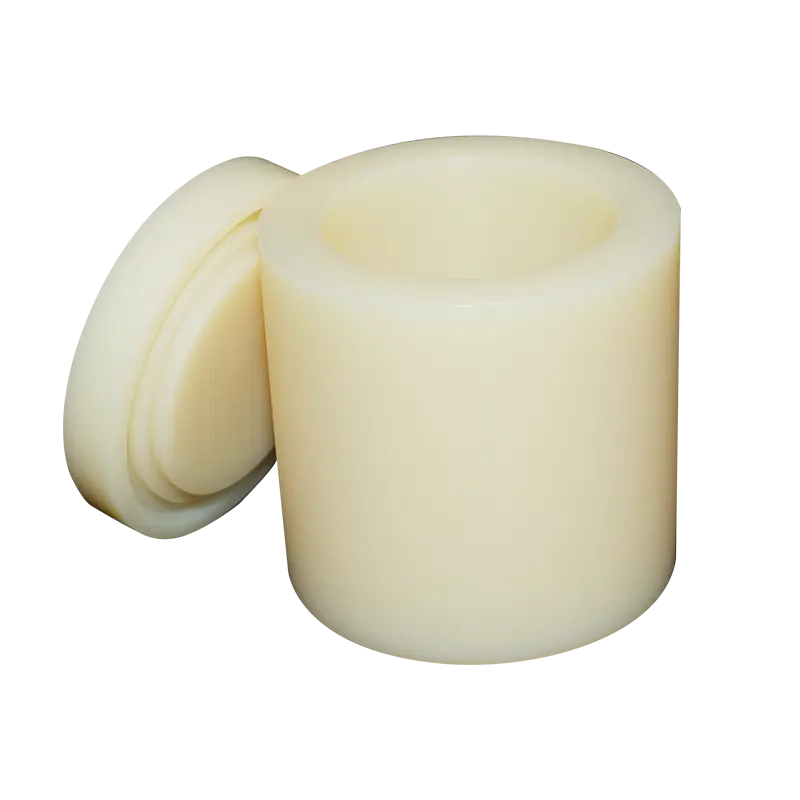
A nylon cup is a cylindrical container with a sealed lid and fastening elements that correspond to the seat of a specific mill model. The nominal volume, diameter and height are indicated in the product card; they are checked against the mill model, and not selected “by displacement” approximately. The cover and seal must hold the material when rotating and not themselves become a source of contamination.
Available versions and product descriptions are shown on the page nylon grinding bowl for planetary mill; The general catalog of grinding equipment and equipment is posted on the website tencanballmills.com.
Grinding media as a working tool
Grinding is performed by grinding bodies - balls or cylinders. Their density and diameter determine the kinetic energy of the impact, and their material adds its own component to the contamination of the sample. In a polymer cup, a relatively soft wall absorbs some of the energy, so expectations for the final size should be more modest than in a corundum or tungsten cup under the same conditions.
The ratio of the mass of grinding media to the mass of the sample is the main parameter of the process. It is selected experimentally: too much ball loading accelerates wall wear and heating, too little load delays grinding and increases the dispersion in coarseness. We must not forget about free volume: the balls need room to accelerate and fall, otherwise grinding degenerates into slow grinding.
Pollution and wear: what does polymer pay for?
Any contact of the sample with the equipment results in wear. The question is not whether there is an impurity, but what its nature is, how much there is, and whether it interferes with the measurement. A nylon cup is characterized by abrasive wear, surface smearing, and transfer of small polymer particles into the sample. Statements about the complete absence of contamination are untenable for any material: options are compared by the composition of the impurity, and not by the fact of its presence.
Hence the practical conclusion. If a post-grind sample is being tested for carbon, nitrogen, or hydrogen, a polymer tool is a poor choice because the organic material in the beaker is composed of the same elements. For analysis of metals, nylon, on the contrary, is convenient: it does not introduce iron, zirconium, tungsten or cobalt.
The wear rate increases with the supplied energy. Large and dense grinding media, long grinding, dry mode without a dispersion medium - all this increases the load on the wall. Signs of wear are noticeable without instruments: changes in color and shine of the inner surface, roughness, darkening of the sample, foreign odor.
A simple way to evaluate the contribution of equipment is a control experiment. The glass is washed, dried, weighed, then grinded without a sample or with inert material in the same mode and weighed again. The mass loss and visible marks on the wall indicate how much material is lost into the sample in one cycle. Such a dry run does not replace analysis, but helps to understand the order of magnitude and frequency of equipment replacement.
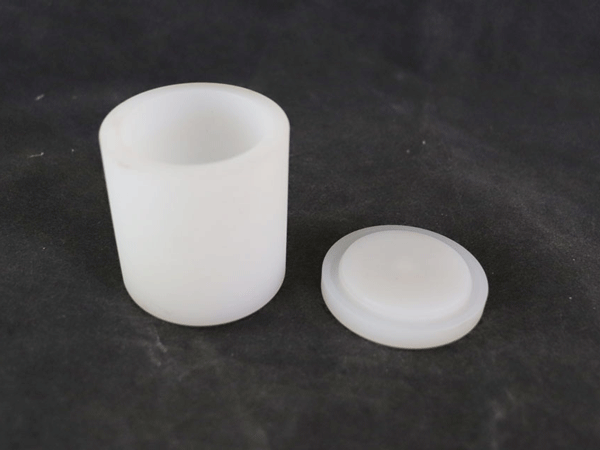
The resource of a polymer cup is limited: it is a consumable element of equipment, and not an eternal part. A series of experiments is planned taking into account periodic replacement, and for repeated techniques it is wise to keep a separate glass for each type of sample.
Compatibility of glass, grinding media and sample
Compatibility is not one parameter, but a set: the hardness of the sample in relation to the wall material, the density and diameter of the grinding media, the chemical nature of the medium, the temperature and duration of grinding. An error in at least one of them either worsens the result or increases contamination. The compatibility of equipment from different classes should not be considered proven by default: belonging to one brand does not mean that the unit will fit another machine.
Density and diameter of grinding media
Zirconium dioxide is often considered as a compromise between impact energy and added impurity. Tungsten carbide provides the greatest energy, but also the greatest abrasive wear of the soft wall. Agate and glass are softer and wear out the polymer less, but they also grind more slowly. The general rule is simple: the harder and denser the grinding body, the higher the requirements for the hardness of the glass. For nylon, it is reasonable to start with bodies of moderate density and medium diameter, and justify the transition to heavier ones by the result of trial grinding.
Dry and wet grinding
Dry grinding is easier to prepare and does not require drying, but it puts more stress on the wall: the powder acts as an abrasive, and fine fractions are prone to agglomeration and sticking. Wet grinding reduces friction and heat, helps prevent particles from sticking together, but introduces an additional factor - the interaction of the medium with the glass material. Polyamides absorb moisture and swell, and environments such as formic acid or phenols are aggressive for them. Water, ethanol, isopropanol and aliphatic hydrocarbons are usually considered safer options, but the suitability of a particular medium for a particular glass is confirmed by the manufacturer.
It’s not just the medium that fights adhesion. Reducing the load, shortening the grinding time and adding small amounts of surfactants often do more than increasing the speed. The latter only increases the temperature and accelerates the wear of the wall, and the fine powder is still prone to aggregation.
Temperature and thermal conditions
A distinction must be made between the cooling of the mill working space and the temperature of the sample. Air cooling removes heat from the body and glasses outside, while inside the chamber during intensive grinding the temperature can be noticeably higher. The polymer conducts heat worse than metal, so heat accumulates faster in a nylon glass. If the technique involves cooling with liquid nitrogen, this is a separate issue: the cryogenic regime requires confirmation of the suitability of a particular glass, and not transfer of the usual air circuit.
Grinding and disagglomeration are different operations
The planetary mill reduces the coarseness, but at the same time destroys already formed aggregates. Disagglomeration is not the same as grinding: if the task is to break up conglomerates rather than crush primary particles, the mode selected is softer and shorter, sometimes with the addition of surfactants. Mixing is a third, independent task for which other equipment is used, and the grinding logic should not be transferred to it.
How to compare equipment options
The comparison is correct only under equal conditions: the same ratio of grinding media and sample, the same environment, the same time. Then the difference in the result is explained by the camera material and its condition, and not by the mode. It is useful to evaluate not only the median particle size, but also the width of the particle size distribution, as well as the visual purity of the powder and the weight loss of the beaker over a series of experiments.
Glass cleaning and cross contamination
The glass is cleaned between samples. Calcination and aggressive reagents are unsuitable for the polymer: they destroy the surface faster than the grinding itself. The usual sequence is mechanical removal of the residue with a soft brush, washing with a suitable solvent, drying and visual inspection of the surface.
Dry the nylon cup at a moderate temperature, without sudden changes and without hot air under pressure: overheating deforms the seating surfaces and disrupts the geometry of the chamber. After drying, it is useful to let the beaker cool to room temperature before loading the sample, otherwise some of the moisture or heat will remain inside the closed volume.
Particles are retained in corners, at seals and in the micro-relief of the wall. This is critical for trace analysis, so separate glasses are used for different types of materials, labeled and stored closed. You should not wash a nylon glass with the same abrasives as a ceramic glass: scratches increase the retention of particles and accelerate subsequent wear.
If the glass has been used for colored, odorous or highly adhesive material, the risk of transfer is greater. It is better to attach such equipment to this type of sample and not use it in techniques that are sensitive to organic traces.
From glass sample to larger batch
When the technique has been worked out on a small sample, there is a temptation to simply increase the load. Direct proportional scaling does not work here: as the volume increases, the energy-to-mass ratio changes, and with it the granulometry and heating. The transition is carried out in stages, with an intermediate check of the particle size distribution.
What is saved during scaling: the ratio of the mass of the grinding media and the sample, the type and diameter of the balls, the material of the equipment, as well as the grinding time per unit of mass, adjusted for the test result. What has to be changed: the rotation speed, the number of cups in the load, and sometimes the cup material if the polymer in a larger volume overheats or wears out too quickly.
It is convenient to carry out intermediate control at two or three time points: this shows when the process reaches a plateau and further grinding only increases contamination and heating. The size-time curve for polymer tooling often flattens out earlier than for ceramic tooling.
A separate topic is the representativeness of the sample. Material selected from a large volume is averaged before grinding; otherwise, increasing the sample size will only perpetuate the initial heterogeneity. For polymer equipment, adhesion is also important: some of the material remains on the wall and does not get into the analysis, so the mass balance is checked.
What to check with trial grinding and what to tell the supplier
Test grinding is the main way to ensure that the equipment is suitable. It must reproduce real conditions: the same ratio of grinding media and sample, the same environment, the same material. Based on the result, they look at not only the size, but also the color, smell, weight loss of the glass and the presence of foreign inclusions under a microscope.
Before testing, the requirements for the sample and the result are recorded. Below is a list that eliminates most misunderstandings during selection.
| Parameter | Why is it important? | What to clarify |
|---|---|---|
| Sample type and hardness | Determines the rate of wall wear and the choice of grinding media | Composition of the material, presence of abrasive phases |
| Acceptable impurity | The polymer contributes carbon, hydrogen, nitrogen | Method of analysis and normalized elements |
| Glass volume | Must fit the mill seat | Nominal volume, workload and sample weight are different values |
| Grinding media | Set impact energy and intrinsic admixture | Material, diameter, density, relation to sample weight |
| Dispersive medium | Affects heating, sticking and swelling of the polymer | Chemical compatibility with polyamide |
| Thermal mode | Limits time and speed | Is forced cooling necessary, is the cryogenic option confirmed? |
| Cleaning and resource | Determine cross contamination and replacement frequency | Acceptable detergents, glass marking procedure |
Frequently asked questions
Is it possible to use a nylon glass for cryogenic grinding?
Automatically - no. Cooling with liquid nitrogen changes the mechanical properties of polymers, and the suitability of tooling for this mode must be confirmed by the manufacturer. Conventional air cooling of a mill is not a cryogenic process.
Will tungsten carbide balls work?
Formally, they are compatible with any camera, but they provide the maximum impact energy and maximum abrasive wear of the soft wall. It makes more sense to start with bodies of moderate density and move on to heavier ones only based on the results of trial grinding, assessing both coarseness and contamination.
Does glass produce a larger end product?
The chamber material affects the process indirectly: the soft wall dissipates some of the energy, so under the same mode the result may be larger and less uniform. The specific size depends on the material, the initial particle size, the medium, the mode and method of measurement; the typical catalog minimum is not guaranteed for any sample.
Is it possible to clean a glass with ultrasound?
An ultrasonic bath helps remove residue from hard-to-reach places, but the applicability of the specific mode and cleaning composition depends on the material of the equipment. After any cleaning, the glass is dried and inspected: hidden scratches and darkening are a reason to assign it to a less important task or replace it.
For trial grinding, it is useful to immediately inform the mill model, the required beaker volume, sample properties, target size, acceptable impurities and cleaning operating mode. Descriptions of nylon equipment versions are given on the page nylon grinding bowl for planetary mill.