
Statement of the problem: glass as a source of restrictions, not a “default” consumable
The grinding mode in a planetary ball mill is usually discussed in terms of speed, time and mass of grinding media. However, when preparing soft, fibrous, polymeric samples or materials with strict requirements for the absence of metal contamination, the first limitation is not the mode, but the material of the grinding bowl. The glass is in contact with the sample over the entire working surface, perceives the impacts of the grinding media and determines which particles will enter the sample along with the powder. Therefore, the issue of choosing a glass is often more important than the issue of grinding duration.
The main subject of this analysis is a nylon grinding bowl for a planetary mill. His card on the manufacturer's website: nylon grinding bowl for planetary mill. General directions of equipment and brand positioning TENCAN (Changsha Tianchuang Powder Technology Co., Ltd.) удобно проверять на main page of the site. Here it is important to immediately separate two levels: the properties of polyamide as a container material and the parameters of a specific design - nominal volume, geometry, method of sealing the lid. The second level is always specified in the product documentation and is not derived from general considerations.
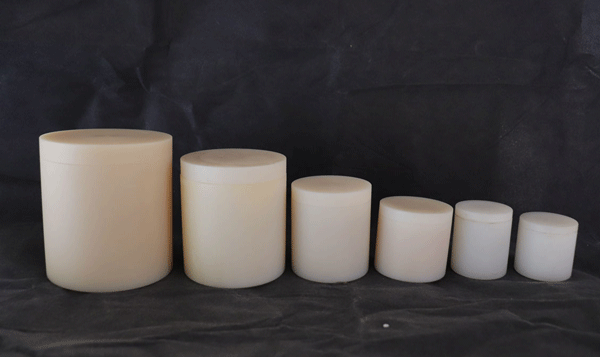
It is useful to agree on terms because they are often confused in correspondence with the supplier. The volume of one glass is the geometric capacity of one grinding chamber. The total volume of the set is the product of the volume and the number of glasses installed in the mill at the same time. Working load is the mass of the grinding media and the sample, at which normal conditions for the movement of the balls are maintained. Sample weight - the amount of sample taken per grind. Time productivity - how many samples per hour or per shift actually pass through the installation, taking into account loading, unloading and cleaning. These quantities are related, but none of them is equal to the other, and substitution of concepts leads to errors in experimental planning.
A nylon cup is considered when it comes to relatively soft and medium-hard materials, homogenization of powders, working with fibers, deagglomeration of an already crushed product, as well as cases where metal contamination is unacceptable and there is no need to obtain submicron fineness from hard, brittle raw materials. For quartz, corundum, carbides and other hard materials, a soft polymer container is usually not the first choice: it absorbs impact energy and wears out quickly.
Typical difficulties with which the analysis begins look mundane: grinding takes longer than expected, results differ between batches, during trace analysis an element appears that was not in the original raw material, and the wall of the glass after a series of grindings acquires a noticeable mark from the balls. All these observations point to one group of reasons - a discrepancy between the properties of the container, the mode and the task. It is more productive to understand them before purchasing equipment, rather than after the technique has already been implemented.
The design of the glass and the operation of the “container - grinding media” pair
Polyamide as a construction material for grinding containers
Nylon is the trade name for a group of thermoplastic polyamides. As a material for laboratory equipment, it is attractive due to its combination of viscosity, elasticity and low density: unlike brittle ceramics, it does not crack from an accidental impact, and, unlike steel, it is not a source of metal impurities. Polyamide is well processed, containers with complex geometries are made from it, and its low density reduces the contribution of the rotating mass to the load on the mill drive.
There is a downside to this choice, and it needs to be understood before, not after, the first grind. Polyamides are able to absorb moisture from the air and, when saturated, slightly change their dimensions and mechanical properties; This process is reversible, but requires attention to storage conditions. The chemical resistance of polyamides is selective: they are resistant to dilute alkalis and many organic media, but are sensitive to strong acids, phenols and a number of polar solvents that cause swelling or dissolution. The thermal limit of polyamide is significantly lower than that of zirconium oxide, tungsten carbide or hardened steel, so heating during intensive grinding is more critical for such a glass than for a ceramic one.
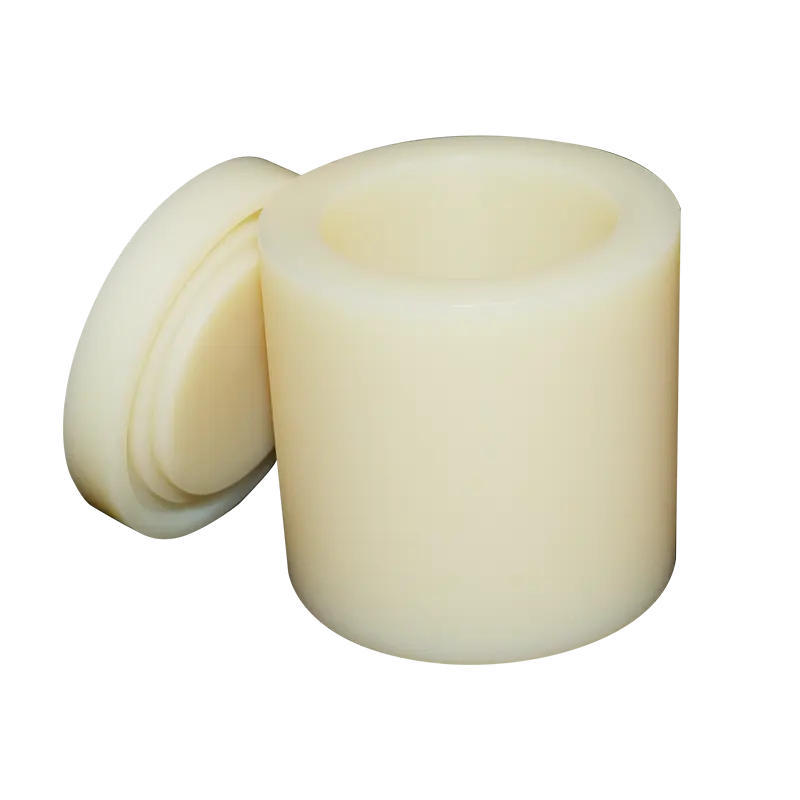
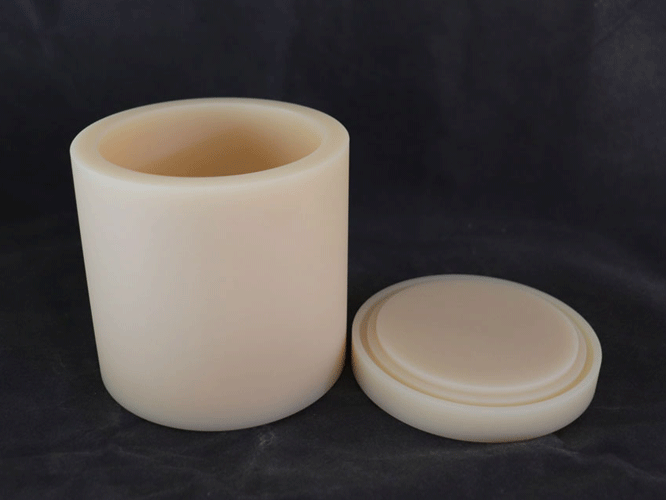
Separately, it is worth mentioning the design. A planetary grinding bowl is a cylindrical container with a lid and seal; the presence and geometry of internal elements, wall thickness, method of fixing the lid and nominal volume refer to the design of a particular model. There is no universal description of a “nylon cup in general”: two products made from the same material may differ in seating dimensions, permissible rotation speed, and sealing system. That is why the characteristics are taken from the product card, and not transferred from a similar-looking product from another manufacturer.
Another practical note concerns padding. The grinding chamber should not be fully loaded: part of the volume is necessary for the movement of the grinding media, otherwise the balls stop coming off the wall, abrasion degenerates into slippage, and local wear and heating increase. The ratio of the volume of the glass, the mass of the balls and the mass of the sample is selected for the task, and not “to the maximum”: increasing the load beyond a reasonable limit does not speed up the achievement of coarseness, but increases the wear of the container and the risk of its deformation.
What happens inside the glass during planetary motion
In a planetary mill, the glass participates in two rotations simultaneously: around its own axis and around the common axis of the carrier. Due to this, the grinding bodies repeatedly rise along the wall, come off and fall, and also roll and slide along the inner surface. Grinding occurs through a combination of impact and abrasion, and the ratio of these mechanisms depends on the rotation speed, diameter and density of the grinding media, degree of filling and properties of the sample material.
The role of the wall in this scheme is not passive. When a ball hits an elastic polymer wall, part of the kinetic energy is spent on deforming the material of the container and turns into heat, and not into the destruction of the particle. For soft and viscous samples this is not significant or even useful, since abrasion does most of the work. For a hard, brittle material, this loss of energy means that it will take longer to achieve the same fineness, which means increased wear on the cup. In addition, during long-term operation without pauses, the temperature inside the grinding chamber rises, and polyamide approaches the thermal limit earlier than for ceramics or metal: the material softens, its abrasive resistance decreases, and sample contamination increases. Conventional air cooling of the case does not turn such a process into a cryogenic one: cooling with liquid nitrogen is a separate technical solution with its own limitations, and one cannot be replaced by the other in the description of the technique.
From this follows a practical conclusion about the coordination of the “glass - grinding media” pair. Wear in a contact pair is primarily determined by the harder participant: the harder and denser the ball, the more it wears out the soft wall. Heavy balls made of dense materials in combination with a polymer cup provide the maximum rate of material removal from the wall, so such a set is justified only when the ingress of polymer into the sample is acceptable or when its contribution is assessed by a control experiment. The opposite combination - less dense grinding media in a polymer container - reduces contamination, but also reduces the grinding energy.
Introduction of impurities: what exactly goes into the sample
The phrase “zero contamination” does not describe any actual grinding equipment material. Any pair of “glass - grinding media - sample” exchanges material, the only question is how significant this exchange is for subsequent analysis. The practical task is formulated as follows: determine what elements or compounds can be introduced by the selected equipment, and check whether the analysis method is sensitive to them.
For a nylon glass, the main contribution is organic: polyamide particles carry carbon, hydrogen, oxygen and nitrogen. If the sample is then analyzed for metals, for example by atomic emission or inductively coupled plasma mass spectrometry, polymer particles usually do not interfere with the elements being determined, but can affect sample preparation and the completeness of decomposition of the sample. If the elemental analysis of organic materials or the determination of carbon is of interest, the contribution of the container material must be taken into account separately and controlled by a blank experiment.
The second mechanism is not abrasive, but adhesive. Fine powders tend to stick to the walls and corners of the chamber, and polymers, due to their low surface energy and tendency to accumulate static charge, can retain a layer of adhered material. This is not contamination in the chemical sense, but sample transfer: part of the previous sample remains in the glass and ends up in the next sample. For trace determinations, such transfer is more dangerous than wall wear, and combating it is primarily a matter of cleaning discipline and separate sets of equipment.
The third factor is moisture. Polyamide absorbs water from the air, and during grinding, water absorption can change locally along with the temperature and condition of the surface. For hygroscopic samples, this means that the glass should be dry and, if possible, kept under the same conditions as the sample; For water-sensitive systems, dry grinding in a polymer container requires more careful preparation than in a metal or ceramic one.
The contribution of the equipment can be assessed using a simple scheme: compare the mass of the sample with the expected material removal from the wall during grinding, obtained by weighing the glass before and after the series, and compare the resulting value with the detection threshold of the method. This calculation is an estimate, but it allows you to notice in time that the selected container “eats” more than the methodology allows.
| Container material | Main contribution to pollution | Tendency to wear on hard samples | Chemical resistance | Cleaning |
|---|---|---|---|---|
| Polyamide (nylon) | organic C, H, O, N; polymer particles | high: soft material | resistant to dilute alkalis and many organic media, sensitive to strong acids, phenols, polar solvents | soft, without abrasives and metal scrapers, with mandatory drying |
| Agate | silica | average | resistant to most acids except hydrofluoric acid | Be careful: the material is fragile |
| Zirconium oxide | zirconium, yttrium | low or medium | wide | allows more intensive cleaning |
| Tungsten carbide | tungsten, as well as a bunch | low | wide | requires attention to the composition of the ligament |
| Hardened steel | iron, chrome, nickel | average | limited to acidic environments | simple but metal contamination |
The table is indicative and qualitative in nature: it compares classes of materials, not specific products, and does not replace the documentation for the selected glass. Actual performance depends on the sample, mode, properties of grinding media and operating time.
Glass wear: causes, signs and resource
Wear of a polymer container consists of abrasive wear, impact loads and thermal softening. Abrasion occurs on the cylindrical wall and in the bottom area, where the balls are pressed by centrifugal force; shock loads occur at the places where the balls come off; heating reduces the hardness and elasticity of the polymer and accelerates both first processes. Unlike fragile ceramics, which are destroyed abruptly - by a chip or crack, polyamide wears out gradually, and at first it is hardly noticeable from the outside.
Signs to watch for
- Changes in color and appearance of dullness in areas of contact with grinding media.
- Ring abrasions and “tracks” on the wall, repeating the trajectories of the balls.
- Darkening or thick adhering layer on the bottom.
- Gaps and play in the cover, traces of powder spillage on the seal.
- Deformation of the body, ovality of the cross-section, local dents.
- The appearance of a smell during grinding, indicating heating of the material.
The most objective way to keep wear under control is to periodically weigh a clean, dry glass on a laboratory scale and record the result in a journal. The difference in mass over a known number of hours of operation gives an estimate of the rate of material removal and allows one to recalculate the possible contribution of the container to the sample. This calculation is approximate: some of the worn material may remain in the sample, some may settle on the walls and in the seal, but it shows the order of magnitude and helps determine the replacement period.
What accelerates wear?
- High rotation speed and long continuous operation without pauses.
- Dense and large grinding media, as well as an increased degree of filling.
- A hard abrasive sample, especially with a large initial particle size.
- Dry grinding of hard materials without intermediate cooling.
- Working with a swollen surface and accumulation of an adhering layer on the walls.
The resource of a particular glass is not a constant value: it depends on the listed conditions, and it cannot be transferred from one task to another. A reasonable approach is to establish regulations: after each grinding, a visual inspection, after a series, weighing, and if deformation or loss of tightness occurs, shutdown. Replacing a glass due to wear is cheaper than investigating an inexplicable variation in results between batches.
Compatibility: sample, grinding media and grinding unit
Compatibility is three separate questions, and a positive answer to one does not mean a positive answer to the others. The first is the chemical compatibility of the beaker material with the sample and grinding medium. The second is the mechanical consistency of the container and the grinding media. The third is the correspondence of the glass to a specific mill in terms of seating dimensions, method of fastening and permissible rotation speed.
Chemical compatibility and grinding medium
During wet grinding, the glass comes into contact not only with the powder, but also with the liquid. For polyamide, sensitivity to strong acids, phenols and a number of polar solvents, as well as swelling in aqueous media during prolonged contact, must be taken into account. Water, alcohols and dilute alkalis are usually tolerated to a limited extent, but the specific medium and its concentration require separate testing - ideally by first keeping a sample of the container material in this environment. Dry grinding eliminates some of these issues, but adds the risk of heating and static charge accumulation.
It is also important to distinguish between dry and wet grinding based on the mechanics of the process. The liquid acts as a dispersion medium, reduces particle aggregation, removes some of the heat, and often allows one to obtain a narrower particle size distribution with less processing time. At the same time, it increases the load on the seal and creates additional requirements for the chemical resistance of the wall and for subsequent drying of the sample.
Coordination with grinding media
A pair of “glass - grinding media” is selected according to hardness, density and size. The closer the materials are in hardness, the less wear of the soft member, but the lower the energy transferred to the particles. Large balls give impact, small ones give abrasion; For polymer containers, the abrasion-dominated mode is usually preferred because it reduces the impact loads on the wall. The size and material of the grinding media must be consistent with the load and the target size: too much ball mass with a small bowl volume leads to their jamming and a sharp increase in local wear. No combination guarantees a given size - it depends on the material, the initial particle size distribution, the environment, the mode and method of measurement.
Compliance with grinding plant
A glass only becomes meaningful when paired with the mill for which it is intended. Seats, mounting systems and permissible rotation speeds vary between installations, so compatibility is confirmed by the documentation for a specific mill model, and not by external similarity. Separately, it is worth warning against a common mistake: a drum ball mill with a lined drum is another class of equipment where the drum rotates on rollers rather than undergoing planetary motion. Such a drum is not a replacement for the grinding bowl of a planetary mill, and vice versa; the corresponding type of equipment is described in the card ball mill with lined drum. It is impossible to transfer the parameters of this installation to the planetary glass, just as it is impossible to assume their automatic compatibility.
It is also useful to distinguish between grinding and mixing. A mill with large balls at low energy can operate as a mixer, and then the pollution requirements are different than with true grinding. Disagglomeration of ready-made fine powder is close to mixing in mechanics and is almost always less critical to the glass material than the destruction of solid raw materials.
Cleaning and transferring samples between batches
For a polymer container, cleaning is the same part of the technique as the grinding mode. The general rule is simple: the mechanical impact should be minimal, and the chemical impact should be compatible with the material. Metal scrapers, abrasive powders and hard brushes leave marks on the polyamide, which then retain particles and accelerate wear, so dry cleaning is carried out with a soft brush or dry cloth, and it is better to soak the stuck layer rather than scrape it off.
Water washing with a neutral or slightly alkaline detergent is acceptable as a standard procedure, but after it thorough rinsing and, most importantly, drying are necessary. Polyamide retains moisture, and an undried glass will introduce water into the sample and change the grinding conditions; In addition, residual moisture accelerates the swelling of the surface. Drying is carried out at a temperature that is known to be safe for the material, avoiding overheating and sudden changes. Solvents are used only after checking compatibility and taking into account that part of the solvent may remain in the polymer volume and then pass into the sample.
Storage conditions also affect the results. Before use, a glass stored in a room with high humidity is kept in the same conditions as the sample, or dried according to the regulations; A sharp change in humidity immediately before grinding results in unstable surface behavior and poorly reproducible sample transfer.
The transfer of samples between batches is controlled organizationally. The working method is to assign separate sets of glasses to the types of samples, and for trace determinations to use blank grinding: running the grinding media without a sample or with an inert material, after which the washouts are analyzed and the contribution of the equipment is assessed. A blank grind does not “sterilize” the beaker, but it does provide a numerical score against which results can be compared. If there is an inexplicable drift in any element between batches, it is wise to check the equipment - bowl, grinding media, compaction - before changing the grinding mode.
What to prepare for trial grinding and configuration selection
The most practical way to select a glass and grinding media is to organize a trial grinding and analyze the result. To make it informative, the request should be accompanied by information that actually determines the choice, and not just the name of the material.
- Nature of the sample: class of material, hardness, brittleness or toughness, tendency to stick and swell.
- The initial particle size and target particle size distribution along with the method by which the particle size will be measured.
- Sample weight per grinding and required number of samples per shift.
- Type of grinding - dry or wet - and with wet grinding the composition and volume of liquid.
- Contamination restrictions: which elements are determined and at what level, what is the sensitivity of the method.
- Temperature sensitivity of the sample and permissible heating in the grinding chamber.
- Mill model, seating dimensions, number of simultaneously installed glasses, available rotation speed.
- The material and size of the intended grinding media, as well as the acceptability of their wear.
- Cleaning regulations and permissibility of separate sets of equipment.
The answer to such a request allows you to agree on the material of the container, the size of the glass and the mode, and not select them by brute force. It is also useful to agree in advance on the evaluation criteria: how the coarseness will be measured, what the blank experiment will be, how many parallel grindings are needed to assess the spread, at what level of contamination the result is considered unacceptable. These criteria are no less important than the characteristics of the equipment, because they determine whether the chosen option will be considered successful.
And one last thing. Neither the beaker material nor the mode guarantees the “best result” for any sample: the achieved sample size and purity depend on the specific combination of material, medium, grinding media, time and method of measurement. The correct task is not to find a universally ideal glass, but to select one whose limitations are known, documented, and acceptable for a specific analytical purpose. In this sense, a nylon grinding bowl for a planetary mill is a predictable solution for soft and medium-hard materials, when the organic contribution of the equipment is acceptable and when the mode is selected so as not to overheat the polymer.