
Stirring a liquid in one vessel rarely becomes the subject of a separate analysis: a magnetic stirrer is perceived as an auxiliary device that simply rotates the stirrer. A different situation arises when several dozen samples need to be prepared using one method during a shift. Here, it is not individual revolutions that come to the fore, but the stability of conditions: is the flow pattern the same at different positions, are particles settling in the corners of the vessel, is the viscosity changing during mixing, is the sample heating up more than expected.
Multi-position magnetic stirrer TENCAN — The device is specifically designed for such serial work. Below we discuss how magnetic stirring works, what parameters really influence the result, where the limits of applicability of the method lie, and what is worth checking before the entire series of samples is placed on the platform.
Why mixing a series of samples is a separate task
A single experiment allows for adjustments “by eye”: you can add speed, adjust the stirrer, rearrange the vessel. In the series, such freedom turns into a variety of conditions. If the first sample was mixed more quickly, the second stood longer before sampling, and the third was in a vessel with a different bottom shape, the differences in the result will reflect not the properties of the material, but the procedure.
A device with multiple operating positions reduces some of these variations, but does not eliminate them completely. There remain factors that are determined not by the platform, but by consumables and utensils: the length and shape of the stirrer, the thickness and condition of its shell, the diameter and profile of the bottom of the vessel, the accuracy of level setting. Two identical vessels with different stirrers will give a different flow pattern at the same speed.
It is worth mentioning separately what magnetic stirring does not do. It is not a fine dispersion and does not replace grinding equipment: a rotating mixer creates a volumetric flow and moderate shear, but does not destroy strong agglomerates or crush particles. If the goal is to obtain a narrow particle size distribution from a powder charge, a mill is needed; if the task is to keep a ready-made suspension in suspension and average it before sampling, a magnetic stirrer is appropriate.
Finally, a series often means long work: hours, and sometimes even days. During this time, effects appear that were imperceptible in a short experiment - evaporation, gradual heating from the drive, sedimentation of a large fraction, wear of the stirrer shell. Therefore, when choosing a device, it is useful to immediately think not about the maximum speed, but about the reproducible mode, which can be repeated tomorrow and in a month.
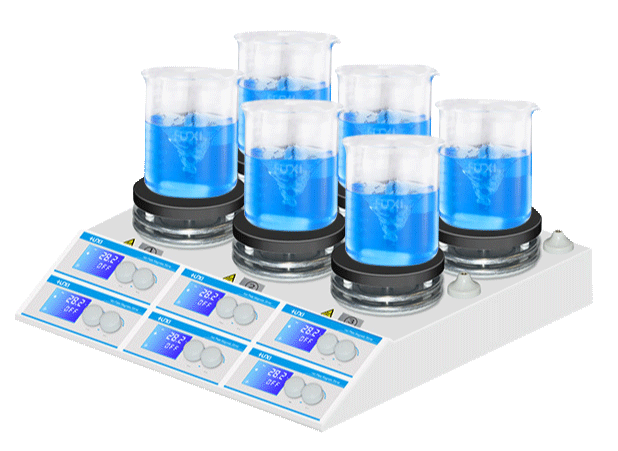
The principle of operation of a magnetic stirrer and what it means in practice
It is based on contactless torque transmission: the rotating magnetic field of the drive carries with it a magnetic insert pressed into the stirrer. The vessel remains closed, the stirrer does not have a shaft passing through the lid, and does not require seals. That is why the method is convenient for working in closed vessels and in cases where contact of the contents with the drive mechanism is unacceptable.
Magnetic coupling and torque limit
The transmitted torque is limited by the strength of the magnetic coupling. As long as the load on the stirrer is small, it rotates synchronously with the field. As soon as the resistance of the medium exceeds this limit, the connection is broken: the stirrer begins to slip, twitch or stop, and the field continues to rotate. By ear, this is often perceived as an extraneous rhythmic knocking, although there may not be a malfunction in the device.
The practical conclusion is simple: the maximum achievable speed depends not only on the device, but also on the viscosity of the medium, the loading volume and the length of the stirrer. The same speed value, comfortable for water, will be unattainable for a concentrated suspension. Therefore, it makes sense in the protocol to record not only the specified setting, but also the actual behavior of the flow.
Flow pattern: from annular motion to vortex
At low speeds, the liquid moves predominantly in a circle, being involved in a tangential flow. Mixing along the radius and height of the vessel is weak: the colored stream can persist for a long time, and stagnant areas form near the walls. As the speed increases, an axial component appears, the liquid rises at the walls and falls towards the center, and only then a pronounced funnel is formed.
A funnel is not a sign of high-quality mixing, but a sign that the flow has become predominantly rotational. With a further increase in speed, its depth increases, the surface draws in air, and bubbles enter the volume. For oxygen-sensitive samples, volume measurements and suspensions prone to foaming, this is not a desirable scenario.
It is convenient to describe the flow regime by the Reynolds number for mixing: Re = ρ n d²/μ, where ρ is the density of the medium, n is the rotation frequency, d is the characteristic size of the stirrer, μ is the dynamic viscosity. The formula does not require calculations in each experiment, but it clearly shows why with an increase in viscosity by an order of magnitude, the flow pattern changes more than with a slight increase in speed.
Multi-position layout: synchronicity, geometry, limitations
The name itself indicates multiple jobs on one platform. This arrangement saves space in the fume hood and allows for parallel experiments, but adds questions to ask before purchasing.
Single drive or independent positions
Different designs use different solutions: a common drive with transmission to several places or separate motors for each position. This determines whether individual speeds can be set, how big the difference is between the extreme positions, and what happens if one vessel is removed. There is no universal answer - this is a characteristic of a specific model, and it should be clarified based on the product card and documentation, and not assumed based on the appearance of the platform.
There it is also worth finding out what the indicator shows: the specified setpoint or the measured rotation speed. This difference is important when working with viscous media, where the actual speed may differ from the set speed.
Arrangement of vessels and platform level
The vessels must be stable and not overlap each other. If the diameter of the flask exceeds the pitch of the positions, adjacent vessels may touch, and large dishes may hang over the edge of the platform, which changes stability and load distribution. With a dense arrangement of positions, magnetic fields close in distance are in principle capable of influencing each other; how noticeable this is depends on shielding and distance and is verified on site rather than taken at face value.
The level of the platform is no less important: the tilt causes the stirrer to move towards the wall, the flow becomes asymmetrical, and at high speeds the risk of failure increases. The bubble level and adjustable feet are simple tools that save a lot of time when doing batch work.

Rotation speed and flow mode
Speed is the most accessible parameter for adjustment, so it is the one that is most often treated carelessly. Meanwhile, any task has not only an upper, but also a lower limit of reasonable speed, and the optimal mode usually lies in a relatively narrow range.
Upper limit: stirrer breakdown and air entrapment
Signs of exceeding the permissible regime are quite characteristic: a stable deep funnel, air entrapment, splashing on the walls and lid, rhythmic knocking of a slipping stirrer, noticeable vibration of the platform. For a series of samples, the danger is that some positions may work stably, while others may fail, and then the conditions within one batch will be different.
A useful practice is to reach the operating mode gradually: first set the minimum speed, make sure that the stirrer is rotating, and only then increase the speed until the desired flow pattern appears. A sudden start from a high setting often results in the stirrer simply “sticking” to the magnet and not starting to rotate.
Lower limit: stagnant zones and particle settling
Stirring too calmly looks safe, but does not solve the problem. In suspensions, heavy particles settle at the bottom, especially in the peripheral zone of the vessel, while in solutions, density stratification and local areas with different concentrations remain. The criterion here is formulated not in terms of revolutions, but in terms of the observed result: the particles must remain in suspension throughout the entire time between sampling, and not just at the time of mixing.
For reproducibility, it is convenient to introduce a selection rule: the sample is always taken from the same point and at the same interval after the last change in the mode. Otherwise, even a small difference in the moment of selection will give a scatter that can easily be attributed to the properties of the material.
Volume, viscosity and vessel: where mistakes are most often made
The magnetic stirrer works with the vessel, and not on its own, and most failures are due to a mismatch between the vessel and the load. An overfilled vessel causes splashing and air entrapment; an underfilled vessel causes a funnel that reaches the stirrer and gas leaks into the volume. The working level is usually selected so that the funnel does not reach the bottom and the walls remain wet.
Viscosity limits the method more than volume. As the viscosity increases, the resistance of the medium increases, the magnetic connection is broken, and instead of mixing, slipping begins. Thick pastes and gels cannot be mixed with a magnetic stirrer - a top-drive apparatus with a mechanical blade is needed here. In addition, viscosity depends on temperature, so the mode selected on a cold sample may change after heating or holding in a thermostat.
The shape of the bottom and the length of the stirrer are directly related. Approximately, the stirrer is taken such a length that it occupies approximately half - two-thirds of the internal diameter of the vessel; this rule is useful as a starting point, but not as a guarantee. A stirrer that is too short does not engage the periphery well; if it is too long, it catches the walls and stops. Conical flasks and round-bottomed vessels have their own caveats, and there is no one-size-fits-all stirrer.
| Task | Magnetic stirring | What to consider |
|---|---|---|
| True solution, low viscosity | Fits | Funnel and evaporation control |
| Suspension with dense particles | Maybe | Subsidence at the bottom, sampling mode and time |
| High viscosity paste, gel | Doesn't fit | Top drive needed |
| Destruction of agglomerates, fine dispersion | Doesn't solve the problem | Grinding equipment required |
| Small volume in a narrow vessel | Depends on the dishes | Check the compatibility of the stirrer and the bottom |
| Air sensitive environment | Limited | Gas entrapment in a funnel is unacceptable. |
The table is indicative in nature: it helps formulate the question, and does not replace testing on a specific sample.
Heating, materials and contaminant transport
Even an unheated stirrer introduces a small amount of heat into the sample: the engine is running, and in a viscous medium, part of the mechanical energy is converted into heat. For a short experiment this can be neglected, but for many hours of exposure - not. If the model is equipped with heating, a distinction is made between the plate temperature, the medium temperature and the temperature shown by the sensor; this is not the same thing, and the delay depends on the volume and material of the vessel.
Temperature: what the device shows and what happens to the sample
The presence of a heating function and its characteristics should be clarified on the card of a specific model, and not transferred to the entire range. When working with heat, it is useful to remember the unevenness: the layer adjacent to the bottom is warmer than the top, and without stirring this difference remains. This is why flow rate and temperature are related: weak mixing makes heating uneven.
If the device is intended to be used in a climate chamber or a cold room, it is worth finding out the permissible operating conditions - this information relates to the documentation and is not derived from general considerations.
Mixer and its wear
The stirrer shell is usually made of a chemically resistant polymer, most often PTFE. This material is inert with respect to most media and is easy to clean, but it is soft: over time, scratches appear on the surface, the edges become wrinkled, and with severe wear, particles of the material can be transferred into the sample. The statement about the “complete absence of contamination” is inappropriate here - it is more correct to talk about minimizing the contribution and monitoring the condition of the consumable element.
Practical measures are simple: inspect the stirrers before a critical series, do not use the same stirrer for different chemical media without cleaning, store them separately from metal instruments. If the sample is sensitive to traces of polymer or special chemical resistance is required, the sheath material and contact tolerance must be agreed upon separately.
Batch reproducibility and pre-purchase testing
The main result of the multi-position stirrer is not a single successful experiment, but the comparability of samples. It is achieved by the procedure, and not just by the device.
What to record in the mixing protocol
The minimum set of records includes vessel type and volume, stirrer size and material, feed volume, target speed, actual flow behavior, duration, room temperature and vessel position on the platform. It is useful to note whether there have been instances of stirrer failure: if so, this sample cannot be considered to have been stirred under the same conditions as the others.
To check homogeneity, simple techniques are used: adding a drop of dye and assessing the time of its distribution, measuring electrical conductivity at different points, taking samples from above and below with subsequent comparison. These tests do not require complex equipment, but give reason to talk about the mode, and not about the impression.
What to tell the supplier and how to conduct a test mixing
To select equipment, it is useful to prepare a short description of the task: what media are supposed to be mixed, their approximate viscosity and density, working volumes and type of glassware, how many samples need to be carried out at the same time, is heating required, how long does the experiment last, are there any requirements for a closed vessel and cleanliness. The more specific this data is, the less likely it is that the device will be convenient for demonstration and inconvenient in daily use.
Test mixing should be carried out on a real sample and in the container that will be used. Three things are checked: stability of rotation at minimum and operating speeds, absence of air entrapment at the required intensity, and retention of suspension for the planned time. The extreme positions of the platform are checked separately if full loading is expected.
You can read the description of the device and clarify its characteristics in the card multi-position magnetic stirrer TENCAN, and the general line of laboratory and industrial equipment - on website TENCAN. The exact parameters of a specific design, including the number of positions, adjustment range and configuration, should be taken from the documentation for the model.
Magnetic stirring remains a convenient and predictable method where the medium is liquid, volume is moderate, and shear requirements are low. The multi-position layout makes it suitable for serial work, but shifts the focus from the device to the procedure: identical vessels, working stirrers, a verified level, a clear criterion for homogeneity and recorded conditions. This approach produces results that can be repeated, which is exactly what is required from a laboratory technique.