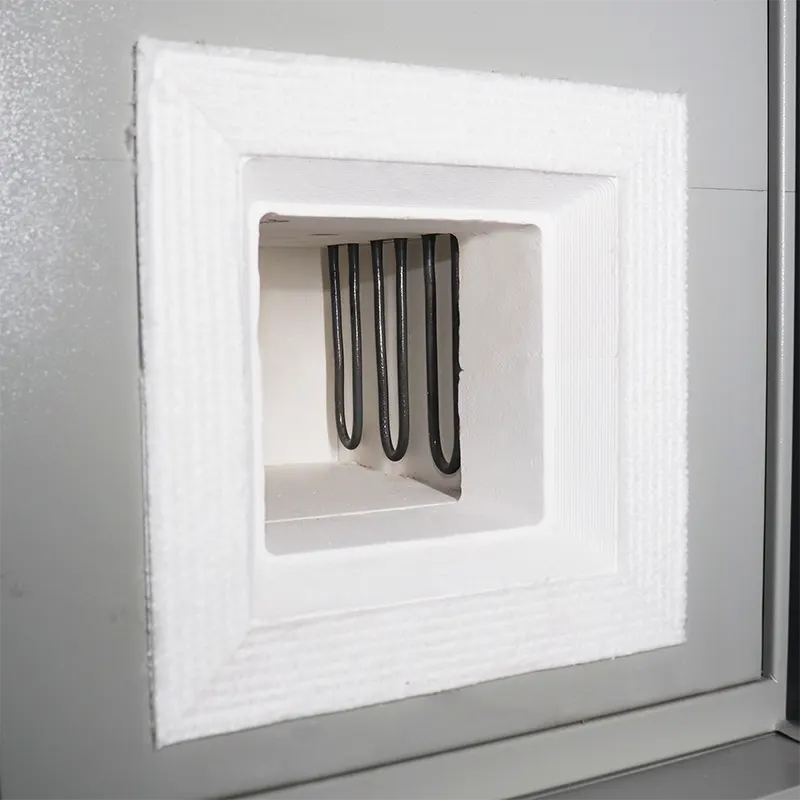
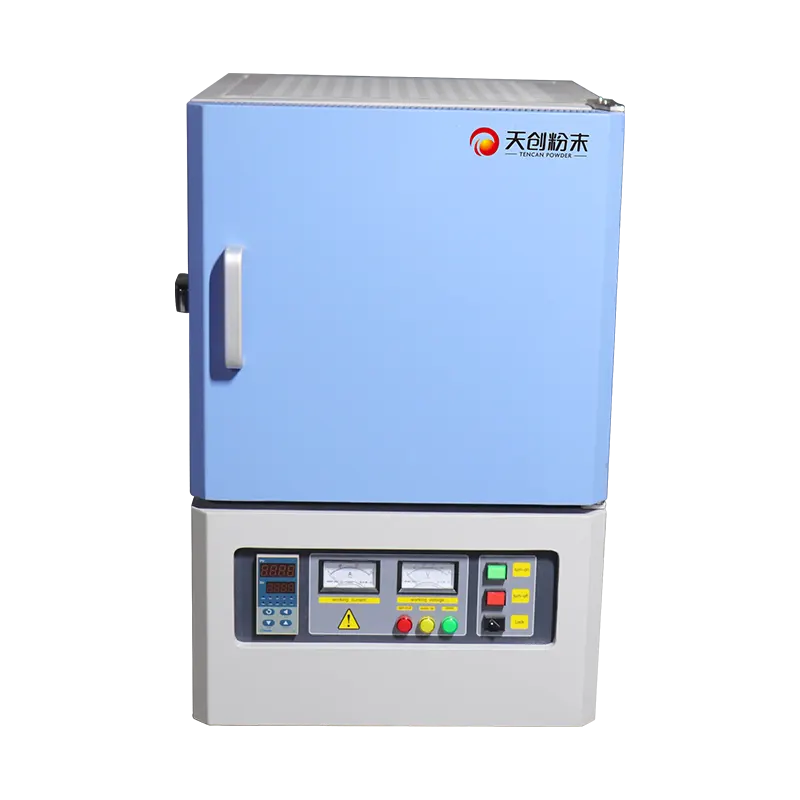
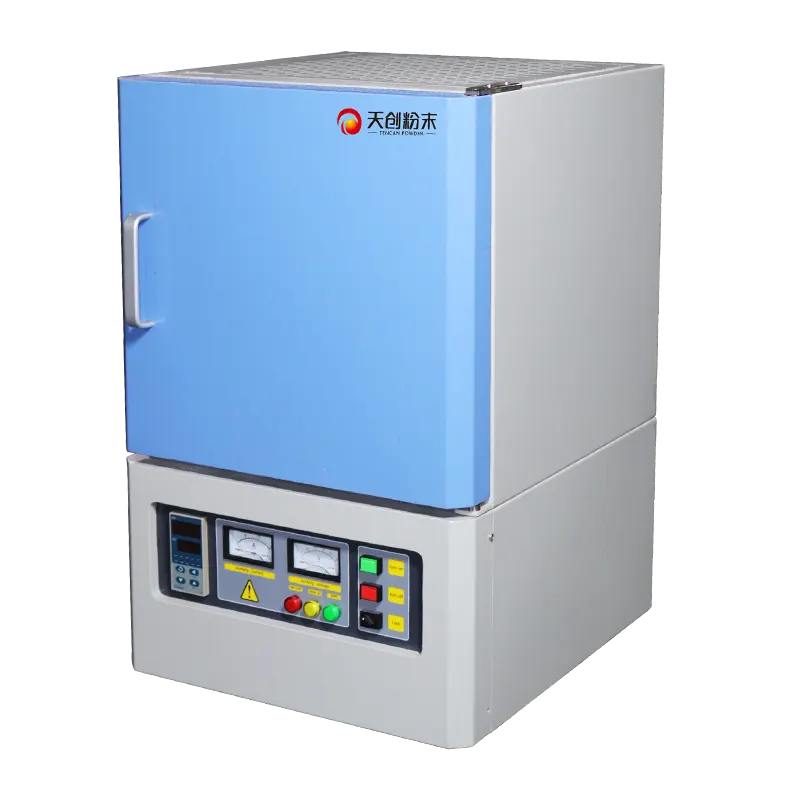
The laboratory sample has already been dried and averaged, the crucibles have been selected, but firing is postponed: one temperature is indicated in the furnace passport, another is indicated in the procedure, and it is not always clear which of them refers to long-term operation and which to short-term operation. This is a typical situation for chamber muffle furnaces: the same number can indicate the maximum capability of the heaters, the permissible chamber mode and the temperature recorded by the thermocouple at a specific point in the working space. Below we consider one practical issue - how to coordinate the heat treatment mode with the task of the sample and the service life of the furnace - using the example of a chamber muffle furnace TENCAN (product card).
From sample task to mode parameters
Heat treatment in laboratory practice covers various operations: removal of moisture and adsorbed gases, burnout of organic components, calcination with decomposition of salts and hydroxides, phase transformations, sintering of powder compacts, annealing after deformation, production of ash residue. These operations require different heating rates, different exposure times and not always the same atmosphere, so the mode cannot be selected “by the name of the material.”
The difference is fundamental. When drying and low-temperature heating, the main risk is cracking and spattering; upon calcination - incomplete decomposition and violent release of gases; during sintering - shrinkage, grain growth and interaction with the substrate. The same final temperature in all these cases does not mean the same regime: the rate of rise, the duration of exposure, the cooling rate and the composition of the gaseous medium are also important.
Before making a choice, it is useful to formulate the performance requirements in measurable terms: target temperature and acceptable range, required dwell time, acceptable rate of ascent, cooling requirements, atmosphere, acceptable changes in mass, phase composition or density. If the requirement is specified only with the words “calcinate until sintering,” the mode will have to be clarified experimentally, and not calculated by analogy.
It is worth assessing the sample itself: mass, bulk density, particle size, presence of volatile components, tendency to stick together, chemical activity towards the crucible material. A large, dense sample warms up more slowly than a thin layer of powder, and with the same regulator readings it will end up in different conditions.
Furnace structure and its influence on the mode
A chamber muffle furnace is a thermally insulated chamber with heating elements and a temperature sensor, the operation of which is controlled by a regulator. The versions differ in the type of heaters, lining material, presence of a muffle, chamber volume, loading method and permissible atmosphere; these features determine how evenly and accurately the heating can be carried out.
Muffle, lining and heaters
In muffle-type furnaces, the working space is separated from the heaters by the muffle wall. This separation protects the sample from direct contact with the heaters and their wear, and the heaters from volatile substances from the sample. At high temperatures, the bulk of the heat is transferred by radiation rather than by convection, so the geometry of the chamber, screens and the condition of the internal surfaces affect heating no less than the declared power.
Thermocouple and regulator: where the temperature is measured
The regulator maintains the temperature according to the readings of a thermocouple installed at a certain point. This temperature is not equal to the temperature of the sample: when loading a cold sample and during endothermic reactions, the sample is colder; during exothermic reactions, it is hotter. When entering the mode, overshoot is possible, especially if the regulator is not configured for a specific load, so the first shutter speed is sometimes made shorter and the condition of the sample is monitored.
Maximum and long-term operating temperature: where is the limit?
The documentation for laboratory furnaces usually contains not one, but several temperature values, and they cannot be mixed. Maximum temperature is the limit that a structure can withstand for a short time; long-term operating temperature is the level at which a furnace can be operated in repeated cycles without accelerated degradation. There is a third value - the temperature to which the sample in a particular load is actually heated, and it depends on the mass, placement and crucible.
The reason for the separation is simple: the heaters, lining and sensor age faster near the limit values. Oxidation of metal heaters, changes in resistance, cracking of insulation, thermocouple drift accumulate, and a furnace operating at the limit loses accuracy and service life. Therefore, the operating mode is planned with a margin relative to the maximum, and the amount of the margin is determined according to the passport of a specific model, and not according to general habit.
Practical conclusion: if the technique requires a temperature close to the maximum, it is worth clarifying in advance whether the model allows long-term operation at this level and what heating rate is allowed. The wording “the oven heats up to this value” does not mean “the oven operates at it constantly.”
| Parameter | Why is it important? | What to clarify for a task |
|---|---|---|
| Maximum temperature | Short term heating limit | Is it acceptable to work near it for a long time? |
| Long-term operating temperature | Service life of heaters and linings | What value corresponds to a continuous loop |
| Heating rate | Casting, uniformity, thermal shock | Acceptable Temperature for Sample and Crucible |
| Chamber volume and loading | Inertia and temperature distribution | Sample weight and number of crucibles |
| Atmosphere | Oxidation, reduction, volatiles | Is work in a gas environment declared? |
| Sensor and regulation | Cycle accuracy and repeatability | Thermocouple type, regulator setting |
Heating rate and holding time: a trade-off between time and quality
The rate of temperature rise is limited by two sides. On the furnace side - power and inertia: a massive lining and a large chamber take time, and forced heating gives increased overshoot and unevenness. On the sample side - the thermal resistance of the crucible and the sample itself, as well as undesirable reactions that, with rapid rise, take place under uncontrolled conditions.
Ceramic crucibles do not withstand sudden thermal shock: a crack may not appear immediately, but during cooling or in the next cycle. Powder compacts crack when heated quickly due to uneven shrinkage. Organic binders require a slow low-temperature section: if you immediately reach a high temperature, decomposition products are released violently and pollute the chamber.
Holding is needed not only to complete the reaction, but also to equalize the temperature throughout the sample volume and chamber. The criterion for completion is not only time: the change in mass, shrinkage, density, and the results of phase analysis are monitored. If the sample has not reached the desired state within the estimated time, the reason may be the mass of the sample or the stacking, and not “low heat.”
Cooling is part of the regime. Rapid cooling is convenient, but for heat-resistant ceramics and materials with phase changes it can cause cracks and undesirable structure. Opening a hot furnace to speed up the process should not be done: this is both a risk for the operator and a thermal shock to the lining, muffle and sensor.
Chamber loading, crucibles and thermal inertia
The same oven behaves differently when empty and when fully loaded. An empty chamber warms up quickly, but also cools down faster; a filled chamber stores heat, returns to operating mode more slowly and maintains the temperature longer after switching off. Therefore, the mode worked out on a single crucible is not automatically transferred to a full load.
Laying is as important as weight. The crucibles are placed in the working area, not close to the heaters and without blocking the gas circulation path, if it is provided for by the design. Several crucibles are placed on a stable tray; The sample should not touch the walls of the chamber and the sensor. For control, it is convenient to place an empty crucible and a witness sample into the chamber, which are then inspected and weighed.
Crucible material and possible interactions
A crucible is not a passive container. Corundum (aluminum oxide) is resistant to high temperatures and moderately resistant to alkalis; quartz tolerates sudden temperature changes well, but interacts more actively with some oxides; porcelain is cheaper, but has a lower temperature limit; graphite burns out in an oxidizing atmosphere. At high temperatures, sintering of the sample with the crucible is possible, so the contact layer is sometimes separated by bedding or a substrate is used.
Another factor is the material of the stand and tray. Sand, aluminum oxide or ceramic slab may themselves react with the spilled sample. If the sample is prone to melting, it is wise to provide a second, safety crucible and not fill it to the brim.
Atmosphere, Volatile Components and Ventilation
Not every chamber furnace is designed to operate in an inert atmosphere or vacuum; If such a possibility is not stated in the model description, one should proceed from working in air. Even when heated in air, the composition of the medium changes: organics burn out, carbonates decompose, sulfides and chlorides release aggressive gases. These products settle on the lining and fall on the heaters and thermocouple.
Practical measures: preliminary low-temperature heating with holding time to remove the main part of volatiles, moderate loading, work under exhaust ventilation, regular checking of the condition of the chamber. For samples with unknown behavior, it is better to perform a small test firing and inspect the chamber afterwards rather than loading a full crucible straight away.
It is also worth considering that cooling in a closed oven and cooling with the door ajar give different results and different loads on the structure. Forced cooling, if provided for in the design, also changes the thermal picture in the chamber.
What to check before test firing
Before firing a new sample for the first time, it is useful to perform several steps::
- warm up the empty furnace according to the selected mode and evaluate the behavior of the regulator, the presence of overshoot and the holding time;
- weigh the sample before and after firing to assess mass loss and completeness of volatile removal;
- place a witness sample and an empty crucible to control interaction with ceramics;
- inspect the crucible, substrate and chamber after cooling, note traces of sedimentation of products;
- compare the result with the requirements for mass, density, color or phase composition, if these methods are available.
To select the mode and configuration, the supplier is usually informed of: the material and origin of the sample, the mass of the sample, the size and bulk density, the material and size of the crucible, the target temperature and the required holding time, the permissible rate of rise and cooling, the working atmosphere, restrictions on interaction with ceramics, as well as the method of monitoring the result. The more specific the initial data, the fewer iterations will be required.
Some information can only be clarified from the documentation of a specific model - for example, the maximum long-term temperature, permissible heating rate, the ability to work in a gas environment and the type of installed sensor. These parameters are not derived from general considerations, so their place is in the passport and in correspondence with the supplier, and not in analogy with another oven.
General range of directions and equipment TENCAN given on main page of the site; the card of the selected model remains the main source of data on a specific design.