
A sample leaving a planetary ball mill is rarely ready for measurement. This is either a suspension with a wide distribution of particle sizes, or a powder in which the fine fraction has clumped together into aggregates. A mini-high-speed centrifuge, a laboratory device that occupies a place in sample preparation that is different from the place of the mill, allows you to divide the material into fractions, clarify the liquid and concentrate the sediment.
The practical difficulty is usually not in starting the device itself, but in choosing a mode. Too soft a setting leaves the supernatant cloudy; too hard overheats the sample, destroys aggregates that were intended to be preserved, or leads to loss of material on the walls and seals. Between these extremes lies the operating range, determined by the properties of the suspension and the design of the particular rotor, and not by a single speed figure.
Below we explain how to relate speed, rotor radius and sample properties, what characteristics of the device really affect the result and what restrictions cannot be removed by any setting. General patterns of deposition are separated from the passport data: the parameters of a specific configuration should be checked with the product card and the manufacturer’s documentation.
Considered as the main product mini high speed centrifuge TENCAN from the laboratory and research equipment section.
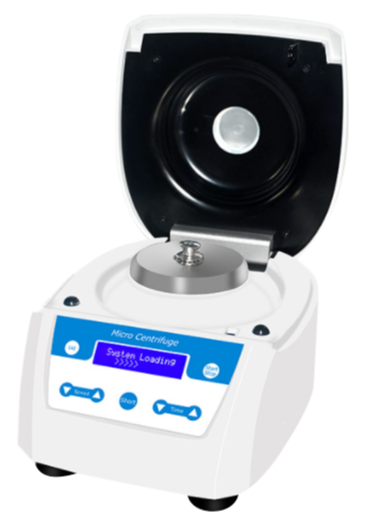
Place of the centrifuge in the sample preparation chain
Sample preparation is almost always a sequence rather than a single operation: sample collection and averaging, grinding, disagglomeration if necessary, then phase or fraction separation, and only then measurement. The centrifuge operates in the separation step. A planetary ball mill, roller crusher or bead mill operates in the size reduction step. These are different tasks with different setting criteria.
The centrifuge does not crush the material. If, after separation, the coarse fraction is larger than required, the reason is usually the grinding mode, and not due to insufficient rotation speed. The opposite error also occurs: an attempt to “break up” sticky aggregates by prolonged centrifugation produces a dense sediment, which is then difficult to return to a stable suspension.
If grinding was carried out using the wet method, separation of the suspension becomes a natural continuation of the operation. In this case, it is important to decide in advance what exactly is considered the result: a clarified liquid, a concentrated sediment, a washed fraction, or a preparation for further analysis. The requirements for the regime and for the dishes depend on this.
There is a separate question about the consumable elements of the mill. Grinding bowl made of reinforced nylon refers to planetary ball mills and is not part of a centrifuge. Its mounting dimensions, permissible loading and compatibility are checked for a specific mill; You cannot transfer this data to a centrifuge, since it has its own rotor and tube system.
The practical meaning of separation usually comes down to four operations: clarification of the liquid phase before spectral or chemical analysis, concentration of the fine fraction, washing of the precipitate from the remnants of the dispersion medium and coarse fractionation by size. Each of them sets its own tolerances for time, temperature and completeness of deposition.
Precipitation: what determines the result
The division in the field of centrifugal forces is described by several quantities. Relative centrifugal acceleration is calculated as RCF = 1.118 × 10⁻⁵ × r × n², where r is the radius of rotation in centimeters, n is the rotation speed in revolutions per minute. A simple conclusion follows from this: the same rotation speed on devices with different rotors creates different acceleration, and therefore different deposition conditions.
The settling rate of a spherical particle in the simplest approximation is described by Stokes' law: v = d²(ρp − ρf)g / (18η), where d is the diameter of the particle, ρp and ρf are the densities of the particle and liquid, η is the dynamic viscosity of the medium. The formula does not describe a real polydisperse suspension exactly, but it shows the direction well: the result depends most strongly on the size and on the difference in density, and the viscosity of the medium has a linear effect.
It is convenient to estimate the deposition time through the k-factor of the rotor: it is inversely proportional to the square of the rotation speed and depends on the ratio of the maximum and minimum radii. The lower the k-factor, the faster the rotor sediments particles with a given sedimentation coefficient. For a practitioner, this means that switching to a higher speed reduces the time, but not the quality of separation of the fine fraction if it is held by Brownian motion.
The viscosity and density of the medium depend on temperature, so heating the sample during the cycle changes the deposition conditions as the process progresses. A warm suspension settles faster, but thermal degradation of the sample or a change in its state of aggregation can invalidate this gain. The air temperature in the working chamber of the device and the temperature of the sample itself are different values, and the sensor readings cannot be used to judge the condition of the sample without a separate check.
Colloidal-sized particles in the field of centrifugal forces settle extremely slowly or do not settle at all. For them, separation is usually achieved not by increasing the speed, but by changing the state of the system - coagulation, selection of ionic strength, or other preparation of the suspension. Specific formulations and additives go beyond the selection of the centrifuge mode and require a separate technique.
Finally, a real sample is always polydisperse. The sediment forms as a layered structure: large particles reach the wall first, small ones continue to move in the compacting layer. Therefore, “complete deposition” is a conditional concept, and the criterion of completeness is set by the requirements of the analysis, and not by the passport characteristics of the device.
How to Read the Specifications of a Mini High Speed Centrifuge
Speed and acceleration
The product card usually indicates the maximum rotation speed and the corresponding acceleration range. These data should be read together: the maximum speed is valid only for a specific rotor and a specific cookware, and the acceleration depends on the radius of rotation. When replacing the rotor, the limit values change.
To select a mode, it is more useful to operate not with revolutions, but with calculated acceleration and time. Two samples deposited at different combinations of radius and rotation speed may give comparable results if the product r × n² is close. This allows you to transfer the technique between devices consciously, and not by copying numbers.
Rotor and seats
The angle rotor shortens the path of the particle to the wall, so it deposits faster, but it forms sediment on an inclined surface, which makes it difficult to remove. A rotor with horizontal bowls produces a flat sediment and is often more convenient for quantitative transfer. The choice is determined by the task, not just the maximum speed.
The number and diameter of seats determine the workload per cycle. It is important to take into account the balancing rule: symmetrical positions should be filled, and the permissible difference in the mass of the tubes is determined by the manufacturer. Partial loading is not acceptable for all designs, and this issue needs to be clarified in the manual.
Temperature
Distinguish between devices without active cooling, with air blowing and with rotor thermostatting. Lack of cooling does not mean that the sample will necessarily overheat: the acceleration, cycle time and thermal mass of the tube are significant. But when operating at extreme conditions, heating becomes a noticeable factor.
Liquid cooling of the working chamber is not equal to sample cooling. Heat is removed from the rotor and air, and the temperature of the suspension inside the tube can remain higher. If the technique is temperature sensitive, it is wise to measure it in a control experiment rather than rely on the instrument reading.
Governance, protocols and security
The presence of programmable protocols and smooth braking affects repeatability more than the maximum speed. Sharp braking mixes the supernatant liquid and draws part of the sediment back. The ability to set the acceleration and deceleration profile allows you to compare series of experiments correctly.
Security is not just about the lid and lock. The aerosol generated by tube rupture requires a substance-specific risk assessment; work with aggressive or toxic media should be based on the manufacturer’s instructions and internal laboratory rules.
Dry and wet grinding: what does it mean for separation?
Dry grinding produces a powder that is separated by sieving or air classification. In this case, centrifugation is used after transferring the sample into suspension, and the main issue becomes dispersion: without it, the result reflects not the size of the particles, but the strength of the aggregates.
Wet grinding immediately produces a suspension, but adds environmental factors. The nature of the fluid, its viscosity, the presence of surfactants and pH determine whether particles will be suspended or quickly clump together. Grinding and disagglomeration are not the same thing: grinding reduces primary particles, disagglomeration separates pre-existing aggregates.
When centrifuging a suspension after wet grinding, it is important to understand which fraction remains in the supernatant. If there is a significant fraction of fine particles there, an increase in speed will have a limited effect, and a change in the state of the system will have a noticeably greater effect.
Washing the precipitate after separation requires re-dispersion. Each cycle of “sedimentation - removal of liquid - addition of fresh medium” increases losses and can change the state of aggregation. The number of such cycles and the volume of washing liquid should be recorded in the protocol, otherwise the series of experiments will be incomparable.
Typical difficulties and their possible causes
Most problems when selecting a regime manifest themselves in the same way: the result is either insufficient or unstable. Below are observations, probable causes and data that need to be clarified. This list is not a diagnosis of a specific malfunction - without measurements it cannot be said that the cause is in the device or in the technique.
| Observation | Possible reasons | What to clarify |
|---|---|---|
| The supernatant remains cloudy | Insufficient acceleration or timing, small rotor radius, high fluid viscosity, colloidal fraction | Calculated RCF and actual radius, viscosity and temperature of the medium, fraction of particles smaller than several micrometers |
| The sediment is dense and does not return to suspension | Excessive acceleration or long time, particle clumping during deposition | Minimum sufficient mode, method and medium for redispersion |
| The sample is heated per cycle | Rotor heating, no cooling, long-term operation, extreme acceleration | Type of cooling device, initial sample temperature, cycle duration |
| Increased vibration and noise | Unbalanced, asymmetrical loading, incorrect placement of tubes, worn elements | Balancing rules for a given rotor and permissible filling |
| Material loss | Splashing during acceleration and braking, overflow, secondary entrainment of sediment | Maximum volume for tubes used, inhibition profile |
| The result is poorly reproduced | Different initial suspensions, temperature fluctuations, manual sediment transfer | Standardization of the initial sample, fixed protocol, control point |
The most common mistake when analyzing such observations is to change several parameters at once. If you simultaneously increase the speed, time and volume of the sample, the reason for the improvement or deterioration will remain unclear. It is more rational to change one factor at a time while maintaining the rest.
Materials, impurities and consumables
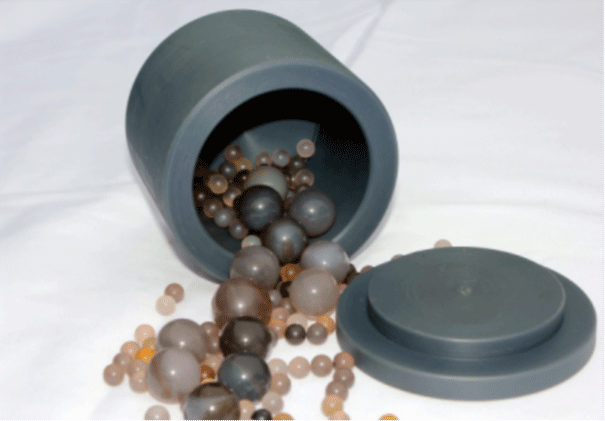
The introduction of impurities into the sample is determined by two sources: contact with the material of the working surfaces and the transfer of the substance between operations. For a centrifuge, this is the material of tubes and adapters; for the mill - the material of the grinding bowl and grinding media. Both operations contribute to the final composition of the sample.
A glass made from reinforced nylon is used where moderate weight and reduced risk of metal contamination are important. Nylon is a relatively soft polymer: it wears out solid particles less, but is itself susceptible to abrasive wear, the accumulation of scratches and the retention of fine powder in the microrelief. This affects both material loss and transfer between samples.
The wear of bowls, linings and grinding media cannot be considered constant: it depends on the hardness and abrasiveness of the material, the ratio of the masses of the balls and the sample, the duration of grinding and the rotation mode. The claim of "zero contamination" is not true for any material - tungsten carbide, zirconia, ceramics and polymers vary in the nature and extent of their contribution to the sample, but do not completely eliminate it.
Cleaning consumables is part of the technique, not a secondary operation. Residues of the previous sample in the pores of the polymer or in wear zones give overestimated results for trace components. The cleaning mode should be selected taking into account the material and should not be automatically transferred from one type of cookware to another.
Compatibility here is more important than formal similarity. The grinding bowl and centrifuge tube are subject to different loads and contact with different media, so data for one element does not describe the behavior of the other. For each position, its own limitations on temperature, environment and mechanical loads are checked.
From single sample to series: reproducibility and trial run
The transition from one sample to a series almost always reveals something that was not noticeable in a single experiment. Differences in the initial size, in the amount of dispersion medium and in the temperature at the start accumulate, and the spread of the result increases. The task of selecting a mode is not to find the “optimal” figure, but to determine the window within which the result remains acceptable.
Trial separation plan
- Record the initial sample: mass, dispersion medium, temperature at the start, method of preliminary dispersion.
- Carry out the series at constant time and variable acceleration, maintaining the same load of seats.
- Repeat the series at constant acceleration and variable time to evaluate the contribution of each factor.
- Check the inhibition profile separately: it often affects the turbidity of the supernatant more than the settling time.
- Compare the result by at least two criteria, for example, the optical density of the liquid and the mass of the sediment.
Data that should be prepared for equipment consultation
- Type and condition of the sample: suspension or powder, density of the solid phase, approximate particle size distribution.
- Properties of the medium: viscosity, density, pH, presence of additives, chemical aggressiveness.
- Required volume per cycle and number of samples in a series.
- Permissible heating and requirements for the safety of thermolabile components.
- The desired result: clarification, concentration, washing or fractionation, as well as the required completeness of separation.
Issues that are resolved before ordering, not after
It makes sense to find out in advance what rotors and tube types are available for the selected configuration, how the limit parameters change when replacing the rotor, whether active temperature control is provided, and what balancing restrictions apply. The answers to these questions determine whether the device is suitable for a particular technique, whereas the maximum speed alone does not provide such information.
A general idea of the directions of equipment and the place of the device in the laboratory line can be obtained at website TENCAN, and the characteristics of a specific configuration are in the product card and accompanying documentation. The final separation regime is always confirmed by a trial run on a real sample: only this shows whether the desired degree of clarification is achieved and whether the sample is maintained under acceptable conditions.