
Laboratory Rod Mill TENCAN — sample preparation equipment in which grinding is carried out using rods rather than balls. This choice is justified when a controlled reduction in particle size is required and it is important not to over-grind the sample, but it also requires more careful adjustment. Card laboratory rod mill provides a reference point for design and execution, but does not replace the decision of what sample, what mass and what final size the laboratory needs. Below is a practical analysis: from sample conditions and operating principles to checking the mode during trial grinding.
Why the rod mill is not a one-size-fits-all answer
Rod and ball mills are similar in external principle: rotating drum, grinding media, loading and unloading. The difference lies in the nature of the contact. Balls act primarily as impactors and provide many points of contact, whereas rods make contact along a line. Because of this, energy is distributed differently, and the proportion of fine fractions may be smaller. That is why rod grinding is considered for tasks where a relatively even granulometric composition and moderate overgrinding are needed.
This does not mean that a rod mill is better than a ball mill. For fine and ultrafine grinding, where the target size is in the micron range, planetary ball or bead mills are more suitable. The core machine occupies its niche: preparing samples before chemical or mineralogical analysis, grinding fragile materials, obtaining a product with a limited amount of dust. If the task is formulated as “to obtain the finest powder,” the choice of a rod mill must be justified separately.
The second important point is representativeness. A small sample and a larger sample behave differently even in the same drum. The result is influenced not only by speed and time, but also by the initial size, bulk density, humidity, and tendency to agglomerate. Therefore, the selection of a mode begins not with the question “which model is more powerful,” but with a description of the sample and the purpose of grinding.
Sample conditions that determine the mode
Size, weight and representativeness
The initial size must correspond to the loading hole and the working gap between the rods. Too large a piece is not captured by the grinding media and can jam the load; a sample that is too small, on the contrary, does not create enough load and gives an unstable result. The maximum piece size is a parameter of a specific model; it cannot be derived only from the size of the drum or the diameter of the rods.
The mass of the sample and the mass of the rods are different quantities, and they cannot be mixed in the calculation. The sample quantity determines how much material is in the work area and how representative the sample is for analysis. The number of rods determines the energy and nature of the impact. If the sample is too small, the proportion of rod-to-rod and rod-to-lining impacts increases and wear becomes less predictable. If there is too much sample, the material begins to dampen the movement of the grinding bodies with a “cushion”, and grinding slows down.
Material, humidity and heat sensitivity
Brittle materials are crushed predictably, plastic ones may not be crushed, but crumple, stick to rods and walls. For such samples, a rod mill is not always the appropriate tool. Humidity also changes behavior: at high humidity, bulk material clumps, sticks to the lining and is difficult to unload. Sometimes this is solved by switching to wet grinding, but such a possibility must be provided for in the design and confirmed for a specific design.
The temperature sensitivity of the sample requires special attention. Mechanical energy in the drum is converted into heat, and even short grinding can noticeably heat the sample. Air cooling of the housing reduces the temperature of the components, but does not make the process cryogenic. If a material breaks down or changes properties when heated, you need to discuss realistic cooling and temperature control options with the equipment supplier, rather than transferring the characteristics of one model to the entire range.
How does a laboratory rod mill work? TENCAN
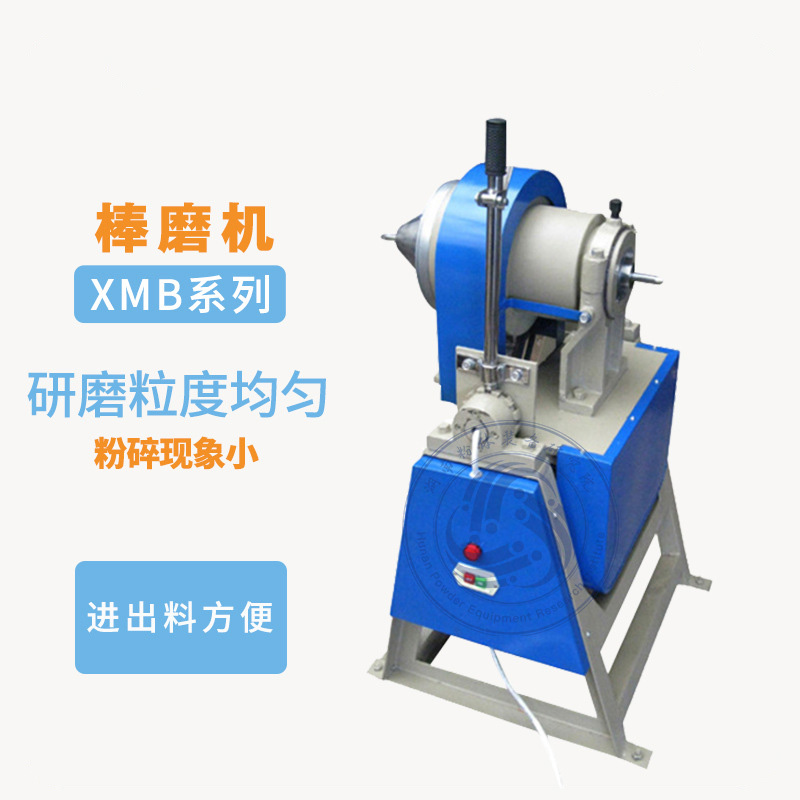
In the laboratory version, a rod mill usually includes a drum, a drive, a loading and unloading device, a frame and protective elements. The drum rotates around a horizontal axis; there are rods inside. When lifting, the rods first move along with the wall, then break off and roll down. Grinding occurs due to impact, crushing and abrasion between the rods and the material. The higher the speed, the further the rods rise and the greater the energy of each cycle, but as they approach the critical speed, they begin to press against the wall and the useful work drops.
For an approximate estimate of the critical speed, use the relation nc ≈ 42,3 / √D, Where nc is the critical speed in rpm, D — internal diameter of the drum in meters. This is a general physical assessment and not the operating conditions of a specific machine. The actual speed range, load capacity and drive type must be specified in the product documentation. You cannot substitute a diameter taken from the description of another model into the formula.
The rods must be straight and free of burrs. A bent rod changes the movement pattern, can jam and accelerate lining wear. The loading geometry is also important: the rods should not be arranged chaotically if the structure is designed for an ordered layer. Before each grinding, check the cleanliness of the drum, the condition of the rods and the absence of foreign inclusions.
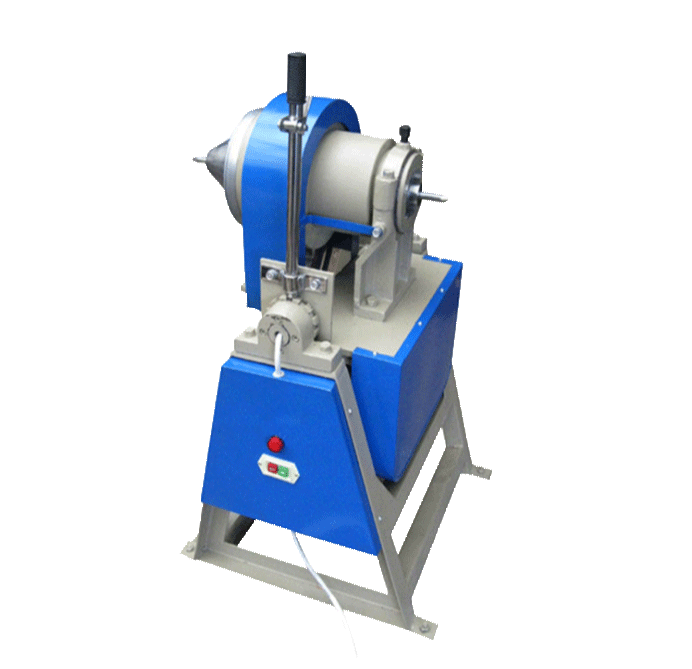
Laboratory Rod Mill TENCAN Primarily designed for sample handling where reproducibility and cleanability are important. That is why when choosing, you should look not only at the dimensions, but also at access to the drum, ease of unloading, material of the contact surfaces and the possibility of replacing wear parts.
What do the parameters mean: selection table
Passport values should be read as working conditions, and not as a promise of results. The same drum with different loading, size and time will give a different product. The table below contains questions that are helpful to ask before purchasing or trial grinding.
| Parameter | What does it mean | What to clarify |
|---|---|---|
| Drum inner diameter and length | The geometry of the working chamber, on which the volume and movement of the rods depend | Is the internal size indicated taking into account the lining; what is the length of the rods |
| Geometric and useful volume | Full drum capacity and permissible working load | What proportion of volume is recommended for rods and material; What is the difference between useful volume and geometric volume? |
| Weight, diameter and material of rods | Grinding energy, permissible feed size and wear | Are the rods included? whether other materials are available; how are they replaced |
| Rotation speed | Rod movement mode and grinding intensity | Is there any adjustment? what range is considered working; How is speed related to drum diameter? |
| Drive power | Ability to rotate drum with loading | At what load is the power indicated; Is there overload protection? |
| Lining and contact surface material | Wear and possible contamination | What materials are available; how do they relate to the hardness of the sample? |
| Loading and unloading | Ease of use, sample loss and cleaning | What size is the piece? how the material is unloaded; Is it possible to work with liquid? |
The volume of one drum, the total volume of the load, the mass of the sample and productivity over time are separately distinguished. If the description indicates the volume, this does not mean that so much material can be loaded: part of the volume is occupied by the rods, part should remain free for movement. If power is indicated, it cannot be automatically converted into productivity for the finished product: it depends on the material, size and mode.
For laboratory rod mill TENCAN The key remains repeatability and controllability, not maximum numbers. A small machine with clear geometry and cleanability is often more useful than a model with overstated capabilities that are not supported by testing conditions.
Dry and wet grinding: choice of medium
Dry grinding is simpler organizationally: no liquid is needed, fewer operations with drying and filtration. But it has limitations. Small particles tend to agglomerate and stick to rods and walls, while dust requires sample handling in a closed system. If the material is sensitive to air humidity, dry grinding may produce inconsistent results from batch to batch.
Wet grinding improves particle transport and reduces dust, but introduces new variables: the nature of the liquid, its viscosity, chemical compatibility with the material, corrosion of components and the need for subsequent separation of the liquid. Water is not suitable for all samples; sometimes a non-aqueous medium is needed, but its choice requires separate justification. Unless the mill design supports liquid handling, wet mode cannot be considered a standard feature.
In a rod mill, a pulp that is too thick dampens the movement of the rods, while a pulp that is too thin can carry away small particles and cause uneven discharge. Pulp density and solid to liquid ratio are not universal constants, but parameters that are selected for a specific sample. For the first series of experiments, it is enough to fix the mass of the sample, the volume of liquid and time, and then change only one factor.
Overheating, wear and contamination
Heat in a rod mill occurs due to friction, impact and drive operation. The temperature of the working space of the installation and the temperature of the sample itself are not the same thing. The body can remain moderately warm, while local contact areas become hotter. If a technique requires temperature control, you need to measure exactly what is important to the sample and record how you measure it.
Air cooling and liquid nitrogen cooling are fundamentally different solutions. Conventional blowing reduces the temperature of the nodes, but does not turn the grinding into cryogenic. The presence of a casing, ventilation slots or thermal insulation does not in itself confirm a low-temperature regime. For heat-sensitive materials, this issue should be clarified from the documentation of the specific design, and not from the appearance of the machine.
Wear of rods and lining is inevitable. Its speed depends on the hardness and abrasiveness of the sample, grinding time, speed and surface condition. Tungsten carbide, ceramic or zirconia do not mean “zero contamination”: any contact surface material can transfer into the sample, just to varying degrees. Material selection is a trade-off between durability, cost, friability, and acceptable levels of impurities in the assay.
The grinding bowl from a planetary mill is not automatically compatible with the drum of a rod mill, even if both products are grinding equipment. They have different kinematics, mounting and loading conditions. Compatibility of consumables is confirmed only by documentation for a specific machine. It is important to clean the drum, rods and discharge assembly between samples; For hard-to-reach places, use suitable tools and compatible cleaning products that do not leave residues.
From sample to batch and testing the regime during trial grinding
Scaling without linear transfer
Moving from a laboratory sample to a larger batch is not a matter of multiplying the grinding time. As the load increases, the heat dissipation, the trajectory of the rods, the probability of jamming, and the uniformity of unloading change. The laboratory result characterizes specific conditions: mass, size, medium, speed, time. It can be transferred to another volume only after checking, and not according to proportion.
For comparability of results, the method of sampling, its humidity, the initial distribution of particles and the method of analysis are recorded. When fineness is measured by sieve analysis and laser diffraction, results may vary; This is not necessarily an error, but the methodology should be the same when comparing modes. It is impossible to promise a typical minimum size for any material: it depends on the properties of the sample and grinding conditions.
Checklist for trial grinding
Before the first series, it is useful to prepare a short sample passport and test plan. This saves time and makes the result reproducible.
- Description of the material: nature, original size, bulk density, humidity, tendency to stick, thermal sensitivity.
- Purpose: target size, acceptable proportion of large and small fractions, measurement method.
- Limitations: Acceptable contamination, possibility of wet grinding, cleaning requirements between samples.
- Configuration: mill model, drum volume, rod material and size, speed, loading weight.
- Mode: dry or wet grinding, medium, time, pauses, temperature control.
- Analysis: a method for selecting a representative sample after grinding and a method for determining the size.
It is better to build a trial grind as a sequence with a change in one parameter. First, the load and speed are fixed, then the time is varied, after which the influence of the feed size or environment is checked. If the result is unstable, look for the cause in sample heterogeneity, insufficient cleaning, overheating or improper unloading, rather than immediately changing the equipment model.
To inquire at TENCAN It is useful to indicate the sample material, its mass, initial and desired size, acceptable contamination, handling of liquid and temperature requirements. Based on these data, the design of the laboratory rod mill, the material of the rods, and the trial grinding procedure can be discussed. Website TENCAN helps to check the direction of the equipment, and the card laboratory rod mill — clarify the design and available options. The final regime is established based on the results of our own tests, and not on the promise of a universal size.