
Laboratory Jet Mill TENCAN Designed for dry fine grinding and deagglomeration of powders. There is no grinding bowl or grinding media: the particles are accelerated by the gas and are destroyed upon collision. The setup comes down to raw material supply, gas pressure, flow rate and product collection. The design is described in laboratory jet mill card.
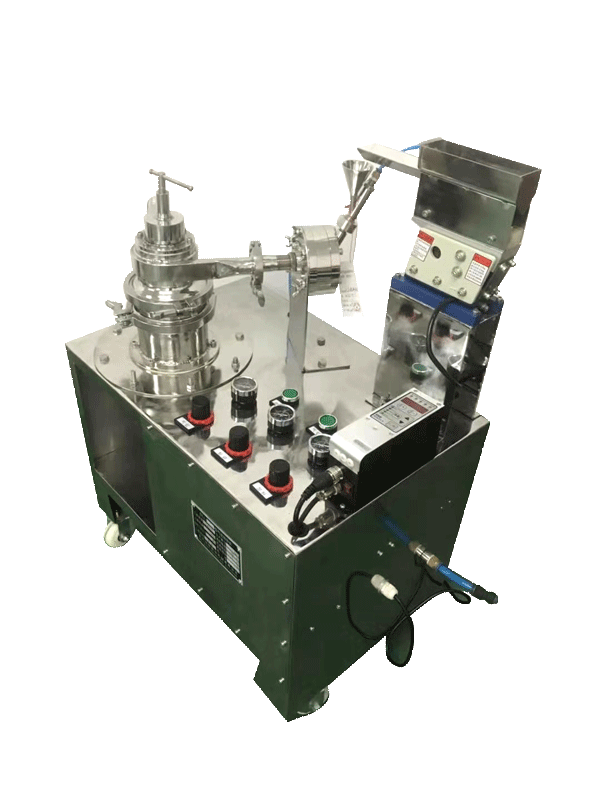
When is jet grinding appropriate?
A jet mill is useful when you need dry, fine powder without grinding from grinding media, and the material is already limited in size. It is suitable for fragile samples, deagglomeration and preparation for analysis. Limitations include dust collection, humidity, caking and gas consumption. Large pieces are crushed first: overloading reduces efficiency and accelerates wear.
Operating principle and role of nodes
Gas through the nozzles creates a zone of high speeds. Shredding occurs during oncoming collisions, and in some designs - when hitting a target. The classifier, if present, returns large particles and outputs fine fractions. The mill, feeder and collector work as a single circuit: an error in any unit results in a large product or unstable dust removal.
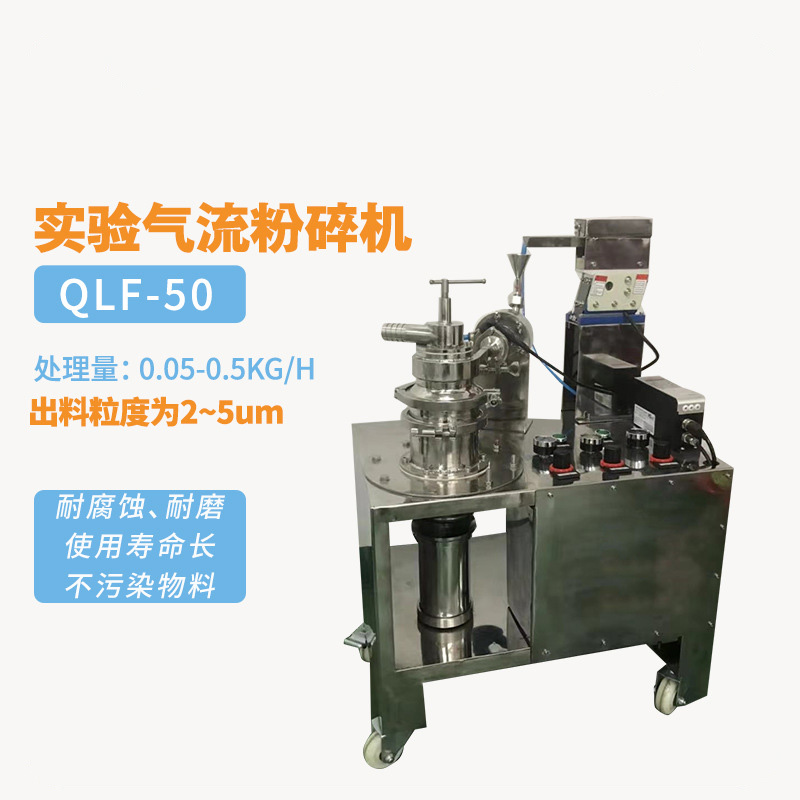
Pressure, feed and size
Distinguish between pressure in the line, in front of the nozzle and speed at the exit. The compressor pressure gauge does not equal the impact energy. Increasing pressure generally increases particle velocity, but increases gas consumption and nozzle wear. Too much feed overloads the chamber: the product becomes rough; too low increases specific consumption. The coarseness also depends on the original size, hardness, humidity and measurement method. The values are determined based on the manual and trial grinding.
Gas pollution and treatment
The absence of grinding media reduces the risk of grinding, but does not mean zero contamination. Impurities can be introduced by working surfaces, nozzles, seals and dust collector; materials must be compatible with the sample. Moisture is removed and the gas is cleaned of oil and particles. Gas expansion can cool the flow, but a conventional jet mill is not a cryogenic machine.
What to check during test grinding
- initial size, moisture content and tendency to agglomerate;
- gas pressure, supply range and flow stability;
- material of nozzles and lining, permissible wear;
- size, particle shape and collection efficiency after the same preparation.
To select, please indicate the desired size, sample weight, material properties and available gas pressure. General directions TENCAN are given on home page; Check the configuration parameters in the manual.