
A ceramic grinding drum is often perceived as a secondary part: the main thing is the mill, and the container can be selected according to its volume. In practice, it is the drum that determines what material the sample comes into contact with, how much energy is transferred to the grinding media, how quickly the mixture heats up, and how easy it is to obtain a reproducible result. For the laboratory, selection errors are costly: a batch of sample may be lost due to impurities, insufficient grinding energy, suspension leakage, or surface damage. Therefore, the choice begins not with the volume, but with the task, the limitations of the methodology and checking compatibility.
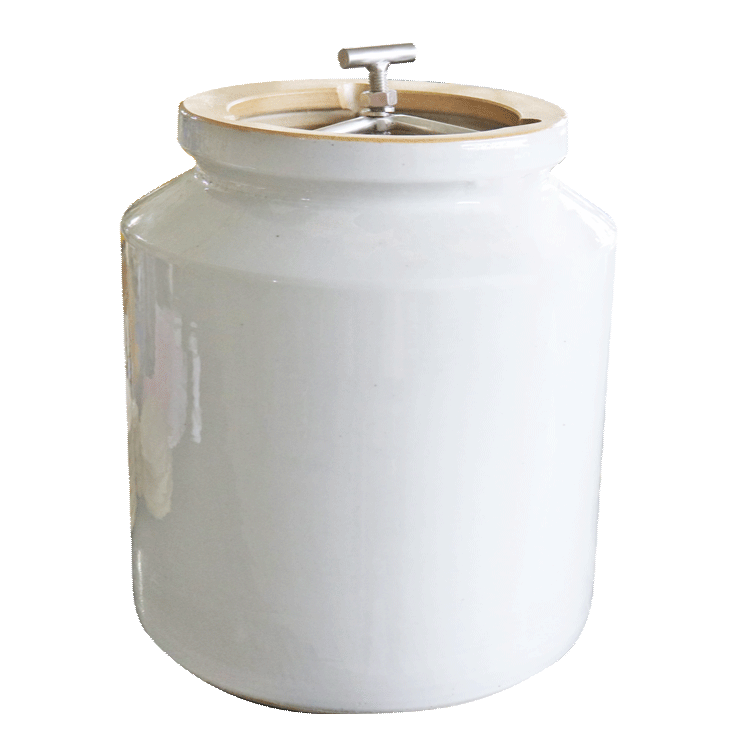
Below is a practical approach to the ceramic grinding drum as a working element, and not just a container. It is separately noted what information needs to be confirmed from the documentation of a particular product, and what conclusions cannot be drawn from a photograph or category name.
Challenge: the drum as part of the technique, not just a container
In the card TENCAN The ceramic grinding drum belongs to the group of drums for roller ball mills. This is important but not sufficient information: it indicates the purpose of the family, but does not replace checking the actual ceramic material, internal dimensions, cover design, load capacity and grinding media requirements. Link to ceramic grinding drum card TENCAN useful for clarifying the position, but specific parameters should be taken from the current product documentation.
The drum performs three functions simultaneously. Firstly, it forms a working chamber in which the grinding media move and the sample is located. Secondly, it is a wear part: its surface is in contact with abrasive powder, liquid and grinding media. Third, it serves as a mechanical interface to the mill: the outer diameter, length, neck shape, cover and loaded weight of the drum affect the installation and rotation mode. If we consider only the volume, the last two factors are left out of the calculation, although they often determine the suitability of the drum.
Before selection, it is useful to fix the experimental conditions. These include: nature and hardness of the sample, initial fineness, target particle size, acceptable contamination, dry or wet grinding, chemical reactivity of the medium, required sample weight, type of mill and available grinding media. For trace analysis, elements contributed by the drum material can be critical; For coarsely ground ceramics, wear and impact resistance are decisive. The same drum cannot be equally convenient for all these cases.
Ceramic material and impurity transfer
The word “ceramics” combines different materials, and it is impossible to transfer the properties of one of them to the entire class. In laboratory practice, aluminum oxide, zirconium dioxide, silicon carbide, agate and other options are found. They differ in hardness, viscosity, density, chemical resistance and wear patterns. Unless the actual drum material is specified in the documentation, it cannot be assumed that it is chemically inert or that its particles will not interfere with the analysis.
Conventionally, several compromises can be identified. Aluminum oxide is often considered a relatively accessible and hard material, but wear can add aluminum to the sample. Zirconium dioxide has a high density and viscosity, but its use does not mean that it is free of contamination: zirconium particles may enter the sample. Silicon carbide is hard and wear-resistant, but this does not make it universal for all chemical environments. It is important to discuss these differences with the supplier on a product-specific basis and not infer them from a generic group name.
In the context of grinding, “zero pollution” does not exist. Sources of impurities can be the drum itself, the grinding media, the cover, the seal, the previous sample, and even dust from the environment. The ceramic drum reduces the risk of metal contamination compared to some metal chambers, but does not eliminate ceramic wear. If the technique is sensitive to certain elements, it is necessary to evaluate not only the drum material, but also the entire contact path.
Chemical resistance also needs to be checked. Ceramics may be resistant to some reagents and not sufficiently resistant to others; much depends on the composition, porosity, presence of glaze and surface condition. The cap and gasket may have polymer elements that limit solvent selection or temperature. Therefore, when working with acids, alkalis, salts and organic media, the chemical compatibility of a specific design should be inquired rather than relying on a general understanding of ceramics.
For sensitive analyses, control grinding without a sample or with a matrix of similar composition is useful. It allows you to see the contribution of the drum and grinding media to the background values. This control does not prove suitability for any sample, but helps detect obvious carryover of contaminants prior to a series of experiments.
Wear, grinding media and surface condition
The wear of the ceramic drum appears gradually. The inner surface may become dull, change shade, or acquire ring marks or local depressions. Chips are possible on the edges of the neck and seating surfaces of the lid. If there is a gasket in the structure, it ages, loses its elasticity and begins to trap particles. These changes affect not only the resource, but also the purity of the grind.
The rate of wear depends on the hardness of the sample, the size and weight of the grinding media, the duration of grinding, the rotation speed and the presence of liquid. High hardness abrasive powder wears the surface faster than soft material. Large grinding bodies give a more pronounced impact effect, small ones give a larger contact area, but a different nature of energy transfer. Recommendations for grinding media cannot be transferred from a metal drum to a ceramic one without checking: the fragility of ceramics and permissible shock loads may vary.
Grinding media are a separate element of the technique. Their material, diameter, density and quantity determine the efficiency of grinding and the level of contamination. Ceramic bodies are not necessarily compatible with every ceramic drum: hardness, shape, surface quality and absence of defects are important. Metal bodies in a ceramic drum require special care as metal may transfer and damage the inner surface. This combination is only permissible if confirmed by the manufacturer.
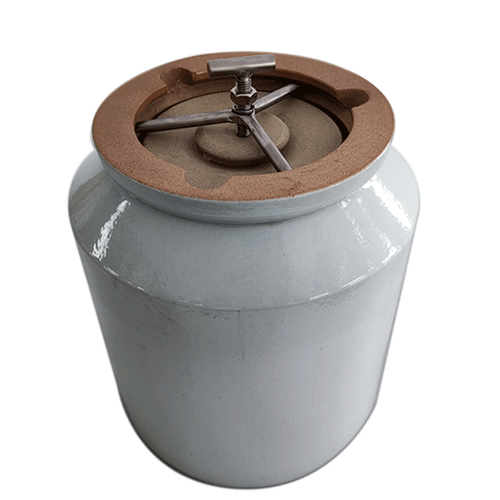
It is useful to keep a log of the condition of the drum: record the start date of work, materials, modes, inspection results and signs of wear. If the surface begins to change noticeably, do not continue the series without checking. Sometimes it is enough to allocate a drum for less demanding tasks, but such a decision must be conscious. For trace analysis, it is better not to use a container with an unclear history, even if visually it looks clean.
Separately, you need to check the completeness. Availability of cover, seal and grinding media depends on the specific delivery; these elements should not be inferred from the image. If the card does not indicate whether grinding media are included in the kit, this needs to be clarified. An incorrectly selected seal can cause leakage and contamination greater than the ceramic material itself.
Dimensions, workload and weight
The nominal drum volume is a guide only. The working load is always less than the full volume, because part of the space is occupied by the grinding media, and particles and liquid need space to move. It is impossible to convert the volume into the mass of a sample without taking into account the bulk density, suspension density, volume of grinding media and the manufacturer’s recommendations. The same drum volume can accommodate different masses of different materials.
External dimensions are important for installation: the diameter of the cylindrical part, the overall length, the shape of the neck, the height of the cover and the presence of protrusions. The drum must lie stably on the rollers, rotate without beating and not touch the elements of the mill. If the outer surface is contaminated with powder, the adhesion of the rollers may be affected; this is especially noticeable with wet grinding and leaks. The cleanliness of the outer surface is not a cosmetic requirement, but a condition for stable rotation.
| Parameter | What does it define | What needs to be clarified |
|---|---|---|
| Nominal volume | Total chamber capacity | Working volume and permissible load |
| Internal dimensions | Movement of grinding media and sample | Diameter, length, wall profile |
| External dimensions | Roller mill landing | Diameter, length, permissible runout |
| Drum curb weight | Load on drive and rollers | Empty Drum Weight and Mill Limit |
| Cover and seal | Sealed and easy to clean | Material, design, compatibility with the environment |
The weight of a loaded drum is often underestimated. Ceramics are denser than they appear, and grinding media add significant stress. If the mill is designed for a certain weight, exceeding it can lead to overload of the rollers, heating and rotation instability. You need to check not only the empty drum, but also its condition when fully loaded.
When moving from a small drum to a larger one, you cannot simply increase the mass of the sample proportionally and leave the same grinding time. The path of the grinding media, the frequency of collisions, heat generation and uniformity of mixing change. A large container may require a different ratio of grinding media and material. These issues can be resolved by trial grinding, and not by recalculating one parameter.
Mill Compatibility: What to Check Before Installation
The ceramic drum for the roller ball mill transmits motion by friction with the rollers. Therefore, not only the dimensions are important, but also the condition of the outer surface, alignment, absence of cracks and chips, and reliable fixation of the cover. A drum with a damaged lip may rotate unevenly, and a poor seal may cause powder or liquid to eject. Before installation, you should make sure that the specific mill model allows this weight, diameter and length of the drum.
A ceramic drum cannot be automatically assumed to be compatible with other types of equipment. For example, laboratory ball mill with stirring has a different operating principle: it uses a mixing organ and a fixed working chamber, rather than a freely rotating drum on rollers. The geometry, mount, cover and method of energy transfer are different here. The roller mill drum should not be transferred to the mixing plant without the manufacturer's approval.
Compatibility checking includes several levels. Mechanical level: fit on rollers, no runout, permissible weight, clearance to fixed parts. Kinematic level: range of rotation speed and stability of movement at a given load. Chemical level: resistance of drum, cover and seal to the environment. Operational level: easy to load, unload and clean. If at least one level is not confirmed, suitability cannot be promised solely on the basis of close volume.
Heating requires special attention. When grinding for a long time, the drum and contents heat up, and ceramics with low thermal conductivity can create an uneven temperature field. This affects polymer compaction, solvent volatility, and sample properties. Conventional air cooling does not become cryogenic just because the sample needs to be kept cold. Cryogenic conditions require a separate validated configuration.
Cleaning and Cross Contamination Control
Ceramic surface does not mean sterility. After grinding, particles remain on the walls, and fine fractions can be retained in microroughnesses and near the seal. If the drum is used for different materials, residual carryover may skew the result more than expected wear. Therefore, cleaning should be part of the procedure, and not the last step before the next experiment.
The sequence usually includes removal of grinding media, dry cleaning with a soft brush or vacuum cleaner, rinsing with a suitable solvent and drying. The specific reagents used depend on the drum material, seal and nature of the contamination. Abrasive powders and harsh scrapers can damage the surface and must be used with care. Acids, alkalis and strong solvents are permissible only if the chemical compatibility of all structural elements is confirmed.
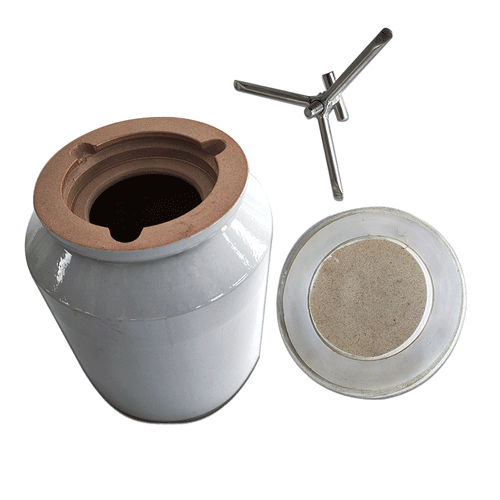
The cover and gasket should be cleaned separately if the design allows it. An unknown elastomer should not be soaked in a solvent for a long time: it may swell, lose elasticity, or release substances into the sample. After drying, it is useful to inspect the inside surface in good light and check that there is no solvent odor. For trace work, additionally use control washing or blank grinding.
When working with hazardous powders and liquids, cleaning must be carried out in accordance with the safety data sheet and laboratory regulations. There is no need to describe a universal neutralization procedure: it depends on the substance. The purpose of the article is to emphasize that drum cleanliness and proven compatibility are more important than the speed of transition to the next sample.
Trial Grinding: How to Get Comparable Data
Test grinding is needed to check not only the coarseness, but also the entire set of conditions: tightness, heating, wear, ease of unloading and reproducibility. Before starting, record the drum identifier, its material and dimensions, type and weight of grinding media, sample weight, presence of liquid, grinding speed and time. If the speed or time is set by the mill management, you should not deviate from them without reason.
It is better to start with short intervals and minimal confirmed load to evaluate the behavior of the system. After each interval, check the lid, leakage, heating and surface condition. The sample is analyzed using the selected particle size distribution method, and not just visually. To compare options, change one parameter at a time, otherwise it is impossible to understand what influenced the result.
It is useful for the supplier to communicate: the intended sample material, its original size, required mass, dry or wet mode, chemical environment, acceptable impurities, mill type, available speed and temperature limitations. This information helps you select a drum and grinding media without making unconfirmed promises. If there is no compatibility data, it should be considered an open issue and not a resolution.
A ceramic grinding drum is not a universal replacement for any chamber. Its benefits are realized when the material, geometry, cleaning and operating conditions are matched to the application. Checking the actual documentation, trial grinding and surface condition control provide more than a choice based on volume or appearance alone. This approach reduces the risk of contamination, premature wear and poor reproducibility.