
The transition from laboratory grinding to an industrial batch is rarely a matter of simply increasing the sample weight. The conditions for heat removal, the residence time of the material in the chamber, the nature of wear and the requirements for reproducibility change. In the card TENCAN the highlight of this review — Industrial Stirring Ball Mill. Below we will not talk about the list of passport numbers, but about what sample conditions and installation components determine the result and what is worth finding out before trial grinding.
From laboratory sample to industrial batch: what changes
In the laboratory, the researcher usually sees the result on a small sample and can quickly repeat the experiment. In the industrial version, other factors come to the fore: energy distribution throughout the chamber volume, residence time of particles, heating of the suspension or powder, ease of unloading and cleaning. Even the same material, when moving to a larger plant, can give a different particle size distribution if you change not only the mass of the load, but also the ratio of grinding media, mixing speed and unloading method.
Therefore, the first step is to divide the tasks. It is one thing to obtain a representative laboratory sample for analysis, another to produce a batch with a given upper limit of size, and a third to prepare a suspension with a certain rheology. The industrial stirred ball mill can be used in a variety of configurations, but the specific configuration must suit the purpose. You cannot transfer a laboratory regime to a production facility just because the name of the material is the same.
Before discussing the model, it is useful to note:
- intermittent or continuous operation is assumed;
- what working volume and what loading weight are actually needed;
- what is the original particle size and by what method is it measured;
- what result is considered acceptable and by what method it is checked;
- whether the material will be in the form of a suspension or dry powder;
- whether heating is acceptable and what temperature control is required;
- what materials of the chamber, mixer and grinding media are acceptable in terms of cleanliness.
These answers are more important than the desire to immediately choose the maximum speed or the largest volume. Industrial execution makes sense when the task requires scale and repeatability, not just the larger appearance of the installation.
How does an industrial stirring ball mill work?
In a stirred ball mill, grinding occurs in a chamber where the grinding media are located. The mixer transmits movement to them, and the particles of material find themselves between the grinding bodies and experience shock and shear effects. Unlike a drum mill, where the movement of the medium is largely determined by the rotation of the drum itself and gravity, here energy is introduced through a mixing element. Therefore, the speed of the mixer, the geometry of the chamber and the filling of grinding media influence the process more directly than the nominal volume alone.
The name “industrial” indicates purpose and scale, not versatility. Depending on the design, the installation can work with suspension or dry material, in batch or continuous mode, with a cooled chamber and different lining options. These features need to be confirmed based on a specific card and technical specifications, and not deduced from the name of the series alone. Also, do not confuse an agitated ball mill with a bead mill: they have different types of grinding media, scale and application conditions, although both use the movement of a medium in a chamber.
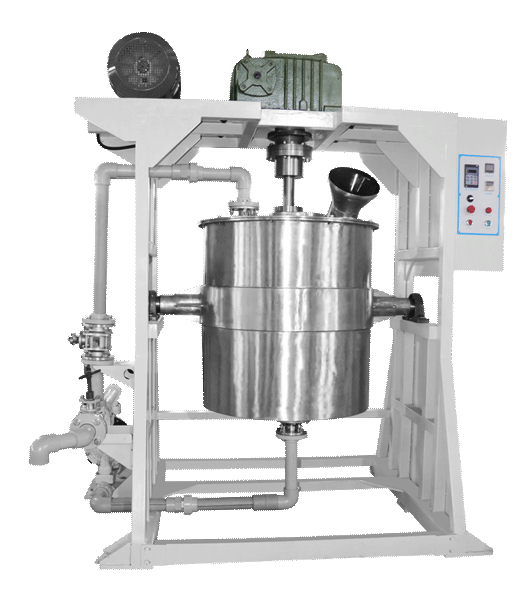
To understand the process, it is useful to distinguish three levels: apparatus, mode and material. The device sets the permissible loads and the method of energy supply. The mode determines how much energy a unit of mass will receive and how long the material will remain in the processing zone. The material is responsible for its behavior under load: hardness, brittleness, tendency to agglomerate, suspension viscosity and tool wear. An error occurs when they try to explain one level to another. For example, “the mill does not produce the required size” may not mean a lack of capacity, but an unsuitable environment, too short a residence time or excessive agglomeration.
In an industrial scheme, it is important to provide not only for grinding, but also for the operations around it: preparing the load, separating the grinding media, unloading, cleaning and sampling. If these operations are not reproducible, the output will appear inconsistent even with the same mill settings.
Grinding mode: speed, load and time
The mode cannot be reduced to one number. The result is simultaneously influenced by the mixing speed, the number and size of grinding media, the degree of filling of the chamber, the ratio of material and medium, as well as processing time. Changing one parameter often requires revising another. Therefore, when selecting, it is better to rely on the specific energy and the observed particle distribution, and not just on the stirrer speed.
Energy per unit of mass, not just revolutions
Increasing the speed usually increases the intensity of the impacts, but at the same time increases heat and wear. A higher speed does not guarantee a smaller particle size: under certain conditions, particles begin to aggregate and the suspension begins to heat up more. In addition, the measurable power may depend on the viscosity of the medium and the filling of the chamber. If you compare two modes, you need to record not only the speed, but also the mass of the material, the type and number of grinding media, duration and temperature. Otherwise the comparison will be incomplete.
Chamber filling and number of grinding media
Too few grinding media reduces the likelihood of contact and makes the process less productive. Too much filling restricts the movement of the medium, increases the load on the drive and increases the heating. The optimal degree of filling depends on the design of the apparatus and the properties of the suspension; There is no universal percentage for all materials. The size of the grinding media is also a trade-off: larger media are capable of breaking up large particles, but may produce less uniform distribution and greater wear; Small bodies increase the number of contacts, but their energy per impact is lower.
Residence time and circulation
In batch mode, the grinding time is set directly, although as grinding progresses, both the rheology and the effectiveness of the effects change. In continuous mode, not only the average residence time is important, but also the distribution of time: some particles may pass through the chamber faster and not receive sufficient treatment. Circulation through a storage tank sometimes helps to even out the result, but requires control of flow and temperature. Without measurements, it cannot be said that increasing the time always improves the product: after a certain stage, agglomeration or unwanted heating may begin.
| What do they change? | Likely effect | What to check |
|---|---|---|
| Mixing speed | Increased intensity, heat and wear | Power, temperature, particle distribution |
| Number of grinding media | Changing contact frequency and load | Filling, power consumption, unloading |
| Grinding media size | Shift between impact and abrasion | Initial size, wear, product purity |
| Solid phase fraction | Change in viscosity and mobility of the suspension | Rheology, deposition, temperature |
| Flow through the chamber | Change of stay time | Productivity, time management |
Such a table does not replace the test, but it helps not to change everything at once. If you regulate speed, load and flow at the same time, it is difficult to understand which factor has the effect.
Dry and wet grinding: not interchangeable modes
Wet grinding involves the presence of a liquid medium that transports the material, affects viscosity and can aid in deagglomeration. But the fluid is not just a “convenience additive”: it changes energy exchange, sedimentation, wear and subsequent processing. Dry grinding eliminates the drying step and is sometimes more convenient for powder products, but is accompanied by dust formation, possible agglomeration and special requirements for sealing and cleaning. For an industrial ball mill with stirring, the specific design and permissible mode need to be clarified: the name of the equipment class does not in itself prove that the installation is intended for both dry and wet grinding.
Separately, it is worth distinguishing between grinding and disagglomeration. If the initial powder consists of strong primary particles, but forms loose agglomerates, the problem can be solved by soft dispersion. If the particles themselves need to be destroyed, different energy and different time are required. Externally, both processes may look like “grinding”, but the selection criteria are different. In a wet circuit, the result is also affected by pH, ionic strength and additives; they cannot be assigned arbitrarily without testing on specific material.
For dry operation, dust collection, sticking prevention and the ability to separate grinding media are important. For wet - stability of the suspension, absence of unwanted sedimentation in pipelines and ease of flushing. In both cases, you need to understand how the size will be measured: the results of sieve analysis, laser diffraction and microscopy answer different questions. You cannot compare values obtained by different methods as if they were the same quantity.
Heat and Cooling: Where Temperature is Measured
The energy supplied to the grinding media ultimately turns into heat. In an industrial installation this is more noticeable than in a short laboratory experiment: the mass is greater, the processing time is longer, heat removal depends on the geometry of the chamber and the flow rate of the medium. The temperature of the working chamber is not equal to the temperature of the sample. A sensor on the wall may show one value, and local zones may show another. Therefore, when selecting, you need to find out where the sensor is installed, what exactly it measures and how the cooling is regulated.
Air cooling and liquid nitrogen cooling are fundamentally different solutions. A regular blower or water jacket does not become cryogenic because the material is heat sensitive. If cryogenic assistance is considered, its availability, flow rate and acceptability for a particular design must be confirmed separately. A standard installation should not be described as cryogenic without documentation.
Heating affects not only the safety of the material, but also the viscosity of the suspension, vapor pressure and wear. In some applications, it is the temperature limit that determines productivity: the mill could transfer more energy, but the product cannot be overheated. Then the solution may not be to increase the speed, but to reduce the specific load, increase heat removal, or change the processing scheme. For test grinding, it is useful to record the temperature over time, not just the start and end values.
Grinding media, lining and addition of impurities
Grinding media are a consumable element that is both part of the process and a source of possible contamination. Material, density, size, shape and surface quality affect grinding efficiency and wear. A denser material can transfer more energy for the same size, but this does not automatically mean an advantage: compatibility with the apparatus, durability in a given environment and acceptable levels of impurities in the product are important.
Tungsten carbide is discussed as a material with high density and wear resistance, but “wear-resistant” does not mean “wear-free.” Any grinding media gradually loses mass, and wear products pass into the sample. Ceramics, zirconia, steel and other materials have different trade-offs in hardness, corrosion resistance and cost. There is no one material that guarantees zero contamination for any application. In addition, a randomly selected ball does not prove compatibility with a specific industrial mill: diameter, load capacity, lining material and cleaning mode must be confirmed.
The lining and agitator are also involved in contact with the material. If one combination of materials was used in the laboratory and another is assumed in an industrial installation, the result and impurity profile may change. For sensitive materials, it is important to discuss not only the “inertness” of the material, but also cleaning between batches, the presence of dead zones, and residue control procedures. Flushing must be compatible with the design and not destroy seals or introduce new contamination.
A practical approach is to first determine the acceptable level of impurities and a method for controlling it, then select a class of grinding media, and then check wear on real material. If the manufacturer has not confirmed the compatibility of a consumable item with the device, it cannot be considered a standard package or a recommended solution.
What to check during test grinding
The trial grind should answer specific questions and not just demonstrate the operation of the unit. It is useful to prepare a protocol in advance: what batch of material was used, how the sample was taken, what method was used to measure the initial and final sizes, how long the experiment lasted, what temperature was recorded and how the chamber was cleaned. If several modes are compared, a limited number of parameters need to be changed, otherwise the result is difficult to explain.
- Check whether the original particle distribution is reproducible from batch to batch.
- Record the actual weight of the load, and not just the nominal volume of the chamber.
- Clarify how the grinding media are separated and how their wear is controlled.
- Compare fineness using the same method for all samples.
- Record the temperature during the process, not just after unloading.
- Assess whether the color, odor or flowability of the material changes.
- Check cleaning and moving on to next material.
- Find out which mode is considered working and which is only starting.
- Discuss how a representative sample will be collected from a production batch.
- Clarify which parameters can be adjusted during the process and which are set in advance.
For an industrial stirred ball mill, it is especially important to understand the relationship between laboratory and production scale. If in a small installation the result is achieved in a short time, this does not guarantee the same in a large chamber: heat dissipation, residence time distribution and hydrodynamics are affected. Sometimes it is useful to conduct a series of experiments with different specific energies and plot the dependence of the size on the energy expended, but only with correct measurements of power and temperature.
You shouldn’t promise yourself a “perfect” result based on one indicator. For one task, the upper limit of particle size is critical, for another - the absence of agglomerates, for a third - the preservation of the crystalline form or the minimum addition of metal. The acceptance criterion must be formulated before testing, otherwise any result will seem controversial.
Selection criteria and request information
Choosing an industrial agitated ball mill starts with the material and scale, not the desired brand. It is necessary to determine the mode, working volume, permissible load, requirements for dry or wet grinding, thermal conditions and permissible contact materials. Then check which of these conditions are confirmed for a particular execution. If some data is missing, it should be queried rather than supplemented with assumptions.
In the request, it is useful to indicate: the name of the material and its behavior during grinding, the initial size and method of analysis, the required result, one-time and monthly requirements, permissible heating, the presence of aggressive components, cleanliness requirements, available areas and heights, as well as the need for periodic or continuous operation. To select consumables, you need separate information about compatibility with the device, acceptable wear and cleaning procedures. This is not bureaucracy, but a way to separate confirmed parameters from general promises.
On the website TENCAN you can check the directions of the equipment and the card of the selected model, and the final decision can be made based on the results of trial grinding on real material. An industrial ball mill with stirring is a device in which the result depends on a set of conditions: medium, loading, heat removal, grinding media and control method. That is why selection of the regime and testing on a representative sample remain mandatory steps, regardless of the scale of the installation.