
The transition from a laboratory sample to a batch of suspension often reveals a problem that is not visible in a small volume: the powder is unevenly wetted, lumps remain on the walls, and viscosity varies from batch to batch. In such problems they consider hydraulic twin shaft dissolver TENCAN — Equipment for mixing and dispersing rather than grinding. Its task is to homogenize the powder, liquid and additives, break up large agglomerates and ensure a reproducible distribution of components. If it is necessary to reduce the primary particles or obtain a given size distribution curve, another class of equipment is needed: a planetary, drum or bead mill. Mixing these tasks leads to errors in selecting a machine and mode.
The problem that a hydraulic twin-shaft dissolver solves
A dissolver is used where it is necessary to quickly involve a bulk component in a liquid medium and obtain a stable suspension or paste. In the paint and varnish, ceramic, catalyst, battery and other fields, the preparation of powder materials often begins with dispersion: the dry powder contains agglomerates, which the liquid must moisten and separate into smaller formations. This is not the same as grinding. The dissolver does not promise to reduce the size of the primary particles to mill level; it creates conditions for wetting, distribution and disagglomeration. Therefore, when choosing, the goal is first formulated: to obtain a homogeneous suspension, remove lumps, stabilize the viscosity, or prepare the mass for the next operation.
The two-shaft design in the name indicates two working bodies. In a typical design, one shaft is responsible for the overall flow and entrainment of the entire volume, the second is responsible for the local high shear zone. The specific geometry of the shafts, the direction of rotation, the presence of a scraper, the type of working element and the control procedure are checked from the card and the manual of the specific model. You cannot transfer the layout of one machine to the entire range. For practice, it is more important to understand what processing zones there are in the working tank and how they interact with the actual rheology of the product.
The word "hydraulic" also requires precise reading. The name indicates the hydraulic unit, but one cannot conclude from the name alone that hydraulics are responsible for heating, vacuum, cryogenic processing or fine grinding. Most often we are talking about the drive or movement of the working element, but the function and parameters of the hydraulic station must be looked at in the documentation. This is fundamental: hydraulic lifting, fixing and maintenance affect ease of operation, safety and line layout, but do not replace mixing performance. Brand TENCAN; The full name of the company is Changsha Tianchuang Powder Technology Co., Ltd. The positioning and direction of the equipment can be checked by website TENCAN, and take specific data only from the current card of the selected car.
How does a twin-shaft dissolver work and what does “hydraulic” mean?
The working capacity of a dissolver is not a “jar” or a grinding glass. This is a process vessel that combines mixing, wetting and dispersing. In the twin-shaft design, it is important to separate macroscopic mass movement and local shear. The first prevents stagnant zones and ensures powder entrainment, the second works with agglomerates and phase boundaries. If the machine is selected only by the volume of the container, but not by the viscosity and the required shear, situations are possible when the entire volume is formally mixed, but lumps are retained or the product overheats from excess circulation.
Two processing zones
The practical meaning of two shafts is the ability to distribute functions. One organ can create a common flow, bring material to the dispersion zone and renew the contact surface. Another is to provide more intense impact in a local area. It is important for the reader not to memorize the proposed diagram, but to check exactly how the shafts are made, what working parts are installed, what gaps are normalized, and whether replacement elements are available. If the card does not indicate the function of each shaft, this question should be asked to the supplier prior to testing. You should not independently attribute to the machine the functions of a scraper, anchor or high-speed disk based solely on appearance.
Hydraulics: a function to be clarified
The hydraulic unit can affect the raising, lowering, fixing or positioning of the implement. For operation, not only the name is important, but also the service conditions: access to the hydraulic unit, safety interlocks, condition of the seals, brand of working fluid according to the manual, procedure for checking hoses and connections. It is impossible to determine the operating pressure of a hydraulic system or the permissible load from a photograph. This information relates to a specific model and must be confirmed by a passport. If the description contains only a general phrase about the hydraulic drive, instructions and a maintenance diagram are requested for a test run.
Card parameters: what really affects the result
A technical card is needed not for copying numbers into an article, but for understanding working conditions. The same nominal volume does not indicate the actual load: powder weight, slurry density, solids fraction and free flange determine how much material can be safely processed. The drive power itself does not guarantee the quality of dispersion if the geometry of the working body and the viscosity of the medium do not correspond to the task. The rotational speed is important along with the diameter of the working element, because it is the peripheral speed and the shear zone that determine the impact on the agglomerates. Therefore, the parameters are read in conjunction, and not one at a time.
| What is indicated | What does this mean | What to clarify |
|---|---|---|
| Total volume of working capacity | Geometric capacity, not workload or sample mass | Minimum and maximum load, solids fraction, permissible level |
| Drive power | Torque and energy reserve, but not the only quality criterion | Drive type, starting mode, overload protection, behavior in viscous media |
| Rotational speed | One of the factors of shear and circulation; without geometry does not give a complete picture | Control range, stability, permissible viscosity, measurement method |
| Diameter and type of working body | Affects local shear, clearance and surface renewal | Geometry, material, wear, replaceability, distance to bottom and wall |
| Hydraulic unit | Can provide movement or fixation; function depends on execution | Purpose, blocking, working fluid, maintenance, access to components |
| Contact material | Determines resistance and possible transfer of impurities | Material grade, media compatibility, cleaning, wear monitoring |
Separately, the volume of the container, the total volume of the load, the mass of the dry powder and the productivity of the finished suspension are distinguished. If the description indicates volume, this does not mean that the machine will work equally with any density and viscosity. For heavy pastes, starting torque, drive cooling and circulation stability are important. For dilute suspensions, uniformity of distribution and the absence of dead zones come to the fore. In the card of a specific model, they look for exactly those parameters that relate to it; You cannot transfer the characteristics of one design to the entire series.
Dry powder, paste and suspension: loading order and mode
The behavior of the dissolver depends not only on the machine, but also on how the components are introduced. Dry powder is added to the liquid so that it does not form dense lumps on the surface and does not settle in the stagnant zone. Sometimes the liquid phase with additives is first prepared, then the bulk material is gradually introduced; in other cases, the order is changed if required by wetting or viscosity stabilization. There is no universal recipe here. The article does not provide specific temperatures, concentrations and hazardous conditions: they must be determined by the technological regulations and guidelines for a specific product.
For practice, it is useful to separate the three states of mass. A diluted suspension is more easily drawn into circulation, but may separate after stopping. Paste requires more torque and careful control of overheating. Powder with a high solids content is prone to local compaction, so injection speed and shear zone position are more important than trying to quickly bring the machine to maximum speed. If the viscosity increases during the process, this may be due to both true structure formation and uneven wetting and the formation of agglomerates. Without measurements, a specific cause cannot be declared proven.
Dispersing is different from mixing and from grinding. When mixed, the components are distributed relative to each other, but large agglomerates may remain. When dispersing, the phase boundary is targeted and agglomerates are destroyed, but the primary particles are usually not crushed to sizes characteristic of a mill. When grinding, grinding media work in the mill, and here the main mechanism is hydrodynamic shear and circulation. Therefore, the phrase “get a finer powder” without specifying the method and initial state does not allow choosing a dissolver. To control the result, you need particle size distribution, rheology, degree of grinding, or another indicator accepted in the laboratory.
Hydraulics, maintenance and safety
The hydraulic unit requires routine maintenance, like any other power element. Before the test run, check that the machine is assembled according to the instructions, the working element is secured, the container is installed in the intended position, and the protective devices are accessible and in good working order. You cannot set hydraulic system pressure or adjust blockages based on appearance. The working fluid, replacement intervals, permissible leaks and the procedure for checking connections must be in accordance with the manual for the specific model. If a document does not contain the required value, it is requested from the supplier rather than selected by analogy.
When working with powders and suspensions, general measures are added: dust emission during loading, splashing, chemical compatibility of the medium with contact materials, cleaning after changing the product. You should not describe hazardous substances and extreme conditions according to the general recommendations from the article. Flammable solvents, toxic powders and high temperatures require separate solutions supported by documentation and local regulations. A hydraulic dissolver does not become explosion proof or vacuum proof just because it has a sealed container. These properties are checked according to the design and passport.
Maintenance also affects reproducibility. Contamination of the walls, wear of the working element, changes in the gap and incomplete flushing can give an effect that is mistakenly attributed to a “bad recipe”. After changing the product, it is important to evaluate how the container is cleaned, whether stagnation zones are accessible, and whether the working element can be removed without damaging the seals. For laboratory and pilot-industrial work, this is no less important than the rated power.
Contamination, tooling and limits of applicability
The contact material is part of the technology, not an afterthought. Ceramics, stainless steel, coatings and seals react differently with abrasive powders and corrosive environments. There is no “zero pollution” just because a material is called wear-resistant. Consideration must be given to wear, possible transfer of impurities, cleaning and product compatibility. If the card does not indicate the brand of material, you cannot substitute a guess. For critical applications, a separate question is asked about material confirmation and which elements are in contact with the environment.
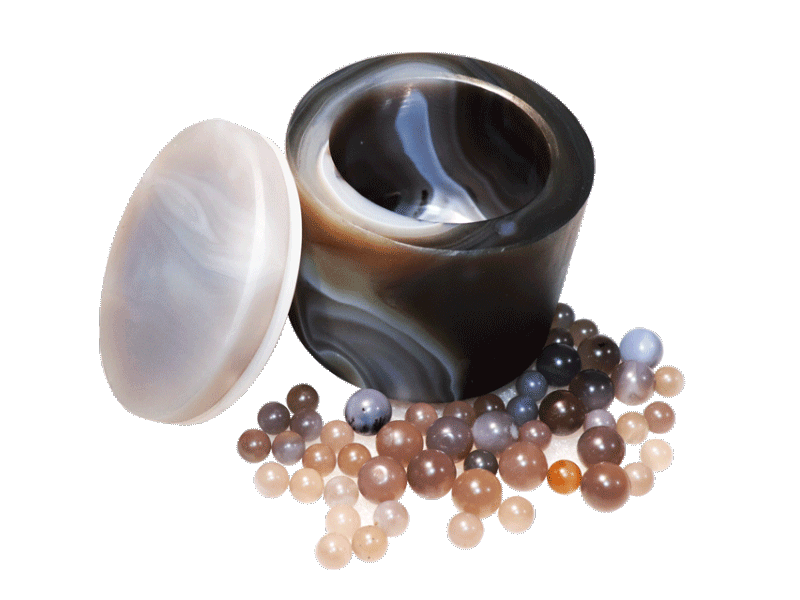
Equipment from another class of equipment does not automatically become compatible. The photo below shows an agate grinding bowl for a planetary mill. This is not a replaceable capacity of a hydraulic dissolver: a planetary mill has a different loading principle, different kinematics and other requirements for fastening. The material itself - agate - does not prove compatibility with the dissolver. For a dissolver, the working capacity, shafts and contact material are selected according to the documentation of the specific machine; the random coincidence of the category name is not confirmation here.
It is useful to discuss the limits of applicability before ordering. The dissolver does not replace a crusher, roller mill, ball mill or bead mill. It is not intended for fine grinding in the sense that mills are understood. It also does not guarantee retention of particle distribution after long-term storage: sedimentation and rheology depend on the composition. If the task is disagglomeration and homogenization, dissolver is considered as a prime candidate. If the goal is to achieve a given fineness, the grinding method and grinding medium are first selected, and mixing is considered as an auxiliary operation.
Try before you buy: test plan and questions for the supplier
The dispersion test should answer specific questions and not just demonstrate the rotation of the shafts. Before testing, the initial state is recorded: the type of powder, its flowability, tendency to clump, composition of the liquid phase, injection order, target viscosity and permissible temperature. There is no need to share dangerous or unconfirmed recipes; For the first test, a safe model system that is similar in rheology is sufficient. The test evaluates how quickly the powder is wetted, whether lumps remain, whether the temperature changes, how stable the circulation is and how the machine behaves when stopped and restarted.
It is useful to divide the test into stages. First check the loading and behavior at a minimum volume, then move on to the operating level, and after that to a more viscous or more concentrated system, if management allows it. The limitations of a particular machine should not be exceeded for the sake of a “more exemplary” experience. For each stage, record the parameters that are available to the operator and the measurement results: uniformity, stratification, presence of agglomerates, temperature, power consumption, if the device shows this. Without this data, comparing the two modes becomes a subjective experience.
Questions to ask before the test
- What workload is acceptable for the selected design and how does it compare to capacity?
- What functions does each shaft perform and is it possible to change the working parts?
- What exactly does a hydraulic unit provide and what maintenance operations does it require?
- What materials come into contact with the product and how is their wear controlled?
- What data does the supplier need to test the regime on real material?
- How is cleaning done and are there areas where product can linger?
To request a trial grind or dissolver test, the following are typically reported: product type, initial particle size and tendency to agglomerate, liquid phase composition, solids fraction, desired viscosity, heat tolerance, required sample volume, and readiness criteria. If restrictions on contact material are known, they are indicated separately. Using this data, you can discuss the configuration rather than guess the model. Hydraulic twin-shaft dissolver TENCAN in this formulation, it is not a universal “shredder”, but a tool for controlled mixing and dispersion, the effectiveness of which is tested on a specific system. Only after a trial run and comparison of the measured indicators can we talk about the suitability of the machine for a given task.