
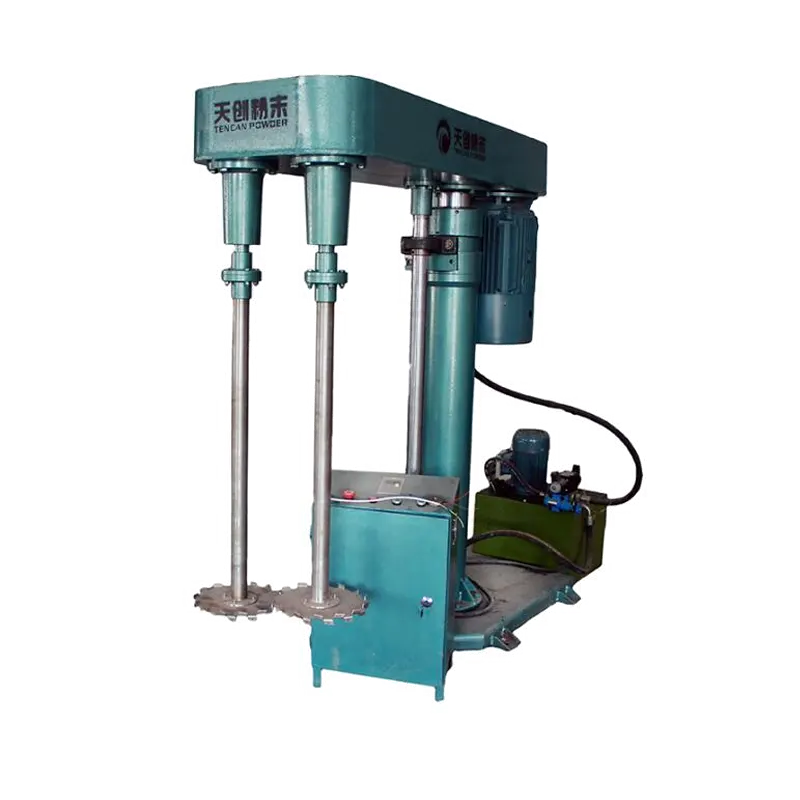
A highly filled paste, pigment suspension or ceramic mass rarely behaves like a simple Newtonian fluid. They have a yield strength, thixotropy, and a tendency to form agglomerates and local overheating. Therefore, the choice of a hydraulic twin-shaft dissolver begins not with a list of options, but with a description of the real problem: what exactly needs to be changed in the material, what loading is acceptable, how the system will behave when mixing and what will be considered an acceptable result. On the website TENCAN presented hydraulic twin shaft dissolver; Below are criteria that are useful to check before a test run, without replacing the passport of a specific car with general considerations.
Why is a dissolver chosen by task and not by name?
A dissolver is used to wet the powder, destroy agglomerates and obtain a more homogeneous suspension or paste. This is not the same as grinding to primary particles. During dispersion, the liquid penetrates into the pores and cracks of the agglomerates, the surface-active components stabilize the interface, and the mechanical shear action breaks up large conglomerates and distributes them throughout the volume. If the goal is to reduce the primary size of crystals or solid grains, a dissolver alone may not be sufficient; then consider a different grinding principle and a different medium. Mixing is also not the same as dispersing: it equalizes the composition by volume, but does not necessarily eliminate strong agglomerates.
Therefore, the first question when selecting is: what characteristics of the material should change? If uniformity in color, absence of visible lumps, storage stability or reduction of large inclusions based on granulometry results are required, the criteria will be different. For pastes, rheology and filler distribution are important; for suspensions - resistance to delamination and lack of foam; for thick masses - the ability of the device to involve the entire volume, and not just the area around the working body. Hydraulic twin-shaft dissolver TENCAN in this sense, it should be evaluated as a tool for a specific viscosity and load range, and not as a universal replacement for all types of mixing and grinding equipment.
The second issue relates to scale. A laboratory sample of several hundred milliliters in volume and a production batch of several hundred liters are not the same hydrodynamic problem. In a small volume, the walls of the vessel and the stirrer occupy a larger proportion of the working space, heat is removed faster, and the circulation time is shorter. As the volume increases, the surface-to-volume ratio changes, local shear zones become different, and overheating can appear where it did not exist in the laboratory. Therefore, transferring the mode only by revolutions or by mixing time almost always requires verification.
The third question is what the device should not do. A dissolver cannot be expected to replace a ball mill if the material contains strong primary particles. It cannot be assumed that the two-shaft arrangement automatically solves the problem of settling of heavy filler or floating of the light phase. You cannot transfer the properties of one model to the entire range. To make a choice, it is useful to divide the requirements into mandatory, desirable and secondary: for example, displacement, solvent compatibility and cleanability may be mandatory, while a certain shape of the working element or seal design may be desirable.
Dispersing, grinding and grinding media: where is the boundary?
In technical literature, the terms are sometimes confused, but for the selection of equipment the difference is fundamental. Dispersion in a liquid medium is primarily the distribution of the solid phase, wetting and disagglomeration. Grinding is the reduction of particle size by breaking down a material, most often in a mill with grinding media. Mixing - leveling the composition. The same device can partially perform several functions, but you should not attribute to it a result that is confirmed only by testing.
If the description of the task states “needs to be crushed to several micrometers,” you should clarify whether we are talking about primary particles, aggregates, or large inclusions. For pigment agglomerates, intense shear and proper wetting are often sufficient; a crystalline product may require a mill. For a very abrasive filler, wear of the working element and possible transfer of impurities become an independent limitation. In this case, even the correct dispersion mode does not eliminate the question of the material used and the service life of the units.
It is useful to separately identify the grinding media. Agate grinding balls — This is an example of a ball mill medium and not a standard dissolver load. Their use is associated with grinding in suitable grinding equipment, where the ball charge and the movement of the grinding media are part of the operating principle. Simply because both processes are wet and both relate to the processing of powders, you cannot transfer the balls into a dissolver and expect a comparable result. The compatibility of a specific medium with a specific apparatus should be demonstrated by documentation and testing, not by the coincidence of the words “balls” and “suspension”.

This boundary is also important for the choice of material for the working parts. In a ball mill, the grinding media themselves are a consumable element and a source of wear. In a dissolver, the main influence on the product is exerted by the rotating elements and the hydrodynamics of the flow. If you try to load grinding media into a dissolver without a proven design, this changes the load on the drive, seals and the vessel itself, and can also cause unwanted contamination. Therefore, it is better to explicitly indicate in the technical specifications whether only dispersion is required or whether a combined scheme with a separate mill is being considered.
When comparing suppliers, it is worth asking the same question in different formulations: “what mechanism ensures the destruction of agglomerates”, “what environment is considered standard”, “what materials are in contact with the product”, “which is confirmed by testing on a similar material”. The answers help distinguish a constructive description from an advertising promise. For a dissolver, the nature of the flow, the shape of the working body, the ability to work with a viscous mass and heat removal are especially important, and not just the name of the category.
Twin-shaft layout and hydraulic lift
A twin-shaft arrangement usually means that two organs with different functions are combined in one working volume. One of them can create an intense shear in the dispersion zone, the second can provide a general flow, draw in material from the walls and bottom, and prevent stagnation. This separation of functions is useful for pastes and thick suspensions, where one high-speed organ is not always able to renew the entire volume of material. However, the specific kinematics, direction of rotation, blade shape and diameter ratio must be clarified in the model documentation. It is impossible to conclude from the name “double-shaft” that both shafts are independently adjustable or that one of them is necessarily a scraper.
The hydraulic circuit in such equipment is often associated with raising and lowering the work unit, which facilitates maintenance, vessel installation, and cleaning. For a specific machine, it is necessary to clarify which operations are served by hydraulics: only vertical movement, clamping the cover, changing the position of the shaft, or several functions. This is not a formality. An understanding of the hydraulic circuit determines the requirements for maintenance, interlocks, safety and behavior in the event of loss of pressure. In addition, the hydraulic lifting force should not be confused with the force acting on the product in the dispersion zone: these are different units and different physical quantities.
When evaluating a layout, it is useful to check a few practical points. Firstly, access to the working element for inspection and cleaning. Secondly, the presence and location of seals that come into contact with solvent vapors. Thirdly, the stability of the vessel when working with a thick mass: rotation and circulation create a load not only on the shaft, but also on the fastenings. Fourthly, the ability to dispense components without depressurization, if the process requires it. Fifth, the compatibility of materials with solvent and temperature. These issues are more important than the appearance of the control panel, although they also affect day-to-day operation.
What does the second shaft give in practice?
The second roll does not necessarily improve dispersing power on its own. Its value is evident in tasks where it is necessary to simultaneously maintain the movement of a dense mass and intensively process a local area. If the material is low-viscosity, one high-speed organ can provide the main effect, and the second shaft will be useful for equalizing the temperature and composition. If the material has a pronounced yield stress, without good overall flow, the high-velocity organ can cut a channel through the mass, leaving immobile zones at the walls. That is why when testing, they look not only at the visible funnel, but also at the mobility of the material at the bottom and the absence of stagnant areas.
It is worth remembering that two shafts create more complex hydrodynamics than one mixer. The mutual influence of flows can be beneficial, but can also lead to uneven load on the drive as viscosity changes. The stronger the thixotropy, the greater the difference between the state of the material after loading and after long-term shear. Therefore, the mode selected on a test with already heated and mixed paste is not always reproduced during a cold start. For such a case, it is better to provide a stepwise exit to the operating mode and load control.
Viscosity, loading and fluid dynamics
The viscosity of a suspension is not a constant number. It depends on the shear rate, temperature, solids content, particle size distribution and mixing history. The paste may appear thick at rest and thin out noticeably when moving, then restructure when stopped. Therefore, selecting a dissolver based on one number “viscosity, mPa s” is often insufficient. It is necessary to understand at what shear rate the value is measured, what instrument it was obtained with, and how the material behaves in the range close to the working one. For thixotropic systems, a viscosity curve rather than a single point is useful.
Loading also requires separation of concepts. The nominal volume of the vessel, working volume, sample weight and productivity per hour are different values. If the description indicates the volume, you need to clarify whether we are talking about the full capacity or the recommended working load. For thick pastes, the useful volume is often less than the geometric volume, because part of the space is needed to create a flow and prevent blowout. Overload can lead to the formation of a dead zone, overheating and overload of the drive; underloading leads to air entrainment, splashing and insufficient contact of the material with the working body.
| What's changing | What to look for when trying | Why is this important |
|---|---|---|
| Solid content | Mass mobility, presence of lumps, drive load | Solid phase growth changes rheology and heat generation |
| Workload | Layer height, involvement of the entire volume, absence of stagnation at the bottom | Too small or large load distorts hydrodynamics |
| Rotational speed | Funnel shape, foam, local heating, dispersion quality | Revolutions by themselves do not set the shear rate without taking into account the diameter |
| Temperature | Increase in temperature over time, change in viscosity | Heat can change the stability and evaporation of components |
| Entry order | Powder wetting, clumping, time to homogeneity | The boot sequence affects the result as much as the device |
The shear rate at the edge of the working body depends not only on the number of revolutions, but also on the diameter. Two devices with the same speed, but different diameters of the working bodies create different peripheral speeds. Therefore, it is impossible to transfer the “so many revolutions” mode from one machine to another without geometric comparison. For scaling, it is useful to record peripheral speed, diameter ratio, power per unit volume and circulation time, but these parameters do not guarantee the identity of the product.
The funnel deserves special attention. In a low-viscosity suspension, the high-speed organ can entrain air and create foam. In a thick paste, the funnel may be poorly defined, but this does not mean that the material is well mixed. On the contrary, immobile areas may remain in the mass. Therefore, when testing, it is useful not only to look from above, but also to take samples from different points after stopping, evaluate the temperature at different horizons and check whether material remains on the walls and bottom. If the design includes a scraper, its operation should also be tested on a thick product, and not just on water.
Another practical point is foam and air. Air entrained in the suspension changes the apparent density and heat transfer and can impair pouring and cause coating defects. Sometimes the problem is solved by changing the loading order or reducing the speed at the initial stage; sometimes a vacuum or other design solution is required. You should not attribute a deaeration function to a dissolver if it is not confirmed by the design. The test should separately record whether foam forms, how quickly it subsides, and whether it affects the result.
Heat, volatiles and materials
Mechanical energy supplied to the suspension ultimately turns into heat. The higher the viscosity, the longer the cycle and the more intense the shear, the more noticeable the heating. This does not necessarily indicate a malfunction: for some processes, heat is a consequence of normal operation. But if the material is temperature sensitive, if the solvent is volatile, or if there are components in the system that are prone to react prematurely, heat becomes a mode limiter. Therefore, when selecting, it is important to distinguish between the ambient temperature, the temperature of the workspace and the temperature of the product itself. Cooling the case or the presence of airflow does not guarantee that the paste temperature will remain set.
For a specific model, you need to clarify what means of heat removal are provided: a jacket, a coil, forced circulation, a cover with a condenser, or another solution. If the description specifies cooling, you should understand what is being cooled and how it is controlled. A process cannot automatically be called cryogenic if conventional refrigeration is used; cryogenic solutions require separate confirmation and other safety. Also, do not confuse tightness, evacuation and circulation gas purification: these are different functions, and the presence of one of them does not mean the presence of the other.
Materials in contact with the product influence corrosion, wear, cleaning and contaminant transport. Stainless steel, coatings, ceramics and polymer seals have different solvent, temperature and abrasiveness limitations. For pigments and mineral fillers, abrasive wear can be significant; For acidic or alkaline environments, chemical resistance is important. There is no universal material that is suitable for all suspensions and at the same time eliminates contamination. The wording “ceramics” or “zirconium dioxide” in itself does not mean zero transfer of impurities: everything depends on the conditions, resource and permissible level of contamination.
Cleaning is part of the choice, not an afterthought. Thick, high-solids paste can dry quickly on exposed surfaces and make disassembly difficult. If frequent product changes are required between batches, access to working parts, smooth surfaces, absence of blind pockets, and compatibility of the cleaning fluid with the seals are important. The test is useful to check not only the receipt of the product, but also the time required to unload and clean it. Sometimes a device with good dispersing characteristics turns out to be inconvenient to use precisely because of difficult cleaning.
It is useful to mention agate grinding balls in this context as an example of a material that does not in itself solve the compatibility issue. Agate may be appropriate in a ball mill for certain applications, but that does not make it a universal dissolver medium. If grinding media are considered in the process, the mill design, liner material, wear and product contact tolerance must be checked separately. For a dissolver, the key remains the working parts, hydrodynamics and thermal conditions.
Scaling and trial run
Moving from a laboratory sample to a larger batch requires caution. Geometric similarity helps, but does not guarantee equality of dispersion time. As the volume increases, the surface-to-volume ratio, layer height, circulation time, and heat removal conditions usually change. If the material was heated by several degrees in a laboratory apparatus, the temperature increase may be more noticeable in a large volume. If there were no stagnant zones in a small vessel, in a large one they may appear at the bottom or near the shaft. Therefore, it is better to build scaling as a sequence: first confirm the mechanism and loading order, then select the range of peripheral speed and time, then check the thermal conditions and only then move on to performance.
It is useful to define in advance what is considered the end of a cycle. For one task this is the absence of visible lumps, for another it is a certain degree of grinding on the device, for a third it is the stability of viscosity after a given time. If the criterion is not stated, the test becomes a subjective assessment. However, one should not promise that the typical minimum size will be achieved for any material: the final result depends on the initial distribution of particles, the environment, the mode and method of measurement. For a dissolver, we are often talking about disagglomeration and homogeneity, rather than a guaranteed reduction of primary particles.
What to record in the protocol
- Name of material, batch, supplier and date; for a multicomponent recipe - composition and order of addition.
- Solids content, density, initial particle distribution and rheological characteristics, if known.
- Working volume, load mass, temperature before and at the end, as well as the method of measuring temperature.
- Loading order, wetting time, speed stages and duration of each stage.
- Visual observations: lumps, foam, delamination, material on the walls, mobility at the bottom.
- Measurement results: granulometry, rheology, degree of grinding, color, storage stability.
- Time of unloading, cleaning and consumption of washing liquid; Notes on node access.
This protocol helps to separate the influence of the device from the influence of the formulation. If the result is not achieved, you should not immediately declare a specific malfunction proven. The reason may be insufficient wetting, incorrect insertion order, too high a load, local overheating, or because the task requires a different type of equipment. Diagnostics begins with observations and measurements, and not with replacing nodes at random.
What to tell the supplier and what to check during the test
To select a hydraulic twin-shaft dissolver, it is useful to prepare a brief but accurate description of the process. Specify product type and purpose: paste, suspension, slip, adhesive, coating or intermediate mass. List the components, especially solvents and surfactants, to discuss seal and material compatibility. Report solids content, density, viscosity, and yield strength if measured; For thixotropic systems, it is advisable to attach a viscosity curve. Indicate the original particle size and what exactly is considered an agglomerate. Do not limit yourself to the word “thick”: for one material it is 5 Pa s, for another it is several hundred pascal-seconds, and without measurement conditions such a characteristic is of little help.
Next, you need data on the batch: minimum and maximum working volume, load weight, required productivity and operating mode. If the process is batch, cycle time is important; If there are multiple batches per shift, unloading and cleaning are important. Describe temperature limitations: product heat tolerance, ambient temperature, presence of volatile components, and condensation requirements. Indicate whether operation is required under vacuum or in an inert atmosphere, if indeed required; do not add such options only from the general list. Separately list available utilities and room height restrictions, as hydraulic lifting and maintenance require space.
| Group of questions | What to clarify | Why is this necessary? |
|---|---|---|
| Product | Composition, density, viscosity, yield strength, abrasiveness | Determines fluid dynamics, wear and material selection |
| Loading | Working volume, mass, fill factor | Helps avoid stagnation, overheating and overload |
| Mode | Input order, speed steps, cycle time | Affects dispersion quality and reproducibility |
| Warm | Permissible temperature, volatility, cooling method | Prevents product alteration and solvent loss |
| Operation | Cleaning, maintenance, seals, safety | Determines the real suitability of the device for operation |
During testing, it is worth checking not only the final appearance of the product. Observe the startup: how the material is captured by the working body, whether there is a sharp increase in load, whether stagnation forms at the walls. Check operation at minimum and maximum load, if such a range is stated. Evaluate the heating time and compare it with what is acceptable for the recipe. Take samples from different points and after different dispersion times. If possible, repeat the run on the same formulation to assess reproducibility. For thick pastes, it is useful to check the discharge and cleaning as these often determine performance.
It is best to agree on acceptance criteria prior to testing. This may be the absence of lumps of a certain size, a given degree of grinding, stable viscosity after 24 hours, the absence of separation, or an acceptable impurity content. The requirement should not be formulated as “perfect homogeneity”: each measurement method has a sensitivity limit. Also, results from one product should not be transferred to another without verification. If the vendor offers a configuration, it is helpful to understand which options are standard and which are optional, and not assume that the option is enabled by default.
The practical conclusion is simple: a hydraulic twin-shaft dissolver is selected based on a combination of rheology, loading, thermal conditions and cleanliness requirements, and not on a single characteristic. For TENCAN It is important to check the specific configuration and confirm the compatibility of the components with the material. If the task requires grinding media, this is a separate process and separate equipment; Agate balls do not become a standard dissolver load without direct confirmation. Before purchasing, it is useful to carry out a trial dispersion with a protocol, samples and clear acceptance criteria. This approach reduces the risk that the device will be correct in name, but inconvenient or insufficient for a particular paste.