
Pastes and suspensions with a high proportion of solids are rarely homogeneous immediately after mixing the powder with the liquid. The powder enters the medium in the form of agglomerates - aggregates that are held by capillary bridges, electrostatic forces and surface tension of the liquid. To obtain a working mass, these agglomerates must be destroyed and the particles evenly distributed in the liquid phase. It is this operation that is performed by dispersing equipment, and the hydraulic twin-shaft dissolver is one of the devices designed for this task.
Selecting a mode for such a device does not come down to one “correct” rotation speed. The result is determined by a combination of the rheology of the mass, the degree of filling of the container, the geometry of the working body, the duration of processing and the temperature limitations of the formulation. Below we discuss what processes occur in a two-shaft dissolver, what characteristics of the equipment make sense to compare before ordering, and what signs show that the selected mode is not suitable for a particular product.
Mixing, disagglomeration and grinding are different operations
In preparing pastes, it is useful to distinguish between three processes that are often lumped together under the word "mixing." The first is macroscopic mixing, that is, bringing the entire volume to the same composition. The second is disagglomeration: the destruction of agglomerates and wetting the surface of particles, in which the primary particles are not crushed, but are separated and distributed in the medium. The third is the actual grinding, that is, reducing the size of the primary particles.
The dissolver solves the first two problems. The third problem is solved by grinding equipment: planetary, drum, vibration and bead mills, and for larger source material - crushers. This difference has a direct practical consequence. If the goal is to reduce the median size of powder particles, a dissolver will not replace a mill, no matter how long the mass is processed: shear in the liquid destroys agglomerates, but does not crush filler crystals.
The converse is also true. If the problem is clots and “grains” that appear when the powder is introduced into the liquid, additional grinding of the finished paste will not give the desired effect. The reason usually lies in insufficient shear, in too high a viscosity that did not allow the mass to pass through the dispersing disk area, or in the wrong order of introducing the components, due to which the powder does not wet, but clumps together.
This implies a method for assessing the result. Dispersion does not have one universal numerical criterion. The degree of readiness is assessed by a combination of characteristics: the absence of visible agglomerates, sample homogeneity, storage stability, reproducibility of rheological measurements, absence of sediment and delamination. Therefore, the regime is selected by testing on a specific recipe, and not transferred from a similar project without testing.
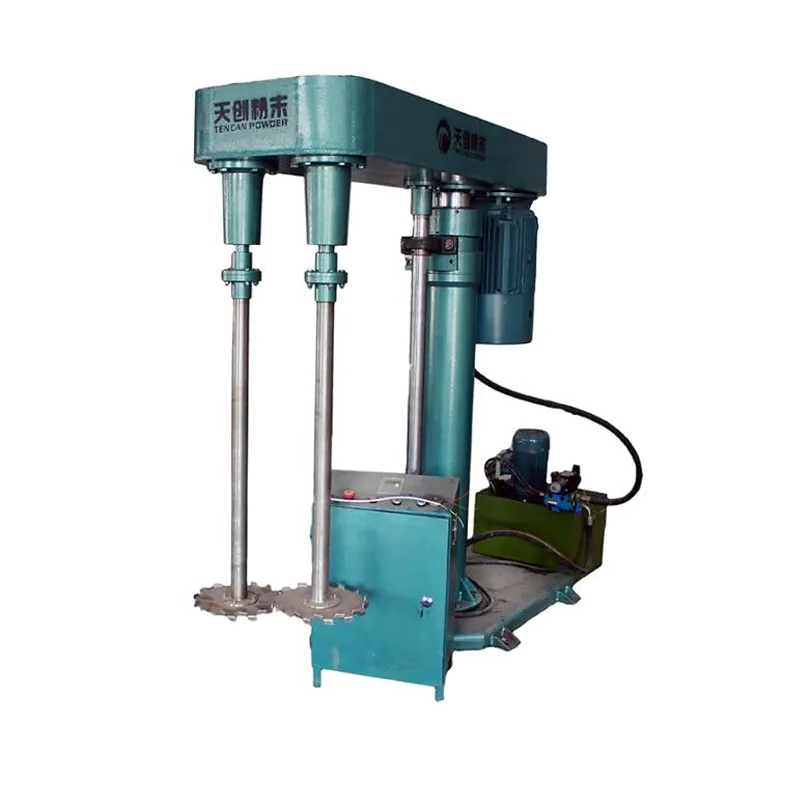
How does a hydraulic twin-shaft dissolver work?
The two-shaft arrangement eliminates the contradiction between two requirements that are poorly combined in one working body. On the one hand, it is necessary to process the entire volume of the viscous mass, including the wall and bottom layers, where undeveloped zones usually remain. On the other hand, a high local shear is needed, sufficient to destroy agglomerates. One shaft cannot perform both functions equally well, so in the device they are divided between two shafts.
Low-speed shaft and volume circulation
The shaft, rotating at a moderate speed, acts as a volumetric stirrer. Its task is to involve the entire load in motion, without leaving stagnant zones at the walls and bottom, and to continuously bring the mass to the high-speed shaft. The working body of such a shaft is designed for viscous media: it must push through the mass, and not just rotate in it. If circulation is insufficient, the high-speed disk processes only a local volume, and a significant part of the capacity remains with the original degree of heterogeneity.
High speed shaft and high shear zone
The high-speed shaft carries a dispersing disk - toothed, impeller or other in design. High local shear velocities and impact forces occur at the tooth edges and gaps; It is here that the agglomerates are destroyed and the surface of the particles is wetted. The size of this zone is small compared to the volume of the container. Therefore, the performance of a two-shaft dissolver is determined not only by the power of the high-speed drive, but also by how effectively the low-speed shaft supplies a fresh portion of mass to the disk.
What exactly does a hydraulic drive provide?
The name “hydraulic” indicates the type of drive for lifting and (or) rotation of the working unit. The specific distribution of functions - what exactly hydraulics does: raising and lowering shafts, turning the console, rotating one or both shafts - depends on the design and should be clarified in the documentation of the specific model. Here it is important not to transfer the features of one design to the entire class of devices: hydraulic lifting of the working unit and hydraulic drive of shafts are different technical solutions, and their presence is checked by the passport, and not assumed by the name.
The practical meaning of a hydraulic drive is that it allows you to smoothly adjust the position and stroke of the working unit and work with viscous media in which the starting torque is significantly higher than the operating torque. However, any conclusions regarding overload capacity, control range and overpressure protection should be made from the manufacturer's documentation and not by analogy with other hydraulic systems.
Device characteristics: what to compare before ordering
The dissolver is selected not by one number, but by a set of parameters, each of which limits the scope of application. Listed below are the characteristics that make sense to compare when choosing, and questions to ask the supplier. Numerical values for a particular model are determined by its documentation; Here we are talking about the meaning of parameters, and not about ready-made quantities.
| Parameter | Why is it important? | What to clarify |
|---|---|---|
| Geometric and working volume of the container | Determines possible batch size and circulation conditions | What volume is considered working and what load is it filled with? |
| Filling level | When overloaded, the mass does not circulate; when underloaded, the shaft captures air | Recommended filling range for media of different viscosities |
| Dispersing disc diameter | Sets the peripheral speed at the selected speed | The diameter of the disk and its relation to the diameter of the container |
| Shaft speed range | Determines available shift modes | Minimum and maximum speeds, control method, shaft speed ratio |
| Drive power and torque | A viscous mass requires torque, not just revolutions | Available torque, starting behavior |
| Material of contact parts | Affects wear and possible contamination | Material grade, coating, availability of replacement discs |
| Lifting and fixing the working unit | Determines ease of maintenance and cleaning | Lifting stroke, position fixation method |
| Management and control | Batch-to-batch reproducibility | Parameter fixation, temperature sensors, overload protection |
| Temperature control | Heat limits processing speed and time | Availability of a cooling jacket and method of heat removal |
Container volume and loading
Confusing the concepts of volume and load is a common cause of selection errors. The geometric volume of the container, the working volume and the mass of the load are three different values. The dispersing apparatus cannot be loaded “to the edge”: with high filling, the shaft cannot involve the mass, a stagnant zone is formed, and the high-speed disk works in almost motionless material. If the load is too small, the shaft traps air, the mass is aerated, and the disk partially works on the surface. Both distort the result and accelerate wear.
Rotational speed and peripheral speed
It is incorrect to compare devices based on the number of revolutions per minute: the same rotation speed with different disk diameters gives different speeds at the periphery. The guideline is the peripheral speed, which is proportional to the product of the disk diameter and the rotational speed. It is this that determines the intensity of shear at the edges. Therefore, when switching to a device with a larger container, the mode is recalculated not by rpm, but by maintaining the peripheral speed and circulation conditions.
Power, torque and mass rheology
For viscous pastes, the determining factor is not so much the maximum power as the available torque and the behavior of the drive during start-up. The effective viscosity of a paste depends on the shear rate: a mass that behaves like a liquid under steady-state mixing may be very reluctant to start moving. Therefore, smooth acceleration and overload protection are more important than the declared maximum speed.
Mode Tradeoffs: Offset, Time, and Temperature
Increasing the speed of the dispersing disk accelerates disagglomeration, but at the same time increases the dissipation of mechanical energy into heat. Shear work eventually translates into heating the mass, and for formulations with volatile solvents, heat-sensitive additives or hardeners, this becomes a limitation before the desired degree of dispersion is achieved. Practical conclusion: it is useful to consider the mode as a set of interrelated parameters - speed, duration, load, cooling - and not as one adjustable value.
Temperature control deserves special attention due to confusion in measurements. The temperature in the workroom, the temperature of the coolant in the jacket, and the temperature of the paste itself are different values, and they do not coincide. The heating of a formulation should be assessed by mass, and not by indications related to the coolant. If the documentation does not provide direct guidance on temperature limits for a particular product, it is safer to rely on your own measurements in a trial batch.
Processing time is also optimal. After the agglomerates are destroyed and the particles are distributed, further processing gives little increase in uniformity, but continues to load the drive, heat the mass and wear out the working element. The stopping criterion is not the usual duration, but the result of control: type of sample, rheological measurements, absence of agglomerates during dilution, stability during aging. For pigment and filled systems, it is common to control the degree of grinding using a grindometer, but it is not applicable to all types of pastes and requires the same methodology from batch to batch.
Another compromise involves aeration. Intensive mixing of the viscous mass inevitably entrains air, especially with a small load and a high position of the working body. Bubbles that are not removed before the next operation result in coating defects, pores after drying or unstable density values. If the recipe is sensitive to air, the mode is designed so that after intensive processing there is a slow mixing stage for degassing.
The order of introducing components and wetting the powder
A significant portion of paste defects occur not due to insufficient speed, but due to the order in which the components are introduced. If dry powder is poured into a small volume of liquid, the particles stick together, leaving dry areas inside the lumps, which are then difficult to wet even with high shear. The usual practice is to introduce the powder into the liquid phase gradually, with the low-speed shaft running and the high-speed shaft at a moderate speed, so that each portion has time to be wetted and distributed. The role of surface-active additives, the order of their introduction and the temperature conditions for the preparation of raw materials are checked on a trial batch: there is no universal sequence suitable for all recipes.
When is a two-shaft circuit redundant and when is it not enough?
A two-shaft apparatus is justified when the product is viscous, contains a significant proportion of solids and requires both full volume circulation and local high shear. For low-viscosity suspensions with low filler concentrations, this configuration may be redundant: some of the capabilities of the apparatus will not be used, and cleaning and maintenance will require the same effort as for a complex formulation. On the contrary, if the task is to reduce the size of primary particles, a twin-shaft dissolver will not replace grinding equipment regardless of the mode. Before ordering, you should honestly formulate exactly what processes the machine should perform: mixing, disagglomeration or grinding.
Observed problems and possible causes
Deviations in paste quality rarely have one cause. Listed below are typical observations and a range of possible explanations. None of these should be considered proven without testing: confirmation requires measuring and changing one factor at a time.
| Observation | Possible reasons | What to check |
|---|---|---|
| Agglomerates and “grains” are preserved | Insufficient peripheral speed; viscosity is too high, due to which the mass does not pass through the shear zone; short duration; poor wetting during insertion | Peripheral speed, order of component input, mass rheology |
| The mass overheats | High shear rate with low load; lack of heat removal; long-term processing | Mass temperature, loading, possibility of cooling and pauses |
| Stagnant zones at the walls and bottom | Insufficient operation of the low-speed shaft; low filling; incorrect position of the working unit in height | Filling, position of shafts, trajectory of mass movement |
| Strong aeration, bubbles in the product | Small load; high disc position; too high speed at the powder injection stage | Filling, sequence of stages, final degassing |
| Delamination or sediment during storage | Insufficient wetting; incomplete particle distribution; mismatch of rheology regime | Sample stability, rheological curves, injection order |
| Accelerated disc wear | Abrasive filler; work at the surface without mass; unmixed start | Filler hardness, start-up mode, working body condition |
| Mode does not play on repeat | Lack of parameter fixation; different temperatures of the starting components; different loading | Parameter log, raw material preparation conditions |
Diagnostics is based on sequential changes in one parameter. If you simultaneously increase the speed, increase the time and change the input order, the result cannot be interpreted. A reasonable sequence for trial work: fix the load and input order, then select the position of the working unit in height, then the rotation speed and only then, if necessary, the duration of processing. The temperature of the mass is recorded at all stages to separate the shear effect from the heating effect.
Contact materials, wear and powder preparation
The question of the material of contact parts arises when working with abrasive fillers, aggressive media and products for which the content of foreign inclusions is standardized. The dispersing disk and shafts wear out the faster, the higher the hardness and concentration of the solid phase, the higher the peripheral speed and the more often the device operates in a mode in which the disk captures air or moves near the surface. Wear is not only a consumable resource, but also a potential source of impurities in the product. Brands of materials, coatings and design options for working bodies should be clarified in the documentation of the specific model.
Sometimes preliminary preparation of the powder is performed on other equipment. If the source material requires particle size reduction, and not just deagglomeration, grinding machines, in particular planetary ball mills, are used. For such mills, grinding bowls are produced, including those made of PTFE, a fluoroplastic material that is characterized by chemical resistance and low surface tension, which makes it easier to remove the product and reduces sticking. A description of such equipment is given on the page PTFE grinding bowl.
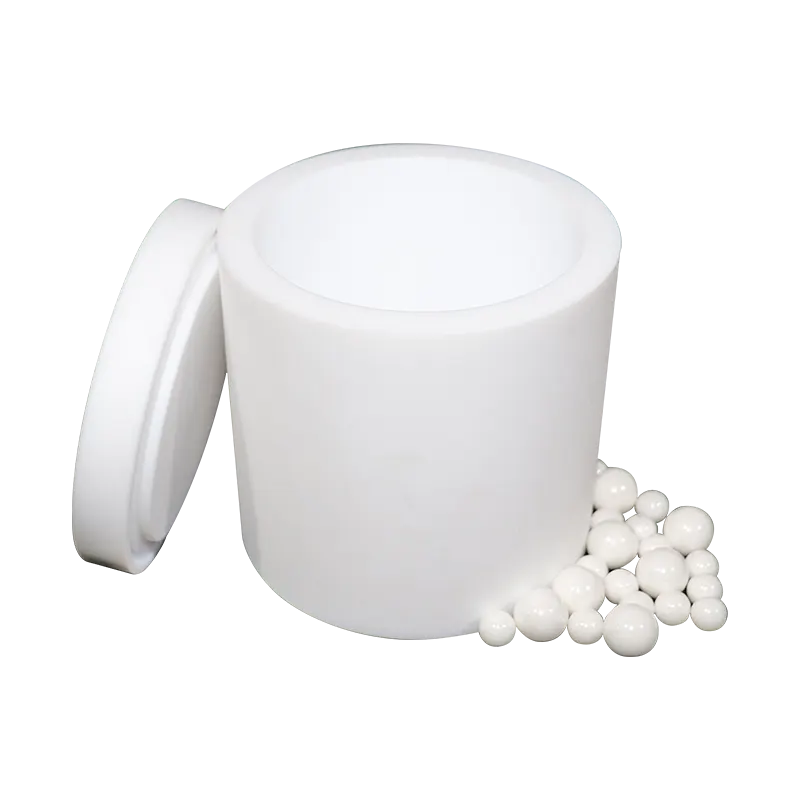
At the same time, it is important to understand that this is equipment for a planetary mill, and not a dissolver assembly: the glass is not attached to the twin-shaft apparatus, and the compatibility of the equipment is determined by the design and documentation, and not by the coincidence of the material. The exact volume of the glass, permissible modes and temperature restrictions are indicated by the manufacturer for a specific model. Accordingly, the grinding parameters in a glass cannot be transferred to the dispersion mode: these are different operations with different goals.
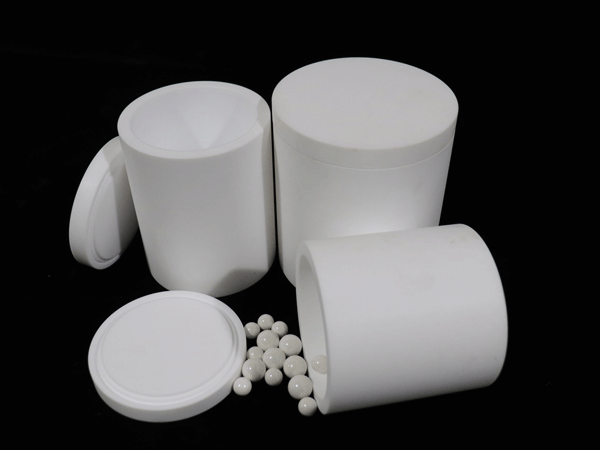
Expectations for product cleanliness are also associated with the materials of the contact parts. PTFE is softer than ceramics and even more so tungsten carbide, so during careful work it introduces fewer abrasive particles of the tooling material; however, this does not mean there is no contamination. Fluoroplastic is prone to deformation when heated and to the accumulation of a static charge, and its surface requires careful cleaning when switching to another formulation, since the remnants of the previous product are retained in microroughnesses and at the edges. Claims of “zero contamination” for any contact material are incorrect without measurements under specific conditions.
The same principle applies to cleaning the dissolver itself. Changing the product requires access to the shafts and disc and checking hard-to-reach areas. If the device is intended for several recipes, ease of cleaning becomes the same selection criterion as power and volume, and the configuration of the working unit and the ability to lift it directly affect the changeover time.
What to prepare for selection and how to build a test dispersion
For a meaningful selection of equipment, the supplier needs data about the product and the task. It is useful to have the following information ready::
- composition of the recipe and the proportion of solid phase, type of filler and its initial size;
- rheological characteristics: how viscosity changes with shear rate, is there a yield point;
- density and tendency to settle, the presence of surfactants;
- target result: acceptable content of agglomerates, requirements for homogeneity and stability;
- temperature limitations of the formulation, the presence of volatile solvents and sensitive components;
- abrasiveness of the filler and requirements for the content of foreign inclusions;
- required batch volume and range of possible volumes from minimum to maximum;
- the number of different formulations on one device and the cleaning requirements between them;
- available site conditions: power supply, cooling water, ventilation, height restrictions.
The trial dispersion is designed so that the result can be reproduced. They start with a load at which the low-speed shaft confidently draws in the mass and does not entrain air, and with a moderate rotation speed of the high-speed shaft. Then the peripheral speed is increased stepwise, recording after each step the temperature of the mass, the processing time and the condition of the sample. If a given uniformity is achieved only at close to the maximum speed, this is a signal that the recipe requires a different disc diameter to container ratio or a different filling rather than continuous operation at the limit.
Changing the load alone is not enough to move from a laboratory sample to a larger batch. The geometry of the apparatus does not scale linearly: as the diameter of the container and disk increases, the ratio of the volume of the shear zone and the total volume of the mass changes. A practical guideline is to maintain the peripheral speed of the disk and the order of component input, and adjust the processing time based on the control results. It is correct to compare laboratory and production conditions only if the sampling method is the same and the method of assessing homogeneity is the same.
Finally, you should determine in advance which observations will be considered a success. It is useful to agree on a set of criteria: absence of visible agglomerates during dilution, reproducible viscosity, absence of separation after aging, stable temperature within the limits allowed by the recipe. This set turns the selection of a mode from a search of options into a verifiable procedure, and the requirements for the device into a specific list of parameters that need to be confirmed according to the documentation. The description of the hydraulic twin-shaft dissolver and its characteristics are given on product page, and the general list of equipment areas is on website TENCAN.