
The task with which the selection of a dissolver begins is rarely formulated as “you need to mix the powder.” Usually there is a specific defect: lumps in the paste, unstable viscosity, stains on the coating, too long a cycle or overheating, due to which the rheology changes. Replacing the mixer with a machine with a higher number of revolutions does not always solve the problem: in some cases there is not enough shift, in others there is not enough heat removal, in others there is not enough order of introducing components. Hydraulic twin-shaft dissolver TENCAN refers to equipment for dispersing and homogenizing liquid and paste systems. Its task is not abrasion of particles, but wetting, destruction of agglomerates and uniform distribution of the solid phase. Page hydraulic twin-shaft dissolver TENCAN serves as a reference point for a specific model; The options below help you understand what questions to ask before the test and what observations to record.
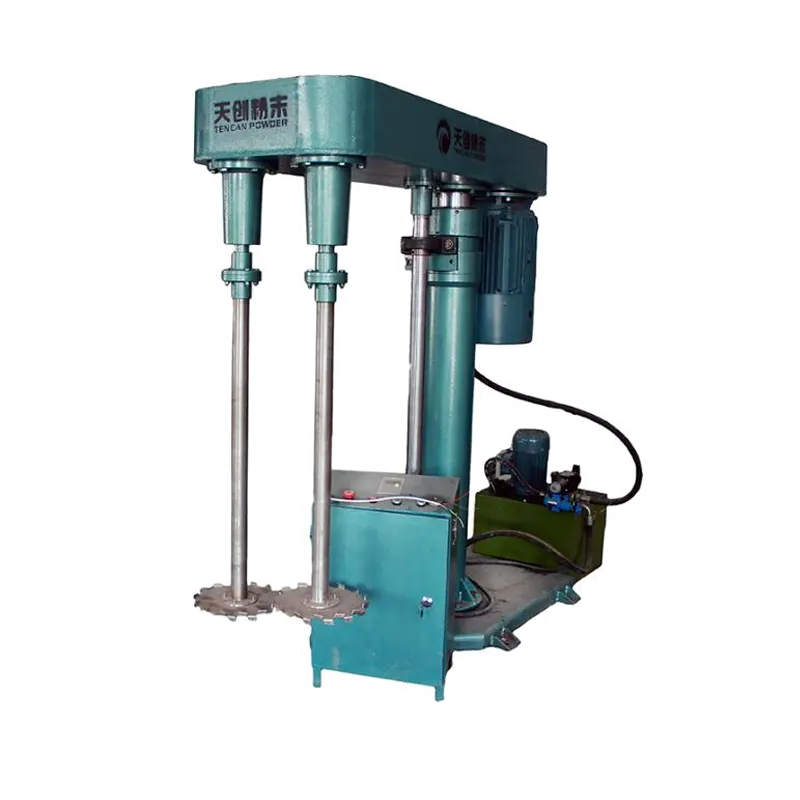
What exactly does a hydraulic twin shaft dissolver do?
The dissolver operates in a liquid medium. The solid powder is introduced into the liquid, wetted, distributed throughout the volume, and large agglomerates are destroyed under the action of shear stresses. However, the primary particles are usually not crushed as much as in a ball or bead mill. Therefore, it is more correct to describe the result of dispersion not only by the number “size, microns,” but also by the absence of undestroyed agglomerates, suspension stability, viscosity and storage behavior.
This difference is fundamental for selecting a regime. If the goal is to break up lumps and create a smooth paste, a dissolver may be sufficient. If it is necessary to change the crystal structure, obtain a narrow particle size distribution, or reduce the primary particles, a different class of equipment is needed. An attempt to solve the problem of abrasion only by increasing the speed of the dissolver often leads to overheating, foaming and excessive energy consumption, but not to the desired size.
Dispersing is not the same as grinding
An agglomerate is a group of particles connected by interaction forces, and not necessarily a large monolithic piece. The liquid must penetrate the pores of the agglomerate, displace the air and stabilize the newly opened surface. Wetting depends on the nature of the liquid, the surface chemistry of the powder, the presence of surfactants, and the order in which the components are added. The shift only helps this process and breaks fragile ties. If the agglomerates are very strong or the powder is poorly wetted, mechanical action alone may not be enough.
The rule of thumb is to check wetting and distribution first, then increase the mechanical load. Otherwise, part of the powder remains in the form of dry inclusions, and the mode already operates at the temperature limit. The mixture may look smooth on the outside, but when diluted or applied, lumps will appear again.
Why do you need a second shaft?
The class of two-shaft dissolvers usually combines two organs with different roles. The fast shaft creates a local high shear zone, while the low speed shaft provides overall mass transfer, brings material to the dispersion zone and reduces stagnant areas. This arrangement is useful for pastes and concentrated suspensions, where one fast organ can only cut a channel through the mass of the product without involving the entire volume.
Specific layout of hydraulic twin-shaft dissolver TENCAN should be checked according to the documentation for the selected machine: the relative position of the shafts, the type of mixing element, the direction of rotation, the presence of a scraper and permissible combinations of speeds. You cannot transfer the characteristics of one model to the entire range. For a test run, it is important to understand what functions each shaft performs in this particular configuration, otherwise the setting comes down to randomly selecting revolutions.
Sample conditions that determine the mode
There is no universal dispersion mode. Even the same powder behaves differently in different liquids: wettability, thickness of hydration layers, tendency to foam and rheology change. Before setting up equipment, it is useful to describe not only the formulation, but also the target state of the product: paste to be applied, suspension to be cast, concentrate to be diluted, or an intermediate mixture before further processing.
Viscosity, wettability and solids content
The solid phase content affects viscosity nonlinearly. Initially, an increase in concentration increases the viscosity smoothly, then a sharp rise begins, and the system passes into a paste-like state. In this region, a small dose error can change the flow pattern and heat transfer. High viscosity increases the load on the shafts and heat generation, but at the same time can improve the transfer of shear from the fast organ to the mass of the product.
Wettability determines how quickly a powder is immersed in a liquid and distributed within it. Hydrophobic powder in an aqueous environment often forms floating clumps, which are difficult to destroy once formed. In this case, the method of introduction is important: gradual addition to the flow zone, pre-dispersion in a suitable medium, or use of a wetting improver. Specific formulations and concentrations should be confirmed by laboratory testing and not selected by article.
Loading, vessel shape and shaft position
The loading volume, the diameter of the vessel, the shape of the bottom and the position of the shaft affect the circulation no less than the number of revolutions. Too small a load causes the shaft to pick up air and operate with low hydraulic resistance. Too large a load limits the mobility of the mass, creates stagnant zones and increases the risk of overflow during foaming. The geometry of the vessel must correspond to the type of mixing organ; transferring the shaft to the first reactor available is not proof of compatibility.
| Parameter | Why is it important? | What to write down for the test |
|---|---|---|
| Solid content | Determines viscosity, load and tendency to clump | Mass fraction, insertion order, component temperature |
| Viscosity in process | Changes circulation and heat transfer | Initial and final viscosity, measurement method |
| Size and strength of agglomerates | Specifies the offset requirement and processing time | Initial powder, drying method, presence of lumps |
| Temperature limit | Limits permissible power and duration | Product limit, measurement method, availability of cooling |
| Foaming and volatility | Affects loading, vacuum and solvent loss | Test run observations, density, smell |
How two shafts and hydraulics work
Setting up a two-shaft dissolver begins with the distribution of roles. The fast organ is responsible for local shear, the slow organ is responsible for involving the entire mass and heat exchange. If you immediately bring both organs to maximum, you can get intense foaming, overheating and unstable circulation. If, on the contrary, you work for too long only at low speeds, the agglomerates will not be destroyed, and the cycle will be extended.
High-speed organ: shear and peripheral speed
To compare modes, it is useful to use the peripheral speed, not just the number of revolutions. It is proportional to the diameter of the organ and the speed of rotation. At the same rpm, a larger diameter organ produces higher velocity at the periphery, but requires more power and can heat the product more. Therefore, transferring the mode from one machine to another using one rpm value is incorrect.
The shear must be sufficient to break down the agglomerates, but not so high that the product begins to undergo intense aeration or chemical breakdown. The presence of a funnel, air entrapment, vibration and a sharp increase in temperature serve as signals that the regime requires revision. It is useful to record not only the final result, but also the moment when the bulk has become homogeneous: further processing may be redundant.
Low speed shaft: mass transfer and heat dissipation
A slow roll is important to ensure that the product does not remain in stagnant areas, especially near the walls and bottom. It also helps to renew the heat transfer surface and uniform distribution of the introduced components. In pastes with high viscosity, it is the low-speed organ that can provide mass movement, while the fast shaft creates only a local cavity.
The speed ratio of the two shafts is selected according to the behavior of the product: the presence of circulation, the absence of stagnant areas, temperature uniformity and the absence of film on the walls. For a specific machine TENCAN permissible combinations and maximum loads should be clarified in the manual. You can't assume that any slow shaft is suitable for any paste just because it rotates.
Hydraulic circuit: moving, not dispersing mode
The machine name indicates the hydraulic circuit. Its function, design and controls should be verified against the documentation of the specific model. In this class of equipment, hydraulics are often associated with raising, lowering or positioning the working parts, but this should not be replaced by guesswork. The hydraulic system is not a replacement for the speed controller and does not determine shift by itself.
Before work, check the smoothness of movement, fixation in the working position, absence of leaks and activation of protections. Particular attention is paid to stopping the shafts before lifting, blocking and access to moving parts. If the hydraulic circuit is used for servicing, it is important to understand which operations are permitted with the equipment raised and which require a complete stop and pressure relief.
Overheating: energy, viscosity and heat dissipation
Dispersion is accompanied by energy dissipation. The higher the shear and viscosity, the more mechanical energy is converted into heat. Part of the heat is removed through the vessel wall, jacket or heat exchanger, while part is accumulated in the product. If the rate of temperature rise exceeds the cooling capabilities, the regime becomes unstable: viscosity decreases or increases, the solvent evaporates, and additives may lose effectiveness.
Why does the temperature rise unevenly?
In the fast shaft zone the temperature may be higher than in the rest of the volume. A sensor installed in a jacket or on the surface of a vessel does not indicate the temperature inside the suspension. To control the result, you need a sensor in the product or a representative sample selected according to an understandable method. As you scale up, the heat transfer area to volume ratio changes, so the lab setting may be too hot for a large batch.
Heating also affects the rheology itself. Liquefaction with increasing temperature improves circulation, but after cooling the structure may not be completely restored. For thixotropic systems, it is important to record the temperature and holding time, otherwise restarting will give a different result at the same speed.
Signs that the regime is excessive
- The temperature of the product rises faster than expected, and cooling does not have time to reduce it.
- A persistent foam appears, which changes the density and makes loading difficult.
- The viscosity drops more than is required for the process, or, conversely, increases sharply due to the loss of solvent.
- A dense layer is formed on the walls and shaft, which is not involved in the circulation.
- After dilution, lumps are again visible, although outwardly the mixture seemed homogeneous.
What to change before increasing speed
First, check the insertion order and powder feed rate. Rapid addition of a large portion creates local clots, which then require excess shear to break up. Sometimes pre-wetting, changing the temperature of the liquid phase or gradually introducing the solid part helps. Then the load and shaft position are assessed: incorrect depth can result in air entrapment without useful circulation.
If the temperature is already close to the limit, not only the speed is reviewed, but also the cycle time, batch size and available cooling. Overheating should not be compensated for by short-term cooling without understanding the heat balance. For hazardous or volatile substances, safety regimes and measures are determined by documentation and local procedures, and not by general recommendations from the article.
Size, particle distribution and result control
The final result of dispersion cannot be described by one number. For one task, the maximum size of unbroken agglomerates is important, for another - the stability of the suspension, for the third - rheology during application. In addition, the measurement method affects the conclusion: the result of laser diffraction after dilution and the result of visual inspection of the paste answer different questions.
What to measure after a trial run
A practical set of controls typically includes the degree of grinding on a wedge gap instrument, particle size distribution by a suitable method, viscosity at a given temperature and shear rate, and observation of separation or slump. For pigmented and filled systems, optical microscopy and evaluation of opacity or color are useful if these are critical. For ceramic and metal suspensions, density and solids control may be added.
It is important to use the same methodology before and after the test. If particle size is measured after dilution, the dilution conditions must be the same. If viscosity is measured at different temperatures, the comparison becomes meaningless. The result “it has become better” without a reproducible procedure does not allow selecting a regimen.
Why the grinding glass is not a dissolver consumable
Sometimes a dissolver is confused with a planetary mill, and a grinding bowl is considered as a replacement container for any machine. These are different devices. The 304 stainless steel grinding bowl for planetary mill is designed to work in a planetary mill with grinding media and corresponding kinematics. The materials provided do not confirm its compatibility with the hydraulic twin-shaft dissolver, therefore it cannot be considered a standard or recommended component of this machine.
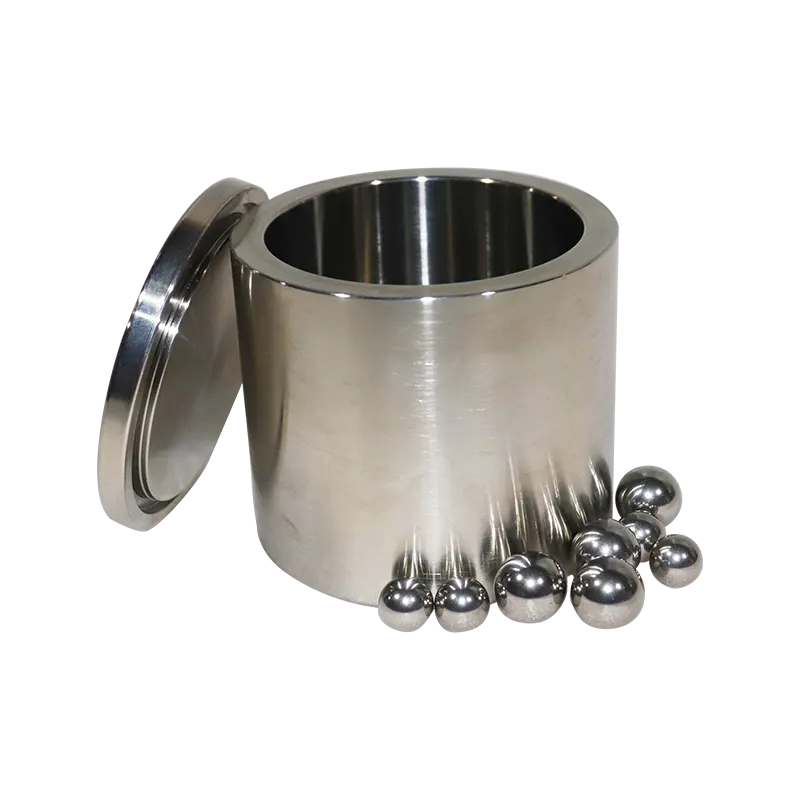
For a dissolver, the vessel, shaft geometry, mounting and circulation conditions are important, not just the wall material. Cup or lining material may influence wear and contaminant transfer, but does not in itself prove compatibility. If the application requires attrition rather than dispersion, mill equipment with a proven configuration should be considered; If the task is to wet and distribute the powder, mixing equipment and a suitable vessel are selected.
Scaling: from laboratory sample to working volume
Transferring the mode from a laboratory installation to a production one does not come down to multiplying the mass and maintaining the number of revolutions. As the volume increases, the heat exchange area, circulation path, residence time in the shear zone, and the ratio of the shaft diameter to the vessel diameter change. Therefore, the laboratory result serves as the basis for a hypothesis, rather than a ready-made setup.
Peripheral speed, power density and heat dissipation
Scaling often attempts to maintain peripheral speed or power density. Both approaches have limitations. A constant peripheral speed better maintains shear intensity at the periphery, but does not guarantee the same circulation and heat removal. Constant power density takes into account volume but may require unacceptable local loads. In practice, several levels are checked and temperature, dispersion and stability are monitored.
For a large batch, not only the maximum speed is more important, but also the time to reach the mode. If the product remains in a stagnant zone for a long time, local overheating or incomplete wetting may persist even at formally correct speeds. The geometric similarity of the vessel, the position of the shaft and the presence of partitions must be checked separately.
What to record in the protocol
- Identification of the powder, liquid and additive lot, including date and storage conditions.
- Load weight, insertion order, component temperature and feed rate.
- The diameter and type of the organ, the position of the shaft, the number of revolutions and the estimate of the peripheral speed.
- The temperature of the product during the process and the method of measuring it.
- Processing time, sampling points and control methods.
- Observations on foam, delamination, sticking and stopping behavior.
Pilot series and stopping criteria
It is better to construct a trial series as several short experiments with sampling, rather than as one long cycle. This allows you to see at what stage the desired homogeneity is achieved and when excessive heating begins. The stopping criterion must be specified in advance: for example, the absence of lumps on the control device, achievement of a given viscosity or temperature stability over a certain time. If the criterion is not met, change one factor at a time.
When moving to a larger batch, it is useful to maintain the same order of entry and the same temperature of the components. If this is not possible, the results are compared with adjustments for conditions. It cannot be argued that the mode has been transferred correctly based solely on the appearance of the product.
What to check before trial dispersion
Before testing, it is useful to collect a short technical data sheet for the task. It helps the equipment supplier and the technologist speak the same language, and also reduces the risk that the trial run will be reduced to overkill without fixing the conditions.
- Product type: suspension, paste, gel, concentrate or intermediate mixture.
- Solid content, nature of the powder, initial particle size and tendency to agglomerate.
- Viscosity and rheology in the operating range, measurement temperature.
- Target result: no lumps, particle distribution, stability, color, density.
- Limitations on temperature, volatility, foaming and cycle time.
- Available volume of the vessel, its geometry, material and cooling capabilities.
- Requirements for purification, impurity transfer and product compatibility.
- Power parameters, controls, safety interlocks and room conditions.
- Quantity of sample to be analyzed and acceptable losses.
- Documentation of component safety and protective measures taken.
To clarify the configuration of the hydraulic twin-shaft dissolver TENCAN Please inquire about available options, contact materials, control ranges, control system and vessel requirements. On website TENCAN equipment directions can be checked, but specific parameters must be confirmed by the documentation of the selected model and test results on a real product.
The main conclusion is simple: the dissolver is chosen not by maximum speed, but by the combination of the task, rheology, heat removal and geometry. Two shafts provide more control over circulation and shear, but require a conscious distribution of roles. The hydraulic circuit facilitates maintenance and positioning, but does not replace process mode. Testing on a trial batch with clear criteria is more reliable than transferring laboratory tests to another volume.