
Heat treatment of a sample in a controlled environment begins not with the choice of model, but with a description of the problem: what kind of material is it, what is the mass of the sample, what temperature is needed on the sample, is a gas flow or vacuum required, how quickly can the product be heated and cooled. A horizontal tube furnace is useful where the sample is placed in a tube and the atmospheric composition along the work area is desired to be controlled. But it is precisely this versatility that creates an error: the furnace is selected based on one maximum temperature, and then it turns out that the pipe is not suitable for the medium, the sample does not fit in the boat, the heating is too inert, and the tightness is insufficient for a long process.
Below is a practical analysis of how to approach the choice of a horizontal tube furnace TENCAN and what parameters to check before the test run. We are talking about selection criteria, and not about replacing the operating instructions: specific values for available versions must be checked with the current product card and the manufacturer’s documentation.
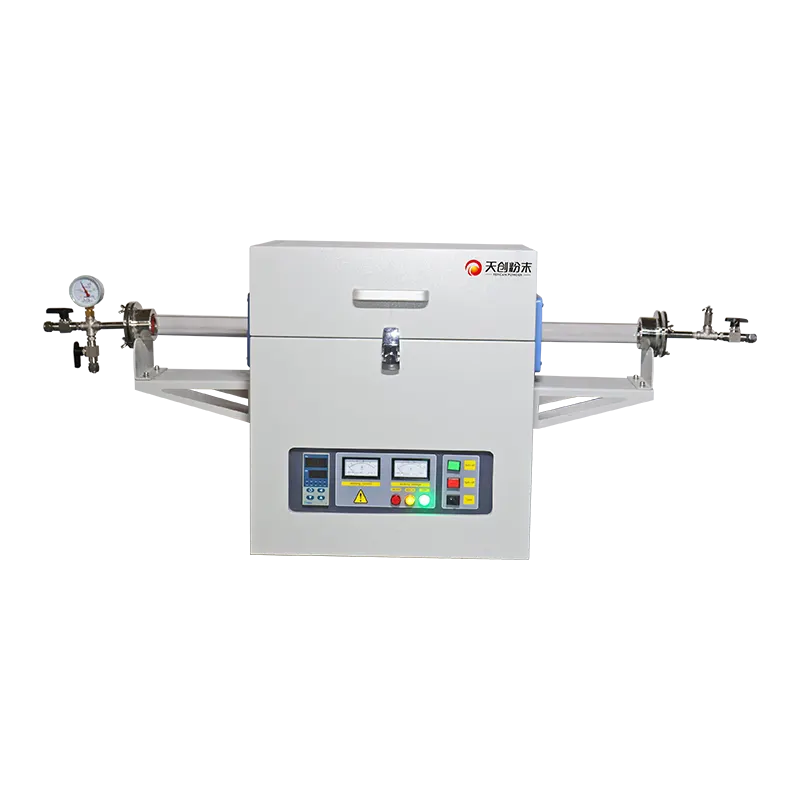
When is a horizontal tube furnace appropriate?
The horizontal tube furnace is used for sintering, annealing, calcination, reduction and other processes where not only the temperature, but also the environment around the sample is important. The pipe forms a limited working volume through which the flow of inert or reaction gas can be organized, as well as the removal of decomposition products. For small samples, such a scheme provides a predictable position in the hot zone and the ability to observe the process through the ends or process windows, if provided for by the design.
The opposite situation is tasks where a controlled atmosphere is not needed. Simply drying, ashing or annealing large items in air is often cheaper and more convenient in a chamber oven. The pipe limits the size and shape of the sample, requires careful loading and cleaning, and its ends and seals become additional points of attention. If productivity and large batch sizes are the main criteria, a horizontal tube furnace may not be the most efficient choice.
The horizontal layout is convenient for manual loading of boats and crucibles, but it has its own characteristics. There may be a temperature gradient along the pipe, and the gas flow may carry dust or condensation towards the cold end. The direction of flow, the position of the sample relative to the thermocouple, and the method of supporting the pipe are all important. A vertical oven is sometimes better for powders that are prone to shedding, but a horizontal oven is easier for placing extended samples and substrates.
The first practical question when selecting is: is it necessary to control the atmosphere and the tightness of the working volume? If so, a tube furnace provides a constructive basis for this, but in itself it does not guarantee either cleanliness of the environment or uniformity of temperature. These properties are determined by the pipe, seals, gas fittings, location of heaters and regulator settings.
How the oven works and what components affect the result
In general, a horizontal tube furnace includes a working pipe, heaters around it, thermal insulation, a housing, end flanges or covers, sealing elements, gas inlet and outlet pipes, a thermocouple and a control cabinet. The specific equipment depends on the design, so when choosing, it is important to separate the required components and options: for example, the presence of a vacuum pump, flow meter or additional heating zone cannot be assumed without confirmation.
Horizontal tube furnace TENCAN the product card describes it as heat treatment equipment; actual parameters of specific designs should be taken from current documentation, and not from general assumptions about tube furnaces.
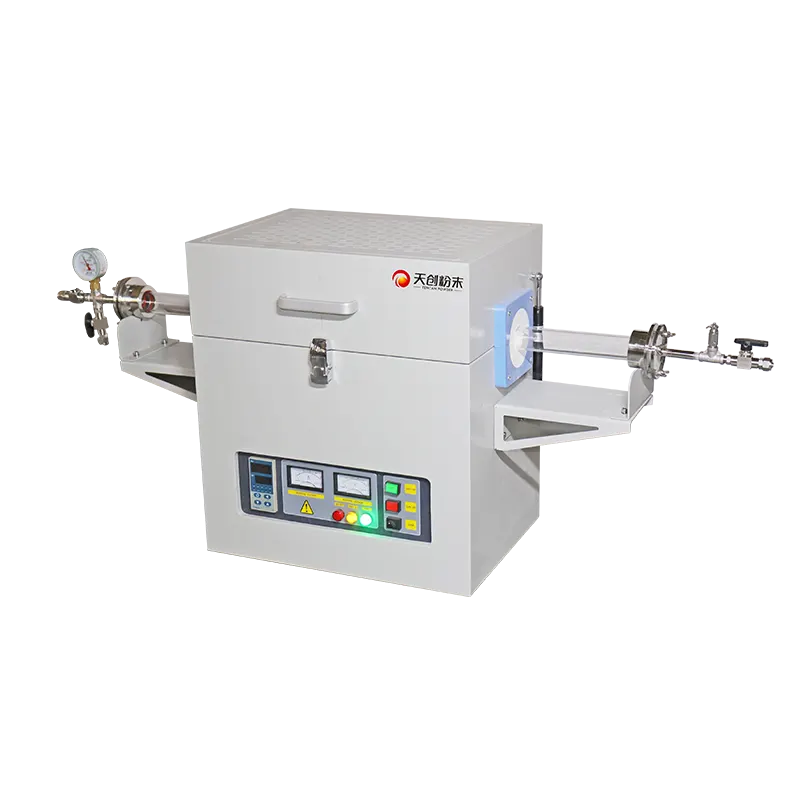
Pipe and working chamber
The pipe is the central element that simultaneously forms the working volume, participates in heat transfer and is in contact with the atmosphere. Its material, diameter, length, wall thickness and method of fastening affect the permissible temperature, heating rate and ease of loading. A pipe that is too tight limits the boat size and gas flow, while a pipe that is too long increases gradients and requires more time to stabilize. The pipe material must be compatible not only with the temperature, but also with the gas environment and process products.
Sealing and gas path
Tightness is ensured not only by gaskets, but also by the quality of the flange fit, the condition of the sealing surfaces, the tightening of fasteners and the temperature in the sealing area. The gas path includes an inlet, an outlet, shut-off valves, a possible flow meter and a discharge system. For processes with inert gas, it is not so much the “hermetically sealed” inscription that is important, but rather reproducible purging and control of air leaks. For vacuum modes, check separately whether the design allows vacuum and which seals are intended for this.
Control and measurement
The thermocouple indicates the temperature at the installation point, not the temperature of the sample. If the junction is located against the pipe wall or in the gas flow, the readings may differ from what occurs in the boat. The software controller sets the heating and holding time, but the quality of control depends on the setting, the inertia of the furnace and the uniformity of the hot zone. Before work, it is worth checking where the thermocouple is located, whether there is protection against overheating, how the program is entered and whether calibration is provided.
Temperature: maximum, operating and sample temperature
Furnace descriptions often indicate a maximum temperature, but this is not the same as long-term operating temperature. The maximum may apply to a short-term run-in, to a heating element, or to a pipe in a certain atmosphere. For long-term soaking, there are usually more careful restrictions depending on the pipe material, type of heaters, seals and loading. The maximum value cannot be transferred to any sample and any gas regime.
The sample temperature may differ from the temperature shown by the controller. The mass of the boat, thermal contact, position in the pipe, gas flow rate and thermal inertia all influence. In transient modes, the furnace and the sample are not heated synchronously: a massive substrate delays heating, and a thin powder can react faster. If the process is sensitive to the rate of temperature rise, a separate control experiment with a thermocouple in the sample area or another validated test method is needed.
The heating rate comes with a risk of overshoot. Reaching the set point too quickly sometimes leads to a short-term temperature overshoot, especially with high inertia. For sensitive materials, select a smoother program and check the actual curve, not just the set values. Speed limits may also be determined by the heat resistance of the pipe and the cooling rate.
Temperature uniformity in the working area is not guaranteed by the name “tube furnace” alone. It depends on the length of the heating zone, the design of the heaters, end losses and the position of the sample. If the documentation indicates a uniform zone, you need to understand under what conditions it is defined. For reproducibility, it is better to fix the position of the boat and not change it from trial to trial unless necessary.
Atmosphere and sealing
Air, inert gas, reducing atmosphere and vacuum are different modes, and each requires its own testing. In an air atmosphere there is no task of removing oxygen, but there is oxidation of the sample and heating of the seals. In an inert environment, purging, gas flow and the absence of suction are key. In a reducing environment, consideration must be given to the compatibility of the gas with the pipe material, heaters and seals, as well as the safety of personnel.
Purging before heating is necessary to replace air in the working volume. However, the duration of purging depends on the volume of the pipe, gas flow and tightness. If you simply open the gas at low flow rates, air may be displaced slowly and unevenly. If you supply too much flow, turbulization, dust entrainment and overcooling of the zone are possible. For repeatability, it is helpful to have a validated procedure for purging and monitoring the media rather than relying on visual assessment.
Vacuuming is not a universal function. Not every pipe, seal and flange is designed to withstand vacuum, and heating in a vacuum changes heat transfer and material behavior. If a vacuum mode is declared, the maximum residual pressure, permissible pumping speed and compatibility with the sample should be clarified. If only gas flow is stated, the installation should not be described as a vacuum furnace.
Safety is determined not only by the oven, but also by the gases that are passed through it. Toxic, flammable and corrosive environments require ventilation, leak control, sensors and compliance with instructions. Sample decomposition products may condense in the cold part of the pipe and contaminate it. Therefore, the gas path, seals and exhaust are considered as a single system, and not as a secondary piping.
Pipe material and sample compatibility
The pipe material is selected based on temperature, atmosphere and chemical compatibility. Quartz is useful for observation and clean processes, but is sensitive to thermal shock and is not suitable for some environments. Ceramic pipes made from oxide ceramics may be more resistant to temperature, but their resistance to sudden changes and contact with melts requires separate testing. Metal pipes have their own limitations regarding oxidation and interaction with gas. No material can be considered universal just by name.
The boat, crucible or support also comes into contact with the sample. Their material can influence the result more than it seems: recovery, sintering with the substrate, transfer of trace impurities and adhesion are possible. Before the process, it is useful to check chemical compatibility and conduct a dry heat to evaluate the behavior of the sample-contact material pair. The promise of “zero contamination” for any material is incorrect: we are talking about controlled and, where possible, measured levels of impurities.
Cleaning between runs is as important as pipe selection. Residues from the previous sample, condensation and dust can become a source of oven memory. If different processes were carried out in the pipe, a cleaning procedure and, if necessary, a control sample are needed. For powders with small particle sizes, dust entrainment should be taken into account: the gas flow can carry material to the outlet, so the position of the boat and the flow rate are selected especially carefully.
Compatibility cannot be confirmed by random coincidence of categories. If an accessory or consumable item is not described for a given oven, its use requires separate technical verification. In an article about a furnace, it is inappropriate to promise compatibility with any grinding media, crucibles or pipes simply because they are laboratory equipment.
Loading, cooling and reproducibility
Sample loading and position
Loading is not only the mass of the sample, but also the geometry of the boat, filling density, position in the hot zone and the area of contact with the gas. A layer of powder that is too thin reacts more quickly with the atmosphere, but is more susceptible to entrainment. A layer that is too thick creates a gradient within the sample. Load mass and productivity over time are different values: one sample cannot judge the throughput of an installation.
The position of the boat relative to the thermocouple and the ends of the pipe must be fixed. If you place the sample in a new place each time, the results will diverge even with the same program. Simple techniques that are helpful for repeatability include a mark on the pipe, a fixed stand, the same boat, and recording the actual position. This is especially important when moving from a single sample to a series.
Cooling and Transients
Cooling is part of the heat treatment, not a pause after it. Slow natural cooling, forced airflow and hardening give different structures and different risks to the pipe. Conventional air cooling should not be called cryogenic: they are different processes with different capabilities and limitations. If the description does not confirm liquid nitrogen cooling, it should not be attributed to the installation.
When cooling, it is important whether the protective environment is maintained to a safe temperature. If the gas supply is stopped too early, the sample may oxidize. If you leave a large flow, uneven airflow and dust removal are possible. For sensitive processes, it is better to have a described transition procedure and temperature control rather than rely on estimated cooling times.
Transition from sample to batch
Increasing load is not linear scaling. A larger mass takes longer to warm up and may require a different position in the pipe and a more careful gas. Sometimes it is easier to increase the number of identical samples than to load the entire pipe. To move to a larger batch, you need to check repeatability at several positions, evaluate the gradient and ensure that the gas flow does not create stagnant zones.
What to check before ordering and trial run
Before selecting equipment, it is worth preparing a short technical specification. It helps to compare performances not by name, but by operating conditions. It is useful to include information about the sample, required temperature, atmosphere, acceptable impurities, boat size and criteria for accepting the result.
- Material, shape and weight of the sample, as well as the material of the boat or crucible.
- The maximum and long-term temperature is for the sample, and not just for the oven.
- Required atmosphere: air, inert gas, reducing atmosphere or vacuum.
- Permissible gas flow rate, sensitivity to moisture and oxygen, composition of decomposition products.
- The size of the working area, the diameter of the pipe, the need for one or more heating zones.
- Requirements for tightness, seals, leakage control and safety.
- Heating and cooling rates, permissible gradients, need for software control.
- Available utilities, ventilation, installation location and personnel qualifications.
It is better to start a test run with an empty pipe: check the heating, the stability of the set point, the operation of the controller and, if tightness is declared, the absence of leaks using an accessible method. Then a control experiment is performed with a sample or simulator, recording the actual position, program and behavior of the atmosphere. If the result is not as expected, first check the measuring point, load and gas path, rather than changing parameters at random.
IN catalog TENCAN you can compare the direction of the equipment and clarify the available versions, and in the horizontal tube furnace card you can check the current information before making a request. For correct selection, it is enough to honestly describe the problem: material, mass, temperature, environment and limitations. The furnace remains a tool, and the reproducibility of the result depends on the consistency of the pipe, load, atmosphere and control procedure.