
Preparing a suspension in the laboratory rarely comes down to simply turning on the stirrer at maximum speed. More often, the problem looks different: the powder is poorly wetted, lumps remain on the walls, bubbles appear in the volume, and the sample temperature rises faster than expected. The focus of this article is the High Speed Dispersant-Homogenizer TENCAN. This equipment is designed for intensive mixing and dispersion of liquid and paste-like media, but its result depends not only on the rotation speed. The result is influenced by the properties of the sample, the geometry of the container, the position of the working head, the order in which the components are introduced, and temperature control. Useful information about the direction of the equipment and its place in the line can be checked at website TENCAN, and the specific version is in the card of the selected model.
Below are practical questions that arise before the first launch and during the selection of the mode. We are not talking about a universal recipe: for different materials and devices it is safer and more accurate to select conditions based on the results of trial dispersion. This approach helps separate the real capabilities of a high-speed dispersant-homogenizer from applications that require a different type of equipment.
First separate dispersing from grinding
In laboratory practice, the words “mix,” “disperse,” “homogenize,” and “grind” are sometimes used interchangeably. This is dangerous for the selection of equipment: different operations require different mechanisms of influence. A high-speed dispersant-homogenizer creates intense shear in the working area, promotes wetting of particles, destruction of soft agglomerates and uniform distribution of the solid phase. It can significantly improve the uniformity of the suspension, but does not replace the ball, bead or vibratory mill where targeted reduction of primary particle size is required.
It is convenient to formulate the practical difference as follows: mixing equalizes the composition by volume, dispersion destroys agglomerates and distributes particles, homogenization reduces the heterogeneity of the system, and grinding reduces the particle size due to grinding bodies or other grinding effects. The boundaries between these processes are not absolute: intense dispersion is sometimes accompanied by a slight reduction in agglomerates. However, it is impossible to guarantee a certain particle size only by using a high-speed apparatus. The final result depends on the source material, environment, mode and measurement method.
| Operation | What mainly happens | What to check |
|---|---|---|
| Mixing | Leveling concentration and temperature, maintaining particles in suspension | No stagnant zones, uniform sampling |
| Dispersing | Powder wetting, destruction of soft agglomerates, distribution of the solid phase | No lumps, stable suspension, presence of bubbles |
| Homogenization | Reduced local heterogeneity, more uniform structure | Result repeatability, temperature, rheology |
| Grinding | Reducing particle size using grinding media or a specialized unit | Granulometry, grinding media material, contamination |
If the task is to obtain a suspension with evenly distributed powder, a high-speed dispersant-homogenizer TENCAN may be appropriate. If it is necessary to achieve a specified upper limit of particle size, confirmed by particle size analysis, dispersion alone may not be enough. In this case, it is useful to first determine whether it is poor wetting, strong agglomerates, or primary particles that are limiting the result. Equipment is selected according to the reason, not the name of the operation.
How does a high speed dispersant-homogenizer work? TENCAN
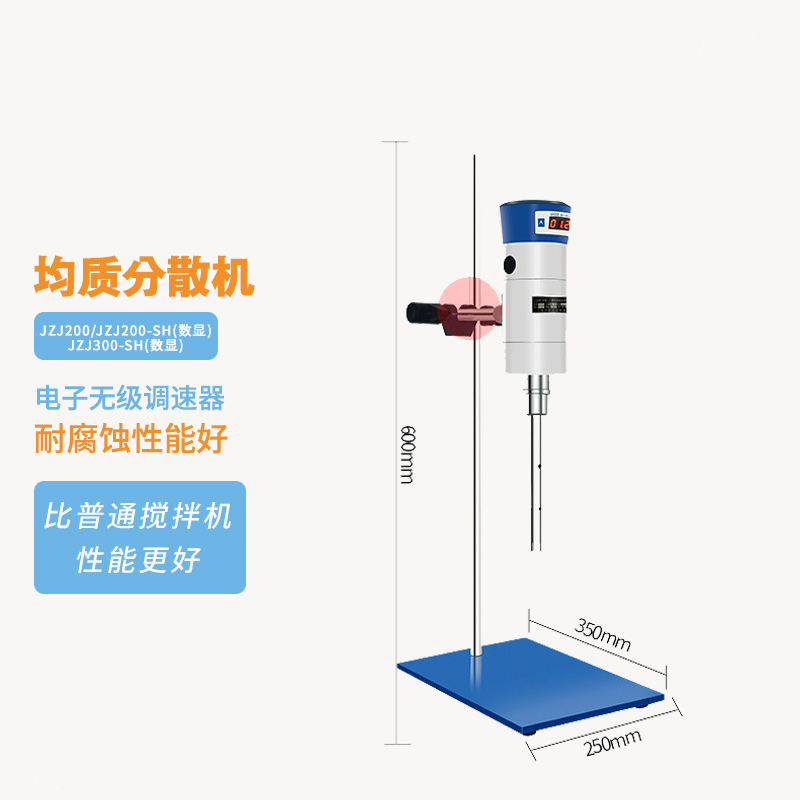
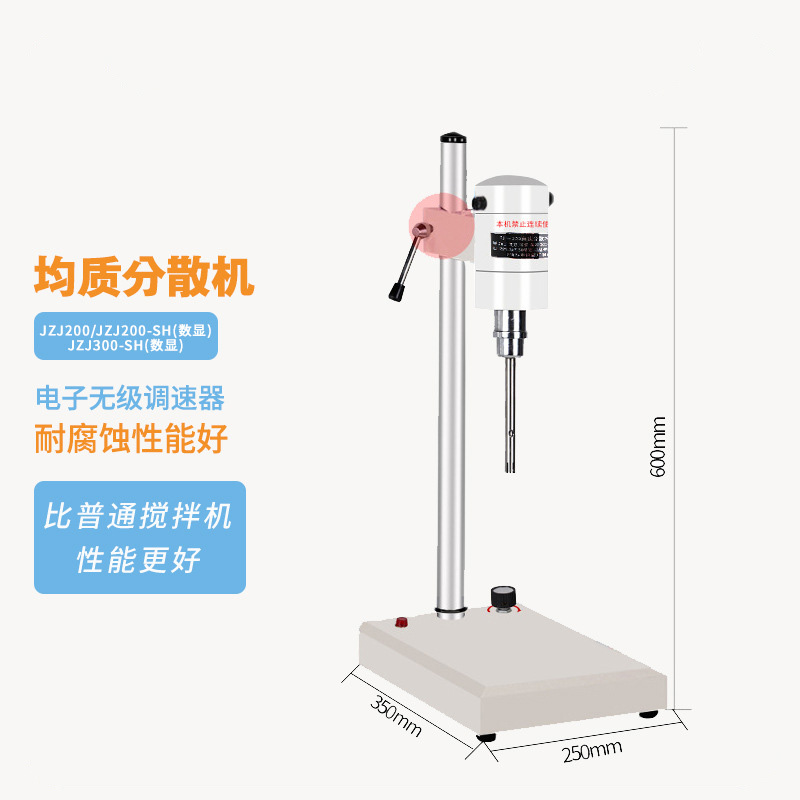
Devices of this class usually include a drive, a vertical shaft with a working head and a speed control system. The working head may have a rotor and a stator with slots or teeth. As the rotor rotates, the medium repeatedly passes through a narrow gap and intense shear zones. It is there that the main processes occur: destruction of agglomerates, wetting of the particle surface, mixing and creation of a developed phase contact surface. The higher the rotation speed, the greater the shear rate, but at the same time the heating and the risk of air entrapment increase.
It is important to distinguish between the rotational speed and peripheral speed of the working head. Two machines with different rotor diameters may have the same revolutions per minute, but differ markedly in speed at the periphery. Therefore, it is incorrect to transfer a mode from one model to another only based on tachometer readings. For reproducibility, it is useful to record not only the revolutions, but also the head geometry, container diameter, shaft position, load volume and processing time. In the card of a high-speed dispersant-homogenizer TENCAN on product page You should check the actual design, configuration and available options of the working head, and not rely on general assumptions.
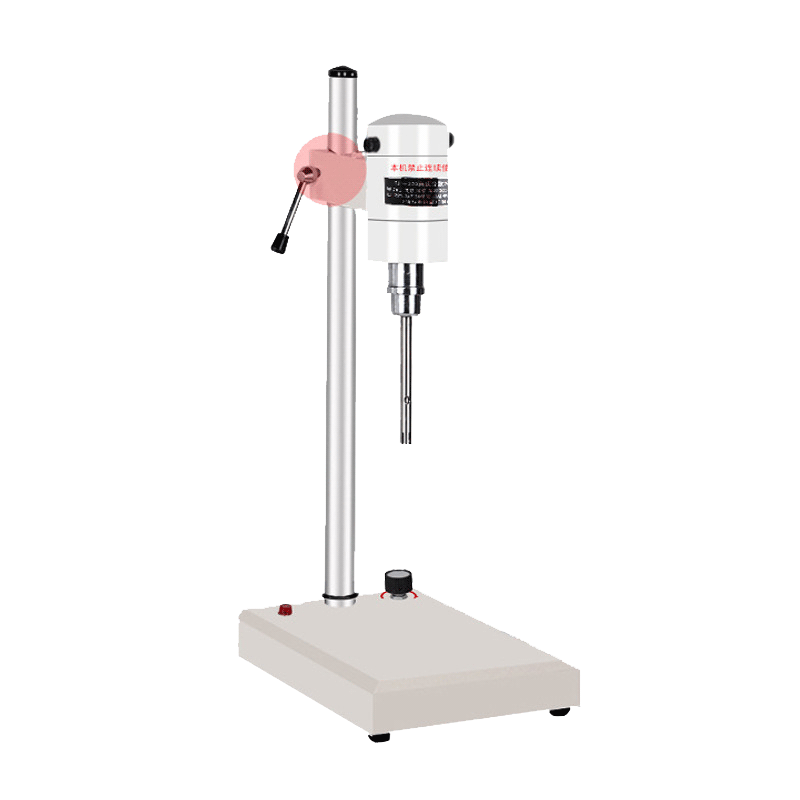
The working head must be immersed in the medium so that dry running and excessive air leakage from the surface do not occur. If the shaft position is too high, a funnel is formed, bubbles are drawn into the liquid, and part of the energy is spent not on dispersion, but on aeration. If the position is too low, overheating in the local area and incomplete involvement of the entire volume is possible. The optimal position depends on the shape of the container and the amount of product, so it is checked visually on a small sample.
The high-speed dispersant-homogenizer is not a mill with grinding media. It does not contain grinding balls, which provide impact and abrasion. If the material contains strong agglomerates, another operation or preliminary preparation is required. Understanding this difference helps you avoid overloading the machine with expectations it shouldn't have to meet and preserves seal and drive life.
What to check in the sample and container before launch
Before the first launch, it is useful to draw up a sample passport: chemical composition, solid phase content, viscosity at operating temperature, density, initial size and tendency to swell. For suspensions, not only the viscosity at rest is important, but also the shear behavior. Thixotropic systems may appear thick without mixing and thin out noticeably in the work area. This affects the choice of initial speed and the order of powder introduction.
The chemical compatibility of the medium with the contact parts of the device and seals is separately specified. Aggressive solvents, abrasive powders and high temperatures can limit application even with suitable drive power. If a specific contact material is not specified on the product data sheet, it cannot be considered universally resistant. This issue should be checked against the documentation of the specific design and, if necessary, clarified with the supplier.
The volume of the container, the loading volume and the mass of the sample are different quantities. The nominal volume of the vessel does not mean that it can be filled completely and immediately enter intensive mode. For high-speed dispersion, there must be sufficient free space above the surface so that the funnel does not trap air, but the work head must be securely submerged. Too little loading results in an unstable vortex, too much leads to overfilling and poor circulation. Specific limitations are determined by the design of the apparatus and the geometry of the container.
Check before starting:
- compatibility of the solvent and powder with the material of the working head, shaft and seals;
- absence of foreign inclusions and large lumps that can clog the head slots;
- temperature conditions and the need to cool the container;
- possibility of safe sampling without stopping the process;
- the presence of a tray or splash protection when working with foaming media.
For the first experiments, it is better to use a smaller sample and gradually increase the load. This makes it easier to see at what ratio of solid and liquid phases a stable vortex appears, thickening begins, or a sharp increase in temperature begins. Data from one sample does not guarantee the behavior of the entire volume, but it does help select a safe starting point.
Mode settings: speed, time and input order
There is no universal speed for all suspensions. The practical logic is usually this: first create fluid movement at a moderate speed, then gradually introduce the powder, avoiding the formation of dry lumps, after wetting, increase the intensity and maintain the regime in short intervals with temperature control. If the powder is administered too quickly, it may clump into clumps that are then difficult to break down. If you start at maximum speed right away, more air will be introduced into the environment, and heating will become less predictable.
The order in which the components are added depends on the recipe. In some cases, the powder is introduced into a liquid base, in others it is pre-mixed with part of the liquid or a wetting component. This is not a universal recommendation, but a technological sequence that needs to be checked for a specific system. The only important thing is that the high-speed dispersant-homogenizer is not intended for “dry” mixing of powders without a liquid medium and should not operate without a sufficient amount of liquid in the working area.
It is convenient to increase the processing time in steps: for example, short cycles with inspection and temperature measurement instead of one long switching on. This makes it easier to notice the moment when the suspension stops changing noticeably. Continuing processing after uniformity is achieved often does not improve the result, but increases heat, wear and aeration. For heat-sensitive materials, pauses, cooling the vessel, or reducing the speed after dispersion is complete are helpful.
Observable signs help to adjust the regimen. If the slurry climbs up the shaft and forms a high vortex, the head may be too high or the speed may be too high for the viscosity. If dry lumps remain on the walls, the problem may be that the powder was introduced too quickly or the initial mixing was not sufficient. If thick foam appears, it is worth checking the immersion depth of the head, the shape of the container and the ability to operate at a lower speed. A specific malfunction cannot be determined based on one symptom, but the direction of the check becomes clearer.
Overheating, foam and aeration: hidden limitations
High-speed dispersion is accompanied by the release of heat. The energy supplied to the liquid is partially converted into heating, and the higher the viscosity and shear intensity, the more noticeable this effect. The shirt or room temperature is not the same as the sample temperature. If the process is sensitive to heat, you need to measure the temperature of the product or at least control it at a representative point, and not rely only on the readings of an external sensor. Air cooling alone does not make the process cryogenic; For low-temperature tasks, separate confirmation of the suitability of the apparatus and equipment is required.
Foam and bubbles are not just a cosmetic problem. Air changes the effective density and viscosity of the medium, reduces heat dissipation and can distort the results of particle size or rheology measurements. A visually homogeneous suspension with a large number of microbubbles sometimes behaves as an unstable system. Therefore, when selecting a mode, it is useful to let the sample settle and compare the results before and after removing air, if the technique allows this.
The cause of aeration is often related to geometry: the position of the working head is too high, the shape of the container is poor, excessive speed or small load volume. Sometimes changing the order of addition helps: the powder is added more slowly, and the foaming component is added closer to the end. If the apparatus is not designed to operate under vacuum, do not expect vacuum degassing to occur spontaneously. Intervention in the design without agreement with the documentation is unacceptable.
For heat-sensitive suspensions, the permissible time at a given temperature and the method of cooling are determined in advance. This may include jacketing the container, pre-cooling components, running in short cycles, or reducing speed after wetting. It is impossible to transfer the parameters of one model system to another without checking: what a diluted sample can withstand is not necessarily what a concentrated paste can withstand.
Monitoring the result, cleaning and moving on to the next batch
The evaluation of the result must correspond to the task. For visual inspection, the absence of lumps, uniformity of color and absence of separation immediately after processing are important. For quantitative assessment, microscopy, granulometry, rheology, sedimentation stability, or other methods accepted in a particular laboratory are used. A high-speed dispersant-homogenizer can improve particle distribution, but does not guarantee a specific particle size for any material. If the problem specifies an upper size limit, it is confirmed by measurement, and not just by the absence of visible lumps.
After work, it is important to clean the working head, shaft and container from any remaining suspension. Dried particles in the head slots reduce the efficiency of the next start and can become a source of contamination. The cleaning method depends on the solvent and seal material; aggressive chemicals or an abrasive brush can damage the surface. If you are going to be handling different materials, it is helpful to have separate containers or a proven cleaning procedure to avoid transferring impurities from batch to batch.
When moving from a laboratory sample to a larger volume, the processing time should not be mechanically multiplied. The result is influenced by the ratio of the diameter of the container and the head, the height of the layer, heat dissipation and circulation. In a large volume, heat is removed more slowly, and the path of particles to the working area may be longer. For scaling, it is useful to maintain a comparable peripheral speed and check the temperature at several stages, but even this does not guarantee a complete match. A more reliable way is a stepwise increase with control of rheological and granulometric parameters.
What to report for trial dispersion
To select the mode and configuration, it is useful to prepare in advance a brief description of the task: the nature of the material, solid phase content, viscosity or its approximate range, type of liquid medium, working volume, permissible temperature, required result and method of its control. If restrictions on contact materials, foaming or cleaning are known, these are also indicated. This helps you avoid selecting equipment blindly and transferring a mode obtained on another product to a new system.
The request should include information about the current preparation method, problems and modes already tried. For high speed dispersant-homogenizer TENCAN Load volume, container geometry and temperature requirements are fundamentally important, since they determine the actual intensity and duration of processing. You can check the performance and characteristics of a specific model at page of high-speed dispersant-homogenizer. Based on the results of the test run, not only the speed and time are recorded, but also the head position, temperature, input order and control method - then the mode can be reproduced and reasonably adjusted.