
Reducing sample size is often formulated too generally: “you need powder.” Meanwhile, the choice between crushing and grinding is determined not only by the target particle size, but also by the properties of the material, permissible heating, requirements for sample purity and batch size. Hammer Crusher TENCAN refers to impact equipment and covers the stages of preliminary and secondary crushing, while fine grinding is performed by machines of another class - drum, planetary or bead mills. The practical question that is discussed below is simple: how to coordinate the mode of a hammer crusher with the task of sample preparation so as to obtain a reproducible distribution of particles and not spoil the sample by overheating, sticking or introduced impurities.
Place of a hammer crusher in sample preparation
Laboratory sample preparation is rarely reduced to one operation. Usually a chain is built: receiving and recording a sample, dividing to a working mass, preliminary crushing, medium crushing, fine grinding, homogenization and, if provided for by the method, sifting into target fractions. Each stage solves its own problem, and trying to jump over one of them is expensive: if you load pieces into the ball mill that it is not able to capture, the grinding either will not start or will stretch, and the wear of the drum and grinding media will be increased.
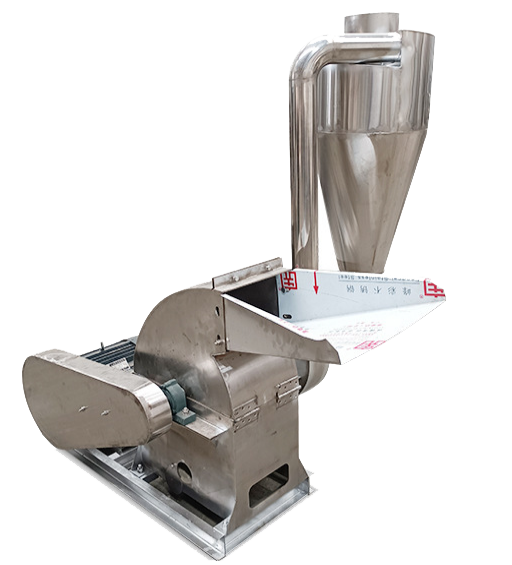
The hammer crusher occupies an intermediate position in this chain - between coarse crushing machines and fine grinding equipment. Its working body is a rapidly rotating rotor with hammers: the particle is destroyed by impact, then by impact with the fender elements of the chamber and, finally, in the gap at the unloading grid, through which the finished product leaves the working space. This mechanism provides a high degree of particle size reduction in one pass and allows continuous operation, which is convenient when preparing a series of similar samples.
The downside of the impact principle is a relatively wide particle size distribution and noticeable heat generation in the contact zone. Therefore, the decision to use a hammer crusher is made not by the name of the material, but by a set of conditions: fragility, humidity, permissible amount of dust, cleanliness requirements and the subsequent processing stage.
Crushing and grinding: where is the border?
Crushing and grinding are distinguished by both the size of the product and the mechanism of destruction. During crushing, the particle splits along weakened sections and cracks: the supplied energy is spent on the formation of new surfaces and on irreversible deformation, but no developed surface is created. Fine grinding goes further - it brings the material to a state where further reduction in size requires a disproportionately large amount of energy, and aggregation of small particles, hardening and re-sticking begin to play a significant role. Mixing and disagglomeration are separate operations: they change the relative arrangement of particles, but not necessarily their size, and one cannot be replaced by the other in a technological scheme.
When is impact crushing appropriate?
The hammer crusher works well with brittle, lumpy and granular materials that do not soften under moderate heat and do not stick to the working parts. Signs that justify the choice of this car usually look like this:
- the material is fragile: when destroyed, a fragment is formed, not a flattened particle;
- the original pieces are confidently captured by the loading device and are not pushed out by the rotor;
- wide distribution of the product is acceptable or compensated for by subsequent sifting;
- contact with metal working parts does not affect the analysis results;
- the humidity is such that the material remains free-flowing and does not clog the discharge grid.
When you need another car
Impact crushing is not suitable for plastic and viscous materials: metals, rubbers, many polymers, foil, as well as for wet and greasy masses that stick to hammers and grids. Heat-sensitive materials - waxes, some organic and pharmaceutical substances, hydrated compounds - change their properties when locally heated, and then machines with a different thermal regime are considered. If a narrow monodisperse distribution or ultra-fine grinding is required, the hammer mill remains only a pre-treatment stage and not a finishing equipment. Finally, with strict restrictions on metal impurities, working parts are selected from a suitable material, but it should be remembered: no design provides an absolute absence of contamination; the question is always about their acceptable level.
Design and principle of operation of a hammer crusher
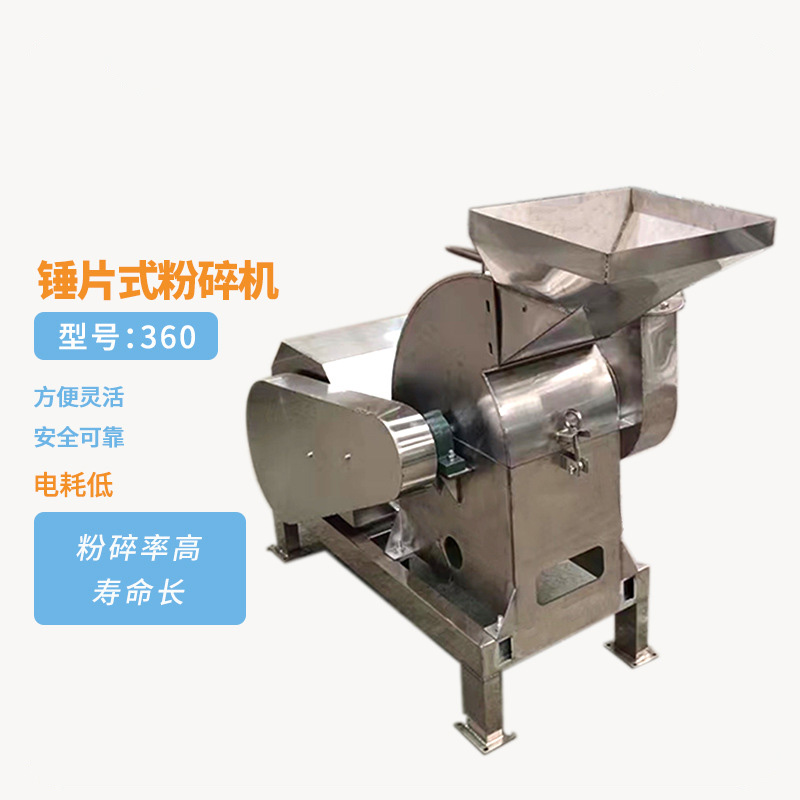
A typical arrangement includes a crushing body, a feed hopper, a rotor on a shaft, hammers, impact plates, a discharge screen, a discharge port, a drive and a base. Structural details of a particular model - dimensions of the working chamber, number and weight of hammers, drive design, available grating options - are given in the manufacturer's documentation; It is incorrect to transfer this data from one machine to another. Technical characteristics and equipment of the hammer crusher TENCAN are given in her card: hammer crusher.
Rotor and hammers
Hammers can be hinged on axles or rigidly mounted on a rotor. A hinged mount reduces the risk of breakage when hit by an unbreakable inclusion, while a rigid mount provides a more predictable transmission of impulse. The weight and number of hammers affect the energy of a single blow, and their wear affects the reproducibility of the result: dull or unevenly worn hammers change the distribution of the product, increase vibration and require rotor balancing. Wear of working parts is a cost parameter that is planned in advance, and is not detected by deterioration in sample quality.
Impact plates and unloading grid
The discharge grate, grate or perforated, sets the upper limit of the size: the particle leaves the chamber only when it passes through the flow section. Reducing the flow area makes the product smaller, but reduces throughput, increases the residence time of the material in the chamber and, as a result, heat and dust formation. The gap between the hammers and the grid also contributes to the formation of the result: additional abrasion and crushing occurs here. Impact plates absorb impacts and protect the hull; their geometry determines the particle trajectory and the number of repeated impacts.
Drive, peripheral speed and feed
The peripheral speed of the hammers is one of the main adjustable parameters. The impact energy grows approximately in proportion to the square of the speed, so its change simultaneously affects the size of the product, productivity, heating and wear rate. If the design provides for regulation of the rotation speed, the mode is selected experimentally; if not, they operate with replaceable gratings and feed speed. The feed must be uniform: overloading leads to incomplete destruction of particles and clogging of the chamber, working “underload” leads to excess dust formation, increased wear and heating.
Housing, sealing and aspiration
Dust formation during impact crushing is inevitable, so the seals, discharge pipe and connection to the local exhaust are no less important than the working parts. Air leakage through leaks impairs sampling, and the lack of aspiration leads to the accumulation of dust in the room. The material of the contact surfaces of the housing and the discharge path should be taken into account when working with traces of metals.
What determines particle size and distribution
The final particle size is the result of the combined action of material properties and machine conditions. The catalog may indicate typical values, but for a specific sample they are not guaranteed: the distribution is always checked by measurement, and not assumed from the passport.
Material properties
Strength, brittleness, fracturing, density and anisotropy determine which path the destruction will take. Layered and fibrous materials produce elongated particles that are prone to agglomeration; monolithic fragile - more isometric fragments. The presence of inclusions of a different hardness leads to jumps in distribution and incomplete crushing of individual pieces.
Moisture and flowability
High humidity is the most common cause of problems in impact crushing. Moisture reduces flowability, promotes sticking to hammers and grates, reduces the effective unloading cross-section and increases heating due to friction. If the humidity is significant, drying is considered before crushing - if the material allows such processing - or they switch to another grinding scheme, including wet.
Unloading flow area and peripheral speed
The size of the holes or slots in the grate sets the upper limit of the product, and the peripheral speed of the hammers determines how completely the material is destroyed before reaching it. Changing the two parameters together allows you to control not only the average size, but also the width of the distribution. Grate wear expands the flow area, and the product imperceptibly becomes coarser - this is one of the reasons why the mode needs to be periodically rechecked.
Feed rate and residence time
The material must have time to degrade before leaving the chamber. If the feed is too fast, large pieces are forced toward unloading without receiving a sufficient number of blows; if it is too slow, the proportion of dust and heating increases, and performance decreases. Stable feed is a condition for reproducibility: identical samples with the same feed give comparable distributions.
How to narrow your distribution
The impact crusher does not produce a completely mono-sized product. Practical techniques - work in a closed cycle: the product is sieved, the large fraction is returned for re-crushing, and the target fraction is selected. Multi-stage crushing with successively decreasing flow area, pre-separation of the sample and correct division of the material after crushing are useful. It is also worth remembering about control methods: sieve analysis and laser diffraction give different numbers for the same powder, so the measurement method is recorded in the protocol, and the results obtained by different methods are not directly compared.
Humidity, overheating and dust formation
Heating in the impact zone
The mechanical energy of the impact is partially converted into heat. Local heating at contact points can be significant, even if the machine body remains cold. Therefore, air cooling of components and purging of the working chamber does not mean that the sample does not heat up: the temperature of the material must be assessed separately, and for temperature-sensitive samples, select a mode with a lower speed or shorter residence time. Cooling with liquid nitrogen is an independent function, its presence and conditions of use are confirmed for a specific version of the machine; Conventional air cooling is not a cryogenic process.
Dust, aspiration and safety
Crushing of brittle materials is always accompanied by dust release. For combustible dusts - coal, sugar, starch, some metals and organic substances - the risk of ignition and explosion requires special attention: grounding of equipment, absence of spark sources, effective local exhaust, regular removal of deposits. Personal protective equipment and room ventilation are not a formality, but part of the regime. Specific safety measures and permissible conditions are established according to the documentation for the equipment.
Noise and vibration
Impact crushing is a noisy process. An unbalanced rotor, worn hammers and loose fasteners increase vibration, which accelerates bearing wear and degrades the quality of the result. Periodic monitoring of the balancing and condition of fasteners is part of normal maintenance.
Wear, contamination and materials of working parts
Where do impurities come from?
The main sources of sample contamination are hammers, gratings, impact plates and chamber walls. The intensity of transfer increases with the abrasiveness of the material, peripheral speed and contact time. The sample may contain iron, chromium, nickel, and when using hard alloys, tungsten and cobalt. For analyzes for trace metal contents, this is critical, so contamination is assessed experimentally: by a blank run and analysis of a witness sample from an inert material.
Selection of material for working bodies
Hardened and tool steels provide high resistance to abrasive materials, stainless steels reduce the risk of iron appearing in the sample, surfacing and coatings extend the service life of wear parts. Hard materials, including ceramics and tungsten carbide, reduce wear but increase the fragility of the end effector and the risk of chipping. The choice is always a compromise between resource, maintenance cost and acceptable level of impurities.
Cleaning between samples
Cross-contamination between samples is eliminated by disassembling the chamber, purging with compressed air, washing and drying accessible surfaces, and dry-running the inert material. The cleaning procedure is recorded in the work instructions: without it, the results of a series of samples are not comparable.
From crushing to fine grinding: coordinating the stages
A hammer crusher does not replace a mill. Its task is to prepare the material for fine grinding, which is performed by drum mills on rollers, planetary, vibration and bead machines. The more homogeneous and finer the crushing product, the more stable the subsequent stage; excessive crushing, on the contrary, produces dust, losses and unnecessary contamination.
| Equipment class | Predominant mechanism | Place in the chain | Basic restrictions |
|---|---|---|---|
| Jaw crusher | Crushing | Coarse crushing | Periodicity, wide gap, limited degree of contraction |
| Roll crusher | Crushing and abrasion | Medium crushing | Sensitivity to solids |
| Hammer Crusher | Impact and impact | Pre- and secondary crushing | Dust, heat, wear, wide distribution |
| Drum mill on rollers | Impact and abrasion by grinding media | Fine grinding, including wet grinding | Requires small feed, long process |
| Planetary Ball Mill | Impact and abrasion in grinding bowls | Fine and ultra-fine grinding of small samples | Limited sample mass, heating |
| bead mill | Abrasion by fine grinding media | Fine dispersion, suspensions | Work primarily with liquid media |
Grinding drums and grinding media
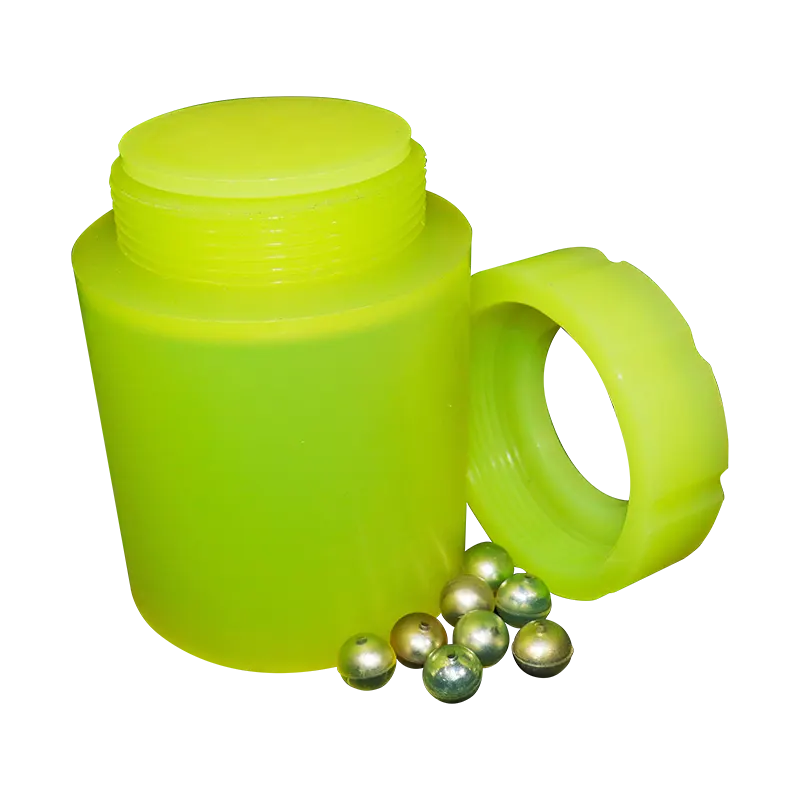
Fine grinding equipment is a separate class, and its equipment is selected for a specific mill. For example, polyurethane grinding drum TENCAN refers to drum mills on rollers: polyurethane grinding drum. Polyurethane is elastic and chemically resistant; it reduces the transfer of metal into the sample, but is inferior to metal and ceramic materials in density and resistance to abrasive wear. The drum is not a part of the hammer crusher, and its compatibility with a specific mill - seating dimensions, drive, permissible rotation speed, loading weight - is confirmed by the documentation for the mill, and not by external similarity.
What to agree upon during the transition
Before transferring the material for fine grinding, the permissible feed size, the mode - dry or wet, the ratio of the mass of the material, grinding media and drum volume, the duration of processing and the cooling method are specified. If the crushed product contains dust along with large residues, grinding becomes poorly reproducible: samples with different compositions behave differently at the same processing time.
Trial crushing and data for equipment selection
Sample preparation
For testing, a representative sample is taken, divided into parallel samples and the initial size and moisture content are recorded. After crushing, the material is also divided - by quartering or dividing - otherwise the part selected for analysis will not reflect the entire batch. It is useful to decide in advance which fractions are considered target and by what method they are measured.
What to record in the protocol
- properties of the source material: type, original size, moisture, bulk density;
- mode: design and condition of the grate, rotor speed, uniformity and feed rate;
- result: before and after mass, losses, particle size distribution and measurement method;
- thermal mode: heating of the housing and, if measured, product temperature;
- machine condition: wear of working parts, sticking, noise, vibration, need for cleaning;
- repeatability: results of at least two or three parallel experiments.
Acceptance criteria
The mode is considered suitable if the repeatability of the distribution from experiment to experiment is acceptable for the method, the proportion of the target fraction is sufficient, the material does not clog the discharge, heating does not lead to a change in the properties of the sample, and the introduced impurities are within the acceptable level. If at least one condition is not met, it is not the material that is changed, but the mode: flow area, speed, feed rate or staging scheme.
What to tell the supplier
To correctly select equipment, you need information about the material and its behavior during crushing, the required size and the method of its control, the single sample mass or the required productivity, permissible contamination, as well as operating conditions - room, food, ventilation and safety requirements. General directions of equipment and brand positioning are given on the website TENCAN: www.tencanballmills.com. Models, sizes, designs of working parts and additional options should be clarified using the current technical documentation and the specific product card, since the parameters of one model are not transferred to the entire range.
The practical conclusion is simple: the hammer crusher is effective where the material is brittle, moderately dry and allows a wide distribution of the product. The main efforts when selecting a mode are spent not on choosing “ideal” numbers, but on coordinating four factors - the unloading flow area, peripheral speed, feed rate and the state of the working elements. It is their change that is checked in test crushing, and the result is recorded in a protocol indicating the method of measuring particle size.
If the application requires ultra-fine and narrow distribution or minimal transfer of impurities, crushing remains a preparatory step, and the finishing operation is carried out on other equipment - with suitable grinding drums and grinding media, the compatibility of which is documented. This step-by-step approach results in reproducible sample preparation and predictable consumption of wear parts.