
A glove box with a cleaning system is chosen when the powder or sample cannot simply be left on the laboratory bench: the material is sensitive to oxygen, moisture or other air components, and you need to work with it with your hands, with utensils, scales and containers. For some applications, short-term protection during weighing and packing is sufficient; for others, a stable, controlled atmosphere is required throughout the work shift. The difference between these scenarios determines not only the type of enclosure, but also the requirements for the airlock, cleaning system, gloves and maintenance.
In the catalog TENCAN presented glove box with cleaning system — a product that should be considered as part of the sample preparation process chain and not as a general-purpose replacement for a fume hood or vacuum desiccator. Below are practical selection criteria: which functions really affect the work with powders, what parameters should be requested from the supplier and what to check before purchasing. Specific values for the selected version should be taken from the product card and manual, and not substituted by analogy with other equipment.
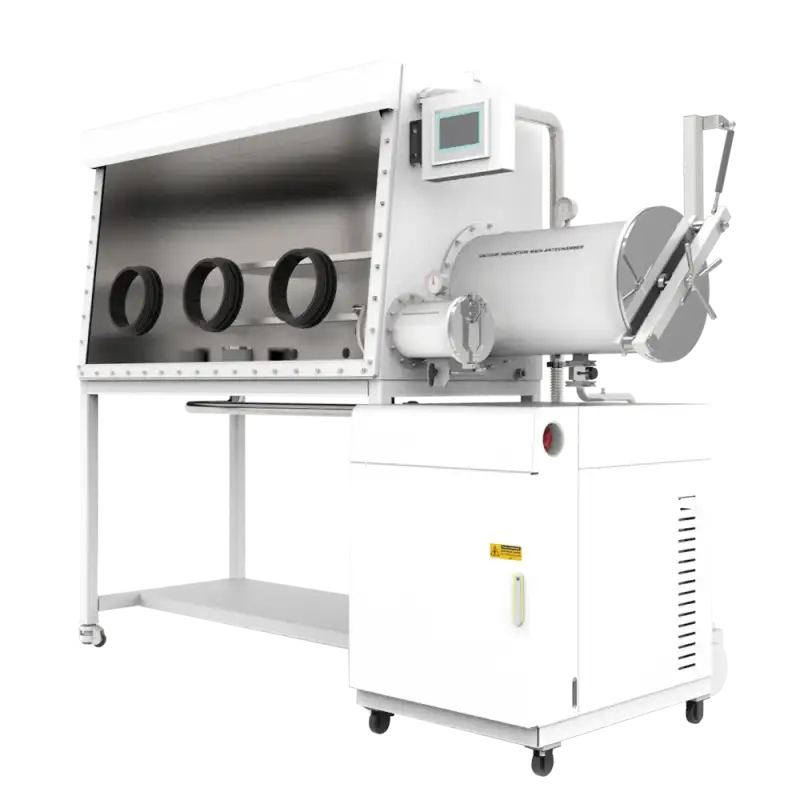
When isolation is not enough
Powder materials change in the air for various reasons: some oxidize, others hydrolyze, others actively adsorb moisture and change flowability, and some lose catalyst activity or surface properties. It is important for the researcher not only to preserve the sample before analysis, but also to carry out the preparation without imperceptibly changing the state of the material. Weighing, sifting, dividing the sample, packaging and transferring to the grinding glass can take more time than the analysis itself, so protection is needed specifically during work operations.
A fume hood solves a different problem: it removes fumes and dust from the work area, but does not create a controlled atmosphere with low oxygen and moisture content. A vacuum desiccator or bag of inert gas is convenient for storage and short-term transportation, but it is difficult to weigh, transfer powder, and assemble laboratory equipment. The glove box occupies an intermediate position: it provides an isolated working volume and at the same time allows the manipulation of the sample through gloves. But the body itself with gloves does not guarantee the desired quality of the atmosphere.
Therefore, the first question when choosing is not “which box is larger”, but “what kind of environment is needed and how long should it be held.” When it comes to a few minutes and a small load, sometimes a simpler solution is enough. If the work is repeated, there are a lot of samples, and the requirements for oxygen and moisture are strict, tightness, the rate of atmospheric recovery, the volume of the airlock and the service life of the cleaning system become important. For powders with a high specific surface area, even a small air leak may be more noticeable than for a bulk sample, so storage and preparation conditions should be assessed together.
Isolation, gas displacement and purification are not the same thing
In equipment descriptions, these functions are often mixed, although they are responsible for different things. It is useful to separate them at the selection stage, otherwise it is easy to buy a box that insulates the chamber well, but does not maintain a given level of impurities, or rely on a purifier without checking the quality of the seals and airlock.
- Insulation. The housing, window, gloves, seals and sealed inlets separate the working volume from the room air. Insulation reduces gas exchange, but does not remove oxygen and moisture already inside, and does not compensate for leaks through gloves or a loose door.
- Evacuation with gas replacement. The air from the airlock or chamber is pumped out and then filled with inert gas. This reduces the entry of room air during loading, but does not replace the continuous cleaning of the atmosphere in the working volume. The replacement cycle can take time and requires the chamber to be vacuum compatible.
- Circulating cleaning. The gas is forced through a cleaning unit, where the oxygen and moisture content is reduced, and then returned to the chamber. Such a system operates in a closed loop and maintains the atmosphere, but its effectiveness depends on the tightness of the box, the load and the service life of the sorbent.
The standalone gas purifier itself is not a complete working cabinet: it does not have a protective chamber or glove access. Likewise, a sealed enclosure without cleaning should not be considered a controlled atmosphere system unless documentation confirms otherwise. For the selected model, you need to clarify which of the three functions are included in the basic version and which are optional. This is especially important when working with powders that are transported in closed containers: even briefly opening the airlock or door changes the balance of moisture and oxygen.
How the cleaning system works and what parameters to check
In gloveboxes, the purification system is usually designed to reduce the oxygen and moisture content of the circulating gas; the specific circuit depends on the execution. The gas passes through the cleaning unit, returns to the chamber and is taken back for cleaning. Control can be manual or automatic, and control can be carried out using oxygen and moisture sensors. The presence of such a system does not eliminate the need for preliminary replacement of the atmosphere and checking for leaks: cleaning maintains the mode, but does not eliminate a large leak.
When choosing, it is helpful to ask for measurable conditions beyond the advertised “low oxygen content.” Key issues relate to target levels, ramp-up time, post-load behavior, gas consumption and purifier maintenance. If the card does not contain a confirmed value, it cannot be substituted by analogy with another model: the parameters of one box do not characterize the entire assortment.
- What oxygen and moisture levels are confirmed for this performance and at what ambient temperature?
- How quickly does the atmosphere recover after opening an airlock, changing gloves, or loading equipment?
- What working gas is allowed and is the gas consumption indicated in the documentation?
- How often is purifier regeneration required, how long does it take, and what operations are not available during this period?
- Are there oxygen and moisture sensors, how often are they checked and how do they confirm the correctness of the readings?
- Are there alarms, interlocks, and clear indications that limits are exceeded?
Purifier regeneration is an important part of operation, not an afterthought. Depending on the execution, it may require time, gas and a certain sequence of actions; During this period, the atmosphere in the chamber may be unstable. Therefore, for daily work it is necessary to understand not only the achievable level, but also the duration of downtime, the availability of consumables and the requirements for operator qualifications. If multiple shifts are expected, it is worth clarifying how maintenance fits into the laboratory schedule.
Atmospheric control requires special attention. The sensor reading refers to the installation point, and not to the entire volume of the chamber; Gas distribution, control placement and door opening all affect local conditions. For critical applications, it is useful to provide independent verification or periodic calibration. You should not assume that one low indicator guarantees the safety of any powder: the cleanliness of the dishes, the open contact time and the properties of the specific material are also important.
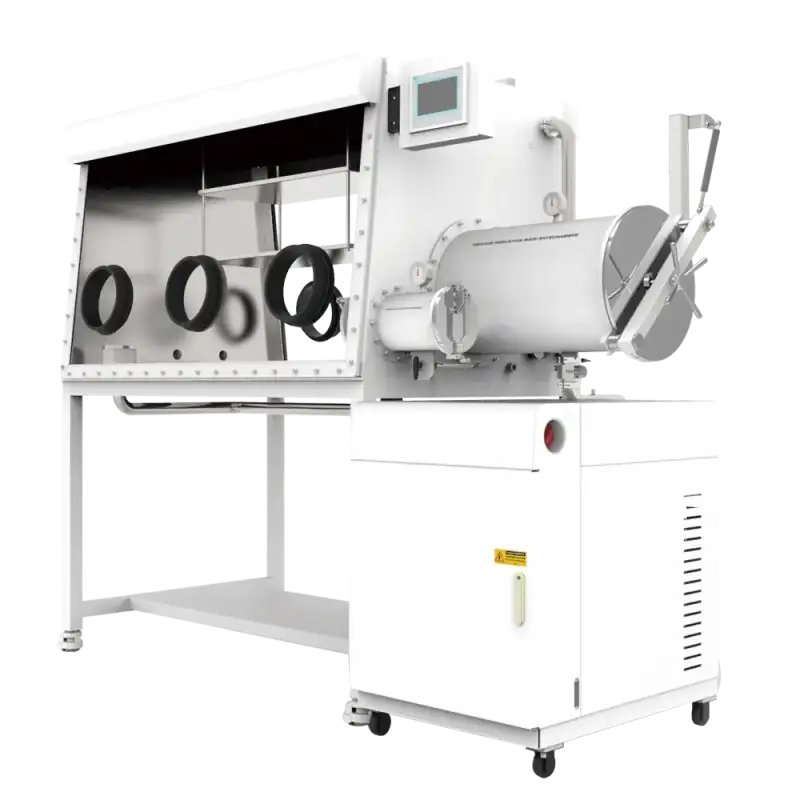
Working gas and pressure
For a purification box, the working gas must be specified by the manufacturer: not every design is equally suitable for different inert gases. The pressure in the chamber also needs to be checked. Slight overpressure reduces room air leakage but may create flow through gloves and seals; Low pressure helps keep dust inside, but increases the risk of suction through leaks. The specific regime is determined by design and guidance, not by a universal rule. If the description does not confirm operation with a specific gas or pressure mode, this must be clarified before ordering.
Layout: chamber, airlock, gloves and service
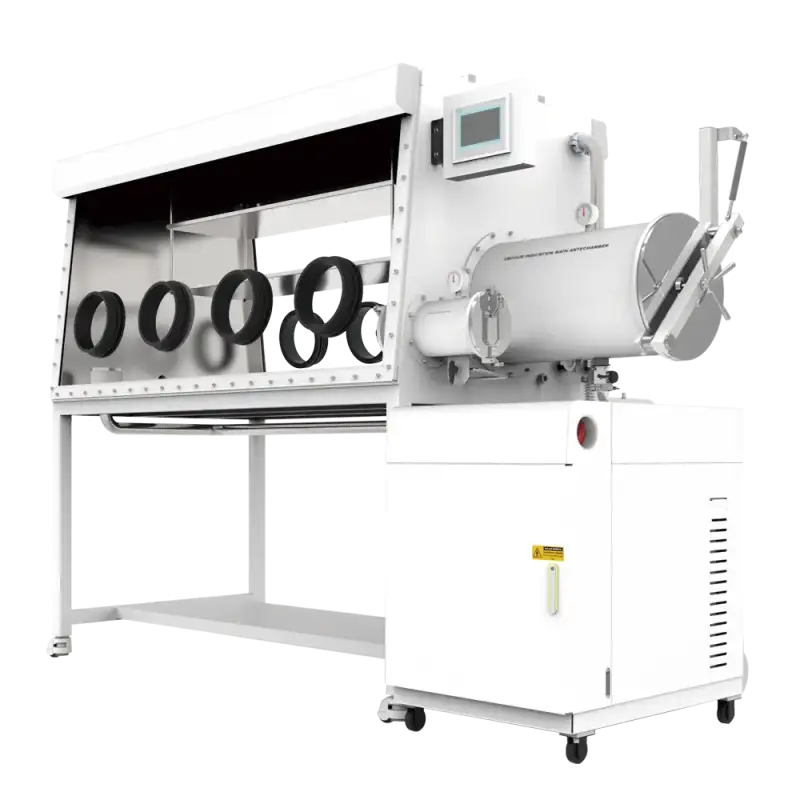
After choosing the operating principle, practice begins. The glove box must accommodate not only the sample, but also equipment: scales, cups, spoons, sieves, containers, cleaning tools. External dimensions say little if the useful volume is occupied by the cleaning circuit and protruding elements. It is useful to draw a picture of the planned operation and check whether there is enough space for hands, a container and moving objects without touching the walls.
Useful volume and access
It is better to evaluate a camera based on the actual equipment, and not on the liters in the description. The height of the working area affects the comfort of working while standing or sitting, the depth affects the ability to place scales and a tripod, and the width affects the simultaneous operation of two gloves without collisions. The window should provide an overview of the sample and controls, and not just a general view of the chamber. If drying or heating is planned inside, it is necessary to separately clarify the permissibility of such an operation and the compatibility of materials; a regular box does not become a thermostat without confirmation.
Gateway and Transient Operations
The airlock reduces the introduction of room air during loading, but its effectiveness depends on the volume, number of cycles and method of replacement. For powders, small closed containers are convenient, which can be wiped from the outside and added without spilling. A sluice that is too large requires more gas and cycle time; too small does not allow the necessary utensils to pass through. You should clarify what items are allowed to be brought in, whether there are weight restrictions and how the inner door opens so as not to create a flow of dust.
Gloves, seals and cleaning
Gloves are a consumable item that simultaneously affects sealing and ergonomics. Their size, material and method of fastening must correspond to the tasks; For work with sharp objects or solvents, a separate compatibility assessment is required. Seals and internal surfaces must be capable of being cleaned of powder. If dust accumulates in corners, it can be transferred between samples and create a false impression of contamination. The presence of removable trays or smooth panels makes maintenance easier, but the specific design must be checked against the documentation.
Selection criteria: verification table
It is convenient to compare performances using a single list of questions. It does not replace the technical specification, but it helps to see what information is confirmed and what is still an assumption. The table should be filled out using the card, manual and supplier’s answers, without mixing data from different models.
| What to clarify | Why is this important | How to check |
|---|---|---|
| Target oxygen and moisture levels | Determine suitability for sensitive powder | Request confirmed values and measurement method |
| Recovery time after boot | Impacts productivity and repeatability | Check in a trial operation with real equipment |
| Tightness of the chamber and airlock | Leakage increases gas consumption and cleaning workload | Request a pressure or leak test report |
| Useful camera dimensions | Must accommodate scales, utensils and containers | Compare with actual lab items |
| Gate volume and cycle | Reduces air ingress during transfer | Clarify size, weight and vacuum restrictions |
| Gloves and ports | Affects ergonomics, wear and sealing | Check size, material and replacement availability |
| Working gas and flow | Determine operating costs | Check the permissible gas and consumption with the documentation |
| Purifier regeneration | Creates downtime and requires training | Specify the mode, frequency and automation |
| Sensors and calibration | Responsible for the reliability of atmosphere control | Request type, range and order of check |
| Resistance to media | Affects cleaning and solvent compatibility | Get a list of acceptable materials and restrictions |
| Documentation and training | Required for safe startup and maintenance | Check the manual, diagrams, spare parts and training program |
If the supplier cannot document the item, it is better to consider it open. This particularly applies to oxygen and moisture levels, recovery times, solvent compatibility and regeneration intervals. A characteristic from a general category description should not be transferred to a specific model: gloveboxes vary in design, cleaning and purpose.
Working with powders: cleanliness, statics and circuit life
The powder inside the box is not only a sample, but also a source of contamination. Fine particles settle on gloves, seals, viewing windows, and interior panels, accumulate in corners, and can be carried into the next experiment. The higher the dispersion, the more noticeable each operation becomes: opening the container, pouring it, wiping the surface. Therefore, for powder work, closed containers, neat transfer and accessibility to cleaning without disassembling the entire box are especially important.
Static charge makes working with dry powders difficult: particles stick to gloves and walls, do not flow well and may remain on the surface after visible removal. Methods for dealing with static depend on the material and equipment; There is no universal solution. If the cabinet involves working with flammable or reactive powders, a separate risk assessment is required, not just the choice of atmosphere. Guidelines for safe handling of a specific substance take precedence over general recommendations for the selection of housing.
Sample transfer and compatibility
Before loading, it is worth considering how the sample will be closed, labeled and removed. The container should open inside the chamber without spilling, and its outer surface should not introduce dust and moisture. If transfer to a grinding jar or other container is planned, compatibility is determined not only by size, but also by material, cleanliness, and sealing method. A random combination of equipment and consumables does not prove their compatibility: this must be verified in the documentation and in practice.
Solvents and aggressive media require special attention. Not every glovebox is designed to withstand prolonged exposure to vapors; Glove, seal and liner materials may have limitations. If liquids are used in the process, the permitted substances, ventilation and cleaning procedures, and compatibility with the cleaning system should be clarified. This information may not be included in the product description and must be requested separately.
Maintenance and downtime
The service life of the cleaning circuit depends on the load, gas purity and how carefully the operator handles the box. Frequent openings, damaged gloves and dirty seals increase stress; Dust on interior surfaces makes cleaning difficult and can accelerate wear. The maintenance plan should include checking for leaks, monitoring sensors, replacing consumables, and regenerating the purifier. It is important for the laboratory to understand in advance how long each procedure takes and whether it can be performed without completely stopping work.
Pre-purchase check and trial configuration data
The choice of a glove box with a cleaning system is best completed by testing it on a real task, and not just by comparing descriptions. A trial operation may include loading typical vessels, simulating weighing, opening an airlock, and observing the atmosphere recover. It is useful to formulate acceptance criteria in advance: what levels are considered working, how much time is allowed for recovery, what actions should be convenient without unnecessary movements. If testing is not possible, protocols and clear conditions under which the stated performance is confirmed should be requested.
To select a configuration, the supplier usually needs the following information:
- the nature of the samples and sensitivity to oxygen, moisture or other air components;
- typical mass and dispersion of the powder, as well as permissible open contact time;
- list of operations inside the box: weighing, sifting, packaging, assembling dishes, cleaning;
- requirements for the atmosphere and method of control, including the need for documentation;
- gases, solvents, temperatures, and presence of heat or vacuum used;
- dimensions and weight of equipment that must be brought in through the gateway;
- work intensity, number of operators and allowable downtime for maintenance;
- room conditions, power supply, ventilation and safety requirements.
This data helps distinguish a truly necessary function from a secondary one. For example, a large chamber volume is convenient, but increases gas consumption and recovery time; A powerful cleaning system is useful for frequent loads, but requires space and maintenance. The trade-off depends on the task: for rare analyzes simplicity and reproducibility are more important; for daily preparation of a series of samples, recovery speed and ergonomics are more important.
Before ordering, you should clarify which elements are included in the standard version and which are optional: a vacuum gateway, sensors, alarms, additional ports, cleaning equipment. An option should not be considered standard without written confirmation. It is also important to check that there is a manual in clear language, a diagram of the gas lines and what to do if the alarm occurs. For the laboratory, this is not a formality: an error in servicing the purifier can negate the benefits of the entire system.
In the catalog TENCAN you can correlate the selected box with the rest equipment TENCAN for the preparation of powder materials, however, the compatibility of specific components and consumables always requires separate verification. A glovebox with cleaning system is an atmosphere control tool and is not a guarantee of the integrity of any sample. Its correct selection begins with a description of the material, operations and permissible conditions, continues with testing of tightness, cleaning and sluice, and ends with trial work with real equipment. This approach allows you to obtain a reproducible environment for sensitive powders and avoid solutions that look convenient only on paper.