
If the sample arrives in the form of pieces several centimeters in size, and the next operation requires more homogeneous material, the intermediate task before fine grinding is to reduce the coarseness without excessive overgrinding. For this stage, a two-roll crusher is often considered TENCAN. The question is not whether it replaces a mill, but where in the process chain it is appropriate and what conditions need to be checked before trial crushing.
Double roll crusher TENCAN refers to equipment for crushing, not fine grinding. Its task is to crush the pieces to a more convenient size, after which the material can be separated, reduced, dried or sent to a ball, planetary or other mill. The current product card with a description of the design is available on the page twin roll crusher TENCAN; specific parameters of a particular machine should be taken from there and from the manual, and not transferred from general discussions.
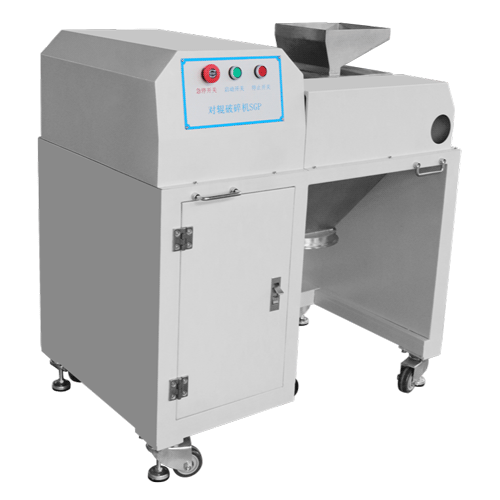
What exactly does a twin-roll crusher do in sample preparation?
In laboratory and pilot industrial practice, a two-roll crusher most often performs the function of primary or secondary crushing of brittle and moderately hard materials. It can prepare pieces of ore, minerals, cakes, some ceramic materials and other samples for subsequent sample reduction or fine grinding. However, suitability is determined not only by the name of the material: the original size, strength of the pieces, humidity, tendency to stick and acceptable contamination of the product are important.
A two-roll crusher should not be considered as a universal unit for any materials. Plastic, fibrous, highly viscous or sticky materials may behave differently in the roll gap than brittle materials. They may cause sticking, uneven grip, increased load on the drive and the need for cleaning. Therefore, the first task when selecting is not to choose the “most powerful” machine, but to understand what properties of the sample determine the behavior in the work area.
Crushing rather than fine grinding
The twin roll crusher reduces particle size by compressing and shearing the material between rotating rolls. The result is a product with a particle size distribution rather than a monodisperse powder. Even with the same slot width, different pieces are destroyed in different ways: weaker ones can produce a lot of fine fractions, while stronger ones can remain larger. This is why the expected size of a product cannot be described in a single number without specifying the measurement method and test conditions.
Ball mill, bead mill and roll crusher solve different problems. The first two work with grinding media and are usually focused on fine grinding and disagglomeration, while the roll crusher prepares the material for such operations. If a powder with a narrow distribution is desired after crushing, a separate grinding step and possibly classification will be required. Mixing also remains a separate operation: the roller crusher is not designed to homogenize the components.
How the process works and why the gap is not the only parameter
In the working area of a two-roll crusher, the material is captured by two rolls rotating towards each other. The pieces fall into a wedge between the surfaces, are compressed and destroyed, after which the product exits through the gap. The result is influenced by the width of the slot, the diameter and condition of the surface of the rolls, rotation speed, uniformity of feed and the size of the initial pieces. The same material at different feeds can produce a different proportion of the over-grinded fraction.
The width of the slot is an important, but not the only adjustment parameter. It sets a geometric limit to the product yield, but the actual size depends on how the piece breaks down in the work area. If material is fed in too large portions, the rollers may run unevenly; If the feed is intermittent, the role of shock loads increases and reproducibility deteriorates. For test crushing, it is important to record not only the gap, but also the feeding method, the weight of the portion and the condition of the rolls.
Material gripping and roll geometry
For a stable grip, the piece must correspond to the geometry of the working area and friction conditions. A piece that is too large may not fit into the gap or may jam it; a fraction that is too small, on the contrary, passes through without noticeable crushing and increases the proportion of the finished product. Therefore, the initial sample usually requires sieving or at least a size assessment. It cannot be assumed that the crusher will equally effectively process both large pieces and the dusty fraction in one load.
The surface condition of the rolls affects grip and wear. Different versions use different options for the working surface, but the specific configuration TENCAN must be confirmed by the product card. If the surface is worn or dirty, grip becomes poor and the product becomes less consistent. Before the critical test, it is worth checking the cleanliness of the rolls and the absence of foreign inclusions that could damage the working surface.
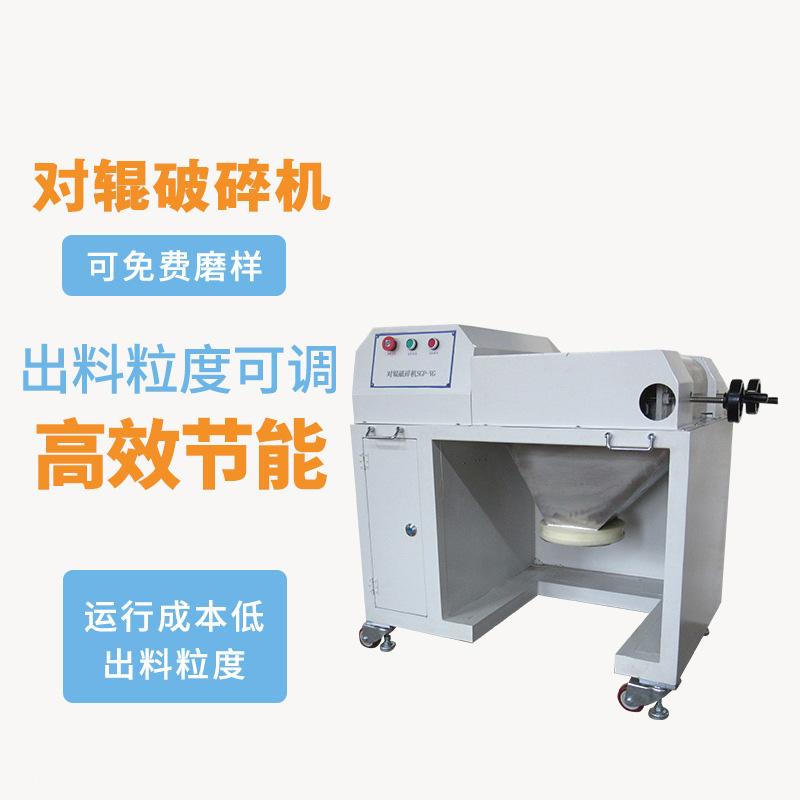
Feed size, reduction rate and particle distribution
Feed size is one of the main limitations on applicability. If the original piece exceeds what is permissible for a specific execution, it must first be crushed or a representative part must be selected. Trying to push through material that is too large will overload the drive, causing increased wear and risk of damage. The product card and manual indicate the acceptable conditions for a specific model; they cannot be replaced by general recommendations.
The degree of particle size reduction in a roller crusher is usually limited to reasonable limits. If very large reductions in size are required in one pass, the crusher may be producing too wide a distribution or the product is not fine enough. Then stage crushing, intermediate sieving or subsequent grinding are considered. You should not expect that adjusting the gap will turn the crusher into a mill: the mechanism of destruction and the field of application remain different.
The distribution of particles after crushing depends on the material and mode. The product usually contains both larger and finer fractions. To prepare the sample for analysis, this means that reduction, mixing and sieving may be required after crushing. If you select only the visually “middle” part, it is easy to get a biased result. The representativeness of the sample is no less important than the accuracy of the gap adjustment.
Material properties: hardness, moisture, tendency to stick
Hardness and abrasiveness affect roll wear and drive load. The stronger and more abrasive the material, the more attentive you need to be to the service life of working surfaces and the possibility of introducing impurities. At the same time, hardness cannot be assessed only by the name of the raw material: different samples of the same class can differ noticeably. For a responsible task, it is useful to have data on strength, size and mineralogy, and not just a everyday description of the material.
Humidity changes the behavior of the material in the gap. Moderately damp material may break down differently than dry material, and higher humidity increases the risk of sticking and clogging. Wet or sticky products require separate verification of execution and delivery. The result of dry crushing cannot be automatically transferred to a wet sample: these are different conditions and may require different measures.
Brittle materials usually break down with the formation of a noticeable proportion of fines. Plastic materials may warp rather than crack, reducing efficiency and making cleaning more difficult. If the material is prone to heating or is sensitive to contamination, it is worth considering not only the crushing process itself, but also contact with the working surfaces. General physical principles are useful to understand, but they are not a substitute for testing a specific specimen.
Roll shape, wear and addition of impurities
The working surfaces of the rolls are in constant contact with the material, so wear is a normal part of operation. Its speed depends on the abrasiveness of the raw material, the size of the pieces, the feeding mode and the material of the rolls. As wear occurs, the geometry of the working area changes, and the gap setting may require additional checking. Regular inspection helps to notice uneven wear and does not transfer its effects to the entire sample batch.
Contaminants are another factor that cannot be ignored when preparing samples. The material of the working surfaces can interact with the sample, especially if it is highly abrasive. The claim of “zero pollution” is inappropriate without proven data and specific conditions. If acceptable levels of impurities are limited, the compatibility of the sample material and working surfaces, as well as cleaning methods between samples, should be discussed separately.
Cleaning between samples is important to prevent cross-contamination. The accessibility of the working area, the ability to remove residues and the compatibility of cleaning agents with the roll material should be checked according to the manual. It should not be assumed that any structure can be easily disassembled or that residues will be completely removed by simple blowing. For the laboratory, this is a practical issue on which the reliability of subsequent analyzes depends.
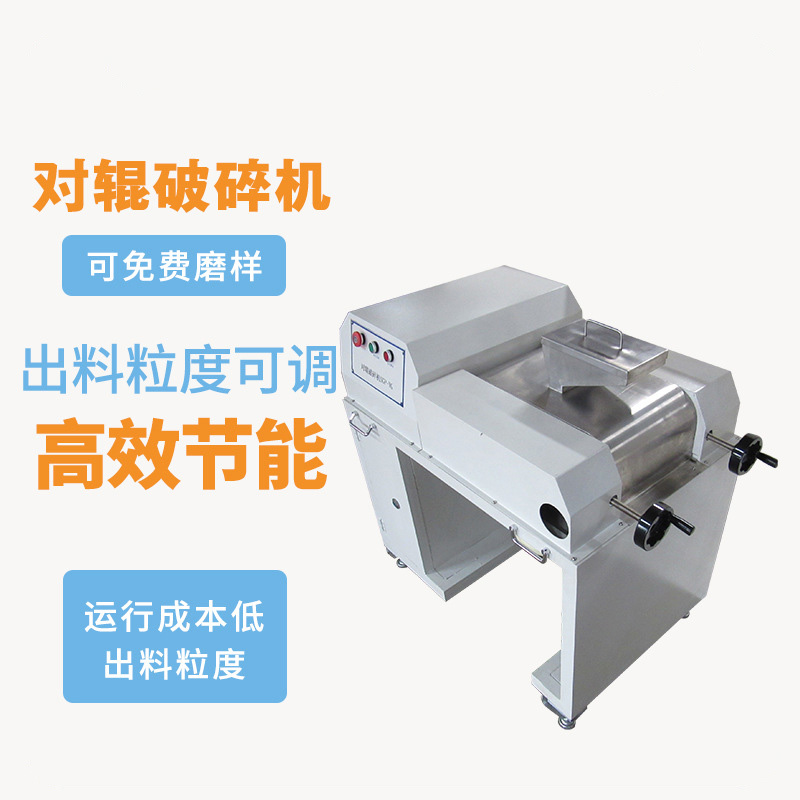
From laboratory sample to larger batch
Transferring a result from a laboratory sample to a larger batch is not a simple mass multiplication. In an industrial or large-scale installation, feed uniformity, thermal conditions, wear and maintenance requirements vary. Even with the same slot width, product distribution may vary. Therefore, when scaling, it is useful to keep the same sampling and size measurement methods in order to compare results correctly.
For comparability of tests, the initial size, humidity, portion weight, gap setting, feeding method and sieving parameters are recorded. If this data is not written down, subsequent discussion is reduced to guesswork. A low-mass laboratory sample may be particularly sensitive to single large pieces, so it should be prepared according to a predetermined reduction pattern rather than collecting random fragments.
If a ball mill is assumed in the technological chain after crushing, the roll crusher and grinding media remain different elements of the circuit. Tungsten carbide grinding balls belong to the grinding equipment, not the consumable parts of the roll crusher; their use requires separate confirmation of compatibility with the specific mill and material. You should not mix these stages in one choice.
What to check during test crushing
Test crushing is needed not to formally confirm the purchase, but to answer practical questions: whether the desired size is obtained, whether the process is stable, how the material behaves, and what will have to be done with the product next. It is useful to determine in advance what proportion of coarse fraction is acceptable, how particle distribution will be measured, and how much material is required for subsequent analysis.
- Assess the original grain size and take a representative sample without unnecessarily mixing pieces of different origins.
- Record the humidity and visual features of the material: dust, sticking, presence of foreign inclusions.
- Check the gap setting and make sure that the selected position is firmly fixed.
- Feed the material evenly and at a speed that matches the capabilities of the equipment and does not create blockages.
- Collect all product, including fines, and evaluate particle size distribution.
- Inspect the rolls and work area after testing, noting build-up, uneven wear, and difficulty cleaning.
| What to clarify | Why is this important | How to check |
|---|---|---|
| Feed size | A piece that is too large may not be picked up or may overload the drive. | Compare with manual and actual sample sieving |
| Slot width | Affects exit geometry, but does not specify a single particle size | Check fixation and repeatability of settings |
| Humidity and sticking | Change grip, cleaning and feed stability | Conduct trial crushing under real conditions |
| Wear and dirt | Affect the resource and reliability of impurity analysis | Inspect work surfaces and discuss acceptable impurities |
| Product distribution | Determines whether sieving, reducing or grinding is necessary | Perform sieving and record measurement procedure |
It is also worth checking safety: the roller area is a high-risk area, so fencing, stopping procedures and blocking must comply with the manual. Dust and noise also require attention. Test crushing should not be attempted without understanding how the equipment is stopped and how stuck material is removed.
Questions to ask before ordering
For selection, it is not enough to name the material and the desired size. It is necessary to describe the entire task: what mass of sample is processed in one cycle, how often samples are changed, what size is considered acceptable, are there any restrictions on impurities and how the product will be used further. The more specific the initial data, the lower the risk that the selected design will be inconvenient in everyday work.
- What material is crushed and what is its approximate strength, abrasiveness and moisture content?
- What is the initial size of the pieces and what proportion of the coarse fraction is acceptable after crushing?
- What is the mass of the portion and the required frequency of work?
- Is regular cleaning necessary between different samples and how easy should it be?
- Are there any restrictions on the introduction of impurities and compatibility with subsequent analysis?
- How will the product be reduced, dispersed and transferred to the fine grinder?
- What requirements for dust removal, noise and safe operation apply in the laboratory?
Double roll crusher TENCAN can be a useful part of sample preparation if its place in the scheme is determined correctly. It does not replace fine grinding and does not guarantee the specified coarseness for any material, but with correct settings and a proven mode, it allows you to obtain a product that is more convenient for further work. The practical conclusion is simple: first they describe the sample and the purpose, then check the specific design in a trial crushing, and only then make a decision on the configuration.
You can get acquainted with the direction of equipment and the general structure of products on the website TENCAN, and the technical details of the selected machine are in the card twin roll crusher. For test crushing, it is useful to prepare a representative sample, record the initial conditions, and determine in advance what criteria will be used to consider the result acceptable.