
A corundum grinding drum is chosen for more than one reason: “ceramics means pure.” In sample preparation, this drum is part of the contact zone: it is its inner surface, cover, seal and grinding media that come into contact with the material. This raises practical questions: how appropriate the drum material is for a particular sample, how quickly it wears out, what happens to cleaning between samples, and whether this drum can be installed in an existing mill. The answers are not automatically derived from the name “corundum”. They need to be checked against the product card, grinding conditions and test run results.
The article deals with the corundum grinding drum TENCAN. His card is available in the section corundum grinding drums. Material, contamination, wear, cleaning, sizing and compatibility are discussed below. This is not a universal instruction manual and is not a replacement for the passport of a specific product. For hazardous substances, non-standard media and high purity requirements, separate tests and agreement with the manufacturer are required.
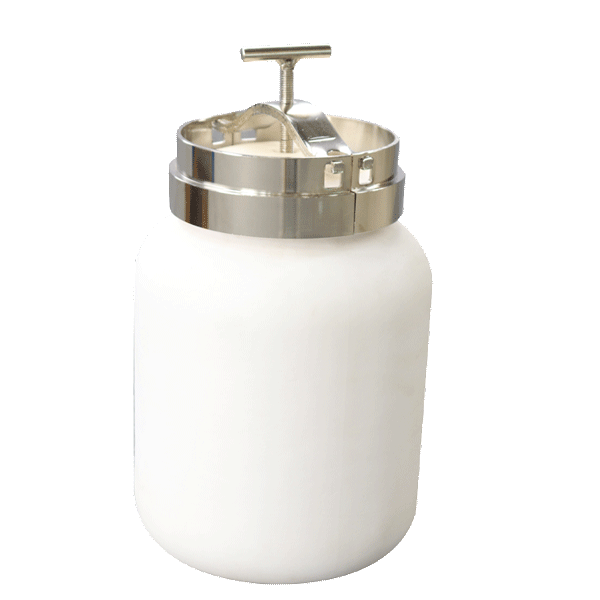
Why the drum is part of the technique, and not a consumable “by eye”
In laboratory practice, the grinding drum is often perceived as a container that just needs to be selected according to its volume. This approach is dangerous. The drum determines not only the geometry of the chamber, but also the wall material, the shape of the inner surface, the quality of the lid fit, weight, thermal characteristics and permissible load. Even with the same volume, two drums made of different materials may produce different results in terms of contamination, wear and sample loss.
During grinding, several processes occur simultaneously. The grinding bodies hit the particles and abrade them; particles abrade each other; the drum material also participates in contact. If the wall is softer or more brittle than it needs to be, it will wear out faster. If the wall material contains an element that is detectable in the sample, even a small carryover can skew the analytical result. If cleaning does not remove residues from the microrelief, the next sample receives not only its own material, but also a trace of the previous one.
Therefore, the drum must be considered together with the technique. The method must indicate the sample mass, initial particle size, type of grinding, medium, grinding media, time, speed and method of monitoring the result. A drum without this data is only selected in advance. In addition, the concepts of “grinding” and “mixing” should not be confused. The drum can be used to disperse and homogenize powder, but this does not make it any type of mixer. Also, a roller mill drum cannot be assumed to automatically fit into a planetary, vibration or bead mill. The seating dimensions, rotation method, speed and loads of these machines are different.
It is useful to determine in advance what exactly is critical: maintaining the chemical composition of the sample, minimal wear, absence of large fragments, ease of cleaning, resistance to wet grinding, or the ability to work with small samples. This determines not only the choice of drum, but also the choice of grinding media, as well as the test grinding mode.
What is a corundum grinding drum?
Corundum in a technical context is related to aluminum oxide. Aluminum oxide ceramics have high hardness and abrasion resistance, so they are used where abrasion must be resisted. However, high hardness does not mean no wear. Ceramics can chip, form microcracks and leave particles of material in the sample. The properties of a particular drum depend on the ceramic composition, porosity, surface quality, wall thickness and lid design. These data cannot be attributed to all corundum drums at once.
Corundum drum is generally considered as an alternative to softer or more fouling-prone materials. But the comparison should not be based on a general label, but on a specific sample. For some applications, ceramics based on aluminum oxide are convenient because they are quite wear-resistant and do not contain metallic iron as a main component. For other applications it is undesirable: for example, if aluminum is the element being determined or if the sample is sensitive to oxide inclusions. There is no material that is simultaneously the hardest, the most inert, the cheapest and completely free of impurities.
The corundum drum also has practical limitations. Ceramics are sensitive to shock loads and sudden temperature changes. Heavy grinding media, too large a load, or careless lid installation can increase the risk of chipping. This does not mean that the drum is unsuitable for general grinding; this means that the operating conditions must be suitable for the product. If the card does not indicate acceptable grinding media, speed, temperature or cleaning method, this information must be clarified and not derived from general ideas about corundum.
Separately, it is worth distinguishing between the drum and the grinding media. The drum is a chamber, and the grinding media is a working tool. Their materials form a friction pair. Even a good drum can quickly wear out with unsuitable bodies, and good bodies do not compensate for poor drum design. Therefore, the question “which drum is better” without specifying the grinding media and mode does not have an exact answer.
Material and contamination: where is the acceptable limit?
The introduction of impurities during grinding is not only a chemical reaction. There are several sources. The first is abrasive wear of walls and grinding bodies. The second is chips and microparticles of ceramics. The third is the remains of the previous sample that were not removed during cleaning. The fourth is the reaction of the material with the liquid medium or with the components of the sample. The fifth is environmental pollution during loading and unloading. A corundum drum can reduce some risks, but does not eliminate all risks at once.
If aluminum is detected in the sample, the corundum drum requires special care. Aluminum oxide is the basis of the material, and even slight wear can be significant. If aluminum is not on the list of target elements, transfer may still affect overall mineralogy, sintering, optical properties, or subsequent processing. Therefore, the statement “ceramics does not pollute” is incorrect. It would be more correct to say: “the material may be acceptable if the transfer of its components does not interfere with the analysis and is confirmed by control experiment.”
A test run is useful for any new combination of drum, grinding media and sample. This may involve grinding a pure carrier or a sample of known composition, and analyzing for elements that may be transferred from the lining. If comparison with the original material shows an increase in the content of the drum component, the material or conditions must be changed. If growth is not detected within the accepted methodology, this does not yet prove absolute inertia, but provides grounds for further work.
Contamination should not be confused with disagglomeration. During wet grinding, aggregates can break down and the particle size distribution changes without noticeable wear on the drum. On the contrary, severe wear may increase the fine fraction, but it will not only be a useful product, but a mixture of sample and lining material. Therefore, when assessing the result, you need to look not only at the size, but also at the chemical composition, particle shape and reproducibility.
For wet grinding, the environment is important. Water, alcohols, organic liquids and solutions interact with ceramics and samples in different ways. The experience of dry grinding cannot be automatically transferred to wet grinding. If the environment is aggressive, heats up or releases gases, a separate compatibility assessment is required. The product data sheet may indicate general conditions of use, but the specific formulation and safety remain the responsibility of the laboratory.
Wear and service life: what to watch
The wear of the corundum drum is not always immediately visible. First, the microprofile of the inner surface changes, then matte zones, ring marks, small chips at the edges and damage to the seal appear. The wear rate is influenced by the hardness of the sample, the size of the starting material, the type of grinding media, the ratio of the mass of the media to the sample, the duration of grinding, the rotation speed and the cleaning method. There is no one service life that fits all conditions: a drum handling soft powder at low loads and a drum handling abrasive material at long cycles will wear out differently.
You need to watch not only the inner wall. The cover and seal are also included in the contact area. If the seal loses elasticity, powder sticking, media leakage, or leakage during wet grinding occurs. Damage to the cover edge can result in misalignment and vibration. Therefore, at each inspection it is useful to check the cleanliness of the thread or lock, the condition of the sealing element, the absence of chips on the edges and the tightness of the fit. If the design includes fasteners, you need to monitor its condition, but do not tighten the connections without the manufacturer’s instructions.
Signs that require you to stop and check:
- the appearance of visible chips or cracks on the inner surface, edge or cover;
- increase in the content of ceramic components in control samples;
- the appearance of uncharacteristic noise, beating or vibration when installing the drum;
- Difficulty cleaning in areas where residues were previously easily removed;
- seal damage, leakage or media build-up;
- a change in the mass of the drum that cannot be explained by sample residues.
Cracks and chips should not be treated as “normal wear.” Damaged ceramics can further deteriorate, and a fragment can get into the sample or into the mill mechanism. If integrity is in doubt, it is better to take the drum out of service and agree on a replacement. It is also impossible to compensate for wear by increasing the load: this increases the load and accelerates destruction.
The wear of grinding media must be assessed separately. If the bodies wear out faster than the drum, they may be the source of impurities. If the drum wears out faster than the bodies, the conditions may be too harsh or the chamber material may be incorrect. Sometimes the problem is not the material, but that the drum is overloaded, poorly aligned or running at the wrong speed.
Dimensions, loading and grinding energy
Drum size is not just “bigger is better.” The internal diameter and length determine the useful volume and trajectory of the grinding media. Wall thickness affects mass and thermal properties. External dimensions and fittings must match the mill. If the drum is too large to drive, the stress on the rollers, bearings and mounting increases. If it is too small, it will not be possible to obtain the required grinding energy or ensure sufficient loading.
The product card must specify not only the nominal volume, but also the useful volume, permissible load weight, outer and inner diameter, length, wall thickness, empty drum weight, type of lid and seal. For a roller mill, the drum diameter and rotational stability are important. For another machine, these parameters may be different. The dimensions of one drum cannot be transferred to the entire line and it cannot be assumed that the same volume guarantees the same compatibility.
The load consists of grinding media and sample. Too many bodies reduce the free volume and can increase wear. Too few bodies will reduce the grinding efficiency. Too much sample weight requires more energy and may result in incomplete grinding. Too little sample may be lost on walls and in gaps. Specific ratios depend on the material, the size of the bodies and the task. There is no universal formula that guarantees a given size for any sample.
Dry and wet grinding differ in the behavior of the powder. In dry grinding, the material may stick to the walls, especially if it is soft or prone to agglomeration. In wet grinding, viscosity, liquid volume and tightness are important. The liquid occupies free volume, changes the movement of bodies and heat removal. Therefore, the same drum in dry and wet mode requires different loading and different times. You cannot transfer the result obtained in wet mode to dry mode without checking.
The final particle size depends on the initial particle size, hardness, fragility, medium, grinding media, time and method of measurement. Catalog minimums, if stated, apply to specific conditions and are not a guarantee of any sample. In some cases, the limit is not the drum, but the agglomeration: the particles are crushed, but then stick together, and the measurement shows a larger result. Then it is not an infinite increase in time that helps, but a change in the environment, load or stage of disagglomeration.
Cleaning and transition between samples
Cleaning the corundum drum should be fairly thorough, but should not damage the surface. Abrasive brushes, metal scrapers and rough tools can leave scratches where residue can accumulate. After cleaning, it is important to remove not only the visible powder, but also the thin layer on the walls, edges and seal. If the drum was used with liquid, you need to remove any remaining liquid and dry the product in a manner acceptable for the specific design.
The sequence may be: mechanical dry bulk removal, then rinsing with a compatible solvent or detergent, then rinsing, then drying. Specific products depend on the sample and material. Do not use aggressive acids, alkalis or high heat without confirming compatibility. Do not place a hot drum in cold water or heat it unevenly: ceramics are sensitive to thermal shock. If ultrasound is used for cleaning, you must ensure that it does not damage the coating, edges or seal.
Between samples, it is useful to do a control blank grinding or wipe the surface with a clean medium, if this is allowed by the method. For trace analysis, visual cleanliness alone is not enough. It is necessary to evaluate whether the previous element remains in the pores and microrelief. If the drum was used for dye, organics, or a highly adsorbable substance, a separate drum or a more stringent cleaning procedure may be required. This is especially important when one laboratory works with different matrices.
Do not store the drum closed immediately after wet cleaning: moisture may remain inside. Also, you cannot leave an aggressive environment in it for a long time without the manufacturer’s instructions. If stains appear on the surface that cannot be removed by regular cleaning, you need to find out their nature and not mask them with an abrasive. A damaged surface is harder to clean and wears out faster.
How to check compatibility and prepare a test grind
The compatibility of the drum with the mill is confirmed not by the name of the site section, but by the geometry and operating conditions. It is necessary to check the outer diameter, length, weight, installation method, presence of necessary seals and permissible speed. If the mill is not designed for ceramic drums, this should be explicitly stated in its documentation. The laboratory flotation machine, for example, is a different apparatus and does not demonstrate compatibility with the grinding drum; its presence in the assortment does not make the drum suitable for it. Link to laboratory flotation machine useful only for distinguishing between types of equipment.
Before trial grinding, it is worth preparing a short list of data:
- mill model, drive type and mounting dimensions;
- proposed drum: material, size, weight, cover and seal;
- sample material, initial size and required task;
- sample weight and approximate loading of grinding media;
- dry or wet grinding, medium and its volume;
- restrictions on temperature, time and cleanliness;
- target elements of analysis and unacceptable impurities;
- purification method and requirements for transition between samples.
It is better to carry out trial grinding in small portions and control not only the size, but also the composition. If growth of ceramic components is detected after grinding, the material of the drum or grinding media must be changed, rather than simply increasing the time. If the result is inconsistent from sample to sample, check cleaning, loading, tightness and seal condition. If the drum becomes hot or smells, stop operation and find out the cause. If runout is observed, check the fit and do not try to hold the drum manually.
To select a corundum drum TENCAN It is helpful to communicate the application, sample material, mill and purity requirements to the supplier. The product card may indicate available sizes and designs, but final suitability is determined by testing. Home page TENCAN helps to navigate in the directions of the equipment, however, it does not replace the technical card and does not confirm the compatibility of specific components.
The practical conclusion is simple: the corundum grinding drum is a ceramic contact chamber, not a neutral container. Its strengths lie in wear resistance and the ability to handle abrasive powders, but these same properties require control of contaminant transfer, surface condition and mill compatibility. Zero contamination, universal compatibility or guaranteed fineness cannot be promised without consideration of sample and mode. The surest way is to check the dimensions and fit, perform a test grind, evaluate wear and cleaning, and then document the operating conditions in the procedure.