
Mixing powder with liquid seems like a simple operation: place the glass on the work platform, lower the magnetic armature, turn on the rotation. Difficulties appear later - dense powder collects at the bottom, the funnel draws in air, the anchor breaks when trying to raise the speed, and after half an hour the suspension stratifies right during sampling. For laboratories where compact magnetic stirrer TENCAN serves as the first step in preparing the suspension before grinding, granulometric analysis or dosing, it is important to separate the tasks that the device actually solves from those that require another class of equipment.
Below is an analysis of working with a compact magnetic stirrer: design, meaning of adjustable parameters, reasons for unstable mixing and the procedure for checking the mode on a real sample. Specific characteristics of the design - rotation speed range, size of the working platform, permissible volume of the vessel, type of power supply - are given in the current product card, and they must be checked with it.
Mixing and grinding: where is the boundary of tasks?
A magnetic stirrer creates a circulating flow of liquid in the vessel. Particles are drawn into it, loose agglomerates are partially destroyed, the surface of the powder is wetted, and the concentration is equalized by volume. The energy that is transferred to the suspension is orders of magnitude lower than in a ball mill: there are no grinding media, no shock loads, or intense abrasion.
This has a practical consequence. If the problem is formulated as “to obtain a suspension with a given particle size distribution,” a magnetic stirrer is not a tool for solving it. It prepares a homogeneous sample: it wets the powder, breaks up fragile conglomerates, and maintains particles in suspension during sampling. Reduction of particle size is a separate operation for which planetary, drum and vibration mills are used.
However, pre-mixing affects subsequent grinding. A uniformly moistened suspension without dry clots behaves differently in a grinding bowl than a powder hastily filled with liquid: there are fewer local zones with high viscosity, and the operation of the grinding media is more stable. The effect depends on the material and environment, so it is checked by comparison and not taken on faith.
It is worth mentioning separately what a magnetic stirrer does not do. It does not thermostat the contents if the product card does not indicate heating; does not replace a rotary disperser with a blade, which creates a forced flow from top to bottom; does not vacuum the vessel; does not provide sterility; does not perform the functions of an ultrasonic bath. Each of these statements is verified against the device description and should not be confused.
Compact magnetic stirrer device TENCAN
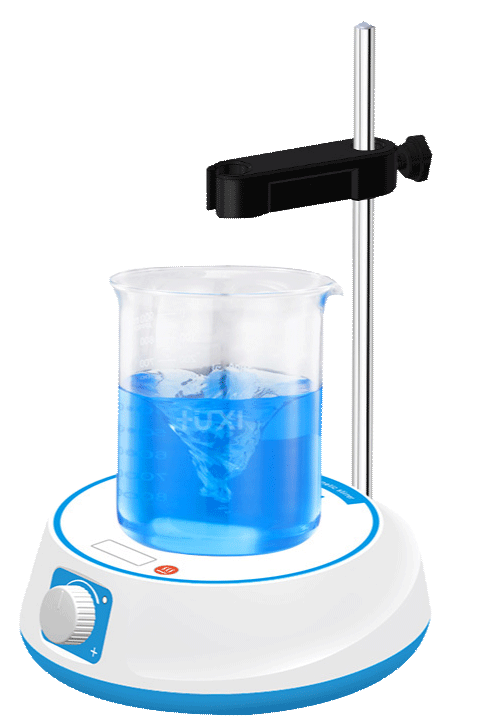
The device consists of a housing with an electric drive, a working platform and controls. A system of permanent magnets rotates inside the housing; above it, on a flat non-magnetic surface, a vessel with a magnetic anchor is installed - a bar or cylinder in a chemically resistant shell. Manufacturer - Changsha Tianchuang Powder Technology Co., Ltd., brand TENCAN.
Rotating field and magnetic armature
The magnetic field of the drive passes through the wall of the vessel and carries away the armature. There is no mechanical contact between the drive and the stirrer: torque is transmitted through a non-magnetic barrier. That is why the vessel can be closed, and the mixer itself is easy to maintain: there is no shaft, no seal, no unit that needs to be disassembled after each sample.
Torque transmission is limited. The bond strength decreases as the gap between the armature and the drive increases, so thick vessel bottoms, double walls and large volumes weaken the bond. The second limiting factor is hydraulic resistance: the more viscous the medium and the larger the anchor, the greater the torque required. When the limit is reached, the anchor breaks and begins to “jump” or freeze, and the liquid continues to rotate by inertia. This is not a breakdown of the device, but an exceeding of its capabilities.
What does compact design mean?
The compact model takes up minimal space on the table, is easy to carry and does not require a separate area. The downside of compactness is a small working platform: the diameter of the vessel that stands stably on it and maintains a good magnetic connection is limited. For trial quantities, small volumes and work in cramped conditions this is sufficient; for liter containers - no.
The small mass of the body also means something else: when working with viscous media or when the armature is unbalanced, the device can move on the table. A stable position, a flat non-magnetic surface and the absence of steel objects nearby are not formalities, but conditions for stable rotation. External ferromagnetic masses distort the field and weaken the connection with the armature.
Controls and modes
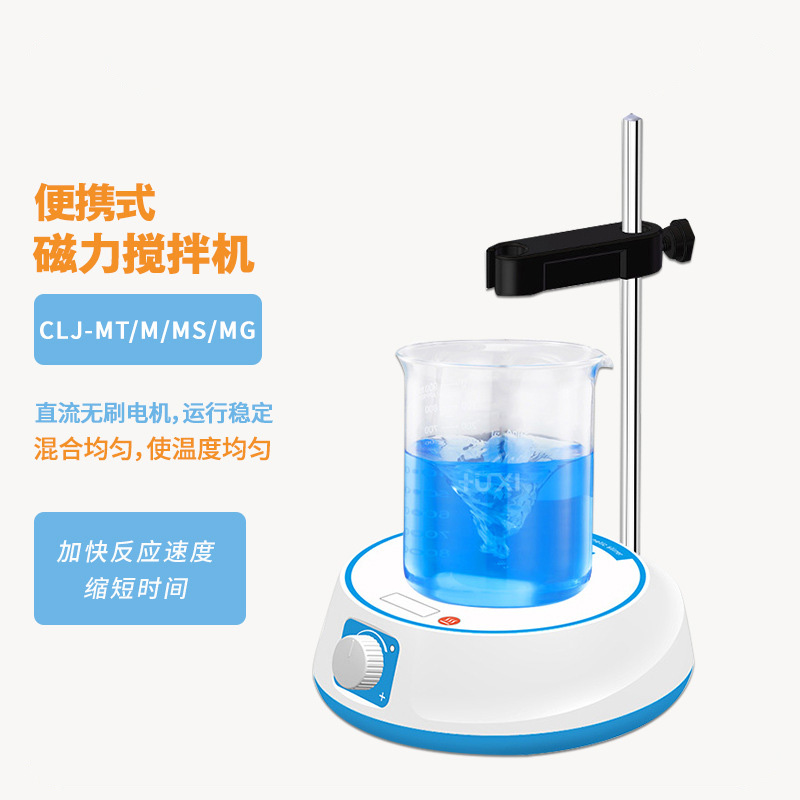
The controls of a compact mixer are usually limited to turning on and adjusting the rotation speed; the presence of a timer, digital display or heating depends on the version and is indicated on the card. For reproducibility, what is more important is not the presence of a display, but the repeatability of the installation: if the adjustment scale is not digitized, the position of the regulator is fixed and transferred to the next sample as an operating point, and not as a physical quantity in revolutions per minute.
Parameters that determine the result of mixing
The result does not depend on one controller, but on a combination of four conditions: rotation speed, geometry of the vessel and anchor, properties of the medium and duration. They should be changed one at a time, otherwise the reason for the changes will remain unknown.
Speed and funnel
At low speeds, the liquid moves slowly, the sediment at the bottom remains untouched. As the speed increases, the entire mass begins to move, and this is the operating point. A further increase results in a funnel: the surface of the liquid bends, air is drawn into the volume, foam rises along the walls, and the effective density of the suspension decreases.
A deep funnel almost never means better mixing. Trapped air changes the sampling conditions, promotes the oxidation of sensitive components, and in foaming systems carries some of the powder to the walls, from where it is no longer returned to the volume. The practical tuning criterion is simple: select the minimum frequency at which, within 10–15 seconds, all sediment leaves the bottom and the surface remains calm or slightly concave.
The upper limit is determined not only by the funnel, but also by the torque transmission limit. The higher the speed, the more resistance the armature experiences and the closer the moment of stalling. For viscous media, the operating range is narrowed on both sides, and this is a normal sign that the task is beyond the scope of magnetic stirring.
Vessel, volume and size of anchor
The anchor is selected so that it rotates freely without touching the walls, and at the same time occupies a noticeable part of the inner diameter of the vessel. An anchor that is too small creates a weak current at the bottom; too large - requires more torque and breaks earlier. For conical flasks and vessels with a round bottom, the flow pattern is different from flat-bottomed glasses, and it is not worth transferring the mode from one vessel to another without checking.
The fill level has no less effect. An overfilled vessel causes splashing and spattering of the neck; with a small volume, the funnel reaches the armature, and air enters the liquid. For suspensions with dense sediment, it is useful that the height of the liquid column noticeably exceeds the diameter of the anchor - then a stable circulation is formed above it, and not a simple rotation of the bottom layer.
Finally, the volume of one sample and the total volume of the series are different things. The compact stirrer works with a small vessel; If the technique requires preparing several samples at once, sequential mixing takes time, and this should be taken into account when planning, and not speed up the process by increasing the speed.
Viscosity, particle density and sedimentation
The settling rate of particles increases with the square of their size and with the difference in the densities of the solid phase and liquid, and decreases with the viscosity of the medium. This explains why a suspension of heavy powder in water separates in minutes, but the same powder in a polymer solution lasts for hours. But an increase in viscosity increases the load on the drive: the connection with the armature weakens, and instead of mixing the entire volume, the armature begins to rotate in the working, leaving the rest of the material motionless.
Thixotropic and paste-like systems behave in an even more complex manner: they have a yield point, and the anchor creates a channel for itself without involving neighboring layers in the movement. In such cases, it is not speed that helps, but a change in geometry - for example, a larger anchor or switching to a mechanical stirrer with a blade.
Typical difficulties: observation, reason, verification
The signs of trouble with magnetic stirring are the same, but the reasons differ. The table below helps outline the check; it does not replace diagnostics for a specific sample and does not identify a device malfunction without additional data.
| Observation | Possible reason | What to check |
|---|---|---|
| The anchor rotates, the powder lies at the bottom | Frequency too low, armature too small, volume too high | Smoothly raise the frequency, take a larger anchor, reduce the load |
| The anchor breaks, “jumps” | Transmitted torque exceeded: viscosity, thick bottom, large anchor | Reduce speed, use a vessel with a thin bottom, reduce the anchor |
| Deep funnel, foam, air volume | Excessive frequency, low fluid | Reduce frequency, increase fill level |
| The suspension separates in minutes | Large or dense particles, insufficient mixing continuity | Do not stop stirring during sampling, evaluate the medium and dispersion |
| The liquid heats up without a specified heating | Drive heat during long-term operation | Reduce continuous operation, check cooling conditions |
| Powder sticks to walls above liquid level | Spattering, drying, electrostatic charge | Reduce speed, cover the vessel, wash off particles with the medium |
It is important not to draw a conclusion based on one sign. For example, “the armature does not rotate” may mean that the viscosity is too high, that the distance to the drive is too large, or that the bottom of the vessel is simply contaminated. Sequential testing - from smaller to larger volumes, from low to high frequencies - gives an answer faster than trying modes at random.
Materials, purity and impurity transfer
The magnetic armature is in constant contact with the sample, so its condition affects the result no less than the mode. The polytetrafluoroethylene shell is chemically resistant and inert to most laboratory environments, but it does not provide “zero contamination”: abrasion may separate small particles of the polymer, and a damaged shell opens the magnetic core, and then iron enters the sample.
The coating is inspected before work. Scratches, burrs, blisters and discolorations are reasons to replace the armature, especially if the sample is intended for elemental analysis or for iron-sensitive measurements. Abrasive powders accelerate the wear of the shell, so gentle modes and more frequent replacement of the consumable element are preferable for them.
Cleaning between samples is a separate source of error. Washing with a solvent removes residual media, but does not always remove the adsorbed layer; For highly coloring and surfactant substances, it is reasonable to have separate anchors for different groups of samples. Abrasive powders are not used for cleaning: they leave micro-scratches in which residues accumulate.
The material of the vessel and its compatibility with the environment also require attention. Glass is transparent and convenient for visual inspection, but is not suitable for environments containing hydrofluoric acid; Polymer vessels are lighter, but they transfer heat less well and can accumulate charge. The compatibility of specific materials with working environments is determined by chemical resistance, and not by general impression.
Heating, evaporation and handling of volatile media
Even without the heating function, the working surface of the compact mixer is gradually heated by the drive. For a small volume, this is noticeable: over an hour of continuous operation, the temperature of the liquid can rise, and the surface temperature of the device is not the same as the measured sample temperature. If the technique is temperature sensitive, it is controlled with a thermometer in the vessel, and not by the sensations of the body.
Volatile solvents evaporate, the concentration of the suspension changes, and reproducibility decreases. Covering the vessel reduces losses, but at the same time changes the conditions: a closed container with a thick bottom weakens the magnetic connection, while a sealed container accumulates pressure. Work with volatile media is carried out in a fume hood, taking into account the compatibility of the vessel material and seals.
If temperature maintenance is required, use an external thermostatic bath or a device with a proven heating and cooling function - but do not attribute these properties to the base model. The distinction between “magnetic stirrer” and “magnetic stirrer with heating” is fundamental: these are different designs with different capabilities.
When a compact stirrer is not enough
The limits of applicability are determined by volume and viscosity. For hundreds of milliliters of viscous paste, the magnetic anchor will not create the desired flow: it will rotate in a local cavity, while the upper layers will remain motionless. In such tasks, they switch to mechanical stirrers with a blade and a motor mounted above the vessel.
If the goal is particle size reduction rather than homogenization, grinding equipment is required: planetary ball mills with grinding bowls and grinding media, bead mills for fine dispersion, drum mills for large loads. An overview of directions and current cards are given in equipment catalog TENCAN; the choice between them is determined by the given size, batch size and permissible level of contamination, and not by the convenience of one installation.
An intermediate place is occupied by disagglomeration in a liquid medium. Stirring breaks up loose conglomerates but does not abrade the primary particles; Ultrasound acts differently on agglomerates, but heats the environment and requires its own safety measures. It is correct to compare these methods only by the result of measuring the distribution of particles, and not by the appearance of the suspension.
A separate issue is the transition from a laboratory sample to a larger batch. A compact mixer by definition works with a small volume; scaling changes the vessel-to-anchor diameter ratio, shear rate distribution, and time to achieve homogeneity. It is impossible to transfer the mode from a test tube to a liter vessel without checking: the same speed will give a different flow pattern.
What to check during test mixing
Test mixing takes less than an hour and eliminates most uncertainties. It is useful to record the initial data in advance: the mass of the powder and liquid, their ratio, bulk density and initial particle size, viscosity of the medium, temperature, cleanliness requirements, volume of the vessel, material of the vessel and anchor, planned duration.
The verification procedure could be like this:
- start with a low frequency and gradually increase it until the moment when all the sediment comes off the bottom in 10–15 seconds;
- fix this position of the regulator and maintain the mode for 10–15 minutes, noting the appearance of sediment, foam and the height of the funnel;
- take samples from the top, from the middle and at the bottom, compare the concentration of the solid phase or the result of measuring the size;
- stop stirring for 5 minutes and evaluate how easily the suspension returns to a homogeneous state;
- check the heating of the contents and the condition of the armature after operation.
If, when the frequency rises, the armature breaks before the sediment leaves, this is an indication of the limit of the device for a given system, and not of an operator error. A reasonable response: reduce the volume, take a vessel with a thinner bottom, choose a different size anchor, or change the environment. There is no point in increasing the speed “until victory”: after a stall, the mixing stops, although the engine continues to work.
For selection and ordering, it is useful to inform the supplier of the type and quantity of powder, the medium and its viscosity, working volume, required duration, temperature and material restrictions, as well as the expected result - uniformity of the suspension or maintenance of particles in suspension. This data allows you to compare the task with the parameters of a specific execution specified in compact magnetic stirrer card TENCAN, and avoid transferring the characteristics of one model to the entire range.
A compact magnetic stirrer remains a working tool where you need to quickly and reproducibly prepare a small sample: moisten the powder, equalize the concentration, maintain the suspension before sampling. Understanding the limits - in terms of volume, viscosity and transmitted torque - allows you to move on to other equipment in time instead of compensating for the limitations of the device with increased speed.