
A colloid mill is needed where the task is not limited to obtaining a powder with a smaller particle size. It is important to obtain a stable suspension or emulsion, destroy agglomerates, evenly distribute the solid phase and maintain repeatability from sample to sample. That is why the choice of such a machine begins not with a list of models, but with a description of the system: what exactly enters the working area, what is the viscosity of the medium, how much solid phase is acceptable, how much the product can be heated and what result is considered acceptable.
In the catalog TENCAN colloid mill refers to the equipment for fine wet grinding and dispersion. This is not a drum ball mill or a bead mill: there are no grinding media, and processing takes place in a narrow gap between the rotor and stator. Understanding this difference helps avoid transferring the expectations associated with a different type of grinding to a colloid mill.
Why a colloid mill is not a universal crusher
The colloid mill works with fluid systems. If the material is free-flowing and does not form a suspension, one such machine is not enough: first you need to prepare the mixture, and sometimes pre-grinding. In the working area, not only the size of the initial particles is important, but also the ability of the suspension to pass through the gap, not delaminate and not clog the channel. Therefore, for an abrasive powder with a high proportion of solid phase and for a liquid emulsion with low viscosity, the performance requirements will be different.
A colloid mill is often confused with equipment that “makes nanopowders.” This formulation is inaccurate. The machine provides intense shearing and deagglomeration, but the final result depends on the initial size, processing time, formulation, temperature and measurement method. The typical minimum stated for one product does not guarantee the same result for any sample. For some systems, it is enough to destroy loose agglomerates, for others, multi-stage processing is required, and sometimes a transition to another type of grinding is required.
There is also a practical limit: a colloid mill does not replace a reactor, high-pressure homogenizer or mixer with a different impact profile. It solves its problem - to create a controlled shift in a wet environment. If a process requires simultaneous heating, vacuum, intense mixing and fine grinding, this should be verified by the specific configuration rather than assumed by the category name.
How does a colloid mill work? TENCAN and which nodes determine the result
In the card colloid mill TENCAN presented equipment specifically for wet dispersion. Its principle diagram is for rotor-stator machines: the product is fed into the working chamber, enters the gap between the rotating rotor and the stationary stator, and is subjected to shear, acceleration and repeated passage through narrow channels. The more intense the exposure and the longer the material remains in the work area, the greater the deagglomeration, but the greater the risk of heat and wear.
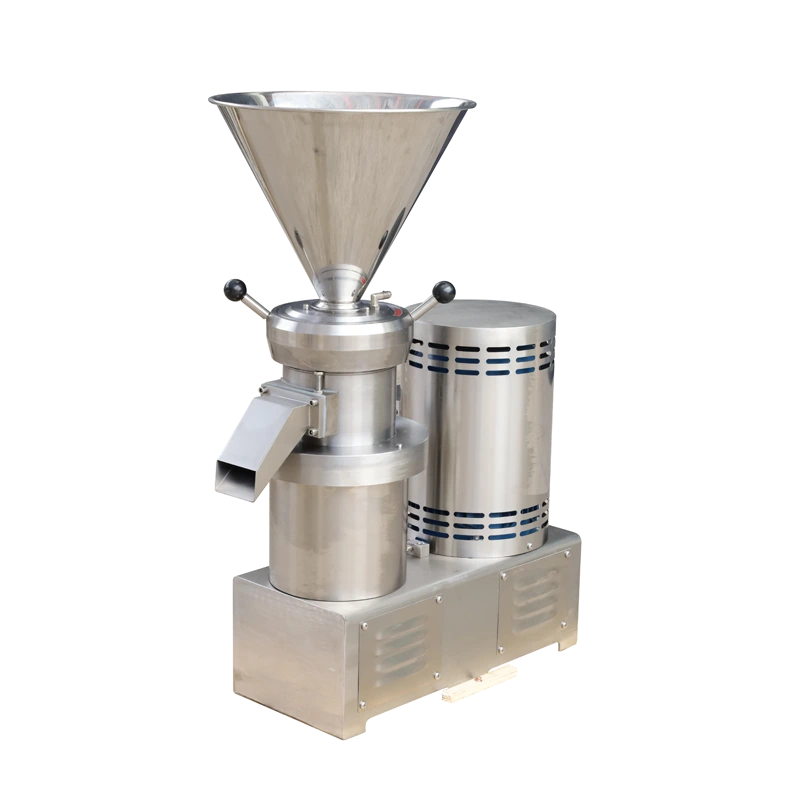
For selection, not only the rotor diameter and rotation speed are important, but also the geometry of the teeth, the number of passes, the shape of the chamber, the position of the feed and outlet, the presence of cooling and the type of seals. These elements determine the shear profile and residence time. For example, the same suspension at the same speed can be processed differently if the geometry of the working area or feed flow is changed. Therefore, comparisons based only on engine speed are rarely correct.
Separately, it is worth considering the drive and control system. For reproducibility, speed stability under load, smooth adjustment and overload protection are important. If the description indicates adjustment, it is necessary to clarify which parameters are changed by the operator: rotation speed, gap, feed flow, or a combination of these values. The presence of regulation does not in itself mean that any mode is suitable for a particular suspension.
Working chamber and product path
The product should not stagnate in stagnant zones. This is especially important for viscous systems: local overheating or clogging can ruin a batch faster than insufficient dispersion. When selecting a colloid mill TENCAN It makes sense to ask for a diagram of the working chamber, flow direction and washing recommendations. If the product is prone to drying out at the edges, provisions are made for quick disassembly and cleaning, but the specific design is checked against the documentation.
Rotor-stator gap and speed: two parameters that cannot be selected one at a time
The gap between the rotor and stator is one of the main factors determining the shear force. Reducing the gap usually increases machining intensity, but at the same time increases hydraulic resistance, heat and the risk of clogging. A gap that is too small is not the default “best”: for a slurry with large or abrasive particles, it can lead to rapid wear and unstable operation. Conversely, too large a gap may result in insufficient deagglomeration and the product will require more passes.
Rotation speed is related to clearance and flow. At high speed and small clearance, more heat is generated in the working area. If cooling is limited, you have to reduce the speed, increase the feed, or make several short passes instead of one long one. For emulsions, increased speed may improve droplet dispersion but also promote foaming and air entrapment. For slurries with a high solids content, it is more important to avoid overheating and clogging than to achieve maximum speed.
The equipment card must specify not only the adjustment range, but also the method of controlling the gap. If the gap is set manually, repeatable installation after disassembly and cleaning is important. If an indication or position fixation is provided, this helps to maintain reproducible modes. Without such information, it cannot be stated that the mode obtained on one machine will be exactly repeated on another without additional tuning.
| What to clarify | Why is this important | How to check |
|---|---|---|
| Gap adjustment | Affects shear, heat and clogging risk | Request instructions and setup procedure |
| Speed under load | Determines mode stability and heating | Compare test passes at the same feed rate |
| Feed flow | Changes residence time and number of passes | Check on a specific suspension |
| Cooling | Limits product temperature | Measure the product, not just the environment |
Viscosity, loading and feeding: what happens to the suspension in the working area
Viscosity is not a secondary characteristic. It determines whether the suspension can pass through the gap, whether it will flow into the chamber by gravity, and how the shift will be distributed. High viscosity increases the load on the drive and heat, while low viscosity can lead to slippage, incomplete filling of the working area and unstable results. For non-Newtonian systems, it is important to consider not only the measured viscosity at a single shear rate, but also the behavior as the rate changes.
The solid phase content and particle size distribution also influence the choice of mode. The more large particles there are, the higher the risk of abrasion and clogging. The wider the distribution, the more difficult it is to get a narrow result in one pass. In some cases, preliminary preparation is useful: wetting, disagglomeration, straining or mixing. But these operations should not replace testing of the colloid mill itself. TENCAN: Only trial grinding shows which mode gives the desired result.
For periodic and continuous circuits, the questions are different. In the batch version, it is important how long the product circulates through the work area and how quickly the temperature rises. In continuous mode - stability of supply, absence of pulsations and the ability to quickly stop the process. If the card does not indicate a method of operation, it should not be considered standard. It is better to request clarification and describe the expected cycle: loading, processing, sampling, washing, moving on to the next batch.
Air and foam
When shear is intense, air can become trapped in the suspension. Foam changes density, flow and measurement result. If the product is prone to foaming, a minimum level of inlet turbulence, suitable container geometry and, if necessary, degassing time must be provided. This does not necessarily mean that the machine is not suitable: sometimes it is enough to change the loading order or eliminate air leaks. But it is impossible to guarantee the absence of foam without testing.
Temperature, Cooling and Seals: Where the Limits Appear
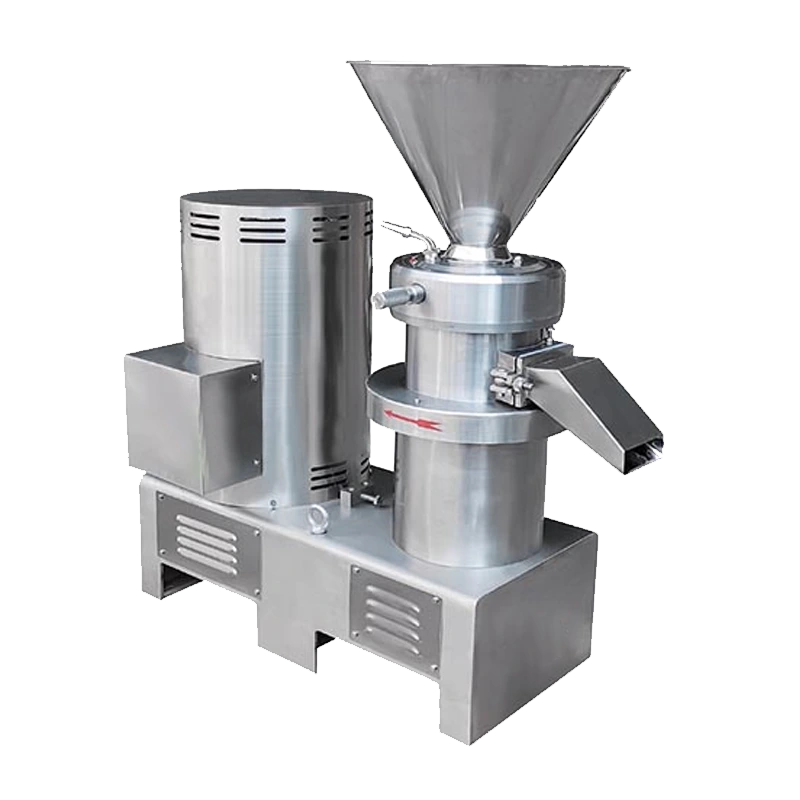
In a rotor-stator machine, shear energy is converted into heat. The higher the speed, the smaller the gap and the greater the number of passes, the more noticeable the heating. This is especially critical for emulsions, food and polymer systems, where temperature can change the viscosity, stability or structure of the product. It is important to distinguish between the temperature of the working environment, the temperature of the housing and the temperature of the product at the outlet: they are not the same thing.
If cooling is provided, you need to understand its type and limitations. Water jacket, air cooling and external loop cooling solve different problems. Air cooling should not be called cryogenic: it does not provide low-temperature processing. Cryogenic modes require separate confirmation of design, materials and safety, not just the presence of a fan. In colloid mill card TENCAN It should be clarified which cooling options are available and which parameter is controlled.
Seals are another component that comes into play when working with low-viscosity liquids, abrasive suspensions and solvents. It is necessary to clarify the seal material, permissible media, the need for flushing and maintenance procedures. If the product contains particulates, seal wear may occur faster than expected. This does not make the machine unusable, but requires inspection and replacement regulations. The promise of “complete tightness” without specifying the conditions is incorrect: tightness always has limits in pressure, temperature and environment.
Material, wear and transfer of impurities
For a colloid mill, contact materials are no less important than the drive. The abrasive slurry attacks the rotor, stator, chamber and seals. Stainless steel is easy to clean and many water systems, but does not mean zero wear. If the description specifies wear-resistant materials or coatings, you need to check which parts receive them and whether they are compatible with the product. You cannot transfer the properties of one design to the entire range.
Contaminant transfer depends on the material, particle hardness, processing time and environment. There is no one-size-fits-all solution. For sensitive products, it makes sense to request information on contact materials and perform a dry run with the simulated environment. If the product requires special purity, the possibility of washing, disassembly procedures and control of residues are discussed. All these issues are resolved before ordering, and not after the first signs of wear.
Cleaning also affects the design. Removable units, chamber access and no hard-to-reach cavities are important for product changes. But you should not assume that the machine can be automatically washed with any solvent: compatibility with the washing liquid and seal materials must be confirmed. For laboratory practice, the ability to process a small sample without large losses is useful, and for pilot practice, a quick transition between batches is useful.
From sample to batch: what questions to ask before ordering
When moving from a laboratory sample to a larger batch, you cannot simply increase the volume. First you need to understand what mechanism determines the result: residence time, number of passes, gap, temperature or formulation. If the laboratory mode was maintained at manual feed and low volume, heating and flow stability may change when scaled up. Therefore, test grinding should record not only “it worked / did not work”, but also the conditions: loading, solids content, viscosity, inlet and outlet temperatures, number of passes, sampling.
To inquire at TENCAN It is useful to prepare a brief description: type of system (suspension or emulsion), nature of the liquid phase, proportion of solid phase, initial particle size, target result, permissible heating, aggressiveness of the environment, requirements for materials and cleaning, estimated batch size. If restrictions on foaming or viscosity are known, they are also indicated. The more specific the initial data, the less the risk that the proposed configuration will be formally suitable, but inconvenient in operation.
During the trial grinding, it is worth checking several modes, not just one. Particle size distribution, suspension stability, temperature, processing time and product appearance are compared. For emulsions, droplet stability and the absence of separation are additionally important. If the result is achieved only at maximum load, this is a reason to discuss the resource of the nodes and cooling. If the result is insufficient in the soft mode, perhaps a different preparation of raw materials or a different type of equipment is needed.
Short checklist
- Clarify which parameters are regulated: clearance, rotation speed, feed.
- Check how the temperature of the product is controlled, not just the body.
- Match the materials of contact parts and seals to the environment.
- Record the order of washing and transition between products.
- Carry out the test on a real sample and save the regime protocol.
Colloid Mill TENCAN — It is a wet dispersion tool that is designed for a specific application. Proper selection is not based on the promise of a “perfect grind”, but on an understanding of the gap, speed, viscosity, temperature and wear. If at least one of these factors is not verified, the result remains a guess. A reliable way is to describe the system, request confirmed characteristics in product card and check the mode on a trial batch.